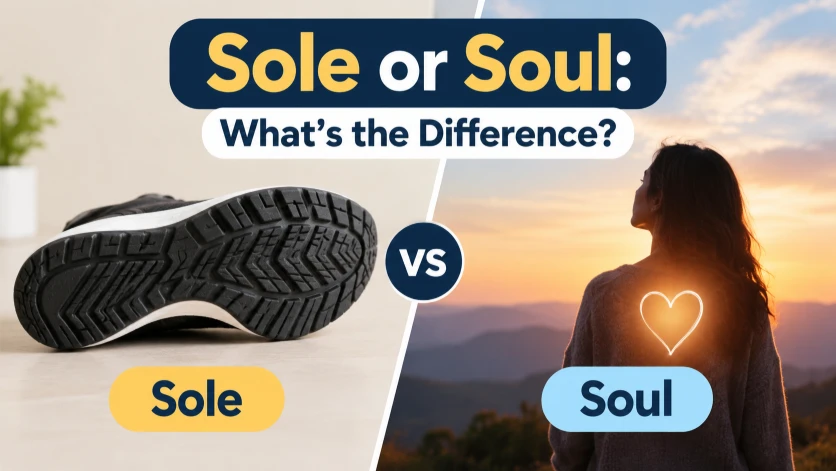
Sole means only one or the bottom of a shoe, while soul means the spiritual part of a person.
The search intent for “sole or soul” is informational, educational, and comparative. Readers want to know which spelling is correct, what each word means, and how to use them in everyday English.
The key point is simple: both “sole” and “soul” are correct words, but they have different meanings. Sole often means the only one of something or the bottom of a foot or shoe. Soul refers to the spiritual part of a person or someone’s deepest feelings and character.
Sole or Soul: Quick Answer
Use sole when you mean only one or the bottom of a foot or shoe. Use soul when you mean a person’s spirit, inner self, or deepest feelings.
Examples:
- Sole: She is the sole owner of the business.
- Sole: My shoes have thick rubber soles.
- Soul: That song touched my soul.
Both spellings are correct. Neither is a British or American spelling variant of the other. They are separate words with different meanings.
What Does Sole or Soul Mean?
What Does Sole Mean?
The word sole has several meanings. It is most often used as an adjective meaning only or single, or as a noun referring to the bottom of a foot or shoe.
1. Sole means the only one.
Use it when one person or thing is the only one involved.
- He was the sole winner of the competition.
- This is my sole reason for visiting.
- She has sole responsibility for the project.
2. Sole means the bottom of a foot or shoe.
The sole is the underside of your foot or the bottom part of a shoe.
- The soles of my shoes are worn out.
- Sand stuck to the soles of his feet.
- The cobbler replaced the leather sole.
3. Sole can refer to a type of fish.
A sole is also a flatfish that is eaten as food.
- We ordered grilled sole for dinner.
- The restaurant serves fresh lemon sole.
The meaning depends on the sentence. In business writing, sole owner means the only owner. In a shoe repair shop, sole refers to the bottom of a shoe.
What Does Soul Mean?
The word soul is a noun. It often refers to the spiritual part of a person, especially in religious or philosophical beliefs. It can also describe a person’s inner character, emotions, or the essential nature of something.
1. Soul means the spiritual part of a person.
In many religious traditions, the soul is understood as the spiritual part of a living being.
- She believes the soul lives beyond the body.
- The book explores the relationship between the soul and the mind.
2. Soul means a person’s inner feelings or character.
The word can express kindness, depth, emotion, and personality.
- He has a kind soul.
- Her words touched my soul.
- Music is good for the soul.
3. Soul can mean the essential character of something.
Writers often use soul to describe what makes a place, culture, or work of art feel special.
- Local music gives the city its soul.
- The old building is the soul of the village.
- The singer puts her soul into every performance.
In short, soul is often linked to spirit, emotion, character, and identity.
The Origin of Sole and Soul
Although sole and soul sound alike today, they have different histories.
The Origin of Sole
The word sole meaning the bottom of a foot or shoe comes through Old French from Latin solea, meaning a sandal or a flat bottom. Its history explains why we use it for the underside of footwear.
The adjective sole, meaning only or single, has a different origin. It came through Old French from Latin solus, meaning alone or only.
Over time, these forms developed into the modern English word sole, with meanings linked to being the only one or to a bottom surface.
The Origin of Soul
The word soul comes from Old English sāwol or sāwul. It has Germanic language relatives, although its deeper origin is uncertain.
Its long history is tied to ideas about life, spirit, and a person’s inner nature. Modern English still uses soul in religious writing, literature, music, and everyday expressions.
Why Are They So Easy to Confuse?
The main reason is pronunciation. In standard English, sole and soul are pronounced alike. A listener cannot usually tell which word someone means from the sound alone.
When writing, you must use context to choose the correct spelling. Their similar sounds do not make them interchangeable.
British English vs. American English
There is no spelling difference between British and American English for these two words. Both regions use sole and soul with the same basic meanings.
| Usage | British English | American English | Example |
| Only one | Sole | Sole | She is the sole applicant. |
| Bottom of a shoe | Sole | Sole | The sole needs replacing. |
| Spiritual nature | Soul | Soul | He believes in the soul. |
| Inner character | Soul | Soul | She has a generous soul. |
| Type of fish | Sole | Sole | We ate grilled sole. |
Regional Differences
The words themselves do not change spelling by region. Differences may appear in accent, writing style, or the situation in which a word is used, but not in the standard spelling of sole or soul.
What About Style Guides?
British and American dictionaries recognize both words. Standard publishing and academic style guides expect writers to select the spelling that matches the intended meaning.
If you are writing for an international audience, do not treat soul as the British form or sole as the American form. That distinction would be incorrect.
Which Version Should You Use?
Choose the word based on meaning, not location.
- United States: Use sole for exclusivity or a foot or shoe bottom. Use soul for spirit and inner character.
- United Kingdom: Follow the same distinction. There is no regional spelling change.
- Canada: Use the same standard spellings in school, business, and everyday writing.
- Australia: Both words retain their usual meanings and spellings.
- International writing: Add enough context to make your intended meaning clear, especially when using emotional or figurative language.
- Academic writing: Use sole for a single factor, purpose, or cause. Use soul when discussing spiritual beliefs, literature, or philosophical ideas.
- Business writing: Write sole proprietor, sole responsibility, or sole supplier when appropriate. Use soul only when discussing culture, identity, or emotional expression.
For example, “The sole purpose of this study is to examine memory” is correct because sole means only. “The poem explores the human soul” is correct because soul refers to inner or spiritual life.
Common Mistakes With Sole and Soul
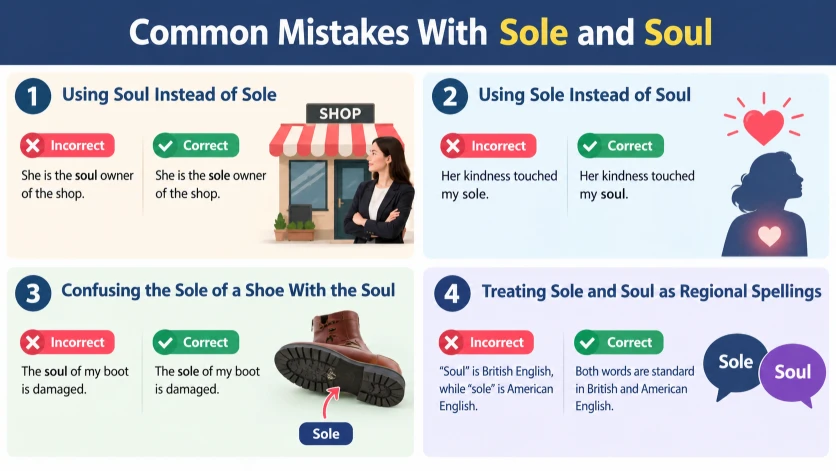
Because these words sound the same, spelling mistakes can change the meaning of a sentence.
Mistake 1: Using Soul Instead of Sole
Incorrect: She is the soul owner of the shop.
Correct: She is the sole owner of the shop.
Why? The sentence means she is the only owner. The word soul refers to a person’s spirit or inner nature, so it does not fit.
Memory tip: If you can replace the word with only, use sole.
Mistake 2: Using Sole Instead of Soul
Incorrect: Her kindness touched my sole.
Correct: Her kindness touched my soul.
Why? The sentence describes a deep emotional response, not the bottom of a foot or shoe.
Memory tip: When talking about feelings, spirit, or inner character, think soul.
Mistake 3: Confusing the Sole of a Shoe With the Soul
Incorrect: The soul of my boot is damaged.
Correct: The sole of my boot is damaged.
Why? A boot has a physical bottom called a sole. The word soul has a spiritual or emotional meaning.
Memory tip: A shoe has a sole that touches the ground.
Mistake 4: Treating Sole and Soul as Regional Spellings
Incorrect: “Soul” is British English, while “sole” is American English.
Correct: Both words are standard in British and American English.
Why? These are two distinct words, not regional versions of one word.
Memory tip: Ask what the sentence means before deciding how to spell the word.
Everyday Examples of Sole and Soul
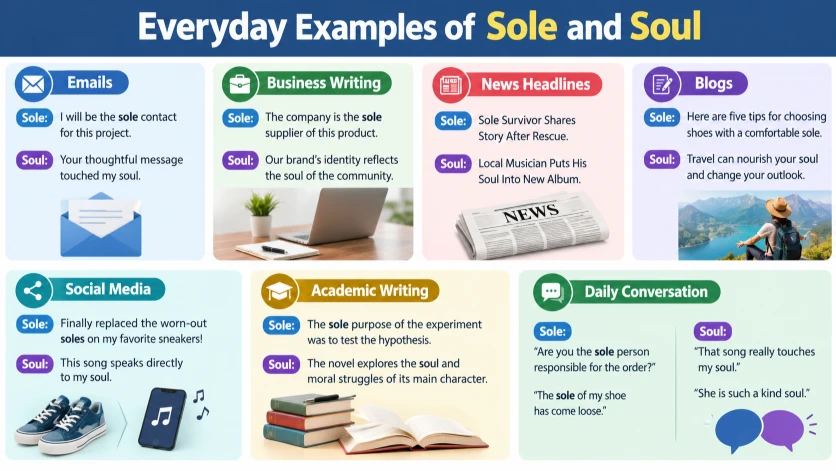
These examples show how to use both words in different types of writing.
Emails
- Sole: I will be the sole contact for this project.
- Soul: Your thoughtful message touched my soul.
Business Writing
- Sole: The company is the sole supplier of this product.
- Soul: Our brand’s identity reflects the soul of the community.
News Headlines
- Sole: Sole Survivor Shares Story After Rescue.
- Soul: Local Musician Puts His Soul Into New Album.
Blogs
- Sole: Here are five tips for choosing shoes with a comfortable sole.
- Soul: Travel can nourish your soul and change your outlook.
Social Media
- Sole: Finally replaced the worn-out soles on my favorite sneakers!
- Soul: This song speaks directly to my soul.
Academic Writing
- Sole: The sole purpose of the experiment was to test the hypothesis.
- Soul: The novel explores the soul and moral struggles of its main character.
Daily Conversation
- Sole: “Are you the sole person responsible for the order?”
- Soul: “That song really touches my soul.”
- Sole: “The sole of my shoe has come loose.”
- Soul: “She is such a kind soul.”
The easiest way to remember these examples is to connect sole with something specific or exclusive, and soul with a person’s inner life.
Google Trends and Modern Usage
People search for “sole or soul,” “soul vs sole,” and “sole vs soul meaning” because the words sound identical but have different meanings. This is a common type of spelling confusion, especially when people write quickly or rely on pronunciation.
Why Do People Search for Sole or Soul?
Common reasons include:
- Schoolwork: Students want to choose the right word in essays and assignments.
- English learning: ESL learners may know how the words sound but not remember which spelling matches each meaning.
- Professional writing: Writers and editors need to avoid errors in emails, reports, and articles.
- Quotes and captions: People often use soul in emotional messages, song captions, and inspirational quotes.
- Business and footwear: Terms such as sole owner and shoe sole can prompt spelling questions.
Is One Word More Popular Than the Other?
Their popularity depends on the context. Soul appears in discussions of spirituality, music, feelings, and personal identity. Sole appears in footwear, business, legal, and general descriptive contexts.
These are broad usage patterns, not measured search-volume statistics. No exact Google Trends figures are presented here.
Google Trends also distinguishes search terms and their variations, so a comparison needs clearly defined search terms, region, and time period before drawing conclusions.
The practical lesson is that search popularity cannot tell you which word is correct in a sentence. Meaning does that.
Quick Comparison
| Version | Meaning | Correct? | Common Context | Example |
| Sole | Only one | Yes | Business, general writing | He is the sole owner. |
| Sole | Bottom of a foot or shoe | Yes | Footwear, everyday use | My shoe’s sole is thin. |
| Sole | A type of flatfish | Yes | Food, cooking | We ordered grilled sole. |
| Soul | Spiritual part of a person | Yes | Religion, philosophy | She believes the soul lives on. |
| Soul | Inner character or feelings | Yes | Literature, daily conversation | He has a gentle soul. |
| Soul | Essential nature of something | Yes | Art, culture, music | The music captures the city’s soul. |
Key Takeaways
- Sole and soul are both correct English words.
- They sound the same but have different meanings.
- Sole can mean only one or the bottom of a foot or shoe.
- Soul refers to spiritual life, inner feelings, or a person’s essential nature.
- Sole can also refer to a type of flatfish.
- Neither word is exclusive to British or American English.
- Use context and meaning to choose the correct spelling.
- If only fits your sentence, sole is usually the right choice.
FAQs
Is a Person a Sole or a Soul?
A person is a soul when referring to their spiritual essence or inner self. Sole means the only one or the bottom part of a shoe.
Does Sole Mean Single?
Yes, sole can mean single, only, or exclusive. For example, “She is the sole owner of the business” means she is the only owner.
What Does Soul Mean?
Soul refers to the spiritual or immaterial part of a person, often believed to represent their deepest identity, feelings, or essence.
What Does “Sole” Mean?
Sole has two common meanings: the only one, as in “the sole survivor,” and the underside of a foot or shoe, as in “the sole of my shoe.”
Can Soul Mean a Person?
Yes, soul can refer to a person, especially when emphasizing their humanity, emotions, or individuality. For example, “She is a kind soul” means she is a kind person.
What Is the Difference Between Soul and Sole?
Soul refers to a person’s spiritual essence or can mean a person, while sole means the only one or the underside of a foot or shoe. Although they sound alike, their meanings and spellings are different.
Conclusion
The difference between sole and soul becomes easy once you focus on meaning. Although both words sound the same, each has its own spelling and purpose.
Use sole when you mean the only one, the bottom of a foot or shoe, or a type of flatfish. Common examples include sole owner, sole purpose, and shoe sole. Use soul when talking about spiritual beliefs, a person’s inner nature, deep feelings, or the essential character of something.
There is no British-versus-American spelling difference to remember. Both words are standard in English worldwide. The right choice depends on what you want to say.
When editing your work, pay special attention to phrases such as sole purpose, sole survivor, kind soul, and touch my soul. These are useful expressions that appear in everyday conversations, school assignments, and professional writing.
Remember this simple rule: sole means only or the bottom of a shoe; soul means spirit or inner nature.
If this guide helped you understand the difference, explore more commonly confused English words to improve your spelling and writing confidence.
READ MORE!
- Porcelain vs Ceramic: What’s the Difference?
- Stafford or Hurts: Who Is the Better NFL Quarterback?
- CGC vs PSA: What’s the Difference and Which Is Better?

I’m passionate about English grammar, vocabulary, and clear communication. I enjoy making English easier to understand through simple, practical, and easy-to-follow explanations. My goal is to help learners build confidence and improve their English for everyday use.







