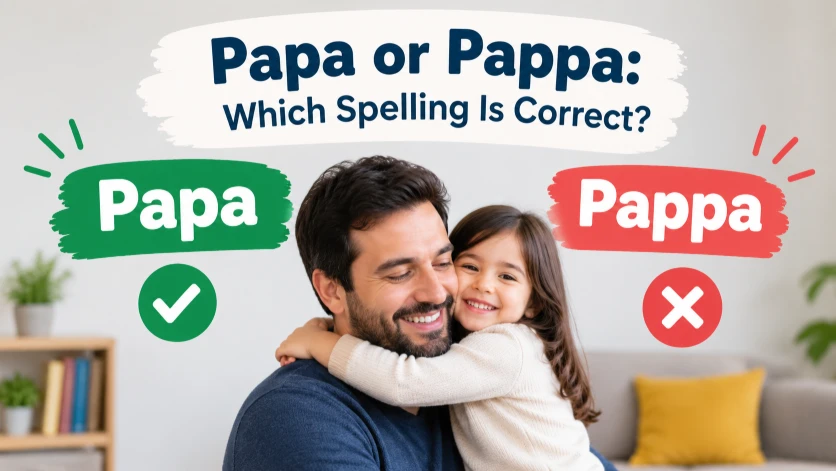
Papa is the more common English spelling for dad or father, while pappa is a variant used in some languages and families.
Is it papa or pappa? If you want to write a word for your father, the extra p can make the choice confusing. Both spellings appear in different languages and family settings, but papa is the more widely recognized English spelling when referring to a father or dad.
The word papa is a familiar name for a father. It can sound warm, loving, or old-fashioned, depending on the speaker and the situation. Some families use pappa as a personal nickname, while the same spelling is a normal word for father in certain other languages.
This difference matters when you write a school assignment, a family message, a story, or an article. You may also see both forms online and wonder if one is a spelling mistake.
In this guide, you will learn the meaning of papa and pappa, their origins, how English usage differs by region, and which form to choose in everyday writing. You will also find practical examples, common mistakes, and answers to frequently asked questions.
Papa or Pappa: Quick Answer
Use papa when you mean “father” in standard English.
Examples:
- “My papa taught me how to ride a bike.”
- “I called my papa after school.”
- “Happy Father’s Day, Papa!”
Use pappa when it is the established spelling in a particular language, family, name, or cultural setting.
For example, a family may call a father Pappa because that is the name they have always used. In Swedish and some other Nordic-language contexts, pappa is a normal word for dad.
The important distinction is that spelling depends on language and context. Do not automatically label pappa wrong in every situation. However, if you are writing in ordinary English and want the familiar word for a father, papa is the safer choice.
What Does Papa or Pappa Mean?
What Does Papa Mean?
Papa is a noun that means father or dad. It is an affectionate or familiar way to refer to a father, although it can sound old-fashioned in some English-speaking regions.
People may use it when speaking directly to their father or when talking about him to someone else.
Examples:
- “Papa, can you help me with this?”
- “My papa works in another city.”
- “She gave her papa a birthday card.”
The word can also appear in books, songs, family stories, and cultural traditions. In some contexts, Papa is capitalized because it is used like a name or direct form of address.
What Does Pappa Mean?
Pappa is a spelling used in several language and family contexts. In Swedish, for example, it is a common word for dad. It can also be used as a family’s preferred nickname in English-speaking households.
Examples:
- “Pappa will pick me up after school.” This may be natural in a family that uses the Nordic-language term.
- “We call our grandfather Pappa.” This can be a personal family choice.
- “The character calls his father Pappa.” This may reflect the language or background of the character.
The meaning is therefore not determined by the extra p alone. You need to consider the language, the speaker, and the intended use.
Are Papa and Pappa Interchangeable?
Not always.
In English writing, papa is the more familiar dictionary form for a father. In a language where pappa is the normal spelling, changing it to papa may create an error or change the intended form.
Think of the two spellings this way:
- Papa: the usual choice for standard English.
- Pappa: appropriate when supported by the language, a name, or a family tradition.
The Origin of Papa and Pappa
The word papa has a long history. The Oxford Advanced Learner’s Dictionary traces it to the late seventeenth century, through French and Late Latin, to Greek papas. It developed as a familiar word for a father.
Words for parents often use simple sounds that young children can produce early in speech. Repeated syllables, such as pa-pa and ma-ma, are easy to say and occur in family words across many languages.
Over time, these sounds became established words and affectionate names for parents.
The spelling pappa also exists in language traditions outside standard English. For example, Swedish uses pappa for dad. This helps explain why English readers may encounter both spellings in books, messages, names, and translated material.
The extra p does not mean that pappa is simply a newer or older English version of papa. The two forms have different patterns of use across languages.
Remember: Word origins can explain why spellings look alike, but the correct spelling for a sentence depends on the language you are writing in.
British English vs American English
The difference between papa and pappa is not mainly a British-versus-American spelling rule. English dictionaries recognize papa, although its tone and frequency vary by region. Pappa is especially relevant when a writer uses a spelling from another language or a family’s preferred name.
| British English | American English | Example |
| Papa is understood but can sound old-fashioned. | Papa is an informal, familiar word for father. | “Papa is waiting outside.” |
| Dad and Dad’s are common everyday choices. | Dad and Daddy are common everyday choices. | “Dad will call tonight.” |
| Pappa may appear in a cultural or family context. | Pappa may appear as a family nickname or foreign-language word. | “Pappa is making dinner.” |
Dictionary descriptions support the regional difference in how papa is used. Cambridge labels it old-fashioned and formal in UK English, while describing it as informal in US English.
What About Canada and Australia?
In Canada and Australia, papa can be understood as a name for a father, but Dad is a familiar everyday choice. The preferred term can depend on a family’s background and habits.
For formal writing, follow the style guide used by your school, employer, or publisher. If you are writing a family story, preserve the name the family actually uses.
Which Version Should You Use?
Your best choice depends on your audience and the language of your text.
- United States: Use papa if it suits the speaker’s tone. Dad is often more conversational.
- United Kingdom: Papa is correct but may sound old-fashioned. Dad is a natural everyday alternative.
- Canada: Use papa for the familiar English word or a family name. Choose the spelling that matches your intended meaning.
- Australia: Papa is understandable, although Dad is a common everyday term.
- International writing: Use papa when writing in English unless the context calls for pappa.
- Academic writing: Use father for a neutral, formal tone. Keep Papa or Pappa when it is part of a name, quotation, or relevant cultural term.
- Business writing: Use father in formal prose. Use papa only when the subject and tone make it appropriate.
For example, “My papa taught me to swim” is suitable for a personal story. “The child’s father attended the meeting” is more suitable for a formal report.
Common Mistakes
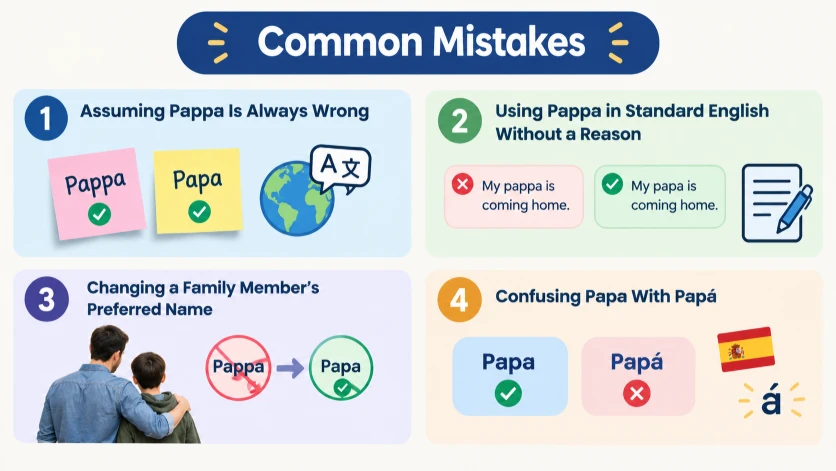
Mistake 1: Assuming Pappa Is Always Wrong
Incorrect assumption: “Pappa is never a correct spelling.”
Better understanding: Pappa is a valid word in some languages and can be a family nickname. The spelling is not automatically wrong just because it has an extra p.
Memory tip: Check the language before judging the spelling.
Mistake 2: Using Pappa in Standard English Without a Reason
Less suitable for standard English: “My pappa is coming home.”
More conventional in standard English: “My papa is coming home.”
The first sentence may still be correct if Pappa is the family’s preferred term. Without that context, papa is the safer English choice.
Memory tip: For ordinary English, start with papa.
Mistake 3: Changing a Family Member’s Preferred Name
Incorrect approach: Changing a person’s chosen family nickname from Pappa to Papa just to follow standard English.
Better approach: Keep the family’s established spelling when referring to that person.
Names and personal forms of address do not always follow general spelling preferences.
Mistake 4: Confusing Papa With Papá
In Spanish, papá means dad or father. The accent mark is important because it belongs to the Spanish spelling.
Example: “Mi papá está en casa.” means “My dad is at home.”
Do not remove the accent when writing standard Spanish. In English, papa is commonly written without an accent.
Everyday Examples
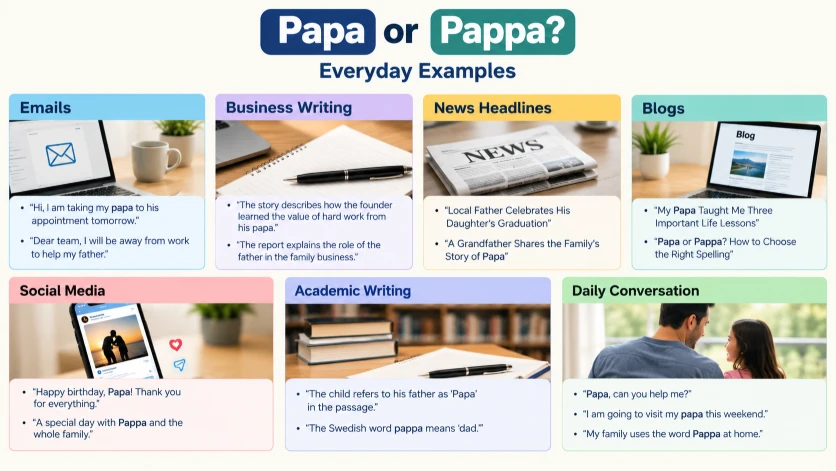
Here are natural examples of papa and pappa in different situations.
Emails
- “Hi, I am taking my papa to his appointment tomorrow.”
- “Dear team, I will be away from work to help my father.”
Use the word that fits your relationship and the tone of the message.
Business Writing
- “The story describes how the founder learned the value of hard work from his papa.”
- “The report explains the role of the father in the family business.”
The first is personal and informal. The second is more neutral.
News Headlines
- “Local Father Celebrates His Daughter’s Graduation”
- “A Grandfather Shares the Family’s Story of Papa”
News writing often uses father for clarity. Papa may be suitable when the personal or cultural context matters.
Blogs
- “My Papa Taught Me Three Important Life Lessons”
- “Papa or Pappa? How to Choose the Right Spelling”
Both examples are appropriate for their intended purposes. The first treats Papa as a name or title, while the second discusses the spelling difference.
Social Media
- “Happy birthday, Papa! Thank you for everything.”
- “A special day with Pappa and the whole family.”
On social media, family names and personal spelling choices are common. Keep the spelling that the person or family prefers.
Academic Writing
- “The child refers to his father as ‘Papa’ in the passage.”
- “The Swedish word pappa means ‘dad.’”
In academic writing, explain foreign-language terms when needed and use quotation marks or italics consistently according to your style guide.
Daily Conversation
- “Papa, can you help me?”
- “I am going to visit my papa this weekend.”
- “My family uses the word Pappa at home.”
These sentences show how the word can work as a direct form of address, a noun, or a family term.
Google Trends and Modern Usage
People search for papa or pappa because the spellings look almost identical. Both are linked to the idea of a father, and the extra p can make writers unsure which form to use.
Several factors may explain this confusion:
- Language differences: Some languages use pappa as the standard word for dad.
- Family traditions: A family may use a personal spelling that differs from the usual English form.
- Online writing: Social media, usernames, and informal messages expose readers to many spelling variations.
- Translation: Readers may see pappa in translated books, subtitles, or foreign-language content.
- Pronunciation: Similar sounds do not always lead to the same spelling in different languages.
Which Spelling Is More Popular?
Papa is the more widely recognized spelling in English dictionaries for the meaning “father.” Pappa is well established in certain other languages, including Swedish.
This is a general usage observation, not a numerical ranking from Google Trends. No exact search-volume figures are presented here, so it would be misleading to claim a specific percentage or search-interest score.
If you want to compare search interest by country, use Google Trends and enter both terms with the same time period and geographic settings. Remember that searches for pappa may include foreign-language meanings and names, not just English spelling questions.
Quick Comparison
| Version | Meaning | Correct? | Region or context | Example |
| Papa | Father or dad | Yes | Standard English | “My papa is kind.” |
| Pappa | Dad or father | Yes, in the right context | Swedish and some family traditions | “Pappa is at home.” |
| Papá | Dad or father | Yes | Spanish | “Mi papá está aquí.” |
| Dad | Father | Yes | Everyday English | “Dad is calling.” |
| Father | Male parent | Yes | Formal and general English | “Her father arrived.” |
The main point is that these words are not interchangeable in every language. Choose the form that matches the language and intended meaning.
Key Takeaways
- Papa is the more widely recognized English spelling for father or dad.
- Pappa is a normal word for dad in Swedish and some other language contexts.
- Pappa can also be a family’s preferred nickname.
- British English often treats papa as old-fashioned, while American English uses it informally.
- Dad is a natural everyday alternative in many English-speaking settings.
- Use father for a neutral or formal tone.
- Spanish uses papá, with an accent mark.
- Always consider language, context, and personal names before correcting a spelling.
Frequently Asked Questions
Is it papa or pappa for dad?
Papa is the more common spelling in English when referring to dad or father. Pappa is also used in some languages and families as an affectionate name for dad.
What does pappa mean?
Pappa is an affectionate word for dad or father in some languages and families. Its exact meaning depends on the language and cultural context.
What is the difference between “Papa” and “Pappa”?
Papa is the more common English spelling for dad, while Pappa is a variant used in certain languages and as a family nickname. The preferred spelling depends on the context.
What is the spelling of pappa?
Pappa is spelled P-A-P-P-A. However, Papa (P-A-P-A) is the more common spelling in English when referring to a father.
Is Papa a word for dad?
Yes, Papa is a familiar and affectionate word for dad or father. For example: “My papa helps me with my homework.”
Is Papa father or grandpa?
Papa usually means father or dad, but in some families and cultures, it can also refer to a grandfather. The intended meaning depends on family tradition and cultural usage.
Conclusion
The choice between papa or pappa depends on the language and context. In standard English, papa is the more widely recognized spelling for a father or dad. It can express affection and may sound old-fashioned in some regions, but it remains a valid English word.
Pappa is not automatically wrong. It is the established word for dad in Swedish and may also be used as a family nickname. Similarly, Spanish uses papá, with an accent mark that should be preserved when writing in Spanish.
For schoolwork, articles, and general English writing, use papa if you want this familiar word for father. For formal reports, father is often clearer, while Dad is a natural choice for everyday conversation.
The best spelling is the one that fits the language you are writing in. When a family has a preferred name, respect that choice rather than changing it to match a general rule.
Remember: Use papa in standard English, and use pappa when the language or context calls for it. If you found this guide helpful, explore more of our commonly confused words articles to improve your spelling and everyday English.
READ MORE!
- Copies or Copys: Which Spelling Is Correct?
- Informations or Information: What Is the Correct Word?
- Cavalry or Calvary: Which Is Correct?

I’m passionate about English grammar, vocabulary, and clear communication. I enjoy making English easier to understand through simple, practical, and easy-to-follow explanations. My goal is to help learners build confidence and improve their English for everyday use.







