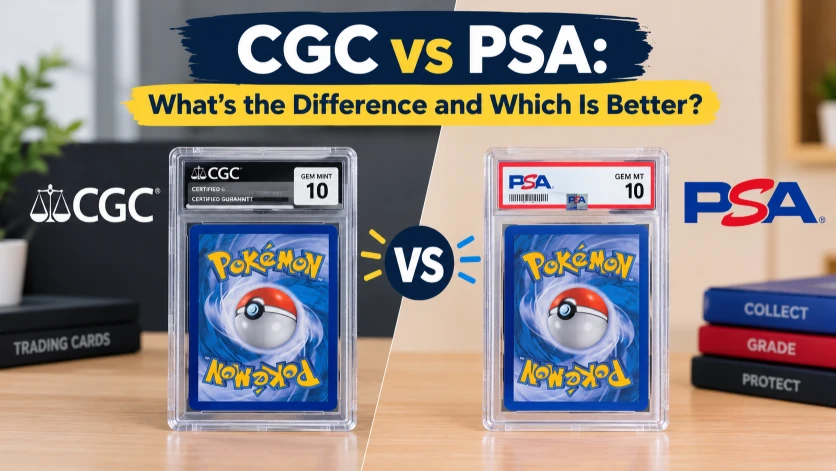
PSA is generally the more widely recognized choice for resale value, while CGC can be a strong alternative with competitive grading and attractive slabs.
If you collect Pokémon, sports cards, Magic: The Gathering, or other trading cards, you have probably asked: CGC or PSA? Both are professional third-party grading services that authenticate cards, assess their condition, and seal them in protective holders.
The main difference is not that one uses grading while the other does not. Both do. The differences are in their grading terminology, service structure, labels, pricing, turnaround options, and how collectors use their certifications in the market.
This question matters because grading can affect how a card is protected, documented, displayed, and evaluated by future buyers. A graded card also receives a certification number that can be checked through the grading company’s online resources.
In this guide, you will learn what CGC and PSA mean, how their grading systems compare, what their top grades are, how regional terminology affects the discussion, and what to consider before submitting a card. The goal is simple: help you understand the choice without relying on vague claims about which company is automatically “better.”
CGC or PSA : Quick Answer
Here is the simplest way to understand the difference:
- PSA stands for Professional Sports Authenticator.
- CGC stands for Certified Guaranty Company, whose CGC Cards division grades trading cards.
- Both authenticate cards before grading them.
- Both use numerical grading systems.
- PSA’s standard top grade is 10 Gem Mint.
- CGC currently uses Pristine 10 as its highest assigned card grade, followed by Gem Mint 10.
For example:
- A nearly flawless card may receive PSA 10.
- A card meeting CGC’s Gem Mint standard may receive CGC Gem Mint 10.
- A CGC card that meets the stricter Pristine criteria may receive CGC Pristine 10.
The numerical grades look similar, but the grading labels are not identical. This is one reason comparing “PSA 10 vs CGC 10” without checking the exact CGC designation can be misleading.
What Does CGC or PSA Mean?
CGC and PSA are names of third-party authentication and grading companies.
When a collector sends a card to a professional grading service, the company generally performs several steps:
- Authentication: The card is examined to determine if it is genuine.
- Condition assessment: The card is inspected for factors such as centering, corners, edges, surface quality, and other defects.
- Grading: A numerical grade is assigned according to the company’s standards.
- Encapsulation: The card is sealed inside a protective holder.
- Certification: The graded card receives identifying information that can be checked through the company’s systems.
PSA describes its process as authentication, grading, and encapsulation. CGC similarly states that its card service includes authentication, professional grading, and encapsulation.
What Is PSA?
PSA means Professional Sports Authenticator. PSA was founded in 1991 and became an established name in third-party trading-card authentication and grading.
Although its name contains “Sports,” PSA grades more than sports cards. Its current trading-card service covers vintage, modern, and TCG cards.
What Is CGC?
CGC means Certified Guaranty Company. CGC is part of the Certified Collectibles Group and has a broader history in collectible authentication and grading.
The current CGC Cards service was launched in 2023 after CGC Trading Cards and Certified Sports Guaranty combined under the CGC Cards brand. The service covers TCGs, sports cards, and non-sports cards.
The Origin of CGC and PSA
PSA’s history in card grading goes back to 1991. The company established its professional authentication and grading service during the early development of the modern third-party graded-card market.
CGC has a different history. Certified Guaranty Company was established in 2000 as part of the Certified Collectibles Group. CGC later expanded into trading cards, while Certified Sports Guaranty handled sports cards. In 2023, these card operations were combined as CGC Cards.
The grading terminology has also changed over time. CGC’s current card system includes Pristine 10 and Gem Mint 10. Older CGC and CSG cards may show grades from earlier grading systems, so a vintage slab should not always be compared directly with a newly graded card by looking only at the number.
CGC also explains that its older Gem Mint 9.5 cards were converted in its online records to the newer Gem Mint 10 designation when the updated CGC Cards system launched.
British English vs American English
CGC and PSA are international grading brands, so there is no separate British-English or American-English grading standard for their card grades. The names of the grades remain the same.
However, spelling can change in ordinary writing. For example, American English normally uses “centered,” while British English commonly uses “centred.”
| British English | American English | Example |
| centred | centered | The card is well centred/centered. |
| colour | color | The card has strong colour/color. |
| organisation | organization | The grading organisation/organization issued the certification. |
| programme | program | The collector joined the grading program. |
For articles about PSA and CGC, the official grade names should not be changed. Write PSA 10, CGC Gem Mint 10, and CGC Pristine 10 exactly as the companies use them.
How CGC and PSA Grading Scales Compare
Both services use 10-point card grading systems, but the terminology at the top is different.
| Grade or designation | PSA | CGC |
| Top assigned grade | PSA 10 Gem Mint | CGC Pristine 10 |
| Other 10 grade | PSA 10 | CGC Gem Mint 10 |
| Half grades | Used in PSA’s grading system | Used in CGC’s scale for several grades |
| Authentication | Yes | Yes |
| Encapsulation | Yes | Yes |
| Certification information | Yes | Yes |
| Population resources | Yes | Yes |
PSA describes a PSA 10 as a virtually perfect card with sharp corners, sharp focus, full original gloss, no staining, and specified centering tolerances.
CGC describes Pristine 10 as a virtually flawless card to the naked eye, with 50/50 centering and flawless color and registration. Its Gem Mint 10 is a 10 overall where one grading criterion does not meet the Pristine requirements.
This means CGC Pristine 10 and CGC Gem Mint 10 are not simply two names for the same grade.
Which Version Should You Use?
There is no single choice that fits every card. Consider the purpose of the submission first.
United States
Both PSA and CGC operate in the U.S. market. Compare the current service level, declared value limit, turnaround estimate, submission requirements, and the type of card you are sending.
United Kingdom
Collectors in the UK can use professional grading services, but shipping, submission locations, insurance, taxes, and return costs can affect the practical cost. CGC has documented international operations, including a London office for card submissions.
Canada
Canadian collectors should compare the current submission route, shipping costs, declared-value rules, and any applicable taxes or import considerations before choosing a grader.
Australia
For Australian collectors, international shipping and insurance can become a meaningful part of the total submission cost. Check the current submission instructions rather than relying on an old price guide.
International Writing
For an international audience, avoid saying that one grader is automatically better. A more accurate statement is that PSA and CGC are two established grading services with different systems and service options.
Academic Writing
If you are writing about card collecting for an academic, educational, or research audience, define the abbreviations on first use:
Professional Sports Authenticator (PSA)
and
Certified Guaranty Company (CGC)
Then use the abbreviations consistently.
Business Writing
For professional content, use the exact grade designation shown on the certification. Avoid changing CGC Pristine 10 into “CGC Perfect 10.” CGC states that Perfect 10 is an older designation that is no longer assigned under its current system.
Common Mistakes
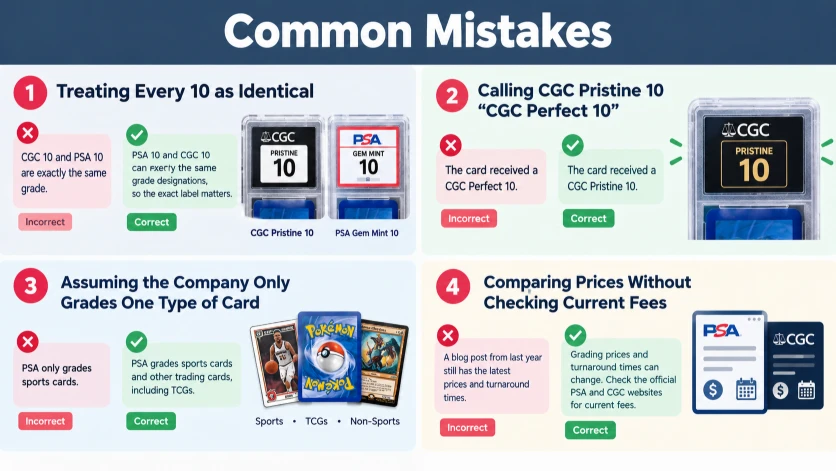
Mistake 1: Treating Every 10 as Identical
Incorrect:
“CGC 10 and PSA 10 are exactly the same grade.”
Correct:
“PSA 10 and CGC 10 can refer to different grade designations, so the exact label matters.”
Explanation: CGC distinguishes Pristine 10 from Gem Mint 10.
Memory tip:
Check the words next to the number, not just the number itself.
Mistake 2: Calling CGC Pristine 10 “CGC Perfect 10”
Incorrect:
“The card received a CGC Perfect 10.”
Correct:
“The card received a CGC Pristine 10.”
Explanation: CGC says Perfect 10 is no longer assigned under the current grading system.
Mistake 3: Assuming the Company Only Grades One Type of Card
Incorrect:
“PSA only grades sports cards.”
Correct:
“PSA grades sports cards and other trading cards, including TCGs.”
PSA’s current service covers vintage, modern, and TCG cards. CGC likewise grades TCGs, sports cards, and non-sports cards.
Mistake 4: Comparing Prices Without Checking Current Fees
Grading prices and estimated turnaround times can change. PSA and CGC currently publish their service tiers and prices on their official submission pages, so an old blog post may no longer reflect current costs.
Everyday Examples

Emails
“Should we submit these Pokémon cards to CGC or PSA?”
Business Writing
“The company provides authentication and grading services for trading cards.”
News Headlines
“CGC and PSA Grading: What Collectors Need to Know”
Blogs
“Before choosing CGC or PSA, check the card’s condition, value, and your reason for grading it.”
Social Media
“Pulled this card today. Now the big question: CGC or PSA?”
Academic Writing
“Third-party grading services such as PSA and CGC provide authentication, condition assessment, and encapsulation for collectible cards.”
Daily Conversation
“Is that a PSA 10 or a CGC 10?”
These examples show why the terms appear so often in collector conversations. The abbreviations are short, but the services behind them involve authentication, grading standards, certification, and encapsulation.
Google Trends & Modern Usage
Searches for CGC or PSA, PSA vs CGC, CGC vs PSA, and which is better CGC or PSA generally reflect a practical collector question: which grading service fits a particular card and purpose?
Interest can also rise when collectors discuss a new grading scale, a service-price change, a popular TCG release, or high-profile graded cards.
Exact Google Trends numbers should not be claimed without checking the relevant Google Trends dataset for a defined country and time period. Search interest also does not prove that one grading service is objectively superior.
Modern usage is especially shaped by the growth of TCG collecting. PSA explicitly states that it grades vintage, modern, and TCG cards, while CGC grades TCGs, sports cards, and non-sports cards.
Quick Comparison
| Version | Meaning | Correct? | Region | Example |
| PSA | Professional Sports Authenticator | Yes | International | PSA 10 |
| CGC | Certified Guaranty Company | Yes | International | CGC Gem Mint 10 |
| CGC Pristine 10 | Current CGC top assigned card grade | Yes | International | CGC Pristine 10 |
| CGC Perfect 10 | Older CGC designation | Historical, not current | International | Older certified cards may show it |
| PSA vs CGC | Comparison of grading services | Yes | International | “PSA vs CGC for Pokémon cards” |
Key Takeaways
- PSA means Professional Sports Authenticator.
- CGC means Certified Guaranty Company.
- Both services authenticate, grade, and encapsulate trading cards.
- PSA uses a 1–10 grading scale, with PSA 10 as its highest standard grade.
- CGC currently uses Pristine 10 above Gem Mint 10.
- Do not compare grades by number alone. Check the complete grade designation.
- Prices and turnaround estimates can change, so check the official submission pages before sending a card.
- The right service depends on the card, its value, your budget, and your reason for grading.
FAQs
What Is Better, CGC or PSA?
PSA is generally considered the better choice for resale value, market recognition, and collector demand, especially for Pokémon and other major trading cards. CGC is also a respected grading company and can be a good option for collectors who prefer its grading standards or slab design. The better choice ultimately depends on if your priority is maximum resale value, grading preference, or personal collection.
Is a CGC 10 Equal to a PSA 10?
Not necessarily. A CGC 10 and PSA 10 are both top grades, but the two companies use their own grading standards and labels. Collectors and buyers may also value the grades differently depending on the card and market. Therefore, a CGC 10 should not automatically be treated as exactly equivalent to a PSA 10 in terms of market value.
Is a CGC 9.5 a PSA 10?
No. A CGC 9.5 is not officially equivalent to a PSA 10. CGC and PSA use different grading systems, so a grade from one company cannot be directly converted into the other. In some markets, buyers may consider a CGC 9.5 highly desirable, but its value can still differ from a PSA 10.
Which Is Better, a CGC 10 or a PSA 9?
It depends on the card and the buyer, but a PSA 9 can sometimes have stronger market value than a CGC 10 because PSA has greater recognition and demand among many collectors. However, a CGC 10 represents a higher numerical grade from CGC. For resale, compare recent sales of the exact card and grade rather than assuming one grade is always worth more.
Can CGC Overtake PSA?
CGC could potentially gain more market share, but PSA currently has a much stronger position in the trading-card grading market. For CGC to overtake PSA, it would likely need sustained growth in submissions, collector trust, resale demand, and market acceptance. If that happens in the future cannot be predicted with certainty.
How Much Does PSA Charge for a $1,000 Card?
PSA’s grading fee depends on the service level, declared value, turnaround option, and current pricing. A card worth around $1,000 may fall into a higher-value service tier rather than the lowest-priced submission level. Because PSA’s fees can change, check its current pricing and declared-value requirements before submitting the card.
Conclusion
The CGC or PSA question is really a question about which grading service fits your particular card and purpose. Both companies provide third-party authentication, grading, certification, and protective encapsulation, but their systems are not identical.
PSA uses a 10-point scale with PSA 10 as its top standard grade. CGC also uses a 10-point system, but its current scale distinguishes Gem Mint 10 from the higher Pristine 10 designation. That difference matters when comparing graded cards.
For collectors, the smartest starting point is to look at the card itself. Consider its condition, type, estimated value, grading budget, turnaround needs, and if you are collecting, protecting, documenting, or preparing to sell it. Then check the current official service details before submitting.
Do not choose a grading company simply because someone says one is always better. Grading services change their prices and procedures, and individual cards can have very different needs.
Memorable takeaway: compare the complete grade, the current service, and your goal, not just the number on the slab.
READ MORE!
- Miconazole vs Clotrimazole: What’s the Difference?
- Stromboli or Calzone: A Simple Guide to the Difference
- Bush or Shrub: Understanding the Difference

I’m Edward Fletcher, a UK-based English language writer with a passion for grammar and vocabulary. At VocabNex, I share simple explanations, useful examples, and practical English tips to help learners improve their language skills and communicate with confidence.








3 thoughts on “CGC vs PSA: What’s the Difference and Which Is Better?”