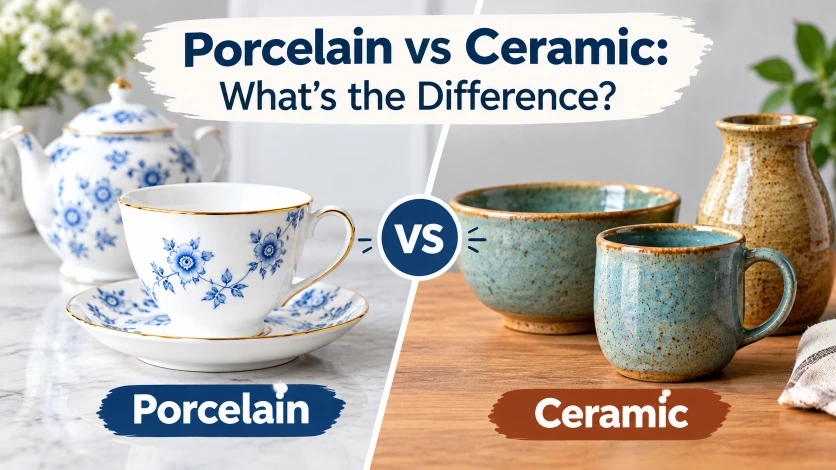
Porcelain and ceramic are often compared when choosing tiles, dishes, bathroom fixtures, or decorative items. They may look alike, but they differ in how they are made, how much water they absorb, and how well they handle daily wear.
Porcelain is a type of ceramic, but not all ceramic is porcelain. Porcelain is usually fired at higher temperatures and has lower water absorption than many other ceramic products. This often makes porcelain tiles denser and better suited to wet or high-traffic areas.
So, which is better: porcelain or ceramic? It depends on what you need. Ceramic tiles are often affordable and easy to cut, while porcelain tiles are usually denser and more water-resistant. For dishes, the differences also depend on the type of porcelain, the glaze, and the intended use.
In this guide, you will learn how porcelain and ceramic differ, where each works best, how their costs compare, and what to consider before buying tiles or tableware. You will also find practical examples and answers to common questions to help you make the right choice.
Porcelain vs Ceramic: The Short Answer
Porcelain is a specialized type of ceramic made from carefully selected materials and fired under specific conditions. It is generally denser and less porous than many other ceramics. Ceramic is the broader category and includes earthenware, stoneware, and porcelain. For floors and wet areas, porcelain often offers better water resistance, while standard ceramic tiles can be a more affordable choice for walls and light-use areas.
What Does Porcelain or Ceramic Mean?
What Is Ceramic?
Ceramic is a broad term for products made from natural materials, such as clay, that are shaped and hardened by heat. Some products also contain minerals and other ingredients to improve their strength, texture, or finish.
Ceramics can be glazed or unglazed. They include tiles, mugs, plates, pottery, bricks, and many decorative objects.
Common types include:
- Earthenware: Often porous unless covered with a suitable glaze. It is commonly used for pottery and decorative pieces.
- Stoneware: Usually denser and more durable than earthenware. It is common in dinnerware and cookware.
- Porcelain: A refined ceramic material that is usually fired at high temperatures and has low water absorption.
The word ceramic describes the larger family of products, not one specific level of quality.
What Is Porcelain?
Porcelain is a type of ceramic made from selected raw materials, often including kaolin clay, feldspar, and quartz or other silica-bearing materials. The exact recipe varies by product and manufacturer.
It is typically fired at high temperatures, which helps create a dense, hard body. Some porcelain is white and slightly translucent when thin, but not every porcelain product has these features.
Porcelain is used for:
- Floor and wall tiles
- Fine plates, cups, and bowls
- Bathroom fixtures
- Decorative ornaments
- Electrical insulators and technical components
The key distinction: All porcelain is ceramic, but ceramic products are not all porcelain.
The Origin of Porcelain and Ceramic
The words have different histories, even though they describe related materials.
Where Does the Word Ceramic Come From?
Ceramic comes from the Greek word keramikos, meaning related to pottery or pottery-making. It is connected to keramos, a word associated with pottery clay.
Ceramic objects have been made for thousands of years. Early communities shaped clay into containers, tools, and decorative objects, then hardened them with heat. Over time, pottery methods developed into many forms of ceramic production.
Today, the term covers both traditional pottery and advanced materials used in technology and industry.
Where Does the Word Porcelain Come From?
The English word porcelain came through European languages, especially Italian and French. Its earlier history is linked to the Italian word porcellana, which referred to a type of cowrie shell.
Porcelain became widely admired in Europe because of fine porcelain objects imported from China. Chinese porcelain had a long history of skilled production before European manufacturers developed their own methods.
As production spread, porcelain became associated with refined tableware, smooth surfaces, and carefully controlled firing. Modern porcelain also includes practical products such as tiles, not just fine dishes.
British English vs American English
Unlike word pairs such as colour and color, porcelain and ceramic are spelled the same way in British and American English. The difference is not regional spelling. It is the type of material being described.
| Context | British English | American English | Example |
| Porcelain | Porcelain | Porcelain | Porcelain tiles |
| Ceramic | Ceramic | Ceramic | Ceramic bowls |
| Floor covering | Floor tiles | Floor tiles | Porcelain floor tiles |
| Tableware | Crockery or tableware | Dishes or tableware | Ceramic tableware |
| Bathroom product | Ceramic basin | Ceramic sink | A ceramic sink |
Some product terms differ by region. For example, basin is common in British English, while sink is widely used in American English. These are differences in vocabulary, not in the meaning or spelling of porcelain and ceramic.
Which Version Should You Use?
You do not need to choose one word based on your country. Use the term that accurately describes the product.
- United States: Use porcelain for porcelain products and ceramic for the wider material category. Follow the manufacturer’s product label.
- United Kingdom: Apply the same distinction. Local product names, such as basin or crockery, may differ.
- Canada: Both terms are standard. Choose based on the material and the product’s stated specifications.
- Australia: Both terms are also standard. For building projects, check the product’s technical details and local requirements.
- International writing: Explain the difference once, then use each term consistently.
- Academic writing: Define the material precisely. For technical work, use relevant material standards and the manufacturer’s stated classification.
- Business writing: Match the wording on product specifications, invoices, catalogues, and installation guides.
For tiles, do not rely on the word porcelain alone. Look for the water absorption rating, slip resistance, intended application, and relevant technical specifications.
For dishes, check if the product is suitable for a microwave, dishwasher, oven, or food contact. These properties are not guaranteed by the word ceramic or porcelain alone.
Common Mistakes
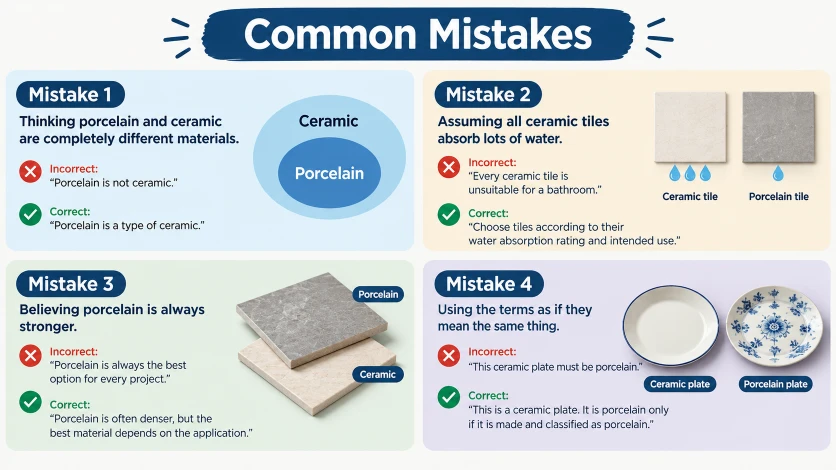
Mistake 1: Thinking porcelain and ceramic are completely different materials
Incorrect: “Porcelain is not ceramic.”
Correct: “Porcelain is a type of ceramic.”
Why? Ceramic is the broad category. Porcelain is one kind of ceramic made using particular materials and firing conditions.
Memory tip: Think of porcelain as one member of the ceramic family.
Mistake 2: Assuming all ceramic tiles absorb lots of water
Incorrect: “Every ceramic tile is unsuitable for a bathroom.”
Correct: “Choose tiles according to their water absorption rating and intended use.”
Why? Ceramic tiles vary. Glaze, body composition, and manufacturing methods affect performance. Some ceramic tiles work well on bathroom walls, while suitable porcelain tiles are often preferred for wet floors.
Memory tip: Check the specifications, not just the name.
Mistake 3: Believing porcelain is always stronger
Incorrect: “Porcelain is always the best option for every project.”
Correct: “Porcelain is often denser, but the best material depends on the application.”
Why? A tile’s strength, surface finish, thickness, installation, and intended use all matter. A good ceramic wall tile may be the better choice for a simple indoor wall.
Memory tip: Match the material to the job.
Mistake 4: Using the terms as if they mean the same thing
Incorrect: “This ceramic plate must be porcelain.”
Correct: “This is a ceramic plate. It is porcelain only if it is made and classified as porcelain.”
Why? A product’s appearance alone cannot reliably identify its material.
Memory tip: Similar appearance does not mean identical material.
Everyday Examples
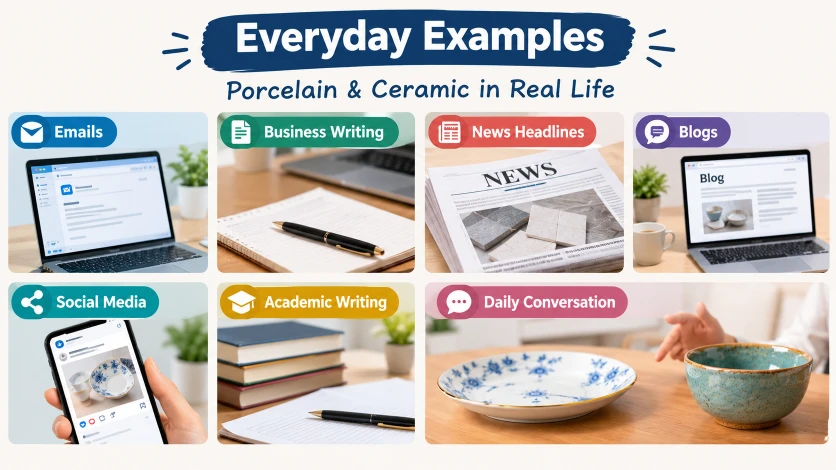
Here is how to use porcelain and ceramic naturally in different settings.
Emails
- “Could you confirm if these bathroom tiles are porcelain or standard ceramic?”
- “Please send the care instructions for the porcelain dinner set.”
Business Writing
- “The supplier offers ceramic wall tiles in several colours and sizes.”
- “The project specification requires porcelain tiles with a suitable water absorption rating.”
News Headlines
- “Homeowners Compare Porcelain and Ceramic Tiles”
- “New Ceramic Collection Brings Fresh Designs to Modern Homes”
Blogs
- “Porcelain or ceramic tiles may suit your renovation, depending on your budget and the room.”
- “Learn how porcelain dinnerware differs from stoneware and other ceramic products.”
Social Media
- “Would you choose classic porcelain plates or handmade ceramic bowls?”
- “Planning a bathroom makeover? Compare tile specifications before you buy.”
Academic Writing
- “Porcelain is a category of ceramic material with distinct compositional and firing characteristics.”
- “Water absorption can help distinguish porcelain tiles from other ceramic tiles.”
Daily Conversation
- “Are these plates made of porcelain?”
- “We chose ceramic tiles for the kitchen wall.”
- “Is porcelain worth the extra cost for our bathroom floor?”
These examples show that the words describe materials and products. They are not alternative spellings of the same word.
Google Trends and Modern Usage
People search for porcelain or ceramic for several reasons. Many want to compare flooring materials before a renovation. Others are choosing dinnerware, buying bathroom products, or trying to identify an item they already own.
The meaning also depends on the product category. Someone comparing tiles is likely to care about water absorption, durability, cleaning, installation, and price. Someone comparing plates may care more about appearance, weight, chipping, and care instructions.
Modern online shopping adds to the confusion. Retailers may use broad terms such as ceramic tiles alongside more specific labels such as porcelain tiles. Product descriptions may also use the word ceramic for the wider material family.
Search interest can vary by location, season, and home improvement trends. No exact Google Trends figures are provided here, so it would be misleading to claim that one term is more popular worldwide.
To research current interest, compare the phrases “porcelain or ceramic” and “porcelain vs ceramic” in Google Trends. Set the same time range and region for each phrase. Remember that search interest measures relative attention, not total sales or product quality.
Quick Comparison
| Feature | Porcelain | Ceramic (non-porcelain) |
| Material category | A type of ceramic | A broad group of fired materials |
| Density | Usually high | Varies by type |
| Water absorption | Usually very low for porcelain tiles | Varies; often higher than porcelain |
| Tile cutting | Often harder to cut | Often easier to cut |
| Cost | Often higher for comparable tiles | Often more budget-friendly |
| Best tile uses | Many floors, wet areas, and high-traffic spaces | Many walls, decorative areas, and indoor spaces |
| Appearance | Can be glazed, matte, polished, or textured | Available in many colours, finishes, and textures |
| Dinnerware | Can be fine, smooth, and lightweight | Includes earthenware, stoneware, and many other types |
| Care | Depends on finish and product instructions | Depends on finish and product instructions |
Important: This table describes common patterns, not universal rules. Some ceramic products are highly durable, and porcelain products still need the correct installation and care.
Key Takeaways
- Porcelain is a type of ceramic, not a completely separate material family.
- Porcelain tiles are usually denser and absorb less water than many other ceramic tiles.
- Ceramic tiles are often a cost-effective option for walls and many indoor projects.
- Porcelain is often a good choice for demanding flooring applications when the product is rated for that use.
- Porcelain and ceramic are spelled the same in British and American English.
- Neither material is automatically best for every room or product.
- Always check technical specifications, installation guidance, and care instructions before buying.
Frequently Asked Questions
Which One Is Better, Porcelain or Ceramic?
Porcelain is generally better for high-moisture areas, heavy use, and outdoor applications because it is denser and less porous. Ceramic is often a better choice for walls, light-use areas, and budget-friendly projects.
How Can You Tell If It’s Ceramic or Porcelain?
Porcelain tiles are usually denser, heavier, and less porous than standard ceramic tiles. However, appearance alone may not be enough to tell the difference. Check the product label or manufacturer’s specifications to confirm the tile type.
Which Is More Expensive, Ceramic or Porcelain?
Porcelain is generally more expensive than ceramic because it requires more refined materials and higher firing temperatures. However, the final price depends on the tile’s quality, design, size, and brand.
Are Porcelain and Ceramic the Same?
No, porcelain and ceramic are not exactly the same. Both are made from clay and other natural materials, but porcelain is typically fired at higher temperatures, making it denser and less porous than standard ceramic.
Is Ceramic Cheaper Than Porcelain?
Yes, ceramic tiles are generally cheaper than porcelain tiles. They are often more affordable to purchase and install, making them a popular option for budget-conscious homeowners.
What Is the Disadvantage of Porcelain Tiles?
The main disadvantages of porcelain tiles are their higher cost, heavier weight, and more difficult cutting and installation. Their hard surface can also feel cold underfoot and may be slippery when wet, depending on the finish.
Conclusion
Porcelain and ceramic are closely related, but they are not interchangeable in every context. Ceramic is the broad material category, while porcelain is a specific type of ceramic that is usually dense and has low water absorption.
For home renovations, porcelain tiles are often worth considering for floors, bathrooms, and other demanding areas. Ceramic tiles can offer an affordable and practical solution for walls and many decorative projects. For dinnerware, the best choice depends on the style, durability, and care requirements you prefer.
Before buying, compare more than the product name. Check water absorption, slip resistance, durability ratings, installation requirements, and care instructions for tiles. For dishes, confirm if the item is safe for your intended use.
The same advice applies wherever you live. British and American English use the same spelling for both terms, so your decision should be based on the material rather than regional language rules.
Memorable takeaway: Porcelain is ceramic, but the best choice depends on where and how you will use it.
If you are planning a renovation or buying new tableware, compare the product specifications first so you can choose with confidence.
READ MORE!
- Stafford or Hurts: Who Is the Better NFL Quarterback?
- CGC vs PSA: What’s the Difference and Which Is Better?
- Miconazole vs Clotrimazole: What’s the Difference?

I’m passionate about English grammar, vocabulary, and clear communication. I enjoy making English easier to understand through simple, practical, and easy-to-follow explanations. My goal is to help learners build confidence and improve their English for everyday use.








2 thoughts on “Porcelain vs Ceramic: What’s the Difference?”