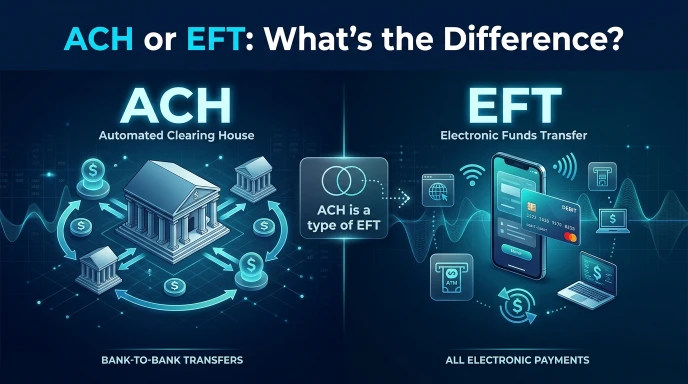
The main distinction is that ACH (Automated Clearing House) is a type of electronic payment network, while EFT (Electronic Funds Transfer) is a broad term for moving money electronically. An ACH payment is one type of EFT, but not every EFT uses the ACH network.
This article focuses on US payment terminology, where ACH has a specific meaning. It explains how ACH and EFT work, when to use each term, how they differ in everyday banking, and what to know about payment speed, fees, direct deposits, and bank transfers.
ACH or EFT: Quick Answer
The easiest way to understand ACH vs EFT is to think of EFT as the larger category and ACH as one method within it.
- ACH: A specific network used to move money between participating US banks and credit unions.
- EFT: A general term for electronic money transfers.
- ACH payment example: Your employer deposits your paycheck directly into your bank account.
- EFT example: You use a debit card to pay for groceries or transfer money electronically.
Both terms are correct. The right one depends on the payment method and the level of detail you need.
If a bank form asks you to choose between ACH and EFT, check its instructions. Some businesses use EFT as a general label for electronic payments, while others use it for a specific payment service.
What Does ACH Mean?
ACH stands for Automated Clearing House. It refers to a US electronic payment network that processes payments between banks and credit unions.
Instead of sending a paper check, a person or business can authorize a payment electronically. The ACH network then processes the payment instructions so funds can move between the relevant financial institutions.
ACH is commonly used for two types of transactions.
1. ACH Credit
An ACH credit sends money into another account. The sender initiates the payment.
Examples include:
- Your employer deposits your salary into your checking account.
- A government agency deposits a benefit payment.
- A business sends a supplier payment electronically.
- You transfer money between eligible bank accounts using an ACH service.
2. ACH Debit
An ACH debit allows an authorized organization to collect money from your bank account.
Examples include:
- Your utility company collects your monthly bill.
- Your mortgage payment comes out automatically.
- You authorize a company to collect a recurring subscription payment.
- A lender collects an eligible loan payment.
The main difference is simple: an ACH credit pushes money to a receiving account, while an ACH debit pulls money from an account under an appropriate authorization.
ACH payments can be convenient for regular transactions because they reduce the need for paper checks and manual payments.
What Does EFT Mean?
EFT stands for Electronic Funds Transfer. It is a broad term for moving money electronically rather than using physical cash or a paper-based payment method.
In US consumer banking, the term has a specific legal meaning under Regulation E. In everyday banking and business communication, it is also used as a general label for electronic payments. The precise scope depends on the context.
Common examples of EFTs include:
- ACH direct deposits.
- Eligible debit card purchases.
- ATM withdrawals and certain electronic deposits.
- Electronic transfers between bank accounts.
- Certain person-to-person payments.
- Some electronic bill payments.
Not every electronic payment follows the same rules or uses the same network. For example, a wire transfer and an ACH transfer are both electronic, but they use different payment systems.
How Does EFT Work?
The exact process depends on the payment method.
In a typical bank transfer, you authorize a payment through an app, website, payment terminal, or other supported service. The relevant financial institutions or payment providers then process the instructions and update the accounts.
The transfer may involve different networks, processing times, fees, and consumer protections. That is why the label EFT alone does not tell you exactly how a payment will be handled.
The Origin of ACH and EFT
ACH and EFT developed as electronic banking became more common, but the terms refer to different things.
The Origin of ACH
ACH is an abbreviation for Automated Clearing House. In the United States, the ACH system developed during the early 1970s as banks and payment organizations sought more efficient ways to process large volumes of payments.
It helped automate transactions that had traditionally relied on paper checks. Over time, the network became widely used for payroll, government benefits, bill payments, and business transfers.
The name describes the system’s role: a clearing house helps process and route payment instructions between financial institutions.
The Origin of EFT
EFT is short for Electronic Funds Transfer. Unlike ACH, it does not name just one payment network.
The term describes the electronic movement of funds. It also appears in the name of the US Electronic Fund Transfer Act, which provides a legal framework for certain electronic transfers involving consumer accounts.
The legal term and the everyday banking term are related, but they should not be confused. EFT can describe a type of transaction, while the Electronic Fund Transfer Act is a law.
Why Are ACH and EFT Often Confused?
The terms overlap because ACH payments are electronic funds transfers. A bank, employer, payment processor, or accounting system may therefore describe the same payment as an ACH payment or an EFT.
For example, a company might advertise that it pays suppliers by EFT, while its payment system actually sends those payments through ACH.
Neither label is automatically wrong. However, ACH is more specific, while EFT describes a broader category or a general electronic payment service.
British English vs American English
ACH and EFT are not two different spellings of the same word. They are payment terms, and their meanings do not change in the same way that words such as color and colour do.
ACH is particularly associated with the US banking system. EFT is used more broadly in banking and payment services, including in countries that operate their own electronic payment systems.
| Context | United States | United Kingdom | Example |
| Specific payment network | ACH | UK payment systems such as Bacs or Faster Payments | An ACH transfer or a Faster Payments transfer |
| General electronic payment term | EFT | EFT or electronic bank transfer, depending on context | The business accepts electronic payments |
| Payroll | ACH direct deposit is common | Bacs is commonly used for salary payments | Salary paid directly into a bank account |
| Bank-to-bank transfer | ACH or wire, depending on method | Faster Payments, Bacs, or CHAPS, depending on method | Sending money to another account |
| Debit card purchase | Often described as an electronic payment or EFT in relevant contexts | Usually described as a card payment | Paying for goods with a debit card |
The UK examples refer to distinct payment systems, not alternative names for ACH. Their availability and suitability depend on the transaction.
What About Canada and Australia?
Canada and Australia have their own banking arrangements and payment terminology. Canadian electronic transfers may use services such as Interac e-Transfer or Canadian bank transfer systems. Australia uses systems such as BECS and the New Payments Platform.
These are not interchangeable with the US ACH network. A business that operates across countries should name the actual payment method instead of assuming that every electronic bank transfer is an ACH payment.
For international readers, the safest rule is to use EFT as a general term when the exact payment method is unknown, then identify the relevant local system when precision matters.
Which Version Should You Use?
The best term depends on where the payment takes place, how the money moves, and who will read your message.
United States
Use ACH when you know the payment uses the Automated Clearing House network.
Examples:
- “Your salary will be deposited through ACH.”
- “We accept ACH payments for monthly invoices.”
Use EFT when discussing electronic transfers as a broader category or when that is the terminology used by the bank, contract, or payment provider.
United Kingdom
Do not use ACH as a generic name for every bank transfer. Refer to the relevant payment system, such as Bacs or Faster Payments, when known.
EFT can be understood as a general term, but everyday communication is often clearer when it simply says “bank transfer” or names the service used.
Canada
Use the name of the actual Canadian payment method when it is known. If you are discussing electronic payments broadly, EFT may be suitable.
Do not assume that an American ACH instruction will work with a Canadian bank account. Confirm the payment route and account requirements with the financial institution.
Australia
Use the relevant Australian payment method, such as BECS or the New Payments Platform, where applicable. Use EFT for general discussion if it matches the bank’s terminology.
Always verify the payment instructions before entering bank details or setting up recurring payments.
International Writing
For an international audience, introduce the broad term first and explain the specific payment system.
For example: “We offer electronic funds transfers (EFTs), including ACH payments for eligible US bank accounts.”
This tells readers what the service does without suggesting that ACH is available everywhere.
Academic Writing
Define each abbreviation at first use:
- Automated Clearing House (ACH)
- Electronic Funds Transfer (EFT)
Then use the abbreviations consistently. If the article discusses US payment networks, explain that ACH is a specific system within the broader category of electronic transfers.
Business Writing
Be specific in invoices, contracts, payment policies, and supplier instructions.
If a supplier requires an ACH payment, do not assume that a wire transfer or another EFT will meet the requirement. Confirm the accepted method, currency, fees, processing schedule, and account details before sending funds.
Common Mistakes When Using ACH and EFT
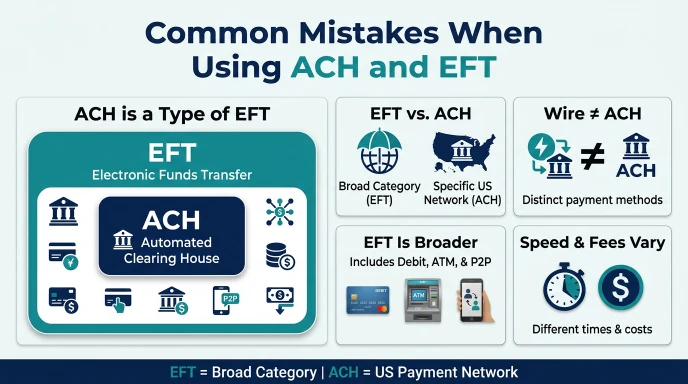
ACH and EFT are related terms, but using them as if they mean exactly the same thing can create confusion.
Mistake 1: Assuming ACH and EFT Are Two Separate Payment Methods
Incorrect: “ACH is an EFT, so EFT must mean a different payment method.”
Correct: “ACH is one type of electronic funds transfer.”
Explanation: EFT is the broader category. ACH is a specific US payment network within that category. Other electronic payment methods can also qualify as EFTs.
Memory tip: Think of EFT as the category and ACH as one member of that category.
Mistake 2: Calling Every Bank Transfer an ACH Payment
Incorrect: “I sent an international wire, so I sent an ACH payment.”
Correct: “I sent an international wire transfer.”
Explanation: Wire transfers and ACH payments use different payment systems. Both move money electronically, but they are not the same method. The term ACH should be used only when the transaction actually uses the ACH network.
Mistake 3: Assuming EFT Always Means a Bank-to-Bank Transfer
Incorrect: “An EFT can only happen between two bank accounts.”
Correct: “EFT can cover several types of electronic transactions, depending on the applicable definition.”
Explanation: Electronic transfers can include eligible debit card transactions, ATM transactions, and certain person-to-person payments. The legal definition under US consumer protection rules is more specific than some everyday business uses of the term.
Mistake 4: Assuming ACH Is Always Faster or Cheaper
Incorrect: “ACH is always the fastest and cheapest way to send money.”
Correct: “ACH can be cost-effective, but speed and fees depend on the transaction and provider.”
Explanation: Some ACH payments settle on the same business day, while others take longer. Banks may also set transfer limits or charge fees. Check your bank’s terms before choosing a payment method.
Mistake 5: Treating EFT as a Specific US Network
Incorrect: “EFT is the name of the US network that processes ACH payments.”
Correct: “ACH is the name of the US payment network, while EFT is a broader term.”
Explanation: The two abbreviations describe different levels of the payment process. This distinction matters when writing payment instructions, explaining bank statements, or comparing payment services.
Everyday Examples of ACH and EFT
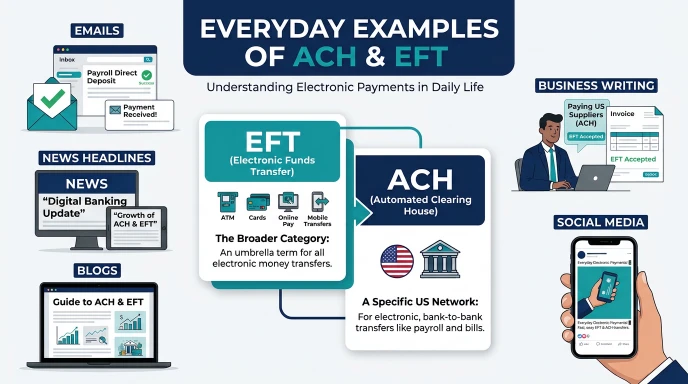
These examples show how the two terms work in real situations.
1. Emails
ACH example
Subject: Payroll Deposit
Hi Alex,
Your salary will be deposited into your bank account through ACH on the scheduled payday.
Best regards, Payroll Team
EFT example
Subject: Electronic Payment Options
Hello Jordan,
We support electronic funds transfers for eligible payments. Please review the available payment methods before submitting your request.
Kind regards, Accounts Team
Use ACH when the payment route is confirmed. Use EFT when discussing electronic payment options more generally.
2. Business Writing
ACH example:
“The company uses ACH to pay approved US suppliers.”
EFT example:
“The company offers EFT options for eligible customer payments.”
The first sentence names a specific network. The second describes a broader service.
3. News Headlines
ACH and EFT may appear in financial news, banking updates, or consumer advice.
Examples:
- “Banks Expand Same-Day ACH Payment Options”
- “What Consumers Should Know About Electronic Funds Transfers”
- “Businesses Review EFT Options for Supplier Payments”
These examples show how the terms fit different topics. ACH works well for news about the network, while EFT suits broader discussions about electronic transactions.
4. Blogs
ACH example:
“ACH payments can help businesses automate payroll and recurring supplier payments.”
EFT example:
“Understanding EFT options can help consumers compare ways to pay bills and move money.”
A blog should explain the exact method whenever speed, fees, or eligibility are important to the reader.
5. Social Media
ACH example:
“Setting up ACH payments can make recurring business payments easier to manage.”
EFT example:
“Before choosing an electronic payment option, check the fees, transfer limits, and expected processing time.”
Short posts can use either term, but the surrounding information should make the meaning clear.
6. Academic Writing
ACH example:
“The study examines the use of the Automated Clearing House network for electronic payroll deposits.”
EFT example:
“The report reviews electronic funds transfers and their role in modern consumer banking.”
Academic writing should define both abbreviations and avoid treating them as synonyms.
7. Daily Conversation
ACH example:
“My employer sends my paycheck through ACH.”
EFT example:
“I made an electronic transfer to pay my bill.”
The second example does not identify a particular payment network. If the bill was paid through ACH, the speaker could say so for greater precision.
Google Trends and Modern Usage
People search for “ACH or EFT” because banks, employers, payment processors, and accounting platforms may use different labels for electronic payments.
Someone completing a payroll form may wonder if ACH and EFT require different information. A business owner may want to know which method to select when paying suppliers. A consumer may see EFT on a bank statement and want to understand how the transaction was processed.
Which Term Is More Popular?
ACH is widely used in US banking discussions about direct deposits, automated bill payments, and bank-to-bank transfers. EFT is a broader term used in consumer banking, business payments, financial documentation, and educational material.
However, these general usage patterns do not establish which search term receives more searches in every region or period.
Google Trends can help compare interest in “ACH” and “EFT,” but results depend on the selected country, time range, and search settings. The terms also have different levels of specificity, which makes a direct comparison less straightforward.
No exact search-volume figures are claimed here.
Why Do People Search for ACH vs EFT?
Common reasons include:
- Understanding the difference between ACH and EFT.
- Choosing a payment method for payroll.
- Completing a bank transfer form.
- Comparing fees and processing times.
- Understanding a bank statement.
- Setting up automatic bill payments.
- Making sure a business payment uses the required network.
The most helpful answer is to identify the payment method, not just compare the abbreviations. If a payment provider says “EFT,” ask which network or service it uses when that detail affects the transaction.
Quick Comparison
| Version | Meaning | Correct? | Region | Example |
| ACH | A specific electronic payment network | Yes | United States | Payroll paid through ACH |
| EFT | A broad term for electronic funds transfers | Yes | General, with local variations | An electronic payment to a supplier |
| ACH credit | An ACH payment that sends money to an account | Yes | United States | Direct deposit of wages |
| ACH debit | An authorized ACH payment that collects money from an account | Yes | United States | Automatic utility bill payment |
| Wire transfer | A separate electronic payment method | Yes | Depends on the banking system | Sending a wire to a business |
| Faster Payments | A UK payment system | Yes | United Kingdom | Sending an eligible UK bank transfer |
The important point is that ACH, EFT, and wire transfer are not interchangeable labels. Use the term that accurately describes the payment being made.
Key Takeaways
- ACH stands for Automated Clearing House.
- EFT stands for Electronic Funds Transfer.
- ACH is a specific US payment network.
- EFT is a broader term for electronic money transfers.
- Every ACH payment is an EFT, but not every EFT is an ACH payment.
- ACH supports direct deposits, recurring bills, and many business payments.
- Payment speed and fees depend on the method, bank, and transaction.
- For international payments, use the name of the actual local payment system whenever possible.
FAQs
1. Are ACH and EFT the Same?
No, ACH and EFT are not exactly the same. EFT (Electronic Funds Transfer) is a broad term for moving money electronically, while ACH (Automated Clearing House) is a specific payment network used to process electronic transfers between bank accounts.
2. Does EFT Use ACH?
Yes, some EFTs use the ACH network. For example, direct deposits and many automatic bill payments use ACH in the United States. However, EFTs can also use other methods, such as wire transfers, debit card networks, or other electronic payment systems.
3. What Is an ACH Payment?
An ACH payment is an electronic transfer of money between bank accounts through the Automated Clearing House network in the United States. Common examples include payroll direct deposits, recurring bill payments, and online bank-to-bank transfers.
4. Does ACH EFT Cost Money?
ACH and other EFT transactions may involve fees, depending on the bank, payment provider, and type of transaction. Many personal ACH transfers are free, while businesses may pay processing fees. Wire transfers and certain other EFT methods can cost more.
5. What Is the ACH-EFT Method?
The ACH-EFT method refers to transferring money electronically through the Automated Clearing House network. The sender authorizes a payment, the relevant financial institutions exchange payment instructions through the ACH system, and the funds are credited to the recipient’s account according to the processing schedule.
6. Is ACH a Payment Processor?
No, ACH is not a payment processor. ACH is a payment network, while a payment processor is a company or service that helps businesses initiate, manage, or process payments. Banks and payment processors can use the ACH network to facilitate electronic transactions.
Conclusion
When comparing ACH or EFT, remember that the terms are related but do not mean exactly the same thing. ACH stands for Automated Clearing House and identifies a specific US payment network. EFT stands for Electronic Funds Transfer and describes a broader category of electronic transactions.
Use ACH when you know that a payment moves through the ACH network. This is common for US payroll deposits, recurring bill payments, and many business transfers. Use EFT when discussing electronic transfers in general, unless a bank, contract, or payment form defines the term more narrowly.
For readers outside the United States, the distinction is especially important. Other countries use their own payment systems, so an electronic bank transfer is not automatically an ACH transaction.
Before choosing a payment method, check the processing time, fees, transfer limits, and recipient requirements. If you are completing a payment form, follow the provider’s instructions rather than assuming ACH and EFT are interchangeable.
The simple rule to remember: ACH is one type of EFT, but EFT includes more than ACH. If this guide helped clarify the difference, share it with someone who needs to understand electronic payments.
READ MORE!
- Congrats vs Congratulations: What’s the Difference?
- Mean or Median: What’s the Difference?
- Immigrated or Migrated: What’s the Difference?

I’m Edward Fletcher, a UK-based English language writer with a passion for grammar and vocabulary. At VocabNex, I share simple explanations, useful examples, and practical English tips to help learners improve their language skills and communicate with confidence.