When you need to write a word that ends in -ves or -vez, it can be hard to know which spelling is right. The answer depends on the word you want to use. In standard English, ves is a common ending in plural words such as leaves, wives, and knives. Vez is not a standard English plural ending.
People search for “ves or vez” because the letters sound similar in some words, and English plural rules can be confusing. Many nouns that end in -f or -fe change to -ves in the plural. For example, leaf becomes leaves, and wife becomes wives. However, this rule does not apply to every word.
Understanding the difference can help you avoid spelling errors in schoolwork, emails, business writing, and everyday messages. You will also learn when -ves is correct, why some nouns follow different plural rules, and how to choose the right spelling for your audience.
The key is to look at the original word and its meaning, rather than choosing an ending based only on sound.
What Does Ves or Vez Mean?
The spelling ves usually appears at the end of English plural nouns. It often replaces f or fe in a singular word.
For example:
- Leaf → leaves
- Knife → knives
- Wife → wives
- Wolf → wolves
- Shelf → shelves
In each case, the plural refers to more than one person, animal, or thing.
Is Vez Ever a Correct Word?
Yes, vez is a Spanish word. It means “time” or “occasion” in English, depending on the context. Its plural is veces, not vezs.
For example:
- Spanish: Una vez más.
- English: “One more time.”
In English spelling, however, vez is not the normal ending used to form plural nouns. It may appear in names, foreign-language phrases, or specialized contexts, but that does not make it an alternative to the English ending -ves.
The Origin of Ves or Vez
To understand why English uses -ves, it helps to look at how plural nouns developed.
Old English used several ways to form plurals. Adding -s or -es became the most common pattern, but some nouns kept older spelling and sound changes.
In certain words, the f sound changed to a v sound when the word took a plural ending. Over time, this pattern became established in words such as leaf, knife, and wife.
That is why these changes are now part of standard English spelling:
| Singular | Plural | Spelling change |
| Leaf | Leaves | f → v + es |
| Knife | Knives | fe → ves |
| Life | Lives | fe → ves |
| Calf | Calves | f → v + es |
| Thief | Thieves | f → v + es |
These forms are examples of irregular plurals because they do more than simply add -s.
However, English does not apply the same change to every noun ending in f or fe. Words such as roof, chief, and belief normally form their plurals as roofs, chiefs, and beliefs.
The main lesson is simple: learn the plural form of the individual word instead of assuming that every word follows one rule.
British English vs. American English
There is no general British-versus-American spelling difference between ves and vez. Both varieties use -ves in the same common plural forms, including leaves, knives, and wives.
Some individual nouns have accepted alternative plurals, but these differences do not make vez a standard English plural ending.
| British English | American English | Example |
| Leaves | Leaves | The leaves fell from the trees. |
| Knives | Knives | Put the knives in the drawer. |
| Wives | Wives | The story mentions two wives. |
| Roofs | Roofs | The roofs need repairs. |
| Chiefs | Chiefs | The chiefs attended the meeting. |
Do Style Guides Prefer Ves or Vez?
Standard English dictionaries and grammar references recognize -ves in established words such as wives and leaves. They do not treat -vez as an alternative plural rule.
When writing for a newspaper, school, university, or business, follow the required style guide and check a reliable dictionary when a plural is uncertain.
For international writing, the same advice applies. Use the accepted English spelling and avoid inventing a new ending based on pronunciation.
Which Version Should You Use?
Your choice should depend on the word you are trying to spell, not on your country.
- United States: Write leaves, knives, wives, and wolves. Use roofs and chiefs for the usual plurals of roof and chief.
- United Kingdom: Use the same standard forms. British English does not replace -ves with -vez.
- Canada: Follow standard English plural rules. For formal writing, use the dictionary or style guide required by your organization.
- Australia: Use established English plurals such as leaves, knives, and shelves.
- International writing: Choose recognized English spellings that readers across regions will understand.
- Academic writing: Check a reputable dictionary and apply the same spelling consistently throughout your paper.
- Business writing: Proofread plural nouns in emails, reports, presentations, and product descriptions.
If you are unsure if a noun takes -s or -ves, check its dictionary entry. This is especially useful for exceptions such as roof, hoof, and dwarf, where usage may vary by word and context.
Common Mistakes With Ves or Vez
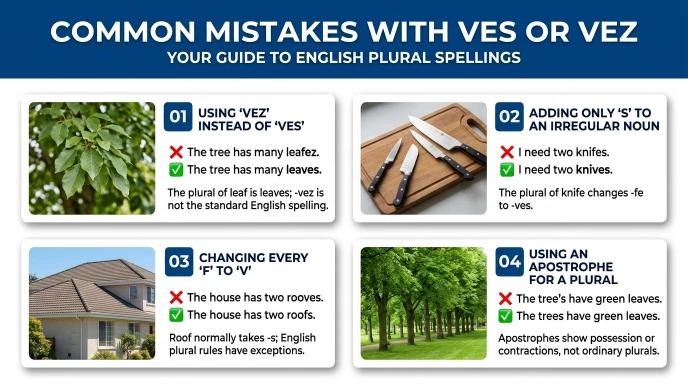
The most common error is replacing the accepted spelling -ves with -vez. Another mistake is assuming that all nouns ending in f or fe must change to -ves.
Mistake 1: Using Vez Instead of Ves
- Incorrect: The tree has many leafez.
- Correct: The tree has many leaves.
Why? The plural of leaf is leaves. The ending -vez is not the standard English spelling.
Memory tip: If the singular is leaf, remember the familiar pair leaf, leaves.
Mistake 2: Adding Only S to an Irregular Noun
- Incorrect: I need two knifes.
- Correct: I need two knives.
Why? The standard plural of knife changes -fe to -ves.
Memory tip: Think of the common phrase “forks and knives.” The word knives has a v.
Mistake 3: Changing Every F to V
- Incorrect: The house has two rooves.
- Correct: The house has two roofs.
Why? Although many nouns change f to v, roof normally takes -s. English plural rules have exceptions.
Memory tip: Learn common exceptions as complete pairs: roof → roofs, chief → chiefs, and belief → beliefs.
Mistake 4: Using an Apostrophe for a Plural
- Incorrect: The tree’s have green leaves.
- Correct: The trees have green leaves.
Why? An apostrophe usually shows possession or a contraction, not a regular plural. In the correct sentence, trees means more than one tree.
Memory tip: To show more than one item, start with the normal plural spelling. Add an apostrophe only when the sentence needs possession or a contraction.
Everyday Examples of Ves and Vez
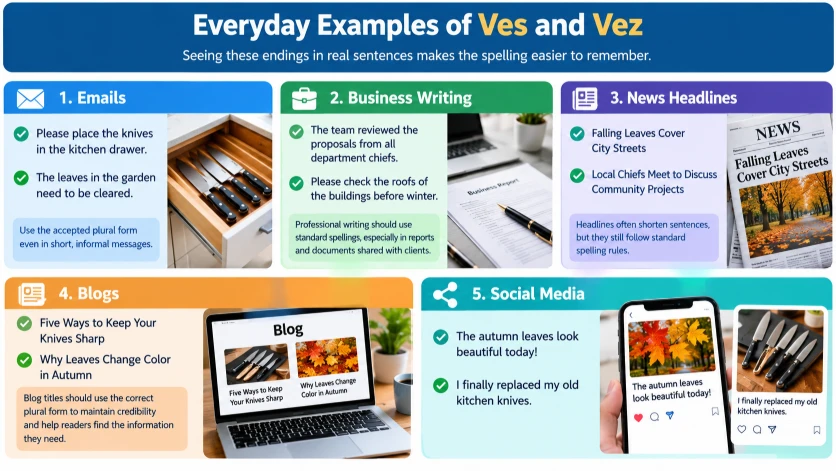
Seeing these endings in real sentences makes the spelling easier to remember.
1. Emails
- Correct: “Please place the knives in the kitchen drawer.”
- Correct: “The leaves in the garden need to be cleared.”
Use the accepted plural form even in short, informal messages.
2. Business Writing
- Correct: “The team reviewed the proposals from all department chiefs.”
- Correct: “Please check the roofs of the buildings before winter.”
Professional writing should use standard spellings, especially in reports and documents shared with clients.
3. News Headlines
- “Falling Leaves Cover City Streets”
- “Local Chiefs Meet to Discuss Community Projects”
Headlines often shorten sentences, but they still follow standard spelling rules.
4. Blogs
- Correct: “Five Ways to Keep Your Knives Sharp”
- Correct: “Why Leaves Change Color in Autumn”
Blog titles should use the correct plural form to maintain credibility and help readers find the information they need.
5. Social Media
- Correct: “The autumn leaves look beautiful today!”
- Correct: “I finally replaced my old kitchen knives.”
Informal writing may use abbreviations or slang, but vez is not the standard plural spelling for these English words.
6. Academic Writing
- Correct: “The leaves were collected from several trees.”
- Correct: “The study compared the roofs of buildings in different climates.”
In academic work, check spelling carefully and follow your institution’s preferred dictionary or style guide.
7. Daily Conversation
- “Can you pass me the knives?”
- “The leaves are falling again.”
- “We need new shelves for these books.”
These simple sentences show how -ves appears in ordinary English.
Google Trends and Modern Usage
People may search for “ves or vez” because they want to know which spelling is correct, how English plurals work, or if a spelling checker has marked their word as incorrect.
The question is closely related to common searches such as:
- Ves or vez: which is correct?
- Is vez a word in English?
- What is the plural of leaf?
- Is it knives or knifes?
- Why does leaf become leaves?
- Which words change from f to ves?
These searches reflect a common learning problem: English plurals do not all follow one rule.
Which Spelling Is More Common?
In standard English, -ves appears in established words such as leaves, knives, wives, and wolves. The sequence -vez is not a competing English plural ending.
No specific Google Trends figures are presented here, so no numerical claim about search popularity or regional demand should be inferred. A live Google Trends comparison would be needed to assess search interest over a selected period and location.
Why Does This Confusion Continue?
There are three main reasons:
- Similar sounds: The endings may sound alike to some learners.
- Irregular plurals: English changes the spelling of certain nouns rather than simply adding -s.
- Unfamiliar exceptions: Words such as roof and chief keep their f when they become plural.
The most useful approach is to check the base word, identify its accepted plural, and use that form consistently.
Ves or Vez: Quick Comparison
| Version | Meaning | Correct? | Region | Example |
| Ves | Ending in established English plural forms | Yes, in the right word | All major English varieties | Leaves |
| Vez | Spanish word meaning time or occasion | Yes, in Spanish | Spanish-speaking regions | Una vez |
| Vez | Proposed English plural ending | No, not as a standard rule | None | “Leafez” is incorrect |
| Ves | Plural ending for every word ending in f | No, not universally | All major English varieties | Roofs, not usually rooves |
Remember that ves is not a complete word in every context. Its correctness depends on the word in which it appears.
Key Takeaways
- Ves is used in many standard English plural words.
- Vez is not a standard English plural ending.
- Leaf becomes leaves, and knife becomes knives.
- Not every noun ending in f or fe changes to -ves.
- Roof becomes roofs, while chief becomes chiefs.
- Vez is a valid Spanish word meaning “time” or “occasion.”
- Check a reliable dictionary when a plural form is uncertain.
- Use the accepted spelling in academic, business, and everyday writing.
Frequently Asked Questions
1. Is it “ya ves” or “ya vez”?
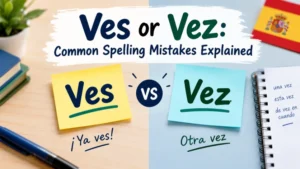
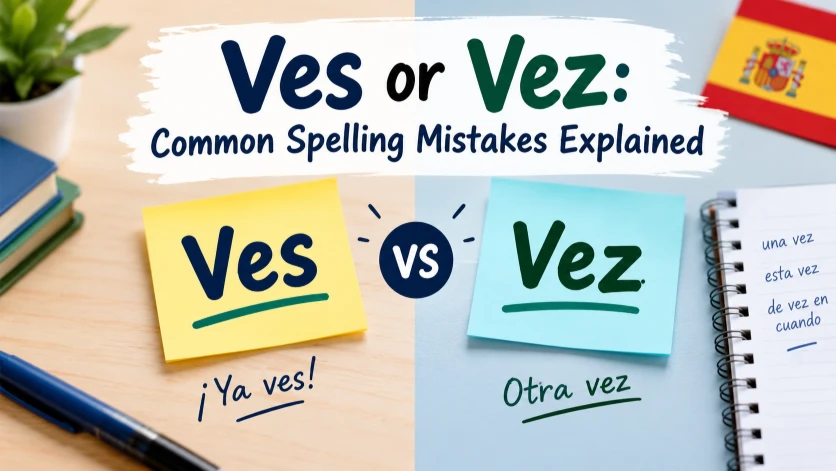
The correct spelling is “ya ves.” It means “you see” or “now you see” in Spanish. “Ves” comes from the verb ver (to see), while “vez” means “time” or “occasion.”
2. What is the difference between “vez” and “ves”?
Ves means “you see,” while vez means “time” or “occasion.” For example, “Ya ves” means “Now you see,” and “una vez” means “once.”
3. Is it “otra vez” or “otra ves”?
The correct phrase is “otra vez,” meaning “again” or “another time” in Spanish. “Ves” is a form of the verb ver, so “otra ves” is incorrect in this context.
4. Is it “una ves” or “una vez”?
The correct phrase is “una vez,” meaning “once” or “one time.” For example, “Te vi una vez” means “I saw you once.” The spelling “una ves” is incorrect.
5. Does “en vez” mean “instead”?
Yes, “en vez de” means “instead of” in Spanish. For example, “Tomé agua en vez de refresco” means “I drank water instead of soda.”
6. What does “ya vez” mean in English?
“Ya vez” is generally a misspelling of “ya ves,” which translates to “you see” or “now you see.” The correct spelling depends on the intended meaning, but when expressing “you see,” use “ves,” not “vez.”
Conclusion
The choice between ves or vez is simple when you are writing in standard English. Ves appears in many accepted plural forms, including leaves, knives, wives, and wolves. The spelling vez is not a standard English plural ending, although it is a real word in Spanish.
The main challenge is that English plural rules have exceptions. Some nouns ending in f or fe change to -ves, while others simply add -s. That is why leaf becomes leaves, but roof becomes roofs.
For school assignments, business documents, blog posts, and everyday messages, use the established spelling of each word. If you are unsure, consult a reliable dictionary rather than guessing from pronunciation.
You do not need to memorize every plural rule at once. Start with common word pairs, practice them in sentences, and learn the exceptions as you encounter them.
Remember: English uses -ves in many irregular plurals, but never assume that every word follows the same pattern.
If you found this guide helpful, explore more English spelling and grammar comparisons to improve your writing with confidence.
READ MORE!
- Greyson or Grayson: Which Spelling Is Correct?
- Mateo or Matteo: A Simple Guide to the Difference
- Meters or Metres: What’s the Difference?

I’m passionate about English grammar, vocabulary, and clear communication. I enjoy making English easier to understand through simple, practical, and easy-to-follow explanations. My goal is to help learners build confidence and improve their English for everyday use.