
The main difference between congrats or congratulations is length and tone. Both are correct ways to express praise or happiness for someone’s success. Congratulations is the full form and works in formal and informal situations, while congrats is a shorter, casual form used in texts, emails, social media, and everyday conversation.
People often search for these words because they want to congratulate someone without sounding too formal or too casual. You might write a message to a friend who passed an exam, a colleague who earned a promotion, or a family member who got married. In each case, the right choice depends on your relationship with the person and the tone you want to convey.
The good news is that you do not need to learn two different meanings. Both words express good wishes for an achievement, happy event, or success. The difference is how formal, warm, or brief your message sounds.
In this guide, you will learn what each word means, where it comes from, how to use it in different settings, and which version is best for American, British, and international English.
Congrats or Congratulations: Quick Answer
Use congratulations when you want a complete, polished expression of praise. Use congrats when you want to sound friendly, relaxed, and brief.
- Formal: Congratulations on your promotion.
- Informal: Congrats on your new job!
- Warm and personal: Congratulations on your wedding!
Neither word is incorrect. Choose the one that matches your audience, setting, and message.
What Does Congrats or Congratulations Mean?
Both words express happiness for another person’s success, achievement, or good news.
What Does Congratulations Mean?
Congratulations is the full expression used to show approval, praise, or good wishes. It is common in formal letters, speeches, business communication, academic announcements, and personal messages.
Examples:
- Congratulations on passing your final exams.
- Congratulations on your well-deserved promotion.
- Congratulations to the happy couple.
The word can also sound warm and personal. It is not limited to formal situations.
What Does Congrats Mean?
Congrats is a shortened form of congratulations. It carries the same basic meaning but usually sounds more casual and conversational.
Examples:
- Congrats on your new home!
- Congrats, you did it!
- Huge congrats on the big win!
People often use congrats in text messages, online comments, quick emails, and friendly conversations. It is short, easy to type, and widely understood.
Is There a Difference in Meaning?
There is no major difference in meaning. The main difference is tone.
| Feature | Congrats | Congratulations |
| Meaning | Expresses praise or good wishes | Expresses praise or good wishes |
| Length | Short form | Full form |
| Tone | Usually casual | Neutral, formal, or casual |
| Text messages | Very common | Also common |
| Formal letters | Less suitable | Usually preferred |
| Speeches | Suitable in relaxed settings | Suitable in most settings |
Remember: congrats is not a spelling mistake. It is an accepted informal word.
The Origin of Congrats and Congratulations
The word congratulations has a long history in English. According to the Oxford Advanced Learner’s Dictionary, it comes from the Latin word congratulatio, which is linked to congratulari, meaning to express joy or share in someone’s happiness. The word entered English in the late Middle Ages.
The shortened form congrats appeared much later. Etymonline records its use from 1884 as a casual shortening of congratulations.
The change reflects a common pattern in English. People often shorten longer words to make everyday speech and writing quicker.
For example:
- Congratulations becomes congrats.
- Application becomes app.
- Advertisement becomes ad.
- Examination becomes exam.
These shorter forms can become widely accepted while keeping the original word’s basic meaning.
Today, both congrats and congratulations are established English expressions. The shorter form is especially useful when space and speed matter, while the full form works well when you want a more polished message.
British English vs American English
There is no major British-versus-American spelling difference between congrats and congratulations. Both forms are used in British English and American English.
The choice depends more on tone and context than on location. British and American writers can use either form, although individual workplaces, publications, and style guides may prefer a particular level of formality.
| British English | American English | Example |
| Congratulations | Congratulations | Congratulations on your new role. |
| Congrats | Congrats | Congrats on your new role! |
| Formal messages often use the full form | Formal messages often use the full form | Please accept my congratulations on your appointment. |
| Informal messages may use the short form | Informal messages may use the short form | Congrats on the win! |
Regional Differences
In the UK, you may hear expressions such as well done alongside congratulations. In the US, congrats, good job, and way to go are also common ways to praise someone’s achievement.
These are tendencies, not strict regional rules. Both congrats and congratulations are understood across English-speaking countries.
What Do Style Guides Recommend?
Formal writing generally benefits from clear, complete wording. However, there is no universal rule that bans congrats from professional writing.
A company may use Congratulations! in an official announcement and Congrats! in a friendly social media post. The important thing is to follow the publication’s style guide and keep the tone consistent.
Which Version Should You Use?
The best choice depends on where you are writing and who will read your message.
United States
Use congratulations for formal emails, awards, academic achievements, and professional announcements. Use congrats with friends, coworkers you know well, and social media contacts.
United Kingdom
Both forms are correct. Choose congratulations for formal situations and congrats for relaxed conversation or informal messages.
Canada
Either form works. In formal Canadian English, the full form is a safe choice. In everyday messages, congrats sounds natural.
Australia
Both forms are understood. Use the full word for formal letters and announcements, and the short form for friendly notes and online posts.
International writing
When writing for readers in several countries, congratulations is a clear, widely understood option. Use congrats when the message is deliberately casual.
Academic writing
Use congratulations in formal announcements, letters, and institutional communication. In academic research, choose words that suit the document rather than inserting casual praise into formal analysis.
Business writing
Use congratulations for clients, senior leaders, official announcements, and unfamiliar contacts. Congrats can work well in a friendly team chat or an informal message to a close colleague.
Simple rule: When you are unsure about the tone, choose congratulations. It is suitable for almost any situation.
Common Mistakes With Congrats and Congratulations
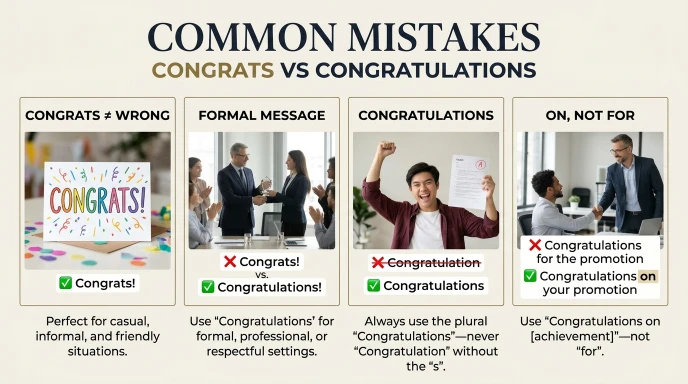
Both words are correct, but writers sometimes use them in ways that do not fit the situation.
Mistake 1: Thinking Congrats Is Incorrect
Incorrect claim: “Congrats is not a real English word.”
Correct understanding: “Congrats is an accepted informal form of congratulations.”
Explanation: Major dictionaries list congrats as an informal expression. It is not a spelling error, although it may be too casual for some settings.
Memory tip: Short does not mean wrong. It usually means informal.
Mistake 2: Using Congrats in Every Formal Message
Less suitable: “Hey, congrats on your appointment as director!”
More formal: “Congratulations on your appointment as director.”
The first message is fine for a friendly colleague. The second is safer for a formal letter, an official announcement, or a message to someone you do not know well.
Memory tip: Match the word to the relationship.
Mistake 3: Writing Congratulation When You Mean Congratulations
Less natural: “Congratulation on passing your exam!”
Correct: “Congratulations on passing your exam!”
When directly praising someone’s achievement, English normally uses congratulations in the plural. The singular noun congratulation does exist, but it is used in other grammatical contexts, such as a letter of congratulation.
Memory tip: For a direct message of praise, use congratulations.
Mistake 4: Using the Wrong Preposition
Incorrect: “Congratulations for your promotion.”
Better: “Congratulations on your promotion.”
The usual pattern is congratulations on an achievement or event.
Other correct examples include:
- Congratulations on your graduation.
- Congrats on winning the competition.
- Congratulations to you both on your wedding.
Memory tip: Remember the phrase congratulations on.
Mistake 5: Forgetting the Audience
Too casual for a formal award letter: “Congrats, Dr. Ahmed!”
More suitable: “Congratulations, Dr. Ahmed, on receiving this award.”
The short form is not grammatically wrong. The issue is if it matches the importance of the occasion and the tone of the message.
Memory tip: Think about the reader before choosing the shorter word.
Everyday Examples of Congrats and Congratulations

Here are practical examples for common writing situations. Notice how the meaning stays the same while the tone changes.
1. Emails
Informal email
Hi Sara,
Congrats on passing your driving test! I knew you could do it.
See you soon!
Formal email
Dear Mr. Khan,
Congratulations on your promotion. I wish you continued success in your new role.
Kind regards, Ali
Use the full form when you want a professional tone. Use the shorter form when writing to someone you know well.
2. Business Writing
- Formal: Congratulations on the successful launch of your new product.
- Informal team message: Congrats, everyone! We reached our sales goal.
- Client announcement: We extend our congratulations to the team on this important achievement.
Business writing can be warm without being overly casual. The right choice depends on the company culture and the audience.
3. News Headlines
- Formal headline: Congratulations to the Winners of the National Science Awards
- Casual headline: Congrats to Our Local Champions!
- Neutral announcement: Congratulations to the Graduating Class of 2026
News outlets and organizations choose wording based on their audience and editorial style. A headline may use a shorter expression to create a friendly tone, but congrats is not automatically better for clicks.
4. Blogs
- “Congratulations on completing your first marathon.”
- “Congrats on starting your first blog!”
- “Congratulations to all the students who completed the course.”
A personal blog can use either form. A formal educational or business blog may benefit from the full word when addressing readers directly.
5. Social Media
- “Congrats on the new job! 🎉”
- “Congratulations to our competition winners!”
- “Huge congrats to everyone who took part.”
- “Congratulations on your graduation. Your hard work paid off!”
Social media allows a relaxed tone, so congrats is a natural choice. The full form is equally appropriate when the occasion calls for a sincere or official message.
6. Academic Writing
- University announcement: Congratulations to the graduating class.
- Teacher’s message: Congratulations on completing your research project.
- Student group chat: Congrats on getting your results!
In academic settings, consider the type of writing. A university announcement may use the full form, while a message between classmates can use the short form.
7. Daily Conversation
Here are examples of how the words sound in everyday speech.
Friend: “I got the job!”
You: “Congrats! That’s amazing!”
Or:
Friend: “We’re getting married next month.”
You: “Congratulations! I’m so happy for you both.”
Both responses are natural. Your choice depends on the mood, relationship, and occasion.
Google Trends and Modern Usage
The search phrase congrats or congratulations reflects a common language question: if a shortened word is acceptable and when it is appropriate to use it.
Both expressions remain part of everyday English. The full form is useful for formal communication, while the shorter form fits quick messages, online conversations, and casual posts.
Which Word Is More Popular?
Popularity depends on the context. People may type congrats when looking for short messages, captions, or text replies. They may search for congratulations when writing formal wishes, greeting cards, speeches, or professional announcements.
These are reasonable usage patterns, not verified search-volume rankings. Without a current, region-specific Google Trends comparison, it would be misleading to claim that one term receives more searches than the other.
Why Do People Search for This Comparison?
Readers often want to know:
- Is congrats proper English?
- Is congratulations more polite?
- Which word belongs in a formal email?
- Can I use congrats in a professional message?
- Is there a difference between British and American English?
The answer is simple: both are correct, but they do not always create the same impression.
How to Check Google Trends
You can compare both search terms using Google Trends at Google Trends.
For a useful comparison:
- Enter congrats and congratulations as separate search terms.
- Select the same time range for both.
- Compare worldwide interest or choose a specific country.
- Check related queries and changes over time.
Google Trends shows relative search interest, not the exact number of searches. Results also depend on the selected region, period, and search settings.
Quick Comparison
| Version | Meaning | Correct? | Region | Example |
| Congrats | Short form expressing praise or good wishes | Yes, informal | International English | Congrats on your new job! |
| Congratulations | Full expression of praise or good wishes | Yes | International English | Congratulations on your new job! |
| Congratulation | The act of congratulating someone | Yes, in suitable grammatical contexts | International English | She sent a letter of congratulation. |
| Congratulate | To express praise or good wishes to someone | Yes, verb | International English | I congratulate you on your success. |
| Congratulatory | Expressing or offering congratulations | Yes, adjective | International English | They sent a congratulatory message. |
This comparison also helps you choose the right word form. Use congrats or congratulations to express good wishes directly, congratulate to describe the action, and congratulatory to describe something that expresses praise.
Key Takeaways
- Both words are correct: Congrats is the informal short form of congratulations.
- The meaning is nearly identical: Both express happiness about someone’s success or good news.
- Use congratulations for formal writing: It is a safe choice for business letters, academic announcements, and official messages.
- Use congrats for casual messages: It works well in texts, social media comments, and friendly conversations.
- There is no strict US-UK spelling difference: Both expressions are used in British and American English.
- Remember the usual phrase: Write congratulations on your success, not congratulations for your success.
- Use the plural for direct praise: Congratulations! is the standard expression when celebrating someone’s achievement.
- Consider your reader: The best choice depends on the relationship, setting, and tone.
FAQs
1. Is it congrats or congratulations?
Both are correct. Congratulations is the full expression, while congrats is its informal shortened form. You can use either to celebrate someone’s achievement, new job, graduation, wedding, or other happy event. Choose congratulations for formal communication and congrats when speaking or writing casually.
2. Is congrats proper English?
Yes, congrats is proper English in informal contexts. Major dictionaries recognize it as a shortened form of congratulations. It is common in everyday speech, texts, and social media. However, a formal letter, official announcement, or academic message may sound more polished with the full word.
3. Is congratulations more formal than congrats?
Usually, yes. Congratulations is the full form and generally suits formal and informal situations. Congrats sounds more relaxed and conversational. For example, you might write “Congratulations on your appointment” in an official email and “Congrats on the new role!” in a message to a friend.
4. Can I use congrats in a professional email?
Yes, if the email is friendly and informal and your workplace accepts that tone. For a client, senior manager, unfamiliar contact, or official announcement, congratulations is usually a safer choice. When in doubt, write “Congratulations on your achievement” to sound warm, respectful, and professional.
5. Is congrats short for congratulations?
Yes. Congrats is a shortened form of congratulations. It carries the same basic meaning but takes less space and usually sounds more casual. You can write “Congrats on passing your exam!” instead of “Congratulations on passing your exam!” without changing the central message.
6. Is it congratulations on or congratulations for?
The usual expression is congratulations on an achievement or event. For example, write “Congratulations on your graduation” or “Congrats on your promotion.” The word for can appear in other sentence structures, such as “I congratulate you for your hard work,” but congratulations on is the standard pattern for direct good wishes.
7. Is congratulations singular or plural?
In the usual expression of praise, congratulations is plural in form. English speakers say “Congratulations!” rather than “Congratulation!” when celebrating someone’s good news. The singular noun congratulation exists, but it is less common and appears in specific constructions, such as “a letter of congratulation.”
8. Do British people say congrats or congratulations?
British English uses both expressions. Congratulations is suitable for formal announcements, letters, and personal messages, while congrats is common in casual conversations and online communication. The choice is not a strict British-versus-American spelling rule. It depends on the setting, audience, and preferred tone.
9. Can I write congrats in a greeting card?
Yes. Congrats works well in a casual greeting card for a friend, sibling, or close colleague. For a wedding, graduation, retirement, or professional achievement, you can use either expression. Choose congratulations if you want the message to feel more traditional, formal, or heartfelt.
10. What can I say instead of congrats?
You can say well done, great job, way to go, bravo, or I’m so happy for you. For formal writing, try “Please accept my congratulations” or “I would like to congratulate you on your achievement.” Choose an alternative that fits the event and expresses the right level of warmth.
Conclusion
When choosing between congrats or congratulations, remember that both expressions are correct. The main difference is tone, not meaning. Congratulations is the full expression and works well in formal letters, professional emails, academic announcements, and personal messages. Congrats is the shorter, informal version that fits texts, social media, and friendly conversations.
There is no strict British-versus-American spelling rule that requires you to choose one over the other. Both forms are widely understood in English-speaking countries. Your audience, relationship with the reader, and purpose should guide your choice.
If you are writing to a client, teacher, employer, or someone you do not know well, congratulations is usually the safer option. If you are sending a quick message to a friend, congrats is perfectly natural.
You can also use alternatives such as well done, great job, and way to go when they better express your feelings.
The easiest rule to remember is this: Use “congratulations” for a polished tone and “congrats” for a casual one. Both can make someone’s good news feel worth celebrating.
If this guide helped clear up the confusion, explore more commonly confused English words to make your writing clearer and more confident.
READ MORE!
- Mean or Median: What’s the Difference?
- Or Is It? Meaning, Usage, and Examples
- Yay or Neigh: What’s the Difference?

I’m Edward Fletcher, a UK-based English language writer with a passion for grammar and vocabulary. At VocabNex, I share simple explanations, useful examples, and practical English tips to help learners improve their language skills and communicate with confidence.





2 thoughts on “Congrats vs Congratulations: What’s the Difference?”