The keyword “or best offer” is commonly used in online marketplaces, classified ads, and sales listings. It tells buyers that the seller may accept an offer below the listed price. For example, a seller who lists a bicycle for $200 or best offer may agree to sell it for $180 if the offer is acceptable.
People often search for “or best offer” because they want to understand what it means in a listing, if they can negotiate the price, and how it differs from a fixed price. The phrase also appears as OBO, a common abbreviation in advertisements.
The key point is that “or best offer” invites negotiation, but it does not guarantee that the seller will accept a lower price. The seller can reject an offer, make a counteroffer, or keep the listed price.
In this guide, you will learn the meaning of “or best offer,” how to use it correctly, where it appears in American and British English, and how to make or evaluate an offer. You will also find practical examples, common mistakes, frequently asked questions, and tips for writing clear sales listings.
Or Best Offer: Quick Answer
The phrase “or best offer” is used when a seller is open to negotiating the advertised price. It is especially common in classified advertisements and secondhand marketplaces.
For example:
- $100 or best offer: The seller may accept less than $100.
- Car for $5,000 OBO: The seller is willing to consider other prices.
- Furniture, $250 OBO: A buyer can ask if the seller will accept a lower amount.
The abbreviation OBO stands for “or best offer.” It is widely used in North American listings.
Remember that an asking price is not the same as an agreed sale price. The final amount depends on what the buyer offers and what the seller accepts.
What Does “Or Best Offer” Mean?
“Or best offer” is a phrase used in sales listings to show that the seller may be willing to accept a different price from the one advertised.
It gives buyers room to negotiate. Instead of insisting on one fixed amount, the seller invites buyers to suggest what they are willing to pay.
How Does It Work?
Imagine that a seller lists a used desk for $150 OBO.
Here is how a negotiation might work:
- The seller advertises the desk for $150.
- A buyer offers $110.
- The seller declines the offer or suggests $130.
- The buyer and seller agree on a price, or the deal does not happen.
The seller does not have to accept the first offer. They can reject it, make a counteroffer, or wait for another buyer.
What Does OBO Stand For?
OBO stands for “or best offer.” It is a written abbreviation commonly found in sales advertisements, especially in North America.
For example:
- Used phone, $180 OBO
- Office chair, $50 OBO
- Set of books, $25 OBO
Each listing tells buyers that the seller may consider another price.
Does “Or Best Offer” Always Mean a Lower Price?
Usually, the phrase signals that a seller is open to accepting less than the asking price. However, it does not promise a discount.
A seller may receive an offer that is too low and reject it. They may also accept the listed price if a buyer is willing to pay it. In some cases, buyers may offer the full asking price to improve their chances of completing the purchase.
The phrase creates room for negotiation, not a guarantee of a bargain.
The Origin of “Or Best Offer”
The phrase “or best offer” developed as a practical way to advertise goods while allowing some flexibility in the final price. Its meaning comes from the ordinary words or, best, and offer, rather than from a single special historical event.
The abbreviation OBO became useful in classified advertisements because it communicates the same idea in fewer characters. Dictionary references identify OBO as a North American abbreviation for “or best offer.”
Why Is OBO Used in Advertisements?
Short advertisements need to communicate important details quickly. Sellers often have limited space for a product description, price, condition, and contact information.
Writing “$300 OBO” is shorter than writing “$300, but I am willing to consider other offers.”
The abbreviation is now familiar in many online buying and selling settings, including local classified listings and secondhand marketplaces.
Is OBO an Official Business Term?
OBO is a recognized abbreviation, but it is informal. It works well in advertisements and casual sales messages. In a formal contract, invoice, or business proposal, it is usually better to state the price and negotiation terms clearly.
For example, a professional seller could write:
“The asking price is $300. Reasonable offers will be considered.”
This wording is clearer for readers who may not know the abbreviation.
British English vs American English
The phrase “or best offer” is understood in English-speaking markets, but its abbreviation and related expressions can vary by region.
| British English | American English | Example |
| O.N.O. or OBO may be understood, depending on the listing | OBO is widely used | “Bike for £100 O.N.O.” |
| “Or nearest offer” is a familiar alternative | “Or best offer” is common | “Desk for $75 OBO” |
| “Open to offers” is also natural | “Open to offers” is also natural | “Used sofa, open to offers” |
| Full wording works in formal contexts | Full wording works in formal contexts | “The seller will consider reasonable offers.” |
Oxford identifies OBO as a North American abbreviation and compares it with O.N.O., meaning “or nearest offer.”
Is OBO More Common in American English?
OBO is particularly associated with North American sales advertisements. It is widely understood in American online marketplaces and is also used in Canada.
In the United Kingdom, you may encounter “O.N.O.” or “or nearest offer,” especially in classified listings. Usage varies, however, so neither expression should be treated as exclusive to one country.
Does the Phrase Change Across Regions?
The basic meaning stays the same: the seller is willing to consider an offer other than the advertised amount.
The difference is mainly in the wording people choose. Local marketplace conventions, audience expectations, and the type of item being sold can influence which abbreviation is most familiar.
Which Version Should You Use?
The best wording depends on your audience, the platform, and how formal your advertisement needs to be.
United States
Use “or best offer” or OBO in casual sales listings.
Example: “Used bicycle, $175 OBO.”
This is a concise way to tell potential buyers that you may negotiate.
United Kingdom
Consider “or nearest offer” or O.N.O. if it suits your audience. You can also write “open to offers” to make your meaning clear.
Example: “Dining table, £120 or nearest offer.”
Canada
OBO is a practical choice for informal listings, particularly when selling used goods.
Example: “Winter tires, $250 OBO.”
Specify the currency when a listing could reach buyers in different countries.
Australia
“Open to offers” is a clear option for local listings. OBO may also be understood, but the full phrase avoids uncertainty.
Example: “Secondhand desk, $80, open to offers.”
International Writing
For an international audience, use the full phrase rather than relying only on an abbreviation.
Example: “The asking price is $200, but reasonable offers will be considered.”
This makes the meaning clear to readers who may be unfamiliar with OBO.
Academic Writing
Avoid OBO in formal academic writing unless you are discussing advertisements or explaining the abbreviation itself.
Instead of writing “The item costs $200 OBO,” write:
“The advertised price is $200, although the seller is willing to negotiate.”
Business Writing
In business messages, be specific about the asking price and the conditions for negotiation.
Example:
“Our asking price is $2,000. We are open to reasonable offers based on the quantity ordered and delivery requirements.”
This wording is more precise than an unexplained abbreviation.
Common Mistakes When Using “Or Best Offer”
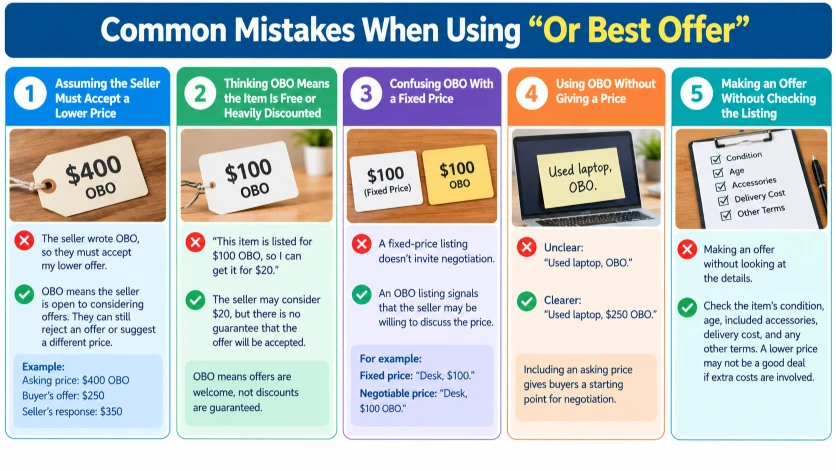
The phrase is simple, but buyers and sellers can misunderstand what it promises. These are the most common mistakes to avoid.
Mistake 1: Assuming the Seller Must Accept a Lower Price
Incorrect assumption: “The seller wrote OBO, so they must accept my lower offer.”
Correct understanding: OBO means the seller is open to considering offers. The seller can still reject an offer or suggest a different price.
Example:
- Asking price: $400 OBO
- Buyer’s offer: $250
- Seller’s response: “Thank you, but I can accept $350.”
The buyer can accept the counteroffer or walk away.
Mistake 2: Thinking OBO Means the Item Is Free or Heavily Discounted
Incorrect: “This item is listed for $100 OBO, so I can get it for $20.”
Correct: The seller may consider $20, but there is no guarantee that the offer will be accepted.
Memory tip: OBO means offers are welcome, not discounts are guaranteed.
Mistake 3: Confusing OBO With a Fixed Price
A fixed-price listing gives a stated price without necessarily inviting negotiation. An OBO listing signals that the seller may be willing to discuss the price.
For example:
- Fixed price: “Desk, $100.”
- Negotiable price: “Desk, $100 OBO.”
However, a seller with a fixed-price listing may still agree to negotiate privately. The wording alone does not determine every possible sales arrangement.
Mistake 4: Using OBO Without Giving a Price
Unclear: “Used laptop, OBO.”
Clearer: “Used laptop, $250 OBO.”
Including an asking price gives buyers a starting point for negotiation. If you have no fixed asking price, “Open to reasonable offers” may communicate your intention more clearly.
Mistake 5: Making an Offer Without Checking the Listing
Before making an offer, check the item’s condition, age, included accessories, delivery cost, and any other terms.
A lower price may not be a good deal if the item needs costly repairs or shipping adds a large expense.
Everyday Examples of “Or Best Offer”
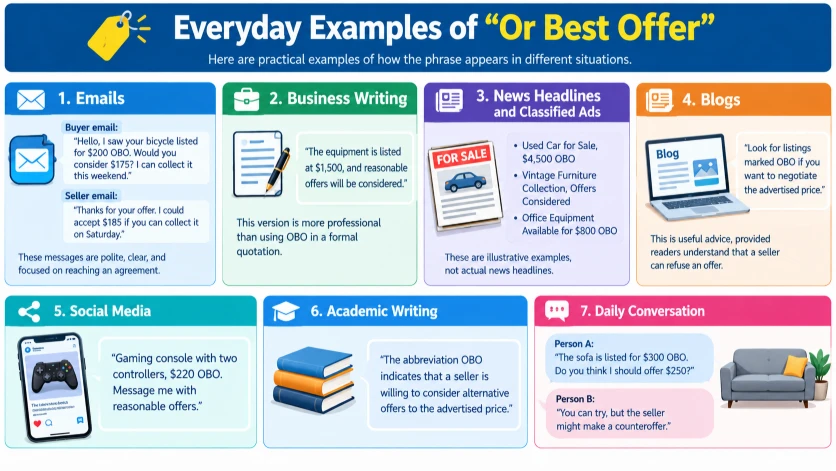
Here are practical examples of how the phrase appears in different situations.
1. Emails
Buyer email:
“Hello, I saw your bicycle listed for $200 OBO. Would you consider $175? I can collect it this weekend.”
Seller email:
“Thanks for your offer. I could accept $185 if you can collect it on Saturday.”
These messages are polite, clear, and focused on reaching an agreement.
2. Business Writing
A business might write:
“The equipment is listed at $1,500, and reasonable offers will be considered.”
This version is more professional than using OBO in a formal quotation.
3. News Headlines and Classified Ads
Examples of advertisement-style wording include:
- “Used Car for Sale, $4,500 OBO”
- “Vintage Furniture Collection, Offers Considered”
- “Office Equipment Available for $800 OBO”
These are illustrative examples, not actual news headlines.
4. Blogs
A blog about buying secondhand goods might say:
“Look for listings marked OBO if you want to negotiate the advertised price.”
This is useful advice, provided readers understand that a seller can refuse an offer.
5. Social Media
A person selling a used gaming console might post:
“Gaming console with two controllers, $220 OBO. Message me with reasonable offers.”
This wording gives potential buyers the price and explains how to respond.
6. Academic Writing
In a paper about online marketplaces, you could write:
“The abbreviation OBO indicates that a seller is willing to consider alternative offers to the advertised price.”
This describes the term without using it as casual shorthand.
7. Daily Conversation
Person A: “The sofa is listed for $300 OBO. Do you think I should offer $250?”
Person B: “You can try, but the seller might make a counteroffer.”
The exchange shows that OBO creates an opportunity to negotiate rather than a promise of a specific discount.
Google Trends and Modern Usage
People search for “or best offer” and “OBO” because they encounter the terms while shopping online, selling used goods, or negotiating prices.
Common questions include what OBO stands for, if it means the seller will accept less, and how much a buyer should offer.
Why Do People Search for “Or Best Offer”?
The phrase appears in several common situations:
- Buying used cars, furniture, electronics, or collectibles.
- Selling personal belongings through classified advertisements.
- Negotiating prices on online marketplaces.
- Understanding abbreviations in product listings.
- Learning how to make a polite offer.
The abbreviation can be confusing to first-time buyers because it does not state a minimum acceptable price.
Is OBO Becoming More Popular?
OBO remains a recognizable abbreviation in online selling. However, without a specific, verified Google Trends comparison, it would be misleading to claim that its popularity is increasing or decreasing.
Search interest can also vary by region and by the type of item being sold. A person searching for OBO may want a definition, while another may be looking for a way to negotiate a purchase.
How Can You Check Regional Search Interest?
You can compare search terms such as “or best offer,” “OBO meaning,” and “OBO price” using Google Trends at Google Trends.
Select a country and time period, then compare the available search-interest data. Remember that Trends reports relative search interest, not the exact number of searches.
Quick Comparison
| Version | Meaning | Correct? | Region | Example |
| Or best offer | Seller may consider other prices | Yes | Internationally understood | $100 or best offer |
| OBO | Abbreviation for or best offer | Yes | Especially North America | $100 OBO |
| O.N.O. | Or nearest offer | Yes | Commonly associated with British listings | £100 O.N.O. |
| Open to offers | Seller is willing to consider offers | Yes | International | Open to reasonable offers |
| Fixed price | Advertised price is stated without an explicit invitation to negotiate | Yes | International | $100 fixed price |
The main distinction is that “or best offer” and “open to offers” invite negotiation, while O.N.O. expresses a similar idea using different wording. A fixed-price listing does not explicitly invite negotiation.
Key Takeaways
- Or best offer means the seller may consider a different price.
- OBO stands for “or best offer.”
- OBO is widely used in North American sales listings.
- A seller can accept, reject, or counter a buyer’s offer.
- OBO does not guarantee a discount or a successful purchase.
- “Or nearest offer” and O.N.O. are alternative expressions associated with British listings.
- Use the full phrase when writing for an international audience.
- Check the item’s condition, additional costs, and sales terms before making an offer.
FAQs
1. How do you say “or best offer”?
“Or best offer” is pronounced as a normal English phrase. It means the seller is willing to consider other prices. In sales listings, it is often written as OBO.
2. What does “or best offer” really mean?
“Or best offer” means the seller may accept a price different from the advertised price. For example, “$200 or best offer” means the seller is asking $200 but may agree to a lower amount. The seller can still reject an offer or negotiate a different price.
3. What does OBO actually mean?
OBO stands for “or best offer.” It is commonly used in online marketplaces and classified ads. For example, “Used laptop, $300 OBO” means the seller is asking $300 but is open to considering other offers.
4. How do I abbreviate “or best offer”?
The standard abbreviation is OBO. You can use it in informal sales listings, advertisements, and marketplace posts.
Example: “Sofa for sale, $150 OBO.”
For formal business writing, spelling out “or best offer” or writing “reasonable offers will be considered” may be clearer.
5. How do I write a special offer?
Write a special offer by clearly stating the product or service, the discounted price, and any conditions or expiration date.
Example: “Special Offer: Get 20% off all items until November 15. Terms and conditions apply.”
Make sure the discount and deadline are accurate so customers understand the offer.
6. How do I ask for the best price?
Be polite and direct when asking a seller for a better price. You can ask, “What is the best price you can offer?” or “Would you consider a lower price?”
Example: “Hi, I’m interested in your bicycle listed for $200. Would you accept $175?”
A respectful, reasonable offer can help start a successful negotiation.
Conclusion
“Or best offer” is a useful phrase for anyone buying or selling goods. It means that the advertised price is open to discussion and that the seller may accept a different amount. The abbreviation OBO communicates the same idea in a short form commonly found in North American advertisements.
The most important thing to remember is that an invitation to negotiate is not a promise to lower the price. Buyers should make fair offers based on the item’s condition and market value, while sellers should set clear expectations about the amount they are willing to accept.
Regional wording can also matter. O.N.O. is a familiar alternative in British classified listings, while “open to offers” is a straightforward choice for international readers. In formal business writing, spelling out the terms is usually clearer than relying on abbreviations.
If you are listing a used phone, buying furniture, or negotiating the price of a car, understanding this phrase helps you communicate with confidence.
Remember: OBO opens the door to negotiation, but the final price depends on what both sides agree to. If you are buying or selling something, check the listing carefully and make your offer politely.
READ MORE!
- Congrats vs Congratulations: What’s the Difference?
- Mean or Median: What’s the Difference?
- Immigrated or Migrated: What’s the Difference?

I’m passionate about English grammar, vocabulary, and clear communication. I enjoy making English easier to understand through simple, practical, and easy-to-follow explanations. My goal is to help learners build confidence and improve their English for everyday use.