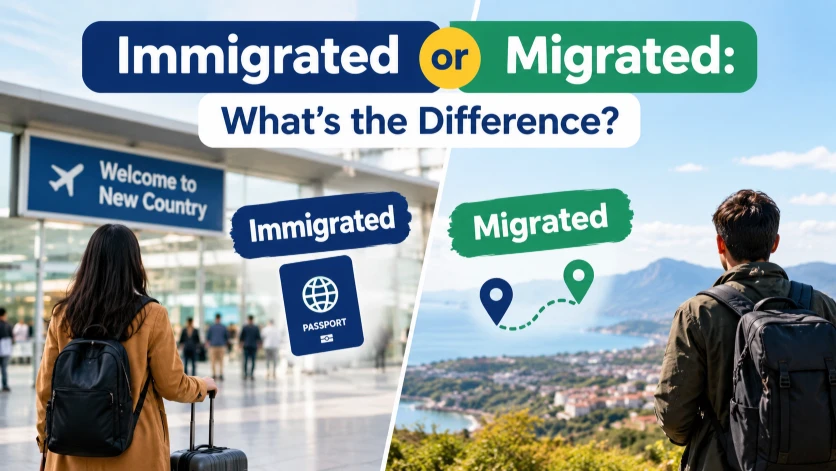
Have you ever wondered if to use immigrated or migrated when talking about moving to another country? Both words describe movement from one place to another, but they do not always mean the same thing. The main difference is that immigrated means moving into a country to live there, while migrated is a broader word for moving from one place to another.
For example, a family that moves from Pakistan to the United States to live there has immigrated to the United States. If birds move to a warmer region during winter, they have migrated. People can also migrate between countries, so the two words sometimes overlap.
This difference matters in everyday conversation, school assignments, news reports, immigration documents, and academic writing. Choosing the right word helps readers understand if you mean entering a country, leaving a country, or moving from one place to another.
In this guide, you will learn the meanings of immigrated and migrated, their origins, regional usage, common mistakes, and practical examples. You will also learn when to use each word in formal and informal writing.
Immigrated or Migrated: Quick Answer
Both immigrated and migrated are correct English words. The difference lies in their meaning and the movement they describe.
- Immigrated: Moved into another country to settle there.
- Migrated: Moved from one place to another, including within a country or across borders.
Examples:
- “My grandparents immigrated to the United States in 1985.”
- “Many families migrated from rural villages to large cities.”
- “The birds migrated south before winter.”
Use immigrated when you want to focus on entering a new country to live there. Use migrated when you want to describe movement more broadly.
Remember that immigrated describes a specific kind of migration. The words are related, but they are not always interchangeable.
What Does Immigrated Mean?
Immigrated is the past tense and past participle of the verb immigrate. It describes the act of moving into another country, usually to establish a new home or live there for an extended period.
The word focuses on the destination. It tells readers where someone moved to, rather than where that person left.
Examples of immigrated
- “She immigrated to Australia with her family.”
- “My parents immigrated to Canada for better career opportunities.”
- “The family had immigrated to the United States several years earlier.”
In each example, the person or family entered a new country to live there.
When should you use immigrated?
Use immigrated when:
- A person moves to a different country to live there.
- You want to emphasize arrival in a new country.
- You are discussing someone’s immigration history.
- You are writing about settlement in another country.
For example, if someone moves from Pakistan to the United Kingdom, you can say:
“She immigrated to the United Kingdom in 2020.”
You can also use immigrate in the present tense and immigrating for an ongoing process.
- Present: “They immigrate to Canada for work.”
- Past: “They immigrated to Canada last year.”
- Ongoing: “They are immigrating to Canada this summer.”
The exact wording should reflect the timing and circumstances of the move.
What Does Migrated Mean?
Migrated is the past tense and past participle of migrate. It means moved from one place to another. The movement may involve people, animals, plants, cells, businesses, or digital information.
Unlike immigrated, migrated does not focus only on entering a new country. It can describe local movement, seasonal travel, or movement across national borders.
Examples of migrated
- “Many workers migrated from rural areas to cities.”
- “The geese migrated south for the winter.”
- “The company migrated its files to a new computer system.”
These examples describe three different types of movement: human relocation, animal movement, and a change in computer systems.
When should you use migrated?
Use migrated when:
- People move between regions or countries.
- Animals move seasonally to find food or suitable weather.
- Groups relocate to a different area.
- Data or software moves from one system to another.
- You want to describe movement without emphasizing immigration.
For example:
“Thousands of people migrated from rural areas to urban centers in search of work.”
This sentence is correct because it describes a broad movement of people. It does not need to specify that they entered a new country.
Can people migrate to another country?
Yes. People can migrate internationally as well as within their own country.
For example, “She migrated from India to Canada” is grammatically correct. However, “She immigrated to Canada” more clearly emphasizes her arrival and settlement there.
The best choice depends on what you want to communicate.
The Origin of Immigrated and Migrated
The two words share a common Latin root, which explains why their meanings overlap.
Origin of immigrated
Immigrated comes from immigrate, which traces back to the Latin verb immigrare. This Latin word means to move into or enter a place.
The prefix im- conveys the idea of moving into something, while migrare means to move from one place to another. The modern English word developed with a specific focus on entering a new country or place of residence.
Origin of migrated
Migrated comes from migrate, which also traces back to Latin migrare, meaning to move from one place to another.
Over time, migrate developed a broad range of uses. It came to describe human relocation, seasonal animal movement, and the transfer of things from one place or system to another.
Why are the words different?
English uses prefixes to add direction or other details to a word’s meaning.
Think of the difference this way:
- Migrate: Move from one place to another.
- Immigrate: Move into a new country to live there.
- Emigrate: Leave one’s country to settle elsewhere.
The shared root connects all three words, but their prefixes and conventional meanings help show different aspects of movement.
British English vs. American English
There is no major British-versus-American spelling difference between immigrated and migrated. Both forms are standard in British English and American English.
The main difference is meaning, not spelling. Writers in both regions use immigrated to emphasize entering a country and migrated for broader movement.
| British English | American English | Example |
| Immigrated | Immigrated | She immigrated to London. / She immigrated to New York. |
| Migrated | Migrated | The birds migrated south. |
| Emigrated | Emigrated | He emigrated from Britain. |
| Migration | Migration | Migration patterns changed over time. |
Regional usage and style guides
British and American dictionaries recognize the same basic distinction between immigrate and migrate. Regional spelling conventions do not change the standard spelling of these verbs.
In Canada, the federal government’s Language Portal also distinguishes immigration, emigration, and migration by the direction or nature of movement.
For publishing, follow the style guide required by your publication, school, or employer. A style guide may specify terminology for immigration-related reporting, but it does not make immigrated a British spelling and migrated an American spelling.
Which Version Should You Use?
Choose the word that matches the movement you want to describe. Your audience’s location matters less than the meaning of your sentence.
| Context | Recommended word | Example |
| United States | Immigrated for arrival in the country | She immigrated to the United States. |
| United Kingdom | Immigrated for arrival in the country | They immigrated to the UK. |
| Canada | Immigrated for arrival in the country | He immigrated to Canada. |
| Australia | Immigrated for arrival in the country | Her family immigrated to Australia. |
| International writing | Migrated for broad movement | Workers migrated across the region. |
| Academic writing | Depends on the subject and direction | The population migrated north. |
| Business writing | Migrated for system transfers | We migrated the database to a new platform. |
For the United States and United Kingdom
Use immigrated when discussing a person who entered the country to live there. Use migrated when describing movement between cities, regions, or countries in a broad sense.
For Canada and Australia
The same distinction applies. For example, “They immigrated to Australia” emphasizes their arrival, while “They migrated across Australia” describes movement within the country.
For international writing
Migrated can be useful when the movement is the main focus and the destination’s immigration status is not important.
However, avoid using it simply to sound more formal. Immigrated is more precise when the sentence specifically concerns settling in another country.
For academic and business writing
In academic work, choose terminology that matches the field. A study of animal behavior may discuss migration, while a study of international population movements may distinguish immigrants, emigrants, and migrants.
In technology and business, migrated is often the natural choice for moving files, databases, websites, or services between systems.
Common Mistakes With Immigrated and Migrated
Writers often confuse these words because both involve movement. The easiest way to avoid mistakes is to identify the direction and purpose of the move.
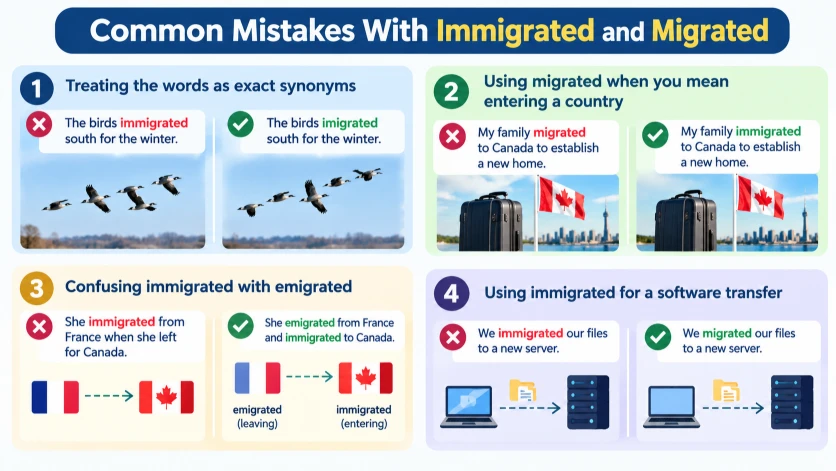
Mistake 1: Treating the words as exact synonyms
Incorrect: “The birds immigrated south for the winter.”
Correct: “The birds migrated south for the winter.”
Why? The sentence describes seasonal animal movement. Migrated is the natural word for this context.
Memory tip: Think of birds migrating with the seasons.
Mistake 2: Using migrated when you mean entering a country
Less precise: “My family migrated to Canada to establish a new home.”
Clearer: “My family immigrated to Canada to establish a new home.”
Why? Both sentences are grammatically correct, but immigrated more clearly emphasizes arrival in a new country to settle there.
Memory tip: If the destination country is the focus, consider immigrated.
Mistake 3: Confusing immigrated with emigrated
Incorrect: “She immigrated from France when she left for Canada.”
Clearer: “She emigrated from France and immigrated to Canada.”
Why? Emigrated focuses on leaving a country, while immigrated focuses on entering another country.
Memory tip: Emigrate means exit; immigrate means enter.
Mistake 4: Using immigrated for a software transfer
Incorrect: “We immigrated our files to a new server.”
Correct: “We migrated our files to a new server.”
Why? In computing, migrate describes moving data, applications, or systems between locations or platforms.
Memory tip: Files migrate between systems; people immigrate to countries.
Everyday Examples of Immigrated and Migrated
These examples show how each word works in common writing situations.
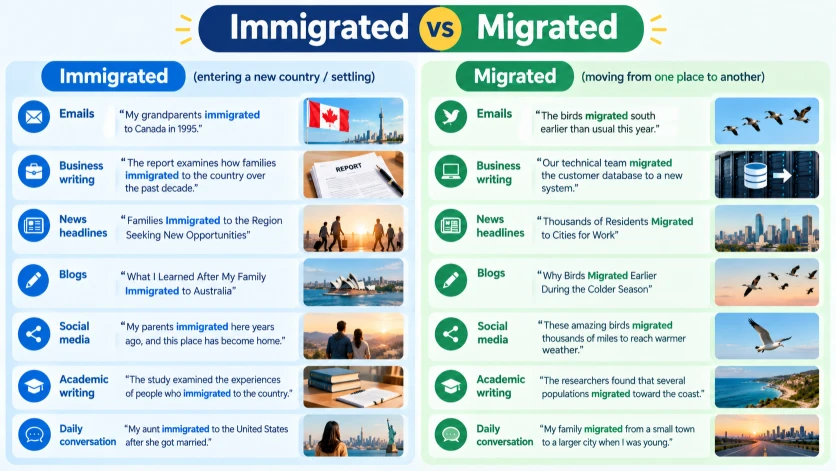
Emails
Immigrated: “My grandparents immigrated to Canada in 1995.”
Migrated: “The birds migrated south earlier than usual this year.”
Business writing
Immigrated: “The report examines how families immigrated to the country over the past decade.”
Migrated: “Our technical team migrated the customer database to a new system.”
News headlines
- Immigrated: “Families Immigrated to the Region Seeking New Opportunities”
- Migrated: “Thousands of Residents Migrated to Cities for Work”
Blogs
Immigrated: “What I Learned After My Family Immigrated to Australia”
Migrated: “Why Birds Migrated Earlier During the Colder Season”
Social media
Immigrated: “My parents immigrated here years ago, and this place has become home.”
Migrated: “These amazing birds migrated thousands of miles to reach warmer weather.”
Academic writing
Immigrated: “The study examined the experiences of people who immigrated to the country.”
Migrated: “The researchers found that several populations migrated toward the coast.”
Daily conversation
Immigrated:
“My aunt immigrated to the United States after she got married.”
Migrated:
“My family migrated from a small town to a larger city when I was young.”
The examples show that both words can describe human movement. The distinction becomes clearer when you consider if the sentence focuses on entering a country or moving more generally.
Google Trends and Modern Usage
People search for immigrated or migrated because the words share a meaning related to movement. They may also encounter both terms in news articles, history lessons, school assignments, immigration documents, and online discussions.
Which word is more popular?
There is no verified Google Trends comparison presented here, so it would be misleading to claim that one phrase has a specific search advantage over the other.
Search interest also depends on the exact query. Someone researching immigration history may search for immigrated, while a student studying animal behavior may search for migrated.
Why do people confuse these words?
Three common reasons explain the confusion:
- Both words share the root migrate.
- Both can describe people moving between countries.
- Their meanings overlap, but they emphasize different aspects of movement.
How should you use them in modern writing?
Use immigrated when the destination country and settlement are central to your sentence. Use migrated when describing movement more broadly, including movement within a country, seasonal travel, or digital transfers.
For accurate research, use Google Trends to compare search interest for specific terms, locations, and time periods. Remember that Trends reports relative search interest, not the total number of searches or proof that one word is grammatically better.
Quick Comparison
| Version | Meaning | Correct? | Typical context | Example |
| Immigrated | Entered another country to live there | Yes | International settlement | She immigrated to Canada. |
| Migrated | Moved from one place to another | Yes | People, animals, data | The birds migrated south. |
| Emigrated | Left a country to settle elsewhere | Yes | Departure from a country | He emigrated from India. |
| Immigration | The process of entering a country to live there | Yes | Population movement | Immigration increased that year. |
| Migration | Movement between places | Yes | Human, animal, or other movement | Seasonal migration began early. |
Key Takeaways
- Immigrated means moved into another country to live there.
- Migrated means moved from one place to another, within or across national borders.
- Both words are correct in British and American English.
- Use immigrated to emphasize arrival in a new country.
- Use migrated for broad movement, seasonal travel, or data transfers.
- Emigrated means left a country to settle elsewhere.
- The right word depends on the context, not a regional spelling rule.
Frequently Asked Questions
Is immigrated or migrated correct?
Both are correct, but they have different uses. Immigrated describes moving into another country to live there. Migrated describes moving from one place to another and can refer to people, animals, or data. Choose the word that best expresses the type of movement in your sentence.
What is the difference between immigrated and migrated?
Immigrated focuses on entering a country to settle there. Migrated is broader and can describe movement within a country, between countries, or between locations for seasonal, economic, or other reasons. For example, a family may immigrate to Canada, while birds migrate south for winter.
Can I say someone migrated to another country?
Yes. The sentence “She migrated to Canada” is grammatically correct. However, “She immigrated to Canada” more specifically emphasizes entering the country to live there. Use migrated when the broader movement is the main point, and immigrated when settlement in the destination country is important.
Is immigrated the opposite of emigrated?
They describe opposite perspectives on international movement. Immigrated means entered another country to live there, while emigrated means left one’s country to settle elsewhere. A person who moves from India to Australia may have emigrated from India and immigrated to Australia.
Is migrated used for animals?
Yes. Migrated is commonly used for animals that move from one region to another, often because of seasonal changes, food supplies, or breeding needs. For example, “The geese migrated south for the winter” is correct. Immigrated is not the natural choice for this type of animal movement.
Is immigrated used in British English?
Yes. Immigrated is standard in British English and American English. There is no spelling difference between the two varieties for this word. The same applies to migrated. The main distinction is meaning, not regional spelling.
Can migrated and immigrated be used interchangeably?
Sometimes, but not always. Both can describe people moving to another country, although immigrated emphasizes entering the destination country to settle. Migrated also describes movement within a country, seasonal animal travel, and transfers between computer systems, where immigrated would be inappropriate.
What is the difference between immigrant and migrant?
An immigrant is someone who moves into another country to live there. A migrant is a broader term for someone who moves from one place to another. The exact meaning of these labels can vary by legal, policy, and research context, so formal writing should follow the relevant definitions.
Should I use migrated or immigrated in academic writing?
Use the word that fits your research topic. Immigrated is useful when discussing people who entered a country to settle. Migrated works for broader population movements, regional relocation, animal behavior, and other forms of movement. Define specialized terms when your research depends on a particular meaning.
Conclusion
Choosing between immigrated and migrated becomes easy once you understand what each word emphasizes. Both words describe movement, but they serve different purposes in English.
Use immigrated when someone moves into another country to live there. For example, “My family immigrated to Canada in 2010” clearly identifies the destination and the family’s move to a new country.
Use migrated when describing movement more generally. It works for people moving between cities, birds traveling with the seasons, and files transferring from one computer system to another. When you want to emphasize leaving a country, emigrated may be the more precise choice.
These distinctions apply to both British and American English. You do not need to memorize different regional spellings. Instead, focus on the direction, purpose, and context of the movement.
If you are unsure which word to choose, ask yourself what the sentence needs to emphasize: entering a new country or moving from one place to another.
Remember: People immigrate into countries, emigrate from countries, and migrate from place to place. Explore our other commonly confused words guides to improve your English vocabulary and writing.
READ MORE!
- Or Is It? Meaning, Usage, and Examples
- Yay or Neigh: What’s the Difference?
- 380 or 9mm: What’s the Difference?

I’m passionate about English grammar, vocabulary, and clear communication. I enjoy making English easier to understand through simple, practical, and easy-to-follow explanations. My goal is to help learners build confidence and improve their English for everyday use.







1 thought on “Immigrated or Migrated: What’s the Difference?”