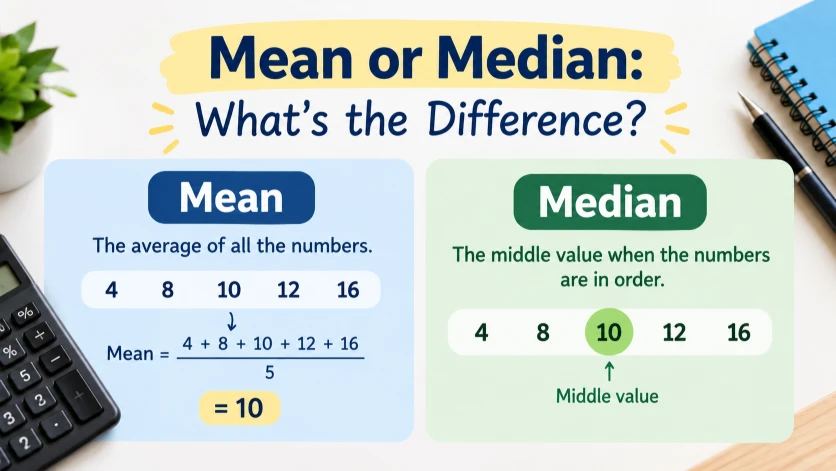
Mean or median: which one should you use when you want to find the average of a group of numbers? Both are ways to describe the center of a data set, but they work in different ways. The mean is the sum of all values divided by the number of values, while the median is the middle value when the numbers are arranged in order.
For example, consider these numbers: 2, 4, 6, 8, and 10. The mean is 6, and the median is also 6. Both measures give the same result in this case.
Now imagine that one number changes from 10 to 100. The mean rises sharply, but the median stays at 6. This shows why choosing the right measure matters.
Students, teachers, researchers, business owners, and anyone who works with data may need to understand the difference between mean and median. The right choice can help you describe test scores, salaries, house prices, sales, and other information more clearly.
In this guide, you will learn how to calculate both measures, when to use each one, common mistakes to avoid, and how they differ in real-life situations.
Mean or Median: Quick Answer
Use the mean when you want to include every value in a calculation and the data has no extreme outliers that would distort the result. Use the median when you want to identify the middle of a data set, especially when some values are much higher or lower than the rest.
For example:
- Mean: The average of 4, 6, and 8 is 6.
- Median: The middle number in 3, 7, and 9 is 7.
- With an outlier: In 2, 4, 6, 8, and 100, the mean is 24, but the median is 6.
The best choice depends on the data and the question you want to answer.
What Does Mean or Median Mean?
Mean and median are both measures of central tendency. This is a term for numbers that describe the center of a data set.
However, each measure finds the center differently.
What Is the Mean?
The mean, often called the arithmetic mean or average, is calculated by adding all the values and dividing the sum by the number of values.
Formula:
Mean=SumofallvaluesNumberofvalues
For example, imagine that a student receives these five test scores:
70, 75, 80, 85, 90
First, add the scores:
70 + 75 + 80 + 85 + 90 = 400
Next, divide the total by five:
400 ÷ 5 = 80
The mean test score is 80.
The mean uses every value in the data set. That makes it useful for many calculations, but it also means that very high or very low values can change the result.
What Is the Median?
The median is the middle value in a data set after the numbers have been arranged from smallest to largest.
Consider these test scores:
70, 75, 80, 85, 90
The middle value is 80, so the median is 80.
When a data set contains an even number of values, there are two middle numbers. Add those two numbers and divide by two to find the median.
For example:
60, 70, 80, 90
The two middle numbers are 70 and 80.
Median=70+802=75
The median is 75.
Unlike the mean, the median does not depend on how far the other values are from the middle. This makes it helpful when the data includes extreme values.
The Origin of Mean and Median
The words mean and median have different histories, although both are now common in mathematics and statistics.
Where Does Mean Come From?
The word mean comes through Old French and Latin, with roots connected to the idea of something intermediate or in the middle. In mathematics, the word has long been used for a value that represents a group of numbers.
Today, the arithmetic mean is one of the most widely used measures in mathematics, science, education, and business.
It is important to remember that mean has other meanings in everyday English. It can describe intention, unkind behavior, or significance. In statistics, however, it refers to a calculated measure of central tendency.
Where Does Median Come From?
The word median comes from Latin medianus, meaning “in the middle.” Its mathematical meaning reflects this idea: the median identifies the central position in an ordered set of values.
For example, if the numbers are 1, 5, 9, 12, and 20, the median is 9 because it occupies the middle position.
The statistical meaning of median developed as a way to describe the center of data without relying on the size of every value.
Why Are Mean and Median Different?
Their names reflect two different methods of finding a typical value.
- The mean uses arithmetic to combine every value.
- The median uses the position of values after sorting them.
Neither measure is automatically better. Each answers a different question about the data.
British English vs American English
Mean and median have the same mathematical meanings in British English and American English. Unlike spelling pairs such as colour and color, these terms do not have separate British and American spellings.
| British English | American English | Example |
| Mean | Mean | The mean score is 80. |
| Median | Median | The median score is 75. |
| Arithmetic mean | Arithmetic mean | Calculate the arithmetic mean of the results. |
| Median value | Median value | Find the median value of the data. |
Do Style Guides Use Different Definitions?
No. The basic definitions and calculation methods are the same in both regions.
British and American textbooks may differ in wording, notation, or how they present a lesson. However, these differences do not change the underlying mathematics.
When writing for an international audience, define the terms clearly and show a simple example. Readers can then follow the explanation regardless of their location.
Which Version Should You Use?
You do not need to choose between a British and an American version of mean or median. Instead, choose the measure that best describes your data.
| Situation | Recommended measure | Why |
| United States | Mean or median | Both terms are standard in US mathematics. |
| United Kingdom | Mean or median | Both terms are standard in UK mathematics. |
| Canada | Mean or median | Use the measure that fits the data. |
| Australia | Mean or median | Both are accepted statistical terms. |
| International writing | Explain both | This helps readers understand the difference. |
| Academic writing | Choose based on the data | Report the method used and explain why. |
| Business writing | Mean or median | Match the measure to the business question. |
For academic reports, state which measure you used and, when useful, why you chose it. In business reports, the median may describe a typical customer or home price more fairly when a few values are unusually large. The mean may be more useful for calculating totals, budgets, or average output per worker.
The key is not regional preference. It is if the measure gives readers a useful picture of the data.
Common Mistakes When Using Mean and Median
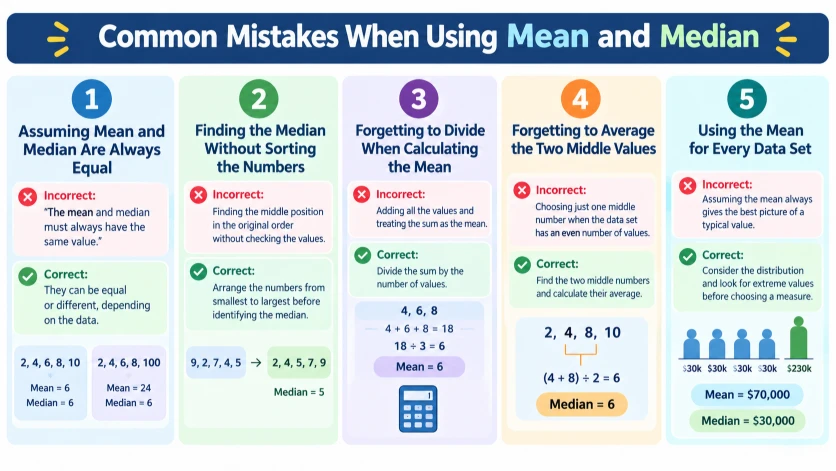
Mean and median are easy to confuse when both are described as averages. These mistakes can lead to incorrect calculations or misleading conclusions.
Mistake 1: Assuming Mean and Median Are Always Equal
Incorrect: “The mean and median must always have the same value.”
Correct: The mean and median can be equal or different, depending on the data.
For the numbers 2, 4, 6, 8, and 10, both measures equal 6. But for 2, 4, 6, 8, and 100, the mean is 24 while the median is 6.
Memory tip: The mean uses the values. The median finds the middle.
Mistake 2: Finding the Median Without Sorting the Numbers
Incorrect: Finding the middle position in the original order without checking the values.
Correct: Arrange the numbers from smallest to largest before identifying the median.
For example, consider 9, 2, 7, 4, 5. After sorting, the numbers become 2, 4, 5, 7, 9. The median is 5.
Memory tip: Sort first, then find the middle.
Mistake 3: Forgetting to Divide When Calculating the Mean
Incorrect: Adding all the values and treating the sum as the mean.
Correct: Divide the sum by the number of values.
For 4, 6, and 8, the sum is 18. Divide 18 by 3 to get a mean of 6.
Memory tip: Mean means add and divide.
Mistake 4: Forgetting to Average the Two Middle Values
Incorrect: Choosing just one middle number when the data set has an even number of values.
Correct: Find the two middle numbers and calculate their average.
For 2, 4, 8, and 10, the middle values are 4 and 8. The median is (4 + 8) ÷ 2 = 6.
Memory tip: An even count means two middle values.
Mistake 5: Using the Mean for Every Data Set
Incorrect: Assuming the mean always gives the best picture of a typical value.
Correct: Consider the distribution and look for extreme values before choosing a measure.
If four people earn $30,000 a year and one earns $230,000, the mean salary is $70,000. The median is $30,000, which better represents the earnings of most people in this small group.
Memory tip: When extreme values pull the average, check the median.
Everyday Examples of Mean and Median
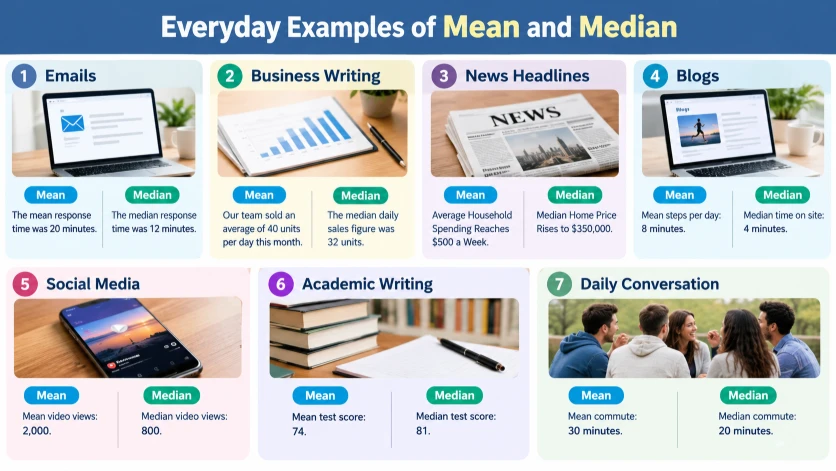
Mean and median appear in everyday decisions, from checking school results to comparing prices. These examples show how the choice of measure changes the story the data tells.
1. Emails
Mean example:
“After reviewing our five weekly response times, the mean was 20 minutes.”
This describes the arithmetic average across the five observations.
Median example:
“The median response time was 12 minutes, so half our recorded response times were at or below 12 minutes and half were at or above it.”
This describes the middle response time, not the arithmetic average.
2. Business Writing
Mean example:
“Our team sold an average of 40 units per day this month.”
If this figure comes from the arithmetic mean, it represents total units sold divided by the number of days measured.
Median example:
“The median daily sales figure was 32 units, despite several unusually busy days.”
The median can help managers understand a more typical day when sales vary widely.
3. News Headlines
A headline might say:
- Mean: “Average Household Spending Reaches $500 a Week.”
- Median: “Median Home Price Rises to $350,000.”
The first headline may report the arithmetic average of household spending. The second reports the middle home price in the relevant data set.
Always check the source’s definition of average. News reports sometimes use the word without immediately explaining which measure they mean.
4. Blogs
A blog about fitness might report the mean number of steps taken by participants each day. Another blog might use the median to describe the typical time readers spend on a website.
For example, website visits of 2, 3, 4, 5, and 26 minutes have a mean of 8 minutes and a median of 4 minutes.
The unusually long visit raises the mean, while the median remains closer to most of the observed times.
5. Social Media
A creator might write:
- “My mean video views over five posts were 2,000.”
- “My median video views were 800.”
Both figures can be correct. One viral video may raise the mean considerably, while the median shows the middle result among the five posts.
This is why comparing social media performance using only the mean can give an incomplete picture.
6. Academic Writing
A researcher may report both the mean and median test scores to describe student performance.
For example, the mean score might be 74, while the median is 81. This difference could indicate that some low scores are pulling the mean downward.
Researchers should also consider sample size, data distribution, and other relevant statistics before drawing conclusions.
7. Daily Conversation
Imagine five friends discussing how long their commute takes:
10, 15, 20, 25, and 80 minutes.
The mean commute is 30 minutes. The median is 20 minutes.
You might say, “The average commute is 30 minutes,” if you mean the arithmetic mean. But if you want to describe the middle commute, say, “The median commute is 20 minutes.”
The exact term matters because the two figures tell different stories.
Google Trends and Modern Usage
People search for “mean or median” for several reasons. Students may want help with homework, teachers may need clear examples, and professionals may want to choose the right statistic for a report.
Other common searches include:
- Mean vs. median difference
- How to calculate the mean
- How to find the median
- Mean or median for skewed data
- When to use mean or median
- Mean, median, and mode explained
These queries reflect a common learning need: understanding not only how to calculate each measure but also when to use it.
Which Term Is More Popular?
Mean and median are both established mathematical terms used in education, research, and everyday data analysis. Their relative search popularity can vary by country, time period, and the wording of a search.
Without a specific, verified Google Trends comparison, it would be misleading to claim that one term receives more searches than the other. Google Trends also reports relative search interest rather than a direct count of all searches.
For a website targeting this topic, useful content should explain the difference, demonstrate both calculations, and answer questions about outliers and real-world applications. These are practical ways to address the reader’s likely intent without relying on unsupported popularity claims.
Quick Comparison
| Version | Meaning | Correct? | Region | Example |
| Mean | Sum divided by number of values | Yes | Worldwide | Mean of 2, 4, 6 is 4. |
| Median | Middle value in ordered data | Yes | Worldwide | Median of 2, 4, 6 is 4. |
| Arithmetic mean | Another name for the usual calculated mean | Yes | Worldwide | Mean of 3, 6, 9 is 6. |
| Median of an even-sized set | Average of the two middle values | Yes | Worldwide | Median of 2, 6, 8, 12 is 7. |
| Mean as a general average | A common but sometimes vague description | Depends on context | Worldwide | Clarify if the reported average is the mean or median. |
Key Takeaways
- The mean is the sum of all values divided by the number of values.
- The median is the middle value after sorting the data.
- For an even number of values, calculate the median by averaging the two middle numbers.
- Extreme values can pull the mean up or down.
- The median is often useful for skewed data, such as salaries and home prices.
- The mean is useful when you need an arithmetic average that includes every observation.
- Mean and median have the same mathematical meanings in British and American English.
- Choose the measure that best answers your question, and explain it clearly when reporting results.
FAQs
1. What is the main difference between mean and median?
The mean is calculated by adding all the values and dividing by the number of values. The median is the middle value after the numbers are arranged in order. The mean responds to changes in every observation, while the median depends on the middle position. As a result, extreme values can affect the mean much more than the median.
2. Is the mean or median better?
Neither is always better. The mean is useful when you want an arithmetic average and the data does not contain extreme values that distort the result. The median is often better when the data is skewed or contains outliers. For a fuller picture, you can report both measures and explain why they differ.
3. When should I use the median instead of the mean?
Use the median when a few unusually high or low values may distort the mean. For example, median home prices can help describe the middle of a housing market where a small number of luxury homes raise the arithmetic average. The median is also useful for skewed income data and other uneven distributions.
4. Can the mean and median be the same?
Yes. The mean and median can have the same value, especially in data that is balanced around its center. For the numbers 2, 4, 6, 8, and 10, both equal 6. However, they do not have to match. Different data sets can produce different means and medians, even when both describe the same group.
5. How do you calculate the mean?
Add every number in the data set, then divide the sum by the total number of values. For example, the mean of 5, 10, and 15 is (5 + 10 + 15) ÷ 3, which equals 10. Remember to count every value, including repeated values, when calculating the mean.
6. How do you find the median with an even number of values?
Arrange the values from smallest to largest, identify the two middle numbers, add them, and divide by two. For example, in 3, 5, 9, and 13, the middle values are 5 and 9. Their average is 7, so the median is 7, even though 7 is not in the original data set.
7. Why is the median useful for salaries and house prices?
Salaries and house prices often have uneven distributions. A few very high salaries or expensive homes can raise the mean above the value experienced by many people. The median is less affected by those extremes, so it can provide a useful picture of the middle observation. It does not, however, describe every person’s situation.
8. What is the difference between mean, median, and mode?
The mean is the arithmetic average, the median is the middle value, and the mode is the value that occurs most often. For 2, 3, 3, 4, and 8, the mean is 4, the median is 3, and the mode is 3. Each measure describes a different feature of the data.
9. Do mean and median have different meanings in British and American English?
No. Mean and median have the same mathematical definitions in both British and American English. There is no regional spelling difference between these terms. Textbooks may present calculations or examples differently, but the core concepts remain the same. You can use either term in academic, business, and everyday writing in both regions.
10. Can the median be a number that does not appear in the data?
Yes. When a data set has an even number of values, the median is the average of its two middle values. For example, the median of 2, 4, 8, and 10 is 6. Although 6 does not appear in the data, it is still the correct median because it lies halfway between the two middle numbers.
Conclusion
Understanding mean or median helps you choose the right way to describe a set of numbers. Both measures identify the center of a data set, but they do so in different ways. The mean adds all values and divides by the number of observations. The median identifies the middle value after the data is sorted.
Use the mean when you want an arithmetic average and every observation should contribute to the result. Use the median when extreme values may distort the average or when you want to describe the middle observation. For salaries, house prices, and other uneven data, the median can offer a more useful picture of a typical value.
Remember that neither measure is always the best choice. Your decision should depend on the shape of the data and the question you want to answer. In some cases, reporting both the mean and median gives readers a clearer understanding of the results.
The same rules apply in British, American, and international English. You do not need to change the terms based on your audience’s location.
The easiest rule to remember is this: the mean calculates the average, while the median finds the middle. Try calculating both for your next data set to see how they compare.
READ MORE!
- Or Is It? Meaning, Usage, and Examples
- Yay or Neigh: What’s the Difference?
- 380 or 9mm: What’s the Difference?

I’m passionate about English grammar, vocabulary, and clear communication. I enjoy making English easier to understand through simple, practical, and easy-to-follow explanations. My goal is to help learners build confidence and improve their English for everyday use.







1 thought on “Mean or Median: What’s the Difference?”