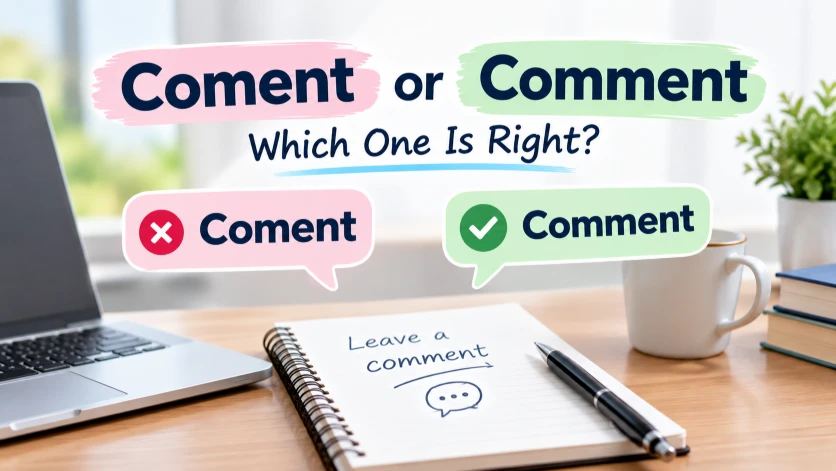
Comment is the correct standard spelling, while coment is a common misspelling that you should avoid in formal and everyday English.
People often search for “coment or comment” because the word is easy to spell incorrectly, especially when typing quickly. The confusion comes from the single m sound in pronunciation, while the correct spelling uses double m.
The word comment is very common in English. You use it when you want to give an opinion, make a short statement, or discuss something. For example, you can comment on a post, make a comment, or leave a comment.
Learning the correct spelling is useful for emails, schoolwork, social media, business writing, and other forms of communication. Once you remember that comment has two m’s, the spelling becomes much easier.
Coment or Comment: Quick Answer
Comment is correct. Coment is incorrect in standard English.
- ❌ Coment
- ✅ Comment
Examples
- Please leave a comment below.
- She made a helpful comment.
- I want to comment on your idea.
- He commented on the news.
Easy rule: Remember com + ment = comment, with two m’s.
Definition and Meaning of Coment or Comment
Comment
Comment is a noun and a verb.
As a noun, it means a spoken or written opinion, remark, or statement about something.
Examples:
- His comment was helpful.
- She made a funny comment.
- I read several comments online.
As a verb, comment means to give an opinion or say something about a topic.
Examples:
- She commented on the article.
- He refused to comment on the matter.
- Many people comment on social media posts.
Coment
Coment is not the standard spelling of the English word. In normal English writing, use comment instead.
If you see coment, it is usually a spelling mistake or typing error.
The Origin of Coment or Comment
The word comment comes from Latin commentari, meaning “to consider” or “to write notes.” It later entered English through French.
The spelling developed with double m, giving us the modern English form comment.
The spelling coment does not represent a standard British or American spelling. It usually appears because writers hear the word and spell it based on its sound.
English has many words where a consonant is doubled. Learning the correct spelling of common words like comment can help prevent similar mistakes.
British English vs American English Spelling
There is no British-American spelling difference for this word.
Both British English and American English use:
comment
| English Variety | Correct Spelling | Incorrect Form |
| British English | comment | coment |
| American English | comment | coment |
| Canadian English | comment | coment |
| Australian English | comment | coment |
| International English | comment | coment |
Examples in Both Varieties
British English:
I left a comment on the article.
American English:
I left a comment on the article.
The spelling remains the same.
Which Spelling Should You Use?
Use comment in all standard English writing.
For US English
Use comment in school, work, emails, websites, and social media.
For UK and Commonwealth English
Use comment as well. British English does not use coment as an alternative spelling.
For Global Audiences
Comment is the safest and correct choice because it is the standard spelling used across major forms of English.
For Formal Writing
Always write comment in:
- Academic papers
- Business emails
- Reports
- Articles
- Applications
- Professional documents
Common Mistakes with Coment or Comment
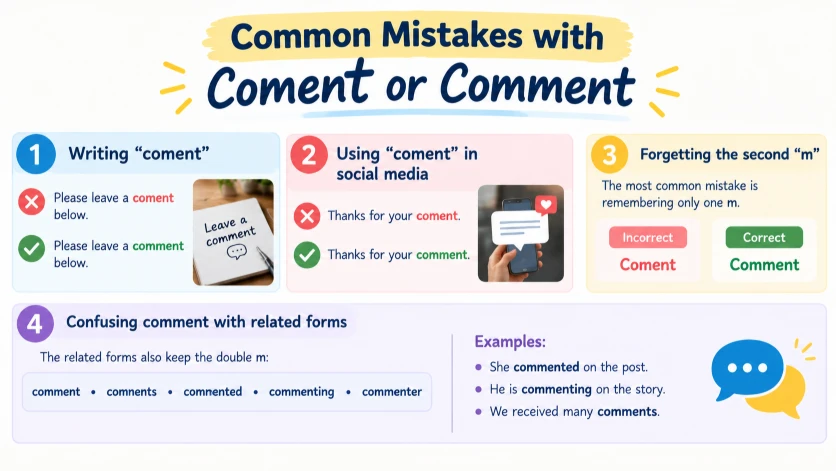
1. Writing “coment”
❌ Please leave a coment below.
✅ Please leave a comment below.
2. Using “coment” in social media
❌ Thanks for your coment.
✅ Thanks for your comment.
3. Forgetting the second “m”
The most common mistake is remembering only one m.
Correct: comment
Incorrect: coment
4. Confusing comment with related forms
The related forms also keep the double m:
- comment
- comments
- commented
- commenting
- commenter
Examples:
- She commented on the post.
- He is commenting on the story.
- We received many comments.
Coment or Comment in Everyday Examples
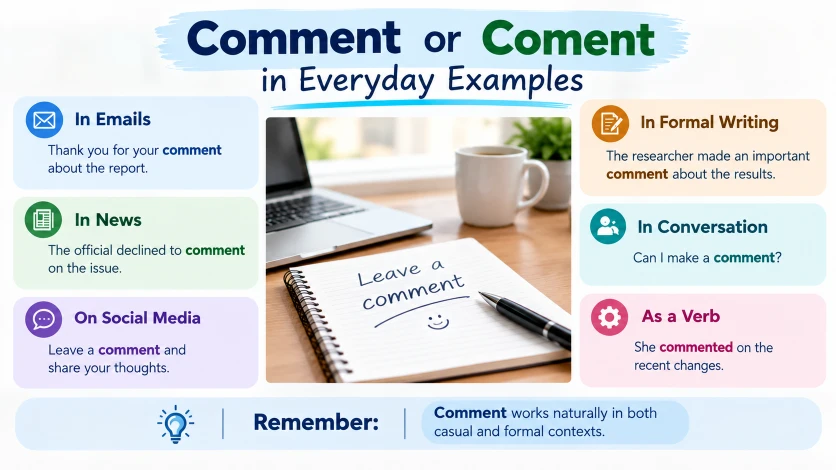
In Emails
Thank you for your comment about the report.
In News
The official declined to comment on the issue.
On Social Media
Leave a comment and share your thoughts.
In Formal Writing
The researcher made an important comment about the results.
In Conversation
Can I make a comment?
As a Verb
She commented on the recent changes.
These examples show why correct spelling matters. Comment works naturally in both casual and formal contexts.
Coment or Comment: Google Trends & Usage Data
Search interest for “coment or comment” usually comes from people checking the correct spelling of the word.
Comment is the standard English form and is widely used in:
- Social media
- Online discussions
- Blogs
- News articles
- Academic writing
- Business communication
- Everyday conversation
Search interest can vary by country, language background, and time. Google Trends uses normalized data rather than showing the total number of searches, so exact popularity can change depending on the selected country, date range, and search term.
For spelling purposes, the key point is simple: comment is the standard English spelling, while coment is generally a misspelling.
Coment vs Comment: Comparison
| Feature | Coment | Comment |
| Standard English | ❌ No | ✅ Yes |
| Correct spelling | ❌ | ✅ |
| Uses double “m” | ❌ | ✅ |
| Noun | ❌ | ✅ |
| Verb | ❌ | ✅ |
| Used in formal writing | ❌ | ✅ |
| Used in social media | ❌ | ✅ |
| British English | ❌ | ✅ |
| American English | ❌ | ✅ |
FAQs About Coment or Comment
What Is Meant by “Comment”?
A comment is a spoken or written opinion, observation, or response about something.
Which Is Correct: “Comment” or “Comment”?
Both are spelled comment; there is no spelling difference.
What Are Examples of Comments?
Examples include “Great job!”, “I agree with your point,” and “This article was helpful.”
How Do You Use a Comment?
Use a comment to express an opinion, give feedback, ask a question, or respond to something.
What Is a Comment Word?
A comment word is a word or phrase used to express an opinion or reaction, such as “excellent,” “interesting,” or “I agree.”
How Do You Start a Comment?
You can start with phrases like “I think…”, “In my opinion…”, “I agree…”, or “I noticed that…”.
Conclusion
Comment is the correct spelling, while coment is a common spelling mistake. The main rule is simple: always write comment with two m’s.
The word comment can work as both a noun and a verb. As a noun, it means an opinion, remark, or statement. As a verb, it means to give an opinion or discuss something. You can use it in emails, articles, news reports, academic writing, conversations, and social media.
There is also no difference between British and American spelling. Both varieties use comment. The same spelling applies in other major English varieties too.
If you often forget the spelling, remember com + ment = comment and focus on the double m. Avoid coment in professional and formal writing because it is not the standard English form.
In short, when choosing between coment or comment, always choose comment.
READ MORE!
- Handywork or Handiwork: Learn the Correct Spelling
- Twinning or Twining: What’s the Real Difference?
- Mens or Men’s: A Simple Guide to Correct Usage

I’m Edward Fletcher, a UK-based English language writer with a passion for grammar and vocabulary. At VocabNex, I share simple explanations, useful examples, and practical English tips to help learners improve their language skills and communicate with confidence.








1 thought on “Coment or Comment: Which One Is Right? ”