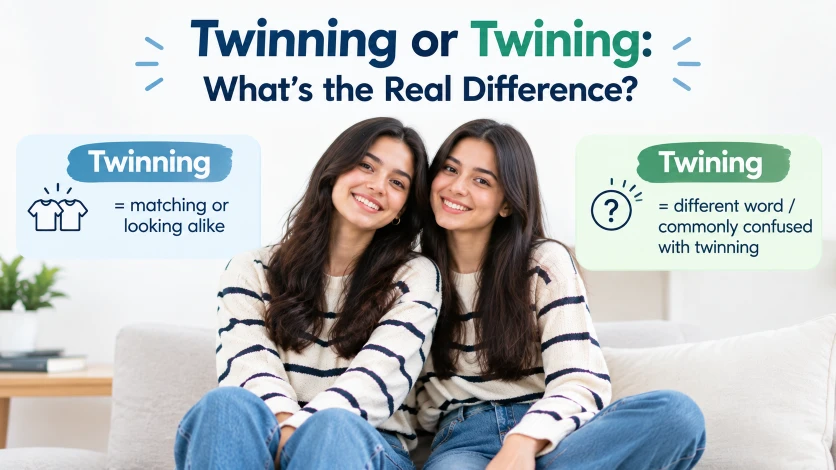
Twinning and twining are both correct English words, but they have different meanings and uses. Twinning usually relates to twins or two matching things, while twining means twisting or winding around something. This simple difference explains why people often confuse the two spellings.
The confusion often comes from the similar sound and spelling of these words. Both contain the letters t-w-i-n, but the extra n in twinning changes the word and its meaning. If you are writing about twins, matching outfits, or two things that look alike, twinning is usually the word you need. If you are describing vines, ropes, threads, or other things twisting around something, twining is correct.
In this guide, you will learn the meanings, origins, spelling rules, British and American usage, common mistakes, and practical examples of twinning or twining. By the end, choosing the right word should be easy.
Twinning or Twining : Quick Answer
Both twinning and twining are correct, but they describe different ideas.
- Twinning = relating to twins or two matching things.
- Twining = twisting, winding, or wrapping around something.
Examples
- The twins were twinning in matching shirts.
- The vines were twining around the tree.
- The two friends were twinning with similar outfits.
Easy rule:
Twinning = twins or matching.
Twining = twisting or winding.
Definition and Meaning of Twinning or Twining
What Does “Twinning” Mean?
Twinning is the present participle of twin. It can mean becoming a twin, producing twins, or being similar or matching with another person or thing.
In modern informal English, twinning is also common when two people wear similar clothes or have a very similar appearance.
For example:
The sisters are twinning today.
This means the sisters are dressed alike or have a matching style.
The word can also appear in scientific, medical, or technical contexts when discussing the formation or relationship of twins.
What Does “Twining” Mean?
Twining is the present participle of twine.
Twine means to twist or wind together, or to wrap around something.
For example:
The plant is twining around the fence.
Here, twining describes the plant’s twisting movement.
The word can describe:
- Plants winding around supports
- Hair twisting together
- Threads becoming intertwined
- Arms or branches wrapping around something
- Objects twisting around one another
The Main Difference
The easiest way to separate the words is to look at their base forms:
Twin → twinning
Twine → twining
The meanings are different because the base verbs are different.
The Origin of Twinning or Twining
The words twinning and twining come from different English words.
Origin of “Twin”
The noun twin comes from Old English twinn, meaning double or twofold. It is related to the idea of two people or things occurring together.
Over time, twin became the normal English word for one of two children born during the same pregnancy.
The verb twin later developed meanings connected with pairing or joining two similar things.
Modern English also uses twinning beyond human twins. It can describe two things that closely match or are paired.
Origin of “Twine”
Twine has a different history. It developed from words connected with twisting or winding together.
The word is related to the idea of two strands being twisted together, which helps explain why twine and twin look somewhat similar.
Today, twine can refer both to a strong thread or cord and to the action of twisting or winding something.
Why Are the Spellings Different?
The spelling difference comes from the different base words:
- twin + ing = twinning
- twine + ing = twining
When twin takes -ing, the final consonant is doubled:
twin → twinning
When twine takes -ing, the silent e is removed:
twine → twining
This is a normal English spelling pattern.
British English vs American English Spelling
There is no major British-American spelling difference between twinning and twining.
Both British and American English use:
- twinning
- twining
The difference is based on meaning, not region.
| Meaning | British English | American English | Example |
| Matching like twins | twinning | twinning | They are twinning today. |
| Relating to twins | twinning | twinning | The study examines twinning. |
| Twisting or winding | twining | twining | The vine is twining around the pole. |
| Cord made from strands | twine | twine | He used twine to tie the package. |
Does British English Use “Twin” Differently?
No. The word twin and its related forms are standard in both varieties.
You may notice differences in vocabulary or style between British and American speakers, but twinning vs twining is not one of those spelling differences.
Which Spelling Should You Use?
Choosing the right word depends on what you mean, not where your readers live.
For US English
Use twinning when talking about twins or matching people and things.
Use twining when describing something twisting or winding around another object.
For UK and Commonwealth English
The same rule applies.
- Twins or matching → twinning
- Twisting or winding → twining
For Global Writing
Use the word that matches the meaning. Both forms are widely understood in standard English.
For Academic Writing
Be precise because the two words can describe very different ideas.
For example:
The researchers studied twinning in the population.
But:
The researchers observed vines twining around the support.
For Business and Professional Writing
Avoid choosing based only on how the word sounds. Check the meaning first.
If two products or brands are being paired, twinning may be appropriate. If cables or wires are being twisted together, twining may be appropriate.
Common Mistakes with Twinning or Twining
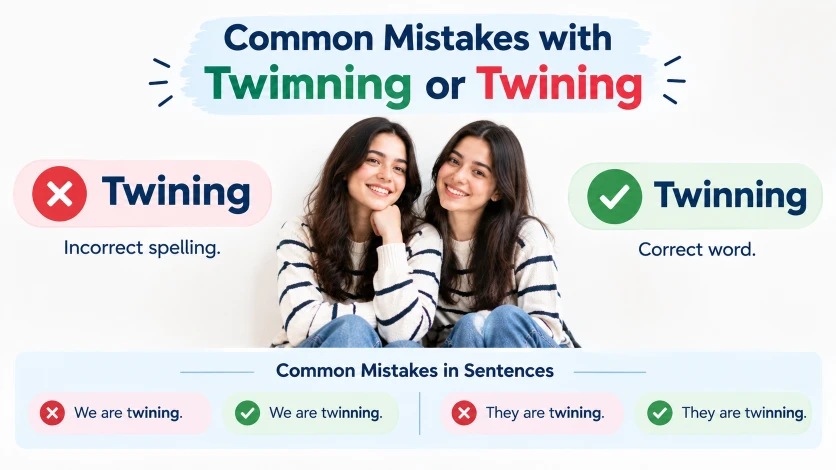
Mistake 1: Using “twining” for matching clothes
❌ The sisters are twining in matching dresses.
✅ The sisters are twinning in matching dresses.
Why? The sentence is about matching, not twisting.
Mistake 2: Using “twinning” for a climbing plant
❌ The vine is twinning around the tree.
✅ The vine is twining around the tree.
Why? The vine is winding around the tree.
Mistake 3: Forgetting the double “n”
❌ The twins are twining today.
✅ The twins are twinning today.
The double n helps you remember the connection with twin.
Mistake 4: Adding an extra “n” to twining
❌ The plant is twinning around the fence.
✅ The plant is twining around the fence.
Remember that twine loses its final e before -ing:
twine → twining
Memory Tip
Think:
Twin = two alike → twinning
Twine = twist → twining
This simple connection makes the spelling much easier to remember.
Twinning or Twining in Everyday Examples
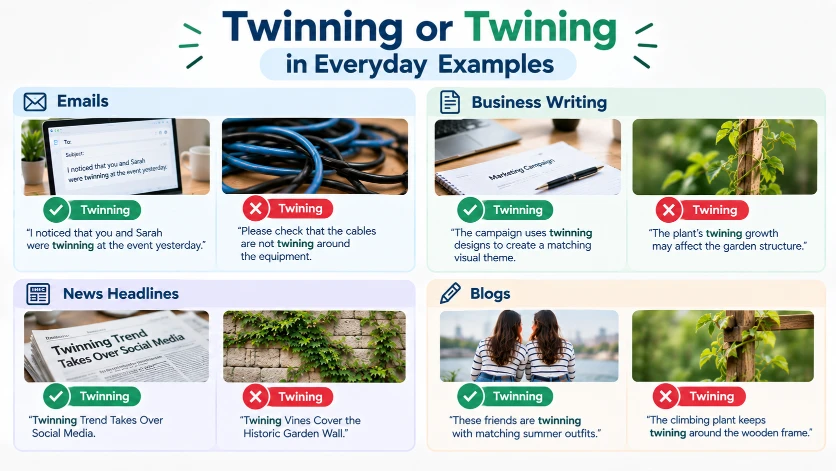
Emails
Twinning:
“I noticed that you and Sarah were twinning at the event yesterday.”
Twining:
“Please check that the cables are not twining around the equipment.”
Business Writing
Twinning:
“The campaign uses twinning designs to create a matching visual theme.”
Twining:
“The plant’s twining growth may affect the garden structure.”
News Headlines
Twinning:
“Twinning Trend Takes Over Social Media”
Twining:
“Twining Vines Cover the Historic Garden Wall”
Blogs
Twinning:
“These friends are twinning with matching summer outfits.”
Twining:
“The climbing plant keeps twining around the wooden frame.”
Social Media
Twinning:
“Twinning with my bestie today! 👯”
Twining:
“Look at these beautiful vines twining around the gate. 🌿”
On social media, twinning is especially common as informal slang for wearing similar clothes or looking alike.
Formal Writing
Twinning:
“The researchers examined patterns of twinning among the participants.”
Twining:
“The stems showed a natural tendency toward twining around nearby supports.”
Twinning or Twining : Google Trends & Usage Data
People searching “twinning or twining” are usually trying to understand which spelling fits a particular sentence. The words look similar, so spelling uncertainty is common.
Modern online usage has also increased interest in twinning because social media frequently uses the word to describe matching outfits, appearances, poses, or styles.
Twining appears more often in contexts involving plants, ropes, fibers, stems, and things that physically wind around one another.
Search interest can vary by country, language background, and context. Google Trends data also changes over time and is normalized rather than presented as an absolute count, so exact popularity figures should be checked for a specific country and date range before publication.
The key usage pattern remains clear:
Twinning → twins, pairs, matching
Twining → twisting, winding, wrapping
Quick Comparison
| Version | Meaning | Correct? | Main Context | Example |
| twinning | Matching or relating to twins | ✅ Yes | Twins, matching styles | We are twinning today. |
| twining | Twisting or winding around something | ✅ Yes | Plants, threads, objects | The vine is twining around the tree. |
| twinning | Same as twinning | ❌ Usually incorrect | Spelling mistake | Avoid this form. |
| twine | To twist or wind together | ✅ Yes | Cord, thread, movement | The stems twine together. |
FAQs About Twinning or Twining
What is the meaning of “twing”?
“Twing” is not a common standard English word. It may be a typo for “twining” or “twinning,” depending on the context.
What does “twinning” mean?
“Twinning” means being or looking very similar to someone, especially by wearing matching or similar clothes. It can also describe two people or things that closely resemble each other.
What is twinning in Gen Z?
In Gen Z usage, “twinning” commonly means matching with someone, such as wearing similar outfits, having the same style, or doing the same thing at the same time.
What is twining in a relationship?
“Twining” is not normally used as a relationship term. If someone uses it this way, they may mean growing or becoming closely connected, but the intended meaning depends on the context.
What does twining mean in slang?
“Twining” is not a widely established slang term. People may confuse it with “twinning,” which commonly means matching or being very similar.
What does “twinned” mean?
“Twinned” means matched, paired, or made similar to another person or thing. In casual use, it can describe two people who dress alike or look very similar.
Conclusion
Twinning and twining are both correct spellings, but they have completely different meanings. Use twinning when you are talking about twins, pairs, matching clothes, similar appearances, or things that are paired together. Use twining when you mean twisting, winding, or wrapping around something.
The spelling becomes easier when you remember the base words. Twin becomes twinning, with a double n. Twine becomes twining, with the final e removed before -ing.
There is no special British or American spelling rule that changes these words. Writers in both regions use twinning and twining according to meaning.
If you are unsure, ask yourself one simple question: Am I talking about twins or matching things, or am I talking about twisting? The answer will usually give you the correct spelling immediately.
Remember: Twin means two, so use twinning for matching; twine means twist, so use twining for winding.
READ MORE!
- Teady or Not: The Correct Phrase Explained
- Bagpack or Backpack: Which Spelling Is Correct?
- Pail or Pale: What’s the Difference?

I’m passionate about English grammar, vocabulary, and clear communication. I enjoy making English easier to understand through simple, practical, and easy-to-follow explanations. My goal is to help learners build confidence and improve their English for everyday use.








3 thoughts on “Twinning or Twining: What’s the Real Difference? ”