Kabob or kebab? Both spellings are correct, but the answer depends on where you are and which English style you follow. If you have seen kebab on a UK menu and kabob on a US menu, you may wonder if they are different foods. In most cases, they are not.
Both words describe dishes made by grilling or roasting meat, vegetables, or other foods. The spelling changes across countries and languages. Kebab is common in British English and many other parts of the world. Kabob is common in American English, especially when talking about food cooked on a skewer.
People search for “kabob or kebab” because they want to know which spelling is correct, if the two words mean different things, and which version they should use in writing. The confusion is easy to solve: both spellings are accepted, but “kebab” is the more widely used international form, while “kabob” is strongly associated with American English.
This guide explains the history, spelling, usage, search intent, and common mistakes so you can choose the right form with confidence.
Kabob or Kebab: Quick Answer
Kabob and kebab are spelling variants of the same broad food term.
- Kebab is the standard spelling in British English.
- Kabob is common in American English.
- Kebab is widely used internationally.
- Neither spelling is automatically wrong.
- Specific dishes may have their own traditional names and spellings.
For example:
We had chicken kebabs for dinner.
An American restaurant might write:
We had chicken kabobs for dinner.
Both sentences are understandable and correct in their respective usage contexts.
However, kebab can refer to a much wider range of dishes than the Western idea of meat and vegetables on a stick. Turkish, Middle Eastern, South Asian, and Central Asian cuisines use many different types of kebabs.
The Origin of Kabob or Kebab
The word kebab has a long history. English borrowed it through languages and cultures connected with the Middle East and the Ottoman world.
The English word kebab comes from Turkish kebap, which is related to Arabic kabāb. The word has been used for grilled or roasted meat dishes for centuries.
The spelling changed as the word moved between languages. English speakers encountered different transliterations of words written in Arabic, Persian, Turkish, and other writing systems. This helped create forms such as:
- kebab
- kabab
- kabob
- kebap
The spelling kabob is especially common in American English. Kebab is more common in British English and is also widely used internationally.
The spelling does not necessarily tell you how the dish is prepared. A kebab may be cooked on a skewer, grilled as pieces of meat, or prepared in another traditional style.
This is why it is useful to separate the word from the specific dish.
British English vs American English Spelling
The main difference is simple:
| English variety | Common spelling | Example |
| British English | kebab | Chicken kebab |
| American English | kabob | Chicken kabob |
| International English | kebab | Beef kebab |
| Turkish | kebap | Turkish kebap |
| Other transliterations | kabab | Shish kabab |
There is no rule that makes one spelling universally correct.
In British English, kebab is the normal spelling. The word is especially common in phrases such as doner kebab, shish kebab, and chicken kebab.
In American English, kabob is often used for food cooked on skewers, such as:
Chicken kabobs
Beef kabobs
Vegetable kabobs
There is also an important regional point. American English may use kebab when discussing a particular foreign or traditional dish. So even in the United States, both forms can appear.
Which Spelling Should You Use?
Your audience should guide your choice.
For a US audience
Use kabob when writing general American English:
We grilled chicken kabobs.
This spelling feels natural to many American readers.
For a UK audience
Use kebab:
We ordered chicken kebabs.
This is the standard British spelling.
For Commonwealth audiences
Kebab is generally the safer choice for international English. It is familiar in many countries and appears frequently in restaurant menus and food writing.
For a global audience
Use kebab unless you are referring to an American business, restaurant, recipe, or source that specifically uses kabob.
For , the best strategy is different. If your target keyword is “kabob or kebab,” use that exact phrase naturally in the title and headings. You can then use both forms throughout the article.
Common Mistakes with Kabob or Kebab
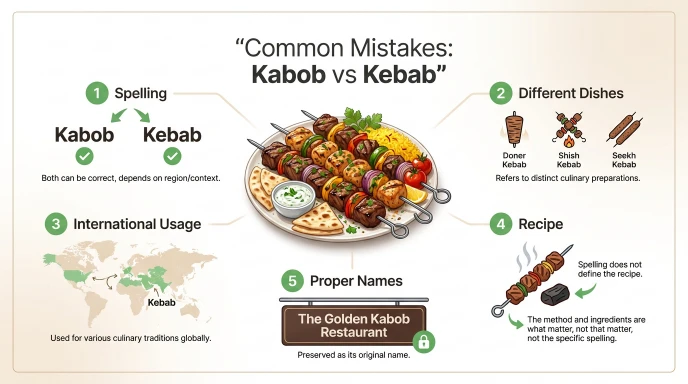
Mistake 1: Thinking one spelling is always wrong
Incorrect assumption:
“Kabob is misspelled.”
Better:
“Kabob is an accepted spelling, especially in American English.”
Mistake 2: Treating every kebab as the same dish
Kebab is a broad food category. Different countries have different kebab traditions.
For example, doner kebab, shish kebab, and seekh kebab are not simply the same dish with different names.
Mistake 3: Using “kabob” for every international dish
If you are writing about Turkish, British, Middle Eastern, or South Asian food, kebab may be the more appropriate spelling.
Mistake 4: Assuming spelling tells you the recipe
The spelling does not tell you exactly how the food is made.
A kabob in an American cookbook may mean meat and vegetables threaded onto a skewer. A kebab in another culinary tradition may be prepared in a very different way.
Mistake 5: Changing the spelling inside a proper name
If a restaurant, cookbook, or dish uses Kabob, keep its original spelling when referring to that specific name.
Kabob or Kebab in Everyday Examples
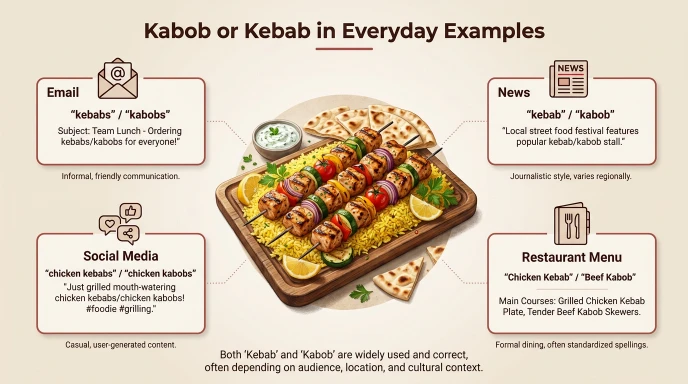
In an email
Hi Sarah,
Would you like to join us for kebabs on Friday evening?
For an American audience, you could write:
Would you like to join us for kabobs on Friday evening?
In news writing
A food article might say:
Kebab shops remain popular across Britain.
For an American publication, the same general idea might appear as:
Grilled chicken kabobs are popular at summer cookouts.
On social media
Nothing beats homemade chicken kebabs! 🔥
Or:
Summer grilling means chicken kabobs! 🌶️
Both forms work.
In formal writing
For a global audience:
Kebab is a broad term for a range of grilled and roasted dishes found across several culinary traditions.
For American-focused writing:
Kabob is a common American spelling for food cooked on skewers.
In a restaurant menu
You may see:
- Chicken kebab
- Shish kebab
- Seekh kebab
- Beef kabob
- Chicken kabob
- Vegetable kabobs
The menu’s chosen spelling usually reflects the restaurant’s location, culinary tradition, or branding.
Kabob or Kebab: Google Trends & Usage Data
Search interest for “kabob or kebab” comes from two types of users.
First, people are checking spelling. They want to know if kabob or kebab is correct.
Second, people are comparing regional food terms. They may have noticed that American websites use kabob, while British websites use kebab.
Search behavior generally follows regional English:
- United States: kabob has strong usage.
- United Kingdom: kebab is the dominant spelling.
- Australia and other Commonwealth markets: kebab is widely recognized.
- International food searches: kebab is usually the safer general term.
Google Trends results can change over time and can also be affected by local restaurants, recipes, news stories, and seasonal grilling interest. Exact search-volume comparisons should therefore be checked for a specific country and date range.
For , related searches can include:
- kabob or kebab
- kebab vs kabob
- is it kabob or kebab
- kabob spelling
- kebab spelling
- kabob meaning
- kebab meaning
- shish kebab or shish kabob
Using these related terms naturally can help an article answer several forms of the same search intent.
Kabob or Kebab: Comparison
| Variation | Where it is common | Meaning | Example |
| kebab | UK and international English | Broad food term | Chicken kebab |
| kabob | US English | Common American variant | Chicken kabob |
| kabab | Some transliterations | Variant spelling | Seekh kabab |
| kebap | Turkish | Turkish form | Turkish kebap |
| shish kebab | UK/international | Skewered grilled dish | Lamb shish kebab |
| shish kabob | US | American variant | Beef shish kabob |
The important point is that these spellings can overlap, but the exact meaning may depend on the culinary tradition.
FAQs About Kabob or Kebab
1. Is it kabob or kebab?
Both are correct spellings. Kebab is more common in British and international English, while kabob is common in American English.
2. Is kabob an American spelling?
Yes. Kabob is strongly associated with American English, although it can also appear elsewhere.
3. Is kebab the British spelling?
Yes. Kebab is the standard spelling in British English.
4. Are kabob and kebab the same food?
Not always. They are spelling variants of a broad food term, but different cultures use the word for different dishes.
5. Why do Americans say kabob?
Kabob developed as an English spelling variant and became established in American usage. It is especially common for meat and vegetables cooked on skewers.
6. Should I write kebab or kabob on a restaurant menu?
Use the spelling that fits your restaurant’s audience and culinary tradition. If the dish has a traditional name, keeping its established spelling can also be important.
Conclusion
So, kabob or kebab? The simple answer is that both spellings are correct, but they belong to different usage patterns. Kebab is the standard form in British English and is widely used around the world. Kabob is especially common in American English.
The difference is mainly about language history, regional preference, and culinary context. It does not mean that every kabob and kebab is exactly the same dish. Kebab is a broad term that covers many grilled and roasted foods from different culinary traditions.
If you write for readers in the United States, kabob may sound more natural. For British, Commonwealth, or global readers, kebab is usually the better choice. When discussing a traditional dish, restaurant, or brand, follow its established spelling.
For Content, you do not need to choose only one. Use “kabob or kebab” as your main comparison phrase, then include both variants naturally. This helps readers find the answer they want without making the article sound forced.
The key takeaway is easy: kebab is the broader international choice; kabob is a common American variant.
Read more about!
Teat or Teet: Which Spelling Is Correct?

I’m Edward Fletcher, a UK-based English language writer with a passion for grammar and vocabulary. At VocabNex, I share simple explanations, useful examples, and practical English tips to help learners improve their language skills and communicate with confidence.








2 thoughts on “Kabob or Kebab: Which Spelling Is Correct?”