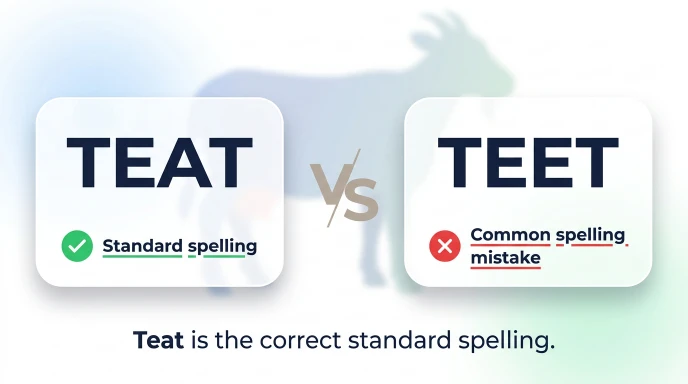
If you are wondering if the correct spelling is teat or teet, use teat in standard modern English. Teat is the established dictionary word for the nipple of a female mammal and can also refer to a feeding-bottle nipple, especially in British English.
The confusion is easy to understand because teat is pronounced like “teet” in many varieties of English. That makes teet look like a logical spelling, especially if you have only heard the word spoken.
In most everyday, academic, veterinary, agricultural, and professional writing, however, teat is the form you should choose. There is no standard US-versus-UK spelling change from teat to teet. The main issue is spelling, not regional English.
This guide explains what teat means, where the word comes from, how British and American English use it, when teet may appear, and how to avoid common mistakes.
Teat or Teet: The Quick Answer
Teat is the standard spelling in modern English. It refers to the nipple or milk outlet of a female mammal. It is also used for the nipple of a feeding bottle in British English and some other varieties of English.
Teet is not the normal spelling to use for this meaning. It can occur as a rare alternative or in regional usage, but it should not replace teat in standard professional writing.
Examples:
- Correct: The calf was feeding from its mother’s teat.
- Correct: The veterinarian examined the cow’s teats.
- British English: The baby needs a new bottle teat.
- Usually incorrect in standard writing: The calf was feeding from its mother’s teet.
The easiest rule
Use “teat” when you mean a mammal’s nipple or a bottle-feeding nipple.
What Does “Teat” Mean?
Teat is a noun used mainly for the nipple or projecting part of a mammary gland through which milk passes. It is especially common when discussing animals such as cows, goats, sheep, and pigs. Merriam-Webster defines it as the projection through which milk is drawn from an udder or breast.
For example:
- The farmer checked each cow’s teat before milking.
- The lamb found its mother’s teat.
- The veterinarian noticed swelling around the teat.
- The calf was unable to latch onto the teat properly.
The plural is teats.
The word also has a second practical meaning. In British English, a teat can mean the rubber or silicone nipple fitted to a baby bottle. Cambridge specifically lists this British usage and notes that American English generally uses nipple for the same object.
So context matters:
| Word | Meaning | Example |
| teat | Mammal’s nipple | The calf suckled from the cow’s teat. |
| teats | Plural of teat | The cow has four teats. |
| teat | Baby-bottle nipple in British English | Replace the bottle teat. |
| nipple | Common US term for a bottle-feeding part | Replace the bottle nipple. |
The Origin of “Teat”
The history of teat helps explain why its spelling does not simply follow its pronunciation.
Merriam-Webster traces the word to Middle English tete and teet, meaning the nipple or breast of a human or animal. Its etymology connects the word with Anglo-French and older Germanic forms. Merriam-Webster records its first known English use in the 12th century.
This is an important point: “teet” is not simply a modern typo that appeared from nowhere. Historical forms of the word included spellings resembling teet. Modern standard English settled on teat for the ordinary word.
That is why saying “teet has never existed in English” would be inaccurate. Rare and regional uses can be found, and some dictionaries or lexical resources record teet as an alternative spelling.
For modern readers, though, the practical rule remains simple:
Historical or rare form: teet
Standard modern form: teat
British English vs American English
Unlike words such as colour/color or centre/center, teat does not have a normal British-versus-American spelling difference.
Both British and American English use teat for the anatomical meaning. Cambridge gives teat as the standard word in both varieties.
The bigger difference is the bottle-feeding meaning.
| Meaning | British English | American English | Example |
| Mammal’s nipple | teat | teat | The cow’s teat was examined. |
| Baby-bottle nipple | teat | nipple | Replace the bottle nipple. |
| Plural | teats | teats | The veterinarian examined the teats. |
| Alternative spelling | teet, rare/nonstandard in ordinary use | teet, rare/nonstandard in ordinary use | Use teat in standard writing. |
So if you are writing for an international audience, teat is the safest choice when you mean the anatomical term.
What about pronunciation?
This is where much of the confusion begins.
Cambridge gives the pronunciation of teat as /tiːt/ in both British and American entries.
In simple terms, it sounds like “teet.”
That does not mean the spelling should be teet. English contains many words whose pronunciation does not make their spelling obvious.
Which Version Should You Use?
United States
Use teat for the anatomical term.
Example:
The veterinarian examined the cow’s teat.
For a baby bottle, nipple is usually the more natural American term. Cambridge specifically identifies nipple as the US equivalent of the British teat in this context.
United Kingdom
Use teat.
The word is common in agricultural and animal-care contexts. British English also uses teat for the soft nipple attached to a feeding bottle.
Canada
For formal Canadian English, teat is the safe standard choice for the mammalian anatomical term. For baby bottles, local preference may favor nipple depending on context.
Australia
Use teat for the mammalian anatomical meaning. In baby-feeding contexts, terminology can depend on the product and audience.
International writing
Choose teat when you mean the anatomical term.
It is clearer and more widely recognizable than the rare spelling teet.
Academic writing
Use teat.
This is especially important in biology, veterinary medicine, agriculture, animal science, and related fields.
Business and professional writing
Use the established term teat unless you are reproducing an exact name, quotation, historical spelling, or source title.
Common Mistakes With Teat and Teet
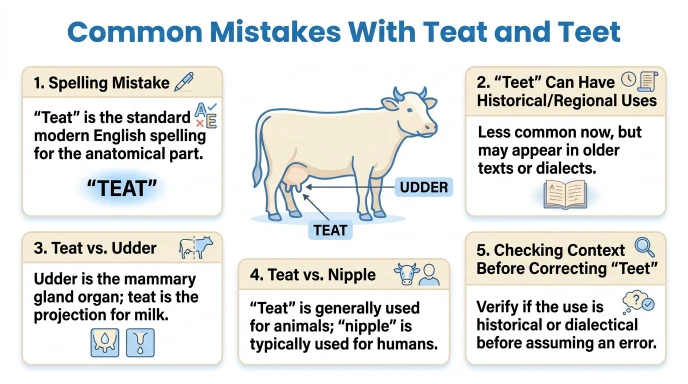
Mistake 1: Spelling the word the way it sounds
Incorrect in standard modern usage:
The calf was feeding from the cow’s teet.
Correct:
The calf was feeding from the cow’s teat.
Why?
Teat is pronounced /tiːt/, which makes teet look natural. But pronunciation does not determine spelling.
Memory tip: Think “teat = feeding.”
Mistake 2: Assuming “teet” is always impossible
It is more accurate to say that teat is the standard modern spelling rather than claiming that every appearance of teet is meaningless.
Historical and lexical sources record teet in alternative or regional uses.
For normal modern English writing, however, choose teat.
Mistake 3: Confusing “teat” with “udder”
These words are related, but they are not identical.
An udder is the larger mammary structure found in animals such as cows and goats. A teat is one of the projecting parts through which milk is released.
Correct:
The cow’s udder was swollen.
Also correct:
The cow’s teat was swollen.
The words describe different anatomical parts.
Mistake 4: Using “teat” and “nipple” as if they always mean exactly the same thing
The terms overlap, but usage depends on context.
In animal anatomy, teat is the common and precise term.
When referring to human anatomy, nipple is usually the standard term in both everyday and medical contexts.
For baby bottles, teat is especially common in British English, while nipple is common in American English.
Mistake 5: Assuming every “teet” search is a spelling question
Sometimes people encounter teet in a historical, regional, slang, or specialized context. A search for the word does not automatically mean that the writer made a mistake.
The best approach is to check the context.
If the intended meaning is the nipple of a mammal, teat is the standard modern choice.
Teat or Teet in Everyday Examples
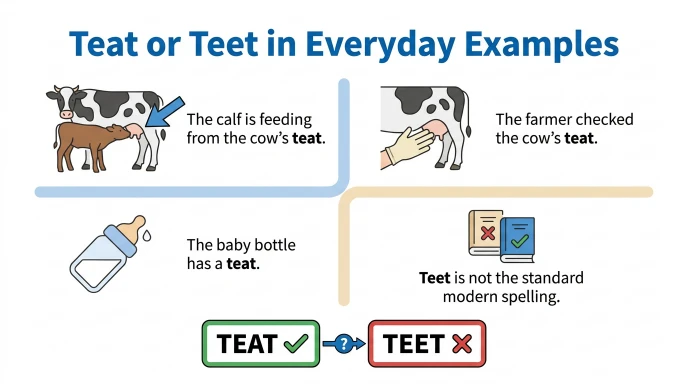
Correct:
The veterinarian will examine the cow’s teat tomorrow.
For professional email, use the standard spelling.
Business writing
The farm has introduced a new system for monitoring teat health.
This wording is suitable for agricultural or veterinary communication.
News headline
Farmers urged to monitor cattle teats during routine checks
News writing generally follows standard dictionary spelling.
Blog writing
A healthy teat is important for successful milking and animal care.
If your audience is general readers, you may want to explain the term the first time you use it.
Social media
The vet checked the cow’s teats during today’s farm visit.
Casual writing still benefits from the standard spelling.
Academic writing
Teat condition can be evaluated as part of routine dairy herd health management.
In scientific and academic writing, teat is the appropriate form.
Daily conversation
The calf is trying to find its mother’s teat.
The word may sound technical in some contexts, but it is a normal anatomical term.
Google Trends & Modern Usage
People search “teat or teet” mainly because the two forms can sound identical or nearly identical in speech. The spelling teet feels plausible because English has many words where the long ee sound is written with ee, such as meet, feet, and green.
But English spelling does not work by sound alone.
Modern dictionary evidence strongly supports teat as the standard word. Cambridge lists teat for the mammalian anatomical meaning and gives the same spelling in its British and American entries. Merriam-Webster also gives teat as the dictionary headword and records its long history in English.
Exact search-volume or Google Trends figures should not be claimed without checking current Trends data. The general pattern is clear, however: the spelling question arises because teat sounds like “teet.”
There is also an interesting historical reason not to oversimplify the issue. Merriam-Webster’s etymology includes Middle English teet among historical forms, while modern standard English uses teat.
Quick Comparison
| Version | Meaning | Correct? | Region | Example |
| teat | Nipple of a female mammal | Yes | International | The calf suckled from the teat. |
| teats | Plural of teat | Yes | International | The cow’s teats were examined. |
| teat | Bottle nipple | Yes | Especially UK | Replace the bottle teat. |
| nipple | Bottle nipple | Yes | Especially US | Replace the bottle nipple. |
| teet | Alternative/historical or regional form in some sources | Rare | Limited contexts | Use teat in standard modern writing. |
Teat vs Teet at a glance
| Question | Answer |
| Standard spelling? | Teat |
| Pronounced like “teet”? | Yes |
| Plural? | Teats |
| US anatomical term? | Teat |
| UK anatomical term? | Teat |
| UK bottle term? | Teat |
| Common US bottle term? | Nipple |
| Should most writers use “teet”? | No |
Key Takeaways
- Teat is the standard modern English spelling.
- A teat is the nipple or milk outlet of a female mammal.
- Teats is the plural form.
- Teat is pronounced like “teet,” which explains much of the spelling confusion.
- British English can use teat for a baby-bottle nipple.
- American English commonly uses nipple for a baby-bottle nipple.
- Teet does appear in historical, regional, or alternative uses, so it is not accurate to call every occurrence meaningless.
- For standard modern writing, choose teat.
FAQs
Is it spelled “teet” or “teat”?
“Teat” is the standard spelling in modern English. It refers to the nipple of a female mammal, such as a cow, goat, or sheep. The word is pronounced like “teet,” which is why the spelling can be confusing.
What does “teet” mean?
“Teet” is not the standard modern spelling of the word meaning a mammal’s nipple. You may find teet in older, regional, or alternative usage, but for normal English writing, teat is the correct choice.
What does “teat” mean?
A teat is the part of a female mammal’s breast or udder through which milk is released.
Example:
The calf was feeding from its mother’s teat.
The plural is teats.
Is “teet” a word?
Yes, teet can appear as a rare or historical form, but it is not the usual standard spelling in modern English. If you are writing an essay, article, email, academic paper, or professional document, use teat.
What is “teet” in English?
If you saw teet and meant the nipple of a mammal, the standard English word is teat.
Conclusion
If you are choosing between teat or teet, the best answer for standard modern English is teat. Use it when referring to the nipple of a female mammal, such as a cow, goat, sheep, or pig. The plural is teats.
The confusion comes mainly from pronunciation. Teat is pronounced like “teet,” so it is easy to assume that teet is the correct spelling. But standard modern dictionaries use teat as the main form. Cambridge also shows that British English uses teat for a baby-bottle nipple, while American English commonly uses nipple in that context.
There is one useful historical nuance: teet has appeared as an older or alternative form, so it should not be described as a word that has never existed.
For modern readers, writers, students, editors, and professionals, the practical rule is simple:
When you mean the mammal’s nipple, spell it “teat.”
Read more about!
Kabob or Kebab: Which Spelling Is Correct?

I’m Edward Fletcher, a UK-based English language writer with a passion for grammar and vocabulary. At VocabNex, I share simple explanations, useful examples, and practical English tips to help learners improve their language skills and communicate with confidence.








2 thoughts on “Teat or Teet: Which Spelling Is Correct?”