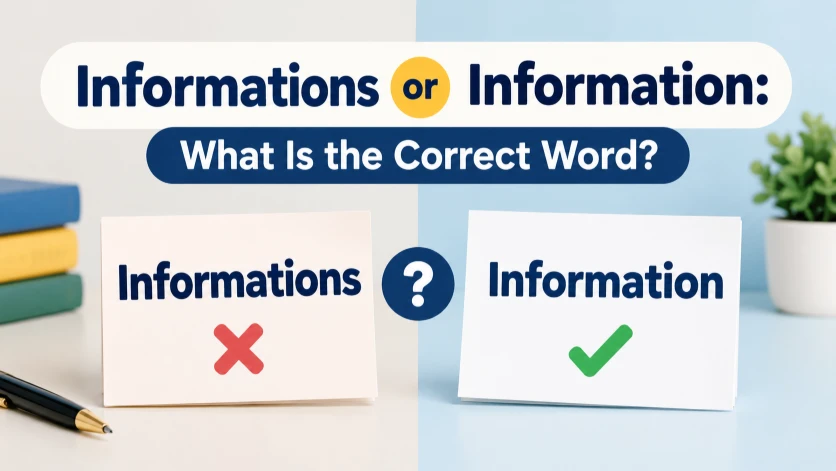
Information is correct; informations is generally incorrect in standard English because information is an uncountable noun.
The correct word in standard English is information, not informations, when you mean facts, details, or knowledge in general. The word information is an uncountable noun, so it does not usually take a plural -s. For example, say “I need more information,” not “I need more informations.”
This mistake is common among English learners because many English nouns form their plurals by adding -s, such as book/books and fact/facts. However, some nouns work differently. Information is one of them.
In this guide, you will learn why information is usually singular in form, how to use it in everyday sentences, if British and American English differ, and what to say when you want to refer to several facts or details. You will also find common mistakes, practical examples, and answers to frequently asked questions.
Information or Informations: Quick Answer
Use information in both singular and plural contexts when talking about facts, knowledge, or details in general. Do not add -s to make it plural.
Examples:
- Correct: I need more information about the course.
- Incorrect: I need more informations about the course.
- Correct: She shared three pieces of information with me.
Remember these basic rules:
- Say some information, not some informations.
- Say a piece of information, not an information.
- Use a singular verb: “The information is helpful.”
- To count separate facts, use pieces, bits, items, or a more precise noun such as facts and details.
Cambridge Dictionary identifies information as an uncountable noun in both British and American English.
What Does Information Mean?
Information means facts, details, or knowledge about a person, place, event, subject, or situation. It can come from books, conversations, websites, reports, research, or personal experience.
For example:
- “The website provides information about university courses.”
- “We need more information before making a decision.”
- “The police asked anyone with information about the incident to come forward.”
In each sentence, information refers to knowledge or facts. It does not need a plural ending, even when it includes many separate facts.
Why Is Information Uncountable?
In English, uncountable nouns refer to things that we do not usually count directly as individual units. Other examples include advice, furniture, knowledge, and equipment.
You can count books, chairs, and individual facts. However, when you use information to describe knowledge as a whole, you do not normally count it by adding a number directly before the word.
Compare these sentences:
| Incorrect | Correct |
| I received two informations. | I received two pieces of information. |
| She gave me an information. | She gave me a piece of information. |
| We collected many informations. | We collected a lot of information. |
| These informations are useful. | This information is useful. |
The key is to count the units of information, not the uncountable noun itself.
The Origin of Information
The word information has a long history. English adopted it through Old French, with roots in the Latin word informatio, associated with the idea of forming, shaping, or giving an account of something.
Over time, the word developed its familiar modern meaning: facts or knowledge communicated about a subject.
The ending -tion appears in many English nouns, including education, communication, and celebration. These words do not all follow the same rules for countability, so their similar endings should not determine how you use them.
Why do people write informations?
One reason is that English learners often apply the common plural rule of adding -s to nouns. Another reason is that the equivalent word in some other languages can have a plural form. Cambridge notes that this difference between languages can make information a common source of mistakes.
The practical lesson is simple: learn information as an uncountable noun rather than trying to form its plural.
British English vs American English
There is no standard British-versus-American spelling difference between information and informations. Both varieties use information as an uncountable noun in ordinary contexts.
| British English | American English | Example |
| information | information | I need more information. |
| a piece of information | a piece of information | She shared a piece of information. |
| some information | some information | We received some information. |
| information is | information is | The information is accurate. |
| pieces of information | pieces of information | We found three pieces of information. |
Are There Any Regional Differences?
The basic grammar is the same in the United Kingdom and the United States. You should not use informations simply because you are writing for a particular English-speaking country.
British and American style guides may differ in punctuation, spelling, and other conventions. However, the countability of information remains the same.
For example, both sentences below are correct:
- UK: “The information is available online.”
- US: “The information is available online.”
Both identify information as uncountable.
Which Version Should You Use?
Use information in standard English, regardless of your audience or location. The main decision is how to express the amount or number of facts you want to describe.
- United States: Write “Please send me the information.”
- United Kingdom: Write “Could you provide some information?”
- Canada: Use “I found three pieces of information.”
- Australia: Write “We need more information about the event.”
- International writing: Prefer clear phrases such as “further information” or “additional details.”
- Academic writing: Use “The study provides useful information” or “The researchers identified three key findings.”
- Business writing: Write “Please share the relevant information” or “We need three specific details.”
If you need to refer to a large amount of knowledge, use a lot of information, a great deal of information, or a wealth of information.
If you need to refer to separate facts, choose pieces of information, facts, details, or findings, depending on the meaning.
Common Mistakes
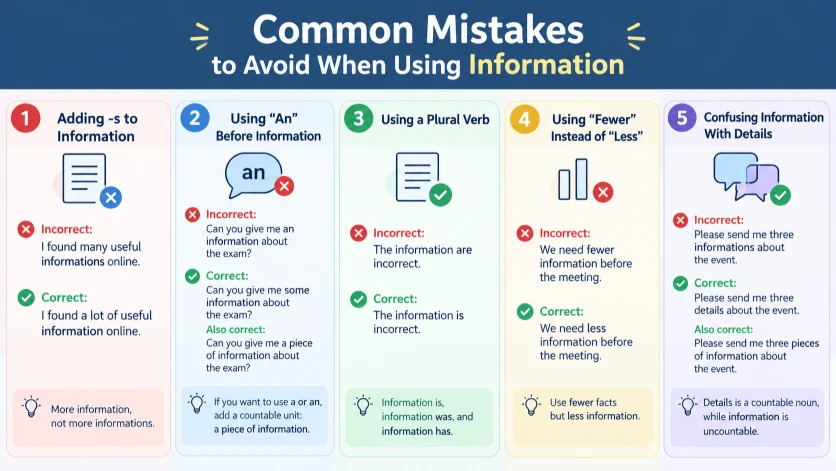
Here are common errors to avoid when using information.
Mistake 1: Adding -s to Information
Incorrect: I found many useful informations online.
Correct: I found a lot of useful information online.
Why? Information is uncountable, so it does not take a regular plural ending in standard English.
Memory tip: More information, not more informations.
Mistake 2: Using “An” Before Information
Incorrect: Can you give me an information about the exam?
Correct: Can you give me some information about the exam?
Also correct: Can you give me a piece of information about the exam?
Why? The article an is used with singular countable nouns, but information is uncountable.
Memory tip: If you want to use a or an, add a countable unit: a piece of information.
Mistake 3: Using a Plural Verb
Incorrect: The information are incorrect.
Correct: The information is incorrect.
Why? Information takes a singular verb in ordinary use, even when it refers to many facts.
Memory tip: Information is, information was, and information has.
Mistake 4: Using “Fewer” Instead of “Less”
Incorrect: We need fewer information before the meeting.
Correct: We need less information before the meeting.
Why? Fewer generally goes with countable plural nouns, while less normally goes with uncountable nouns.
Memory tip: Use fewer facts but less information.
Mistake 5: Confusing Information With Details
Incorrect: Please send me three informations about the event.
Correct: Please send me three details about the event.
Also correct: Please send me three pieces of information about the event.
Why? Details is a countable noun, while information is uncountable.
Memory tip: If you can count each item directly, consider using details or facts.
Everyday Examples
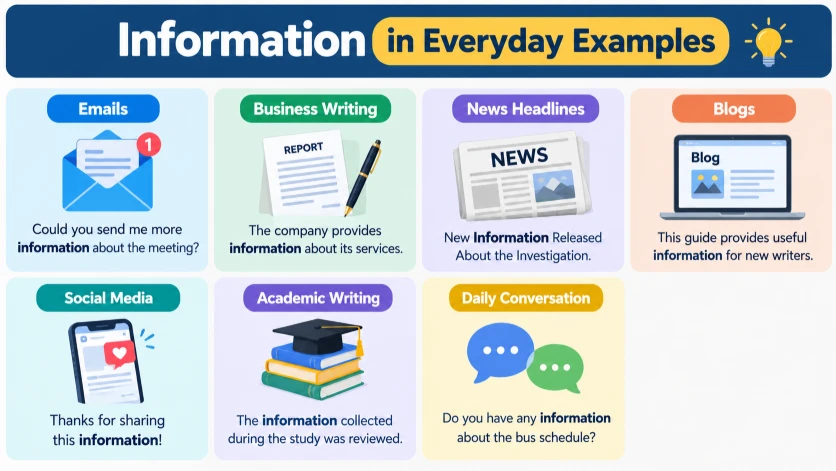
Understanding correct usage becomes easier when you see information in everyday situations.
Emails
- Correct: “Could you send me more information about the meeting?”
- Correct: “Thank you for the information you provided.”
- Incorrect: “Please send me the informations.”
Business Writing
- “The company provides information about its services.”
- “Please review the information in the attached report.”
- “We need three additional details before approving the request.”
These sentences sound clear and professional. When individual items must be counted, use details or pieces of information.
News Headlines
- “New Information Released About the Investigation”
- “Officials Share Further Information With the Public”
- “New Details Emerge in the Case”
News headlines often use short phrases. Information works without a plural ending, even when a report contains several new facts.
Blogs
- “This guide provides useful information for new writers.”
- “You will find more information in our spelling guide.”
- “Here are five facts every student should know.”
Social Media
- “Thanks for sharing this information!”
- “I found some helpful information about the exam.”
- “Here are three useful facts about English grammar.”
Academic Writing
- “The information collected during the study was reviewed.”
- “The report contains a great deal of information about climate change.”
- “The researchers identified four important findings.”
In academic writing, findings, observations, results, and pieces of information may be more precise than trying to pluralize information.
Daily Conversation
- “Do you have any information about the bus schedule?”
- “I need a little more information.”
- “She gave me two useful tips.”
These are natural ways to ask for or share knowledge. You do not need informations to show that you mean more than one fact.
Google Trends & Modern Usage
People search for “informations or information” because they want to know if information can take a plural ending. The question is especially common among English learners whose first languages allow a plural form of the equivalent word.
The mistake can also occur when writers apply a familiar English pattern to every noun. Since many nouns form plurals with -s, informations may look reasonable to someone learning English.
Which Version Is More Common?
In standard English, information is the accepted form for both British and American audiences. Informations is generally treated as a grammatical error when used to mean multiple facts or details.
Exact Google Trends figures are not included here. This explanation is based on established dictionary usage, not a claim about measured search volumes or regional rankings. The confirms that the noun is uncountable in both UK and US English.
Why Does This Confusion Continue?
Three factors help explain the mistake:
- Plural habits: Learners often add -s automatically when they mean more than one thing.
- Language differences: A word may be countable in another language but uncountable in English.
- Unclear counting: People may want to describe several facts without knowing the phrase pieces of information.
The best solution is to learn common uncountable nouns alongside their natural counting expressions.
Quick Comparison
| Version | Meaning | Correct? | Region | Example |
| Information | Facts or knowledge in general | Yes | All standard English varieties | I need more information. |
| Informations | Intended plural of information | No, in ordinary standard usage | Not a standard regional alternative | Avoid “I need informations.” |
| A piece of information | One item of knowledge | Yes | International | I learned a piece of information. |
| Pieces of information | Several items of knowledge | Yes | International | She shared two pieces of information. |
| Details | Separate facts about something | Yes | International | Please provide three details. |
| Information is | Information with a singular verb | Yes | International | The information is correct. |
Key Takeaways
- Information is the correct word in standard English.
- Information is an uncountable noun and does not normally have a plural form.
- Use some information, more information, or a lot of information.
- Use a piece of information for one item and pieces of information for several.
- Write “The information is useful,” not “The information are useful.”
- The same rule applies in British, American, Canadian, and Australian English.
- Use facts, details, or findings when those words express your meaning more clearly.
FAQs
1. What Is the Difference Between “Information” and “Informations”?
Information is an uncountable noun used for facts, details, or knowledge about something. In standard English, informations is generally incorrect when referring to facts or knowledge. For example, “I need more information” is correct, while “I need more informations” is incorrect.
2. Is “These Informations” or “This Information” Correct?
“This information” is correct because information is an uncountable noun and takes the singular demonstrative this. For example, “This information is helpful” is correct. “These informations” is incorrect in standard English. To refer to multiple details, you can say “these pieces of information.”
3. Is It Correct to Say “Some Information” or “Some Informations”?
“Some information” is correct because information does not normally have a plural form in English. For example, “I need some information about the course” is grammatically correct. Avoid “some informations”; use “some information” or “some pieces of information” instead.
4. Is “More Information” or “More Informations” Correct?
“More information” is correct in standard English. The word more can be used with uncountable nouns without adding an -s to the noun. For example, “Please provide more information about the project” is correct, while “Please provide more informations” is incorrect.
5. What Is Correct Information?
Correct information means accurate, reliable, and factual details about a subject. For example, “The teacher gave us correct information about the exam” means the details provided by the teacher were accurate. In this phrase, correct describes the accuracy of the information.
6. What Does “Information” Mean?
Information means facts, knowledge, or details communicated or learned about a person, place, event, or subject. For example, a website may provide information about a university’s admission requirements. Information is an uncountable noun, so standard English uses expressions such as “a piece of information” rather than “an information.”
Conclusion
The correct choice is information, not informations, when you are talking about facts, details, or knowledge in standard English. This rule applies in British English, American English, and other major varieties of English.
The main reason is that information is an uncountable noun. It does not take a regular plural ending, and it usually takes a singular verb. You should write “The information is helpful,” not “The informations are helpful.”
When you need to count separate items, use a piece of information for one item and pieces of information for more than one. You can also use words such as facts, details, or findings when they express your meaning more clearly.
If you are writing an email, preparing an academic paper, publishing a blog post, or speaking in daily conversation, the same rule applies. Learning this pattern will help you avoid a common English grammar mistake and make your writing clearer.
Remember: You can have many facts, but in standard English, you have more information, not more informations. If this guide helped you, explore our other commonly confused words articles to improve your English one word at a time.
READ MORE!
- Cavalry or Calvary: Which Is Correct?
- Met or Meet: Which Is Correct?
- Ma’m or Ma’am: Which Spelling Is Correct?

I’m Edward Fletcher, a UK-based English language writer with a passion for grammar and vocabulary. At VocabNex, I share simple explanations, useful examples, and practical English tips to help learners improve their language skills and communicate with confidence.







