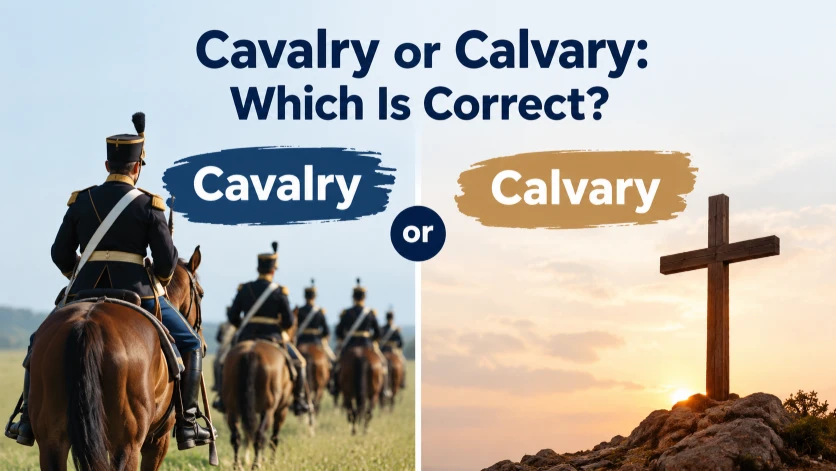
When you mean mounted soldiers or a military unit, the correct spelling is cavalry. Calvary is a different word connected with Christianity, specifically the place where Jesus was crucified, and it can also refer to an artistic representation of the Crucifixion.
The two words look and sound similar, so it is easy to mix them up. This is especially common when writing quickly or when you have only heard the words spoken. In this guide, you will learn the meanings of cavalry and Calvary, where each word comes from, how to remember the spelling, and how to use both words correctly in everyday and formal writing.
Cavalry or Calvary: Quick Answer
Cavalry is the correct word for soldiers who historically fought on horseback and for modern military units associated with armored or highly mobile forces. Calvary refers to the hill associated with the Crucifixion of Jesus, or to an artistic representation of the Crucifixion.
- Cavalry = military soldiers or units
- Calvary = the place associated with Jesus’ Crucifixion
- “The cavalry arrived.” ✓
- “Jesus was crucified at Calvary.” ✓
They are not interchangeable spellings.
What Does Cavalry Mean?
Cavalry is a noun for a military group traditionally made up of soldiers who fought on horseback.
Historically, cavalry played an important role in warfare because mounted soldiers could move quickly across the battlefield. In modern military usage, the term can refer to units using armored vehicles rather than horses.
Examples of cavalry
- The cavalry charged across the field.
- The army sent its cavalry to support the infantry.
- The museum displays uniforms worn by cavalry officers.
You may also see related expressions such as:
- cavalry charge
- cavalry unit
- cavalry officer
- cavalry horse
- armored cavalry
- light cavalry
- heavy cavalry
What does “send in the cavalry” mean?
In everyday English, send in the cavalry can be used figuratively.
It means to bring in additional help when a situation has become difficult.
We were behind schedule, so the manager sent in the cavalry to finish the project.
Here, nobody is necessarily talking about actual soldiers. The phrase uses the historical image of cavalry arriving to provide support.
What Does Calvary Mean?
Calvary is a completely different word.
With a capital C, Calvary refers to the hill outside Jerusalem associated with the Crucifixion of Jesus Christ. Cambridge also records calvary as a noun for a sculpture or painting representing the Crucifixion.
Examples of Calvary
- Christians remember the Crucifixion at Calvary.
- The church contains a painting of Calvary.
- The artist created a dramatic scene of Calvary.
The capital letter matters when you are referring to the biblical place:
Jesus was crucified at Calvary.
The lowercase form can be used for an artistic representation of the Crucifixion:
The church displays a calvary.
So the difference is not simply one letter. The two words have different meanings and different histories.
The Origin of Cavalry
The spelling cavalry comes from a family of words connected with horses.
Oxford traces the word to the mid-16th century. It came into English through French cavallerie, from Italian cavalleria, related to cavallo, meaning “horse,” and ultimately to Latin caballus.
That history helps explain why cavalry is associated with mounted soldiers.
The word’s meaning has also broadened with changes in military technology. Cavalry once strongly suggested soldiers on horseback. Modern dictionaries also use the term for military units that operate with armored vehicles.
So although horses are central to the historical meaning, cavalry does not always mean soldiers riding horses today.
The Origin of Calvary
Calvary has a separate religious history.
It comes from the Latin name Calvaria, associated with the place of Jesus’ Crucifixion. The word entered English through religious and biblical traditions.
This is why Calvary should not be treated as an alternative spelling of cavalry.
The similar appearance is simply a spelling trap. The meanings developed from different sources.
A useful distinction
Think of the words as belonging to two different subjects:
Cavalry → military history
Calvary → Christian history and religious art
That distinction makes the spelling much easier to remember.
British English vs American English
There is no major British-versus-American spelling difference between cavalry and Calvary. Both varieties of English use cavalry for the military term and Calvary for the religious term.
| British English | American English | Example |
| cavalry | cavalry | The cavalry moved toward the village. |
| Calvary | Calvary | The painting shows Christ at Calvary. |
| cavalry officer | cavalry officer | He served as a cavalry officer. |
| cavalry unit | cavalry unit | The cavalry unit moved quickly. |
Pronunciation can vary slightly by speaker or accent, but the spelling distinction remains the same.
Oxford gives cavalry as /ˈkævlri/, while Cambridge gives closely related UK and US pronunciations.
What about Canada and Australia?
Canadian and Australian English also use the same basic distinction:
- cavalry for the military meaning
- Calvary for the biblical meaning
So this is not a regional spelling problem. It is primarily a vocabulary and spelling confusion.
Which Version Should You Use?
Use the word that matches your meaning.
United States
Use cavalry when discussing military forces.
The cavalry unit was deployed during the operation.
Use Calvary for the biblical location.
United Kingdom
The same distinction applies.
The cavalry advanced toward the enemy.
The artwork depicts Calvary.
Canada
Use cavalry for the military term and Calvary for the religious term.
Australia
The same spelling distinction applies in Australian English.
International writing
If your audience includes international English learners, make the distinction especially clear. The two words are easy to confuse because they contain almost the same letters.
Academic writing
Check the subject carefully:
- Military history → cavalry
- Religious history → Calvary
Business writing
You are most likely to encounter cavalry in a figurative expression such as:
We need to bring in the cavalry.
If the context is religious, use Calvary.
Common Mistakes
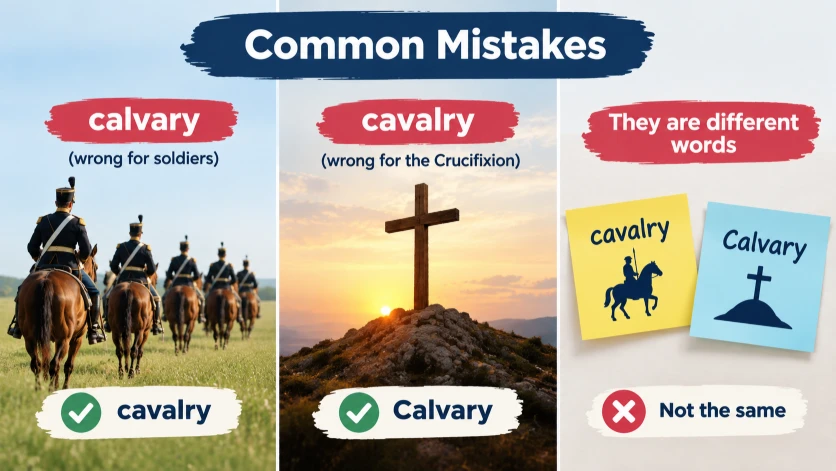
Mistake 1: Using “calvary” for soldiers
Incorrect:
The calvary arrived before sunset.
Correct:
The cavalry arrived before sunset.
Why?
The sentence refers to soldiers, so cavalry is required.
Memory tip:
Think cavalry = cavalry charge.
Mistake 2: Using “cavalry” for the Crucifixion
Incorrect:
Jesus was crucified at cavalry.
Correct:
Jesus was crucified at Calvary.
Why?
The sentence refers to the biblical place, so the word is Calvary.
Memory tip:
Think Calvary = Christ’s Crucifixion.
Mistake 3: Treating Calvary as a spelling variant
Incorrect idea:
Cavalry and Calvary are two spellings for the same word.
Correct idea:
They are two different words with different meanings.
Everyday Examples

Emails
The cavalry unit will arrive tomorrow.
This is correct when referring to a military unit.
Business writing
Our technical team is the cavalry that comes in when a major problem appears.
Here, cavalry is being used figuratively to mean help or support.
News headlines
Cavalry Unit Takes Part in Training Exercise
This uses cavalry in its military sense.
Blogs
Why “Cavalry” and “Calvary” Are Easy to Confuse
This is a natural way to discuss the spelling difference.
Social media
When the deadline is tomorrow and the whole team arrives like the cavalry.
Here, cavalry is metaphorical.
Academic writing
The cavalry played an important role in several historical military campaigns.
The word refers to military forces.
Daily conversation
Don’t worry. I’ve called the cavalry.
This means help is on the way.
Google Trends & Modern Usage
People commonly search “cavalry or calvary” because the words are visually and phonetically similar. Someone may hear cavalry in conversation and later wonder if it should be spelled calvary.
Google Trends provides search-interest data, but the publicly accessible Trends pages do not, by themselves, establish a reliable universal ranking of these two terms for every region and time period.
The confusion is also understandable because both words contain the same basic sequence of letters:
C A _ V A L R Y
The key difference is the middle spelling and meaning:
- cavalry → military
- Calvary → Crucifixion
Modern dictionaries continue to distinguish them clearly. Cambridge lists separate entries for both words, while Oxford’s entry for cavalry gives its military meaning and historical origin.
Quick Comparison
| Version | Meaning | Correct? | Region | Example |
| cavalry | Military troops or units | Yes | International English | The cavalry arrived quickly. |
| Calvary | Biblical place associated with the Crucifixion | Yes | International English | The scene depicts Calvary. |
| calvary | A sculpture or representation of the Crucifixion | Yes, in this specific sense | International English | The church contains a calvary. |
| calvary | Military troops | No | Standard English | ❌ The calvary arrived. |
| cavalry | Biblical Crucifixion site | No | Standard English | ❌ Jesus was crucified at cavalry. |
Key Takeaways
- Cavalry means military troops or units.
- Historically, cavalry fought on horseback.
- Modern cavalry can operate with armored vehicles.
- Calvary refers to the biblical place associated with Jesus’ Crucifixion.
- Calvary can also refer to an artistic representation of the Crucifixion.
- The words are not British and American spelling variants.
- For military writing, choose cavalry.
- For the biblical location, choose Calvary.
- A simple memory trick is cavalry = soldiers, Calvary = Crucifixion.
FAQs
Is cavalry or calvary correct?
Both words are correct, but they have different meanings. Cavalry refers to military troops or units, especially those historically associated with horses. Calvary refers to the place associated with Jesus’ Crucifixion and, in some contexts, a representation of the Crucifixion.
Is “calvary” a misspelling of cavalry?
It can be a misspelling when someone intends to write cavalry. However, calvary is also a legitimate English word with a separate religious meaning. Therefore, it is not always an error. Context determines which word is correct.
How do you spell cavalry?
The correct spelling for the military term is c-a-v-a-l-r-y: cavalry. It refers to soldiers or military units, historically mounted on horses and in modern usage sometimes associated with armored vehicles.
How do you spell Calvary in the Bible?
When referring to the biblical place associated with Jesus’ Crucifixion, it is normally written Calvary, with a capital C. For example: Jesus was crucified at Calvary.
Why are cavalry and Calvary confused?
They are easy to confuse because they look and sound very similar. The main difference is their history and meaning. Cavalry belongs to military vocabulary, while Calvary belongs to religious and biblical vocabulary.
Does cavalry mean soldiers on horses?
Historically, yes. Cavalry was the part of an army that fought on horseback. Modern military terminology can also use cavalry for units that operate with armored vehicles, so the term is not limited to horses today.
Does Calvary always mean a place?
Not necessarily. Calvary primarily refers to the biblical place associated with the Crucifixion. Lowercase calvary can also refer to a sculpture or painting representing the Crucifixion.
Is cavalry pronounced like Calvary?
They can sound very similar, especially in rapid speech. That similarity contributes to the spelling confusion. Because pronunciation may not make the distinction obvious, remembering the meanings is more useful than relying on sound alone.
What is an easy way to remember cavalry vs Calvary?
Use this simple association: cavalry = combat soldiers, while Calvary = Christ’s Crucifixion. If your sentence involves an army, think cavalry. If it involves the biblical Crucifixion, think Calvary.
Is “send in the cavalry” a real expression?
Yes. Send in the cavalry is also used figuratively to mean bringing additional help when a difficult situation needs support. It comes from the image of cavalry arriving to assist other forces.
Conclusion
The difference between cavalry and Calvary becomes simple once you connect each word with its subject. Cavalry is the military word. It traditionally referred to soldiers who fought on horseback and can now describe certain modern armored or mobile military units. Calvary, by contrast, is the religious word associated with the place of Jesus’ Crucifixion. It can also describe an artistic representation of that event.
There is no major US-versus-UK spelling difference here. Writers in both varieties of English use the same distinction.
When you are unsure, look at the meaning rather than the sound. If the sentence is about soldiers, armies, or military units, choose cavalry. If it is about the Crucifixion, choose Calvary.
Remember: cavalry fights, Calvary is the Crucifixion.
READ MORE!
- Ma’m or Ma’am: Which Spelling Is Correct?
- Lowe’s Salem OR: Store Hours, Location & Services
- Visible or Visable: Which Spelling Is Correct?

I’m passionate about English grammar, vocabulary, and clear communication. I enjoy making English easier to understand through simple, practical, and easy-to-follow explanations. My goal is to help learners build confidence and improve their English for everyday use.








2 thoughts on “Cavalry or Calvary: Which Is Correct?”