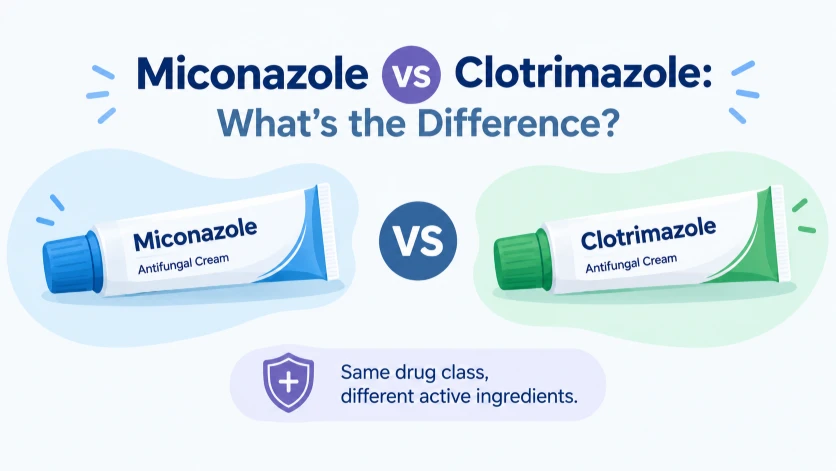
Miconazole and clotrimazole are both antifungal medicines, but they differ in their active ingredients, uses, and available formulations.
If you are comparing miconazole or clotrimazole, you are probably looking for a simple answer: which antifungal medicine is right for a particular infection? The two medicines are closely related. Both are azole antifungals used for several fungal and yeast infections, including some skin infections and vaginal yeast infections.
The confusion comes from the fact that they are available in different strengths, forms, and products. A cream labeled miconazole may be intended for a different use from a clotrimazole cream. The correct choice therefore depends more on the infection, body area, product formulation, and directions than on the drug name alone.
This guide explains the difference between miconazole and clotrimazole in plain English. You will learn what each medicine treats, how they work, where they overlap, common mistakes to avoid, and when professional advice is important.
Quick Answer
Miconazole and clotrimazole are both imidazole antifungal medicines. They work in similar ways by interfering with the production of ergosterol, an important part of fungal cell membranes.
Both can be used for certain fungal skin infections, and both are available in vaginal preparations for uncomplicated vaginal yeast infections. The exact product and treatment schedule matter, so they should not be treated as automatically interchangeable.
For example:
- Miconazole: available as creams, powders, sprays, and vaginal products.
- Clotrimazole: available as skin creams, solutions, sprays, vaginal creams, and pessaries in some markets.
- Both: can be used for conditions such as athlete’s foot and certain yeast infections, depending on the product.
The best option depends on the diagnosed or suspected infection and the specific product instructions.
What Does Miconazole or Clotrimazole Mean?
What is miconazole?
Miconazole is an antifungal medicine in the imidazole class. Topical miconazole is used for several fungal skin infections, including athlete’s foot, jock itch, and ringworm. Some miconazole products are also used for skin yeast infections and vaginal yeast infections.
Miconazole comes in several forms. Depending on the product, it may be supplied as a cream, powder, spray, tincture, or vaginal preparation.
Not every miconazole product is designed for every type of infection. Always check the product label and active ingredient.
What is clotrimazole?
Clotrimazole is also an imidazole antifungal medicine. It is used for several fungal skin infections and is also available in vaginal preparations for vaginal yeast infections.
Topical clotrimazole commonly comes as a cream or liquid. Other formulations are available for particular conditions.
Like miconazole, clotrimazole works against fungi by interfering with the production of ergosterol. This damages the fungal cell membrane and stops fungal growth.
Are they the same medicine?
No.
They belong to the same broad antifungal family and have similar mechanisms, but miconazole and clotrimazole are different active ingredients.
That distinction matters because products can have different concentrations, formulations, approved uses, directions, and precautions.
The Origin and Drug Class of Miconazole and Clotrimazole
The most useful way to understand the “origin” of these medicines is through their pharmacological class rather than the history of their names.
Both miconazole and clotrimazole are synthetic imidazole antifungals. Imidazole antifungals are part of the larger azole family.
Their antifungal action is linked to ergosterol, a sterol that fungi need for a stable cell membrane. These medicines interfere with an enzyme involved in ergosterol production. When this pathway is disrupted, the fungal membrane becomes damaged.
This explains why the two medicines have several overlapping uses.
However, similar mechanisms do not mean that every product can be substituted for another. Formulation, concentration, infection site, and approved use still matter.
Miconazole vs Clotrimazole: Key Differences
| Feature | Miconazole | Clotrimazole |
| Drug class | Imidazole antifungal | Imidazole antifungal |
| Common use | Fungal skin infections and some yeast infections | Fungal skin infections and some yeast infections |
| Skin forms | Cream, powder, spray, tincture, depending on product | Cream, solution, spray, depending on product |
| Vaginal forms | Creams and suppositories | Creams and pessaries/other vaginal products, depending on market |
| Typical skin use | Often applied according to product directions | Often applied according to product directions |
| Exact treatment | Depends on infection and formulation | Depends on infection and formulation |
| Main action | Interferes with fungal ergosterol production | Interferes with fungal ergosterol production |
The key point is that the product formulation can be just as important as the active ingredient.
Which Version Should You Use?
There is no universal rule that miconazole is always better than clotrimazole, or vice versa.
United States
In the United States, both medicines are available in different over-the-counter and prescription products. The correct choice depends on the condition and the formulation.
For vaginal yeast infections, both miconazole and clotrimazole are listed among topical treatment options for uncomplicated vulvovaginal candidiasis.
United Kingdom
Clotrimazole is widely available in the UK for fungal infections and is sold under several formulations. Miconazole is also used for fungal conditions.
Check the product leaflet because instructions can vary between formulations.
Canada
Both active ingredients may be available in topical and vaginal products. Product availability and labeling can vary, so use the instructions supplied with the specific product.
Australia
Availability and approved uses depend on the product and local regulations. A pharmacist can help identify the appropriate formulation.
International writing and general readers
When discussing these medicines generally, use the generic names miconazole and clotrimazole. Avoid assuming that a particular brand, concentration, or formulation is available in every country.
Academic and business writing
For formal writing:
- Use the generic drug name in lowercase.
- Identify the formulation when relevant.
- Include the concentration when discussing a specific product.
- Avoid treating two medicines as interchangeable without evidence.
Common Mistakes
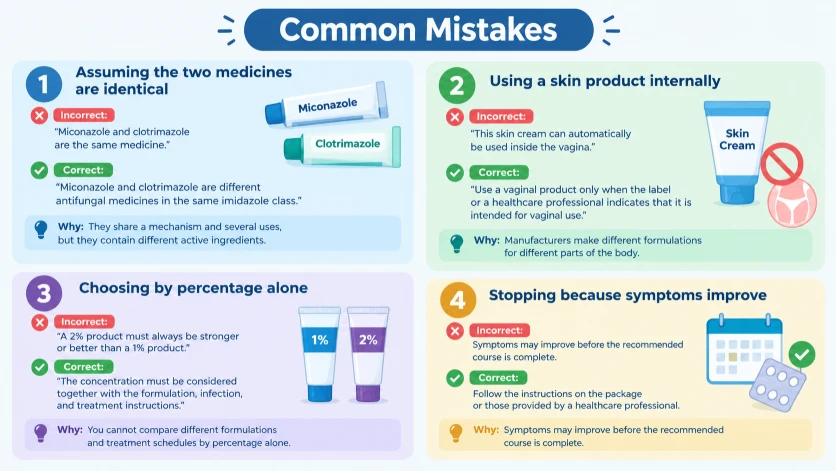
Mistake 1: Assuming the two medicines are identical
Incorrect:
“Miconazole and clotrimazole are the same medicine.”
Correct:
“Miconazole and clotrimazole are different antifungal medicines in the same imidazole class.”
Why:
They share a mechanism and several uses, but they contain different active ingredients.
Memory tip:
Think same family, different medicine.
Mistake 2: Using a skin product internally
Incorrect:
“This skin cream can automatically be used inside the vagina.”
Correct:
“Use a vaginal product only when the label or a healthcare professional indicates that it is intended for vaginal use.”
Why:
Manufacturers make different formulations for different parts of the body.
Mistake 3: Choosing by percentage alone
Incorrect:
“A 2% product must always be stronger or better than a 1% product.”
Correct:
“The concentration must be considered together with the formulation, infection, and treatment instructions.”
Why:
You cannot compare different formulations and treatment schedules by percentage alone.
Mistake 4: Stopping because symptoms improve
Symptoms may improve before the recommended course is complete. Follow the instructions on the package or those provided by a healthcare professional.
Everyday Examples
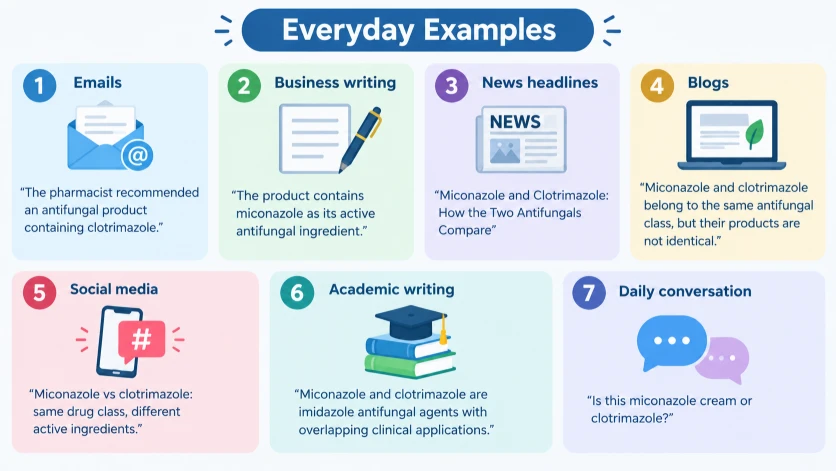
Emails
“The pharmacist recommended an antifungal product containing clotrimazole.”
This is clear because the generic drug name identifies the active ingredient.
Business writing
“The product contains miconazole as its active antifungal ingredient.”
This is suitable for product descriptions and professional communication.
News headlines
“Miconazole and Clotrimazole: How the Two Antifungals Compare”
This gives readers the topic immediately.
Blogs
“Miconazole and clotrimazole belong to the same antifungal class, but their products are not identical.”
Social media
“Miconazole vs clotrimazole: same drug class, different active ingredients.”
Academic writing
“Miconazole and clotrimazole are imidazole antifungal agents with overlapping clinical applications.”
Daily conversation
“Is this miconazole cream or clotrimazole?”
That question is useful because the active ingredient can affect which product instructions apply.
Google Trends & Modern Usage
People searching “miconazole or clotrimazole” are usually trying to compare two antifungal medicines for a particular problem. Common searches may include phrases such as:
- miconazole vs clotrimazole
- miconazole or clotrimazole for yeast infection
- miconazole vs clotrimazole for athlete’s foot
- clotrimazole vs miconazole cream
- miconazole or clotrimazole for skin fungus
- can you use miconazole instead of clotrimazole?
- are miconazole and clotrimazole the same?
Search interest can vary by country because medication availability, brand names, treatment guidance, and consumer habits differ.
Do not assume exact Google Trends numbers without checking a specific country, date range, and search category. General search patterns still show why the comparison matters: readers often want to know if they can substitute two medicines from the same drug class.
The safest answer is that similarity does not automatically mean interchangeability.
Quick Comparison
| Version | Meaning | Correct? | Region | Example |
| Miconazole | An imidazole antifungal medicine | Yes | International | “Miconazole is used in several antifungal products.” |
| Clotrimazole | An imidazole antifungal medicine | Yes | International | “Clotrimazole is available in topical and vaginal formulations.” |
| Miconazole vs clotrimazole | A comparison of two antifungal medicines | Yes | International | “Miconazole vs clotrimazole depends on the infection and product.” |
| Miconazole = clotrimazole | Claims they are the same active ingredient | No | Not applicable | “They are different medicines.” |
When Should You Ask a Doctor or Pharmacist?
Self-treatment is not always appropriate.
Ask a healthcare professional if:
- This is your first suspected vaginal yeast infection.
- Symptoms are severe or unusual.
- Symptoms keep returning.
- Treatment does not improve the problem as expected.
- The affected area is spreading.
- You are pregnant or breastfeeding.
- You take other medicines that may interact with the treatment.
- You are unsure if the condition is fungal.
- The infection involves an area not covered by the product instructions.
A rash or irritation is not automatically a fungal infection. Other skin conditions can look similar, so persistent or worsening symptoms may need a proper diagnosis.
Key Takeaways
- Miconazole and clotrimazole are different medicines.
- Both belong to the imidazole antifungal class.
- They have similar antifungal mechanisms.
- Both can be used for certain fungal skin infections.
- Both are available in products for some vaginal yeast infections.
- A cream, powder, spray, or vaginal product may have different directions.
- Do not assume one product can replace another.
- Follow the label or advice from a doctor or pharmacist.
- Persistent, recurrent, or unusual symptoms deserve professional evaluation.
FAQs
Which is better, clotrimazole or miconazole cream?
Neither is universally better. Both are antifungal medicines, and the best choice depends on the type and location of the fungal infection and the product’s directions.
What is the best antifungal cream for treating yeast infections?
Clotrimazole and miconazole are both commonly used to treat certain yeast infections. The appropriate product depends on the infection and where it occurs.
When should you not use clotrimazole?
Do not use clotrimazole if you are allergic to it or if the product is not intended for the affected area. Follow the package directions or ask a healthcare professional if you are unsure.
What is the best antifungal cream for a private area?
The best cream depends on the cause of the symptoms and the specific area affected. Clotrimazole and miconazole are commonly used for some fungal infections, but not every genital symptom results from a fungal infection.
What is more powerful than clotrimazole?
There is no single antifungal that is simply more powerful than clotrimazole. Different antifungals work against different organisms and may be more appropriate for particular infections.
Can I switch from clotrimazole to miconazole?
You may be able to switch, but it depends on the infection, formulation, and treatment schedule. Check with a pharmacist or healthcare professional before changing treatment, especially if symptoms are not improving.
Conclusion
Miconazole and clotrimazole are closely related antifungal medicines, but they are not the same drug. Both belong to the imidazole class and can be used for several fungal infections, including certain skin infections and vaginal yeast infections.
The biggest mistake is to assume that any miconazole product can replace any clotrimazole product. Formulation, concentration, route of administration, infection type, and product instructions all matter.
For common fungal skin conditions, both medicines are established topical antifungal options. For vaginal yeast infections, both also have recognized topical treatment regimens. Still, the correct choice depends on the specific product and the person’s situation.
If symptoms are new, severe, recurrent, worsening, or not improving with treatment, professional advice is more useful than switching between antifungal products on your own.
Memorable takeaway: same antifungal family does not mean the same medicine or the same product.
If this guide helped clarify the difference, keep the active ingredient and product instructions in mind whenever you compare antifungal treatments.
READ MORE!
- Stromboli or Calzone: A Simple Guide to the Difference
- Bush or Shrub: Understanding the Difference
- Bop or Flop: Meaning, Difference, and Examples

I’m passionate about English grammar, vocabulary, and clear communication. I enjoy making English easier to understand through simple, practical, and easy-to-follow explanations. My goal is to help learners build confidence and improve their English for everyday use.








2 thoughts on “Miconazole vs Clotrimazole: What’s the Difference?”