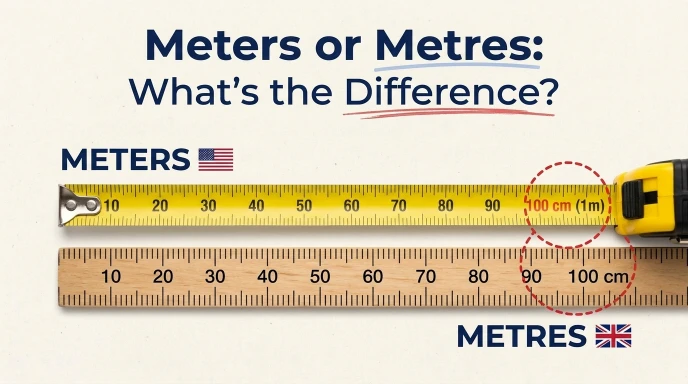
Both meters and metres are correct spellings of the same word. The difference is regional: meters is the standard spelling in American English, while metres is the standard spelling in British English and many other varieties of English.
For example:
- American English: The room is five meters wide.
- British English: The room is five metres wide.
Neither spelling is more correct than the other. Your choice depends on your audience, location, and writing style. The important thing is to use one spelling consistently throughout your writing.
This guide explains the meaning of meters and metres, their origins, regional spelling rules, common mistakes, and everyday examples. You will also learn which version to use in academic papers, business documents, blogs, and international communication.
Meters or Metres: Quick Answer
Use meters in American English and metres in British English. Both spellings describe the same metric unit of length, equal to 100 centimeters.
Examples:
- The park is 200 meters from my house. (US)
- The park is 200 metres from my house. (UK)
- The race covers 100 metres. (Common British and international usage)
Remember that the unit symbol is always m, regardless of the spelling used in the sentence. The international measurement system identifies the unit as the metre, with the symbol m.
What Do Meters and Metres Mean?
The words meters and metres are plural forms of meter and metre. They refer to a standard unit of length in the metric system.
One meter or metre equals:
- 100 centimeters or centimetres
- 1,000 millimeters or millimetres
- Approximately 39.37 inches
- One-thousandth of a kilometer or kilometre
For example, a door that is two metres tall has the same height as a door that is two meters tall. The spelling does not change the measurement.
Meter and Metre as Measurement Units
Both forms are used to describe length, height, width, depth, and distance.
Examples:
- The swimming pool is 25 meters long.
- The bridge stretches for 500 metres.
- The ceiling is three meters high.
- The finish line is 100 metres away.
The choice depends on the spelling convention you follow.
Meter Can Also Mean a Measuring Device
There is one extra detail worth knowing. In English, meter can also mean a device that measures something, such as electricity, water, or gas.
Examples:
- The electrician checked the electricity meter.
- The water meter records how much water a home uses.
- The parking meter accepts payment for a parking space.
In American English, meter is the usual spelling for both the measuring device and the unit of length. In British English, metre means the unit of length, while meter remains the standard spelling for a measuring device.
This distinction is useful when writing about science, engineering, utilities, or everyday measurements.
The Origin of Meters and Metres
The difference between meters and metres comes from the development of American and British spelling conventions.
Both forms trace back to the French word mètre. The word became associated with the metric system, which developed in France during the late eighteenth century.
The metric system introduced a standard way to measure length, mass, and other quantities. The metre became its basic unit of length.
Over time, English-speaking countries adopted different spellings for some words. American English commonly uses meter, while British English retained the spelling metre for the unit of length.
Similar differences appear in other metric terms:
| American English | British English |
| Meter | Metre |
| Kilometer | Kilometre |
| Centimeter | Centimetre |
| Millimeter | Millimetre |
| Liter | Litre |
These spelling patterns reflect regional writing conventions, not differences in the measurements themselves.
The unit’s scientific definition has also changed over time. Today, the metre is defined through the speed of light in a vacuum, making it a precise and internationally standardized unit.
British English vs American English
The main difference is the spelling used for the unit of length. American English normally uses meter, while British English normally uses metre.
Here is a practical comparison.
| British English | American English | Example |
| Metre | Meter | The room is four metres/meters wide. |
| Metres | Meters | The runner completed 100 metres/meters. |
| Kilometre | Kilometer | The town is five kilometres/kilometers away. |
| Centimetre | Centimeter | The table is 80 centimetres/centimeters long. |
| Millimetre | Millimeter | The gap is two millimetres/millimeters wide. |
| Metre (unit) | Meter (unit) | The cable is ten metres/meters long. |
Why Does American English Use Meters?
American English has developed its own spelling conventions over time. Many words ending in -re in British English use -er in American English.
For example:
- Centre becomes center.
- Theatre becomes theater.
- Metre becomes meter.
- Kilometre becomes kilometer.
These forms are standard in American writing. Using metre in a US-focused article is not a measurement error, but it may look inconsistent with the rest of the text.
Why Does British English Use Metres?
British English generally retains the -re ending in these words. This spelling is common in British newspapers, educational materials, books, and everyday writing.
Examples include:
- The shop is 300 metres away.
- The athlete ran 400 metres.
- The road is two kilometres long.
The spelling metre is also used by many other English-speaking countries that follow British spelling conventions.
What About Scientific Writing?
Scientific writing needs both accuracy and consistency. The International System of Units (SI) uses metre in its English-language base-unit terminology, with the symbol m. However, national scientific publications may follow local spelling rules. For example, the US National Institute of Standards and Technology uses meter in its American English guidance.
For formal work, follow the style guide required by your institution, journal, or publisher.
Which Version Should You Use?
The best spelling depends on your readers and the rules of your publication.
United States: Use meters
Choose meter, meters, kilometer, and centimeter for general American English writing. This also matches US government measurement guidance.
United Kingdom: Use metres
Use metre and metres when writing for British readers. Use meter for a device that measures consumption or another quantity.
Canada: Usually use metres
Canadian English generally follows the -re spelling for the unit of length. However, follow the relevant Canadian style guide or technical standard for specialized writing.
Australia: Use metres
Australian English normally follows British spelling conventions. Use metres, kilometres, and centimetres in general writing.
International writing: Choose a consistent style
For a broad audience, decide if your content follows American or British English. If you are preparing a scientific document, use the required technical standard and unit symbols.
Academic Writing
Academic writers should check their university, journal, or publisher’s style guide before choosing a spelling.
A US university may expect meters, while a British or Australian institution may prefer metres. In scientific writing, the abbreviation m is useful because it is internationally recognized.
Business Writing
For business emails, product descriptions, reports, and technical documents, consistency matters most.
If your company serves US customers, use American English. If it targets UK or Australian readers, use the spelling those readers expect.
Avoid switching between meters and metres in the same document unless you are quoting a source or discussing spelling differences.
Common Mistakes With Meters and Metres
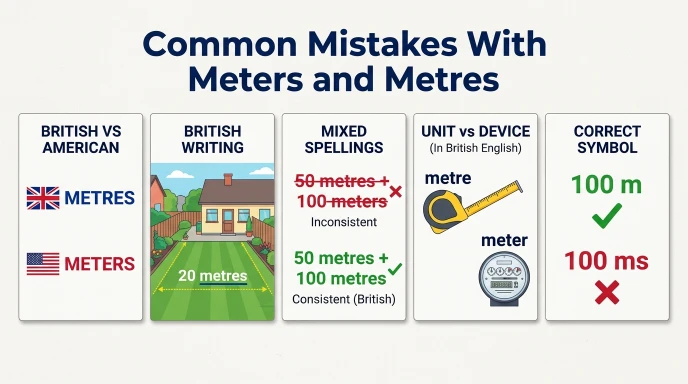
The most common mistake is assuming that one spelling is always wrong. In reality, both are accepted, but they belong to different spelling conventions.
Mistake 1: Calling Metres Incorrect
Incorrect claim: “Metres is a spelling mistake.”
Correct understanding: Metres is the standard British English spelling for the unit of length.
Explanation: The spelling is correct in British English and in many other varieties that use British spelling conventions.
Memory tip: Think of metres as the British form, just like centre.
Mistake 2: Using Meters in British Writing Without a Reason
Less consistent: The garden is 20 meters long.
Preferred in standard British English: The garden is 20 metres long.
Explanation: The first sentence is understandable, but metres better matches standard British spelling.
Memory tip: If your document uses colour and centre, choose metres too.
Mistake 3: Switching Between Both Spellings
Inconsistent: The field is 50 metres long, and the track is 100 meters long.
Better: The field is 50 metres long, and the track is 100 metres long.
Explanation: Both spellings refer to the same unit, but mixing regional styles can make writing look unedited.
Memory tip: Pick one English style and stick to it.
Mistake 4: Confusing the Unit With the Measuring Device
Incorrect for standard British spelling: The room is five meter long.
Correct: The room is five metres long.
Explanation: The unit of length uses metre in British English. A device that measures something is a meter.
Memory tip: In British English, a metre measures distance, while a meter measures or records something.
Mistake 5: Pluralizing the Unit Symbol
Incorrect: The track is 100 ms long.
Correct: The track is 100 m long.
Explanation: The official symbol for the metre does not change in the plural. Write m, not ms, when referring to metres. The symbol ms can mean milliseconds in scientific contexts.
Memory tip: Spell out metres or meters when you want a word. Use m when you want the unit symbol.
Everyday Examples of Meters and Metres
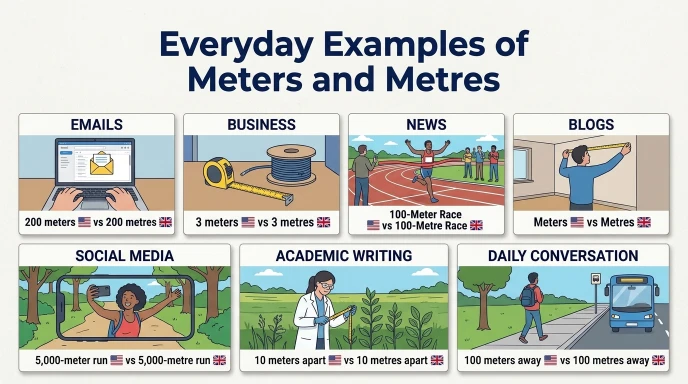
The following examples show how to use both spellings in common situations.
1. Emails
American English:
Hi Alex, the office is about 200 meters from the train station.
British English:
Hi Alex, the office is about 200 metres from the train station.
Both sentences communicate the same distance.
2. Business Writing
American English:
The product cable measures three meters in length.
British English:
The product cable measures three metres in length.
For product specifications, use the spelling required by your target market or company style guide.
3. News Headlines
American English:
Runner Wins 100-Meter Race at Local Event
British English:
Runner Wins 100-Metre Race at Local Event
Headlines may use a hyphen in a compound adjective such as 100-meter race. When the measurement follows the noun, the unit is usually plural: The race was 100 meters long.
4. Blogs
American English:
How to Measure a Room in Meters
British English:
How to Measure a Room in Metres
If you publish online, keep the spelling consistent with the audience you want to reach.
5. Social Media
American English:
Just finished a 5,000-meter run!
British English:
Just finished a 5,000-metre run!
In casual posts, both versions are easy to understand. The regional spelling still helps maintain a consistent voice.
6. Academic Writing
American English:
The samples were collected 10 meters apart.
British English:
The samples were collected 10 metres apart.
For scientific papers, also check if your institution requires a space between a number and a unit symbol. Standard SI presentation uses a space, as in 10 m.
7. Daily Conversation
American English:
The bus stop is only 100 meters away.
British English:
The bus stop is only 100 metres away.
You can use either spelling in writing. In speech, the difference is often less obvious because pronunciation varies by accent.
Google Trends and Modern Usage
People search for “meters or metres” because they encounter both spellings online, in schoolwork, in books, and in technical documents. Searchers often want to know if one form is a typo or if the difference depends on the country.
Which Spelling Is More Popular?
General English usage follows a clear regional pattern:
- Meters: Standard in American English.
- Metres: Standard in British English and commonly used in Australian English.
- Metres in Canada: Generally preferred for the unit of length in Canadian English.
- Metre in international standards: Used in the SI’s English-language terminology.
These are spelling conventions, not a claim about exact search volume.
Can Google Trends Prove Which Spelling Is Correct?
No. Google Trends measures relative search interest, not grammatical correctness. It can help explore regional search patterns, but its results depend on the selected terms, location, time range, and search settings. Google also notes that spelling variants may not be treated as equivalent in certain comparison modes.
To study this keyword, compare regional interest over the same period and check the spelling used in local dictionaries, publications, and style guides. Do not treat search popularity as proof that one form is correct.
Why Does This Keyword Keep Causing Confusion?
Three main reasons explain the confusion:
- Both spellings are correct, so spell-checkers may accept either one.
- Websites and social media expose readers to different English varieties.
- Scientific writing may use standardized symbols even when the surrounding text follows regional spelling conventions.
The simplest solution is to identify your audience first, then use the appropriate spelling throughout your content.
Quick Comparison
| Version | Meaning | Correct? | Region | Example |
| Meter | Unit of length | Yes | US | One meter long |
| Meters | Plural unit of length | Yes | US | Ten meters away |
| Metre | Unit of length | Yes | UK, Australia, Canada | One metre long |
| Metres | Plural unit of length | Yes | UK, Australia, Canada | Ten metres away |
| Meter | Measuring device | Yes | US and UK | Water meter |
| m | SI symbol for the unit | Yes | International | 10 m long |
Key Takeaways
- Meters is the standard American English spelling.
- Metres is the standard British English spelling.
- Both spellings refer to the same unit of length.
- One meter or metre equals 100 centimeters or centimetres.
- The SI symbol for the unit is always m.
- In British English, meter usually refers to a measuring device, while metre refers to length.
- Use the spelling required by your audience, publisher, or style guide.
- Keep the spelling consistent throughout a document.
FAQs
1. Is it meters or metres?
Both spellings are correct. Meters is standard in American English, while metres is standard in British English and commonly used in Australian English. Both refer to the same metric unit of length. Choose the form that matches your readers or the style guide you follow.
2. Is metres British or American English?
Metres is the standard British English spelling for the unit of length. It is also used in Australian English and generally preferred in Canadian English. American English normally uses meters. The difference is regional spelling, not meaning or measurement.
3. Why do Americans spell it meters?
American English uses meter instead of metre as part of its spelling conventions. The same pattern appears in words such as center instead of centre and kilometer instead of kilometre. These forms are standard in the United States and are not spelling errors.
4. Is metres a correct spelling?
Yes, metres is correct. It is the plural form of metre, the British English spelling for the metric unit of length. For example, “The road is 500 metres long” is correct British English. American English usually writes the same sentence with meters.
5. Is meters correct in British English?
When referring to the unit of length, meters is not the usual spelling in standard British English. British writers generally use metres. However, meter is correct in British English when referring to a measuring device, such as a water meter or parking meter.
6. Is it 100 meters or 100 metres?
Both forms are correct. Use 100 meters in American English and 100 metres in British English. The measurement is identical in both cases. If you are writing a sports report, school assignment, or technical document, follow the spelling convention expected by your audience.
7. Is the spelling metre used internationally?
Yes, metre is used in many English-speaking countries outside the United States. It is also the form used in the English-language terminology of the International System of Units. However, American English commonly uses meter, including in US scientific guidance.
8. What is the difference between a meter and a metre?
When referring to length, there is no difference in meaning. Meter is the American spelling, and metre is the British spelling. In British English, meter can also refer to a measuring device. Context tells you which meaning is intended.
9. Should I use meters or metres in academic writing?
Follow your university’s or journal’s style guide. American institutions often expect meters, while British and Australian institutions commonly use metres. In scientific writing, the symbol m is a useful international option. Consistency with the required style is more important than choosing one regional spelling for every publication.
10. Is the abbreviation for meters m or ms?
The correct symbol for the metre or meter is m, if you mean one unit or several. For example, write 1 m or 25 m. Do not add an s to make the symbol plural. In scientific contexts, ms commonly stands for milliseconds, a unit of time.
Conclusion
The difference between meters and metres is simple once you understand regional spelling conventions. Both words describe the same metric unit of length, and neither is universally more correct than the other.
Use meters when writing in American English. Choose metres for British English and generally for Australian and Canadian English. If you are writing an academic paper, technical report, or business document, check the relevant style guide before making your choice.
Remember that the unit symbol stays the same everywhere. If your sentence says five meters or five metres, you can write the measurement as 5 m. The symbol is especially useful in scientific work, where clear and consistent measurements matter.
For blog posts, emails, school assignments, and everyday writing, the best approach is to match your audience and stay consistent. You do not need to change the measurement itself, only the spelling convention.
If you are editing a document, check related words such as kilometer/kilometre and centimeter/centimetre to keep the whole text consistent.
Memorable takeaway: Americans measure in meters; British writers measure in metres. The distance stays exactly the same.
If this guide helped you, explore more commonly confused words and spelling differences to make your English clearer and more confident.
READ MORE!
- Greyson or Grayson: Which Spelling Is Correct?
- Marshmallow or Marshmellow: Which Spelling Is Correct?
- Junky or Junkie: Which Spelling Is Correct?

I’m passionate about English grammar, vocabulary, and clear communication. I enjoy making English easier to understand through simple, practical, and easy-to-follow explanations. My goal is to help learners build confidence and improve their English for everyday use.