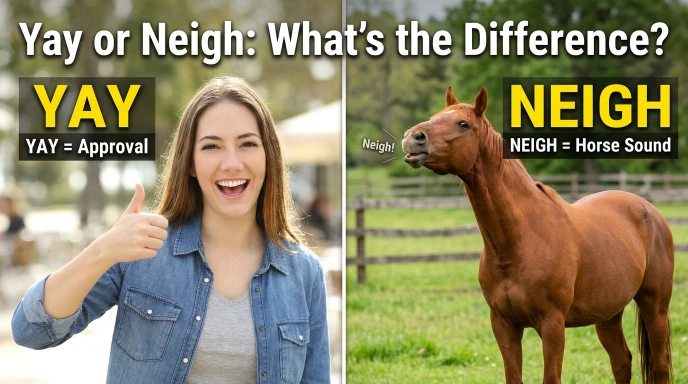
Yay expresses excitement or approval, while neigh is the sound a horse makes.
Have you ever wondered if to write yay or neigh when you want to show excitement or describe a horse? These words sound similar, but they have very different meanings. Yay expresses happiness, excitement, or approval, while neigh is the sound a horse makes.
The confusion often comes from the way these words sound when spoken. People may also mix up yay with yea, which is another word used to express agreement or a positive vote. Although all three words can sound similar, they are not interchangeable.
Knowing when to use yay or neigh can help you write clearer messages, social media posts, captions, and everyday conversations. It can also prevent funny mistakes, especially when you want to celebrate good news but accidentally use a word associated with horses.
In this guide, you will learn the meaning of each word, its origin, common spelling mistakes, and practical examples. You will also discover how yay, neigh, and yea differ so you can choose the right word with confidence.
Yay or Neigh: Quick Answer
Use yay to celebrate something, show joy, or express approval. Use neigh when talking about the sound a horse makes.
- Yay: “Yay! Our team won!”
- Neigh: “The horse gave a loud neigh.”
- Yea: “The proposal received more yea votes than nay votes.”
Remember that yay and neigh are both valid English words. Neither is a misspelling of the other. They simply serve different purposes.
What Does Yay or Neigh Mean?
The phrase yay or neigh compares two words with different meanings. One is an expression of joy, and the other describes a horse’s call.
What Does Yay Mean?
Yay is an informal interjection. An interjection is a word that expresses a feeling or reaction.
People use yay to show:
- Happiness about good news.
- Excitement about an event.
- Approval of an idea or result.
- Celebration after a success.
Examples:
- “Yay! I passed my exam.”
- “Yay, our vacation starts tomorrow!”
- “You got the job? Yay!”
You will often see yay in text messages, online comments, friendly emails, and social media posts. It is a natural choice when you want to sound cheerful.
What Does Neigh Mean?
Neigh refers to the loud, characteristic sound made by a horse. It can function as both a noun and a verb.
As a verb, it describes the action of making that sound. As a noun, it names the sound itself.
Examples:
- “The horse began to neigh.”
- “We heard a loud neigh from the stable.”
- “The mare neighed when she saw the other horses.”
The word whinny is a common synonym for neigh. Both words are associated with horse sounds.
Yay vs. Neigh vs. Yea
There is one more word worth learning: yea. It can mean yes or express an affirmative vote, especially in formal or political settings.
| Word | Main meaning | Example |
| Yay | Joy or excitement | Yay! We won! |
| Neigh | A horse’s sound | The horse gave a neigh. |
| Yea | Yes or an affirmative vote | Three members voted yea. |
| Nay | No or a negative vote | Two members voted nay. |
Although yay and yea are pronounced alike in common English usage, their meanings and typical contexts differ.
The Origin of Yay and Neigh
Understanding where these words came from can make them easier to remember.
Origin of Yay
The exact development of yay as an expression of excitement is not fully certain. Modern dictionaries identify it as an informal exclamation expressing joy, approval, or triumph.
Merriam-Webster records its first known use in this sense in 1916. The American Heritage Dictionary also connects yay with yea, which helps explain why the two words sound alike.
Over time, yay became a familiar way to celebrate good news in everyday speech and informal writing.
For example:
- “Yay! The concert tickets are available.”
- “Yay, we finished the project.”
- “Yay for the weekend!”
Origin of Neigh
Neigh has a much longer history. It comes from Middle English neyen and Old English hnǣgan, words associated with the cry of a horse.
Its origin is likely imitative. This means the word may have developed partly from the sound it describes, a process also known as onomatopoeia. Words such as buzz and hiss work in a similar way.
Examples of its use today include:
- “A horse neighed in the distance.”
- “The loud neigh startled the rider.”
- “We could hear the horses neighing in the field.”
Why Are the Words Spelled Differently?
The spelling difference reflects their separate histories and meanings. Yay is an informal expression of emotion, while neigh developed as a word for a horse’s cry.
Their similar sounds can cause confusion, but they are not alternate spellings of the same word. Replacing one with the other can change the meaning of a sentence completely.
British English vs. American English
The main difference between yay and neigh is their meaning, not their spelling. Both words are used in British and American English.
| British English | American English | Example |
| Yay = excitement | Yay = excitement | “Yay! We did it!” |
| Neigh = horse sound | Neigh = horse sound | “The horse began to neigh.” |
| Yea = affirmative vote or yes | Yea = affirmative vote or yes | “The proposal received a yea vote.” |
Regional Differences
In both the United States and the United Kingdom, yay is informal and suitable for cheerful, everyday communication. Neigh is used when discussing horses, animal sounds, stories, or related topics.
The words do not have separate British and American spellings. You do not need to change yay to another spelling when writing for a British audience.
Style Guides and Publishing Preferences
For professional writing, the best choice depends on the purpose of the text.
- Informal writing: Use yay to express excitement naturally.
- Academic writing: Use yay only when it fits the subject or a direct quotation. Use neigh when describing an animal sound.
- News writing: Use either word when its meaning fits the story. Avoid unnecessary slang in formal reporting.
- Creative writing: Use yay for a character’s reaction and neigh to describe a horse.
The key rule is simple: choose the word that matches your meaning and the tone of your writing.
Which Version Should You Use?
You can use yay or neigh in either British or American English. Your choice should depend on what you want to communicate.
- United States: Use yay to celebrate and neigh to describe a horse’s sound.
- United Kingdom: Follow the same rule. Both spellings are standard.
- Canada: Use either word according to its meaning. Both are understood in everyday English.
- Australia: Use yay for excitement and neigh for the sound of a horse.
- International writing: Choose yay for informal celebration. For formal audiences, consider a more neutral expression such as “Great!” or “I’m pleased.”
- Academic writing: Use neigh in descriptions of horse sounds. Use yay only when the informal expression is relevant.
- Business writing: Yay may suit a friendly team message, but “Congratulations” or “Excellent news” may be better in a formal email. Use neigh only when the subject calls for it.
Best advice: Do not choose a word based on how it sounds alone. Choose it based on the message you want to deliver.
Common Mistakes With Yay and Neigh
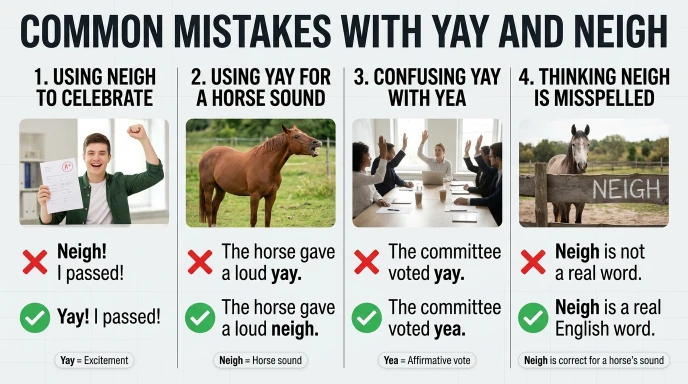
The most common mistake is using neigh when you want to express excitement. Another is confusing yay with yea when writing about a vote or a formal decision.
Mistake 1: Using Neigh to Celebrate
Incorrect: “Neigh! I passed my driving test!”
Correct: “Yay! I passed my driving test!”
Explanation: The sentence expresses happiness, so yay is the right word. Neigh refers to a horse’s sound.
Memory tip: If you feel happy, say yay.
Mistake 2: Using Yay to Describe a Horse
Incorrect: “The horse gave a loud yay.”
Correct: “The horse gave a loud neigh.”
Explanation: The sentence describes an animal’s sound. Use neigh or whinny, not yay.
Memory tip: Think of the “nei” in neigh as a clue to the horse sound.
Mistake 3: Confusing Yay With Yea
Incorrect: “The committee voted yay on the proposal.”
Better: “The committee voted yea on the proposal.”
Explanation: Yea is commonly used to describe an affirmative vote. Yay is more natural when expressing excitement or approval in casual speech.
Memory tip: Use yea for a vote and yay for a celebration.
Mistake 4: Assuming Neigh Is a Misspelling
Incorrect: “Neigh is not a real English word.”
Correct: “Neigh is the word for the sound a horse makes.”
Explanation: Neigh is a standard English word. It is not an incorrect version of yay.
Memory tip: Both words are correct, but their meanings are different.
Everyday Examples of Yay and Neigh

The easiest way to understand these words is to see them in real situations.
1. Emails
- Yay: “Yay! We received approval for the project.”
- Neigh: “The farm reported that a horse began to neigh during the night.”
Use yay in friendly workplace emails. In formal business messages, “Great news” may be more suitable.
2. Business Writing
- Yay: “Yay! Our team reached its monthly goal.”
- Neigh: “The report describes the neigh of a horse during the demonstration.”
The first example is informal. The second is appropriate when the topic involves animals or a sound recording.
3. News Headlines
- Yay: “Yay for Local Students as the Team Wins Its Final”
- Neigh: “A Horse’s Loud Neigh Draws Visitors to the Farm”
News headlines often use short, vivid language. However, yay is better suited to a lighthearted headline than a formal news report.
4. Blogs
- Yay: “Yay! Five Easy Ways to Make Your Weekend Better”
- Neigh: “Why Does a Horse Neigh at Night?”
The first headline expresses enthusiasm. The second asks a question about horse behavior.
5. Social Media
- Yay: “Yay! My new blog post is live!”
- Neigh: “Listen to that horse neigh!”
- Yay: “Yay for small wins and big dreams!”
Yay is common in cheerful social media captions, comments, and messages. Neigh appears more often in animal-related content, jokes, or horse videos.
6. Academic Writing
- Yay: “The character shouted ‘Yay!’ after hearing the results.”
- Neigh: “The observer recorded the horse’s neigh during the study.”
In academic writing, use these words when they accurately describe the subject. Avoid yay in formal analysis unless the expression itself is relevant.
7. Daily Conversation
- Yay: “Yay! We are going to the beach.”
- Neigh: “Did you hear that horse neigh?”
- Yay: “Yay, you finally finished your assignment!”
These are natural examples of how the words work in everyday English.
Google Trends and Modern Usage
People search for yay or neigh because the words sound alike but have different meanings. They may be checking a spelling choice, writing a caption, learning English, or trying to understand a joke.
Which Word Is More Common?
Yay is a familiar expression in casual conversations and online messages. Neigh appears in writing about horses, farms, animal sounds, and children’s stories.
However, these words are used in different contexts, so comparing their overall popularity without a defined search term, location, and time period can be misleading.
No verified Google Trends figures are presented here. Therefore, it would be inaccurate to claim an exact search-volume difference or rank one word as more popular based on current data.
Why Do People Confuse These Words?
There are three main reasons:
- Similar pronunciation: Yay and neigh rhyme in common English pronunciation.
- Different spelling patterns: The letters do not clearly show their different meanings to every learner.
- The extra word yea: Yea adds another similar-sounding word that can mean yes or an affirmative vote.
How to Choose the Right Word
Before you write, ask yourself what you mean.
- Are you celebrating? Write yay.
- Are you describing a horse’s sound? Write neigh.
- Are you recording an affirmative vote? Write yea.
For current search interest, you can compare the terms directly using Google Trends. Select a region and time range, and remember that search interest is not the same as total word usage.
Quick Comparison
| Version | Meaning | Correct? | Region | Example |
| Yay | Joy or excitement | Yes | British, American, and international English | “Yay! We won!” |
| Neigh | A horse’s sound | Yes | British, American, and international English | “The horse gave a neigh.” |
| Yea | Yes or an affirmative vote | Yes | English, especially voting contexts | “She voted yea.” |
| Nay | No or a negative vote | Yes | English, especially voting contexts | “He voted nay.” |
The right word depends on meaning and context, not on regional spelling rules.
Key Takeaways
- Yay expresses joy, excitement, approval, or triumph.
- Neigh is the sound a horse makes and can be a noun or a verb.
- Yay and neigh are both correct English words.
- Yea means yes or an affirmative vote in certain contexts.
- Nay means no or a negative vote.
- British and American English use the same spellings for yay and neigh.
- Use yay in casual celebrations and neigh in descriptions of horses.
- Remember the meaning first, and the spelling becomes easier to choose.
FAQs
Is it yay or nay or yay or neigh?
“Yay or nay” is the correct phrase when asking if someone agrees or disagrees with something. “Yay” expresses approval or excitement, while “nay” means no or indicates opposition. “Neigh” is the sound a horse makes.
What does yay mean?
Yay is an informal word used to express happiness, excitement, approval, or enthusiasm. For example, “Yay! We won the game!” expresses joy about winning.
Which is correct: “nay” or “neigh”?
Both nay and neigh are correct words, but they have different meanings. “Nay” means no or refusal, while “neigh” refers to the sound made by a horse. Use “nay” in the phrase “yay or nay.”
Where is Yay or Nay from?
The phrase “yay or nay” combines “yay,” an informal expression of approval, with “nay,” an older English word meaning no. “Nay” has roots in Old Norse and Middle English usage, while “yay” developed as an informal expression of excitement and approval.
Why do people say yay or nay?
People say “yay or nay” to ask for a quick decision, opinion, or vote. It provides a simple way to express approval or disapproval, such as when deciding if to accept a proposal, attend an event, or approve a plan.
What does “nay” mean?
Nay means “no” or expresses disagreement, rejection, or opposition. It is often used in voting and formal discussions. For example, “Three members voted yay, and two voted nay” means three supported the proposal and two opposed it.
Conclusion
The difference between yay and neigh is simple once you focus on meaning. Yay is an informal expression of joy, excitement, or approval. Neigh refers to the characteristic sound made by a horse. Both are correct English words, but they cannot replace each other without changing the meaning of a sentence.
Remember that yea is another word worth knowing. It can mean yes or an affirmative vote, while nay means no or a negative vote. These words often appear in voting, formal decisions, and expressions such as “yea or nay.”
If you are writing a text message, a blog post, an email, or an academic paper, choose the word that fits your intended meaning. Use yay for celebrations, neigh for horses, and yea for affirmative responses when appropriate.
The easiest rule to remember is this: celebrate with “yay,” describe a horse with “neigh,” and vote “yea” or “nay.”
If this guide helped you understand the difference, explore more commonly confused words to build your vocabulary and improve your writing.
READ MORE!
- Weather Pendleton OR: Forecast, Climate, and Seasonal Guide
- Vulkan vs DX11: Which Is Better for Gaming?
- Relieve or Relief: What Is the Difference?

I’m passionate about English grammar, vocabulary, and clear communication. I enjoy making English easier to understand through simple, practical, and easy-to-follow explanations. My goal is to help learners build confidence and improve their English for everyday use.







2 thoughts on “Yay or Neigh: What’s the Difference?”