Have you ever questioned something you just said and added, “Or is it?” This short phrase is common in everyday English. People use it to express doubt, reconsider an idea, or ask if something might be different from what they first believed.
The phrase “or is it” is correct English when used in the right context. It often appears after a statement or question to show uncertainty. For example, “This looks like the right answer. Or is it?” suggests that the speaker is no longer completely sure.
People search for “or is it” because they may be unsure about its meaning, punctuation, grammar, or use in a sentence. Some also want to know if it is a complete question, how it differs from “is it,” and when to place a question mark.
In this guide, you will learn what “or is it” means, how the phrase works, where it comes from, and how to use it in formal and informal writing. You will also see practical examples, common mistakes, and answers to frequently asked questions.
Let’s start with the simplest explanation.
Or Is It? Quick Answer
The phrase “or is it?” is used to question a statement that has just been made. It can suggest that the statement may be incorrect, incomplete, or less certain than it first seemed.
Examples:
- “This is the easiest way to learn English. Or is it?”
- “He seems honest. Or is he?”
- “The problem is solved. Or is it?”
Use “or is it?” when you want readers or listeners to reconsider an idea. The phrase is especially useful in conversations, opinion pieces, stories, blog titles, and headlines.
Remember: “Or is it?” does not always mean that the first statement is false. It simply invites doubt or further thought.
What Does “Or Is It” Mean?
“Or is it” combines the conjunction “or” with the verb “is” and the pronoun “it.” Its meaning depends on the context, but it commonly introduces an alternative possibility or questions a previous statement.
Meaning and definition
In everyday English, “or is it?” often means one of the following:
- Could that be wrong? The speaker questions a belief or conclusion.
- Could the opposite be true? The speaker considers another possibility.
- Are we sure about that? The speaker invites further thought.
- Is there more to the story? The speaker creates curiosity or suspense.
For example:
“Everyone thinks the task is easy. Or is it?”
The first sentence presents a common belief. The second sentence challenges that belief without directly stating that the task is difficult.
How the phrase works in a sentence
The phrase often appears as a short question after a statement.
Consider these examples:
- “I thought the meeting was today. Or is it tomorrow?”
- “She looks upset. Or is she just tired?”
- “That must be the answer. Or is it?”
The first example shows a speaker who is unsure about the meeting date. The second considers an alternative explanation, while the third questions a possible answer.
The word “it” usually refers to an idea, situation, fact, or thing mentioned earlier. The exact meaning becomes clear from the surrounding sentence.
Is “or is it?” a complete sentence?
Yes. In context, “Or is it?” can stand alone as a short question. It works because the earlier statement supplies information that the reader can understand without hearing it repeated.
For example:
“The plan sounds perfect. Or is it?”
The second sentence is complete enough for normal conversation and informal writing. In a more formal or technical document, you may want to state the alternative clearly instead.
The Origin of “Or Is It”
To understand this phrase, it helps to look at its three parts rather than assume that it has one special historical origin.
- Or: A conjunction used to connect alternatives or possibilities.
- Is: A present-tense form of the verb “be.”
- It: A pronoun that refers to a thing, idea, situation, or fact.
The word “or” has a long history in English and is used to present choices and alternatives. The modern question structure “is it” places the verb before the subject, as is normal in many direct yes-or-no questions.
When speakers place “or is it?” after a statement, they turn a simple assertion into an invitation to reconsider it.
For example:
“The story has a happy ending. Or does it?”
The speaker first presents an apparent conclusion, then questions it. This technique can create suspense, irony, or a surprise.
There is no need to treat “or is it?” as a special spelling variant or a newly invented word. It is a natural English construction whose effect comes from how it is used.
Why writers use it
Writers often use the phrase to make readers pause and think. A mystery writer might use it to hint that a character’s story is not true. A blogger might use it to challenge popular advice. A teacher might use it to encourage students to examine an answer more carefully.
The phrase is powerful because it raises a question without immediately providing the answer.
British English vs. American English
There is no major spelling difference between British and American English for “or is it?” The phrase is written the same way in both varieties.
The main differences are usually related to tone, context, and the surrounding vocabulary, not the spelling of the phrase itself.
| British English | American English | Example |
| “Or is it?” is correct | “Or is it?” is correct | “That seems right. Or is it?” |
| Common in conversation | Common in conversation | “You said it was ready. Or is it?” |
| Used in headlines and commentary | Used in headlines and commentary | “The Case Is Closed. Or Is It?” |
| Usually ends with a question mark when questioning a statement | Usually ends with a question mark when questioning a statement | “We have won. Or have we?” |
Regional differences
British and American writers both use the phrase to express uncertainty, challenge an assumption, or create suspense. Neither region has an exclusive claim to the expression.
Other English-speaking regions, including Canada and Australia, also use the same construction.
Style guides and publishing preferences
Formal writing generally benefits from clarity and a direct statement of uncertainty. A phrase such as “However, this conclusion may be incorrect” may be more suitable in a research paper than “Or is it?”
In a blog, opinion article, story, or headline, the shorter phrase can be effective. Publishers may differ in how they capitalize it in titles, but the underlying grammar remains the same.
For headline capitalization, a publication may use “Or Is It?” or “Or is it?” according to its house style. These are capitalization choices, not differences in meaning.
Which Version Should You Use?
Use “or is it?” when you want to question something that has just been said. You do not need a different spelling for different English-speaking countries.
Here is how to use it in different settings.
- United States: Use “or is it?” in conversations, articles, headlines, and informal writing.
- United Kingdom: Use the same phrase. Follow the publication’s punctuation and capitalization rules.
- Canada: The standard form is also “or is it?”
- Australia: Use the same wording in everyday and professional English.
- International writing: The phrase is widely understandable, but explain the alternative if readers might miss the implied doubt.
- Academic writing: Prefer precise language when discussing evidence, methods, or conclusions. Use “or is it?” sparingly.
- Business writing: It can work in a presentation or discussion, but a direct question is often clearer in reports, proposals, and formal emails.
For example, instead of writing:
“The figures appear accurate. Or is it?”
you could write:
“The figures appear accurate, but they need further verification.”
The second version is clearer in a business report because it identifies the next step.
Common Mistakes
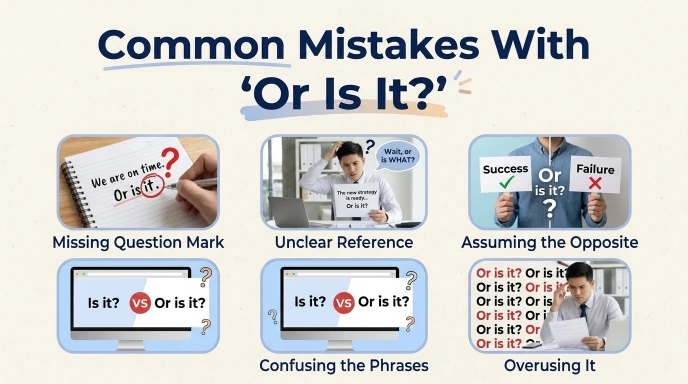
The phrase is simple, but a few common mistakes can affect its meaning or readability.
Mistake 1: Forgetting the question mark
Incorrect: “The answer is correct. Or is it.”
Correct: “The answer is correct. Or is it?”
Why? The second sentence asks a question, even though it is short.
Memory tip: If the phrase asks the reader to reconsider something, use a question mark.
Mistake 2: Using the phrase without a clear reference
Unclear: “Or is it?”
Clearer: “This seems like the best option. Or is it?”
Why? The short question works best when readers know which idea is being questioned. It can stand alone in dialogue when the context is already clear.
Memory tip: Give readers a statement to think about before challenging it.
Mistake 3: Assuming it always means the opposite
Incorrect interpretation: “Or is it?” always proves the earlier statement is false.
Correct interpretation: “Or is it?” expresses doubt or introduces another possibility.
Why? The speaker may be uncertain without knowing the correct answer.
Memory tip: Think “Maybe I should reconsider,” not “The opposite must be true.”
Mistake 4: Confusing “or is it?” with “is it?”
Example A: “Is it ready?”
Example B: “It looks ready. Or is it?”
Why? “Is it?” asks a direct question. “Or is it?” usually challenges an earlier statement or assumption.
Memory tip: “Or” signals an alternative or a reason to reconsider.
Mistake 5: Using it too often in formal writing
Weak: “The results are clear. Or are they? The method is reliable. Or is it?”
Better: “The results appear clear, but further testing is needed to confirm their reliability.”
Why? Repeated rhetorical questions can make professional writing sound vague or overly dramatic.
Memory tip: Use the phrase to create a meaningful pause, not to replace clear reasoning.
Everyday Examples of “Or Is It?”
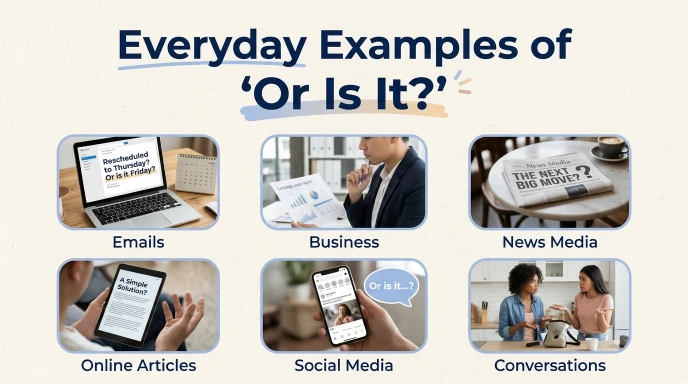
The phrase appears in many forms of writing. Its purpose changes slightly depending on if the writer wants to question a fact, create curiosity, or invite discussion.
Emails
- “I believe the meeting is scheduled for Friday. Or is it Thursday?”
- “I thought you had already sent the file. Or is it still pending?”
In emails, the phrase can show uncertainty about dates, plans, or information. For professional communication, a direct question may be more efficient.
Business writing
- “The new process appears more efficient. Or is it?”
- “Our latest campaign seems successful. Or is there more to consider?”
These examples can work in presentations and discussions. In formal reports, explain the concern instead of leaving the question unanswered.
News headlines
- “The Mystery Is Solved. Or Is It?”
- “A New Record for the Team. Or Is It?”
A headline can use the phrase to suggest that the full story may be more complicated than it first appears. The headline should still match the article’s actual content.
Blogs
- “Is This Really the Best Way to Learn English? Or Is It?”
- “Everyone Recommends This Writing Trick. Or Is It Worth Trying?”
Bloggers use the phrase to challenge common advice and encourage readers to explore an issue further.
Social media
- “Monday is the worst day of the week. Or is it?”
- “This is the perfect vacation spot. Or is it?”
Short, conversational examples work well on social platforms because they invite people to share opinions or reconsider familiar ideas.
Academic writing
- “The initial findings appear conclusive, but are they supported by the full data set?”
- “The proposed explanation seems plausible. However, alternative explanations must also be considered.”
In academic writing, the idea behind “or is it?” is useful, but a precise question usually communicates the point more clearly. Use the short phrase only when the tone and context allow it.
Daily conversation
- “I thought the store closed at eight. Or is it nine?”
- “That looks like your bag. Or is it mine?”
- “He seems angry. Or is he just tired?”
These examples show how naturally the phrase fits ordinary speech. It can express real uncertainty without sounding formal.
Google Trends and Modern Usage
People search for “or is it” for several reasons. They may want to understand the phrase, check its grammar, learn where to put the question mark, or find examples for writing.
The phrase is also common in headlines and online discussions because it creates curiosity. A statement followed by “Or Is It?” suggests that the answer may be less obvious than readers first think.
Regional popularity
“Or is it?” is standard in both American and British English. There is no established regional spelling difference to explain, and the phrase does not need to be adapted for either audience.
However, that does not mean search interest is identical across countries. Search patterns can vary by location, season, topic, and the wording people use in their queries.
What Google Trends can tell you
Google Trends can help compare search interest across selected regions and time periods. It displays relative search interest rather than a direct count of all searches.
Without a verified Trends comparison for the exact phrase and selected date range, it would be misleading to claim that the phrase is more popular in one country or that its popularity has increased by a particular percentage.
Why people confuse its meaning
The main confusion comes from context. Some readers interpret “or is it?” as a simple question, while others understand it as a challenge to the statement before it.
Compare:
- Direct question: “Is it your book?”
- Questioning a statement: “That is your book. Or is it?”
- Offering alternatives: “Is it your book or mine?”
All three examples are grammatical, but they serve different purposes. Understanding the surrounding sentence is the easiest way to interpret the phrase.
Quick Comparison
| Version | Meaning | Correct? | Region | Example |
| Or is it? | Questions a previous statement | Yes | All major English varieties | “It seems simple. Or is it?” |
| Is it? | Asks a direct question | Yes | All major English varieties | “Is it ready?” |
| Or isn’t it? | Questions or challenges a statement, often with a different emphasis | Yes, in suitable contexts | All major English varieties | “That is unusual. Or isn’t it?” |
| Or could it be? | Introduces another possible explanation | Yes | All major English varieties | “It may be a mistake. Or could it be intentional?” |
| Maybe not | Expresses uncertainty or a possible negative answer | Yes | All major English varieties | “Maybe not. We should check.” |
The alternatives are not always interchangeable. “Or is it?” is often more conversational and suspenseful, while “or could it be?” introduces a possible explanation more explicitly.
Key Takeaways
- “Or is it?” is a correct and common English phrase.
- It often questions a previous statement or assumption.
- The phrase can express doubt, uncertainty, curiosity, or suspense.
- It is written the same way in British and American English.
- Use a question mark when it functions as a question.
- Give readers enough context to understand what is being questioned.
- In academic and business writing, a direct explanation is often clearer.
- Do not assume the phrase proves that the earlier statement is false.
Frequently Asked Questions
What does “or is it?” mean in English?
“Or is it?” usually means “Could that be wrong?” or “Might another possibility be true?” It follows a statement and invites the reader or listener to reconsider it. For example, “This is the easiest solution. Or is it?” suggests that the solution may not be as easy as it first appears.
Is “or is it?” grammatically correct?
Yes. “Or is it?” is grammatically acceptable as a question in context. It often follows a statement and uses the information from that statement rather than repeating it. This makes it a natural construction in conversation, fiction, headlines, and informal writing. The key is to make sure readers can understand what the question refers to.
Should “or is it” have a question mark?
When the phrase functions as a question, write it as “Or is it?” For example, “The problem is solved. Or is it?” The question mark shows that the speaker is reconsidering the earlier claim. In a title, capitalization may depend on the publisher’s style, but the question mark remains appropriate when the title asks a question.
What is the difference between “is it?” and “or is it?”
“Is it?” asks a direct question, while “or is it?” often challenges or reconsiders something mentioned earlier. For example, “Is it finished?” asks if a task is complete. “It looks finished. Or is it?” suggests that the task may not actually be complete.
Can you start a sentence with “Or is it?”
Yes. You can start a sentence with “Or is it?” when it follows an earlier statement or when the context makes the reference clear. For example, “Everyone believes the case is closed. Or is it?” This structure is common in conversational writing and dramatic headlines. In formal writing, a more explicit transition may sometimes be better.
Is “or is it?” formal or informal?
The phrase is grammatically standard, but its tone is often conversational, rhetorical, or dramatic. It works well in stories, blog posts, opinion articles, and headlines. In academic papers, legal documents, and formal business reports, writers should usually explain the uncertainty directly so readers know exactly what evidence or issue is being questioned.
What is another way to say “or is it?”
Depending on the context, you could write “Could that be wrong?”, “Are we sure?”, “Could it be otherwise?”, or “Is that really the case?” For example, “This is the best option. Or is it?” could become “This seems like the best option, but are we sure?” Choose the alternative that best expresses your intended meaning.
Is “or is it?” the same in British and American English?
Yes. The phrase has the same basic meaning and spelling in British and American English. Writers in both regions use it to express doubt or introduce an alternative possibility. Differences may occur in the style of the surrounding text or in headline capitalization, but there is no standard US-versus-UK spelling distinction for this phrase.
Can “or is it?” be used in a headline?
Yes. “Or Is It?” is often used in headlines to create curiosity and suggest that a story may challenge an initial assumption. For example, “The Mystery Is Over. Or Is It?” encourages readers to investigate further. Use this style when the article genuinely explores uncertainty or a surprising alternative, rather than adding it simply to attract clicks.
Why do writers use “or is it?” after a statement?
Writers use it to make readers pause and reconsider a claim. The phrase can introduce doubt, irony, suspense, or an alternative explanation without immediately revealing the answer. It is especially useful when the writer wants to challenge a popular belief or create a transition to a deeper discussion.
Conclusion
The phrase “or is it?” is a useful part of everyday English. It allows speakers and writers to question an earlier statement, express uncertainty, or introduce another possibility. Although the phrase is short, it can change the tone of a sentence by encouraging readers to think more carefully about what they have just read.
The main point is that “or is it?” does not automatically mean the first statement is wrong. Instead, it asks if the statement should be reconsidered. For example, “This is the best choice. Or is it?” leaves room for another answer.
The phrase works in both British and American English, and its spelling does not change between regions. Use it freely in conversations, blogs, stories, and headlines when it suits your tone. For academic papers and formal business documents, a direct explanation of your uncertainty may be more effective.
Remember the simple rule: Use “or is it?” when you want to question an idea, and make sure the context tells readers what you mean.
If you enjoy learning the small differences that make English clearer, explore more grammar guides and practical examples to strengthen your writing.
READ MORE!
- Aye or Nay: Meaning, Difference, and How to Use Them
- Vulkan vs DX11: Which Is Better for Gaming?
- Relieve or Relief: What Is the Difference?

I’m Edward Fletcher, a UK-based English language writer with a passion for grammar and vocabulary. At VocabNex, I share simple explanations, useful examples, and practical English tips to help learners improve their language skills and communicate with confidence.






2 thoughts on “Or Is It? Meaning, Usage, and Examples”