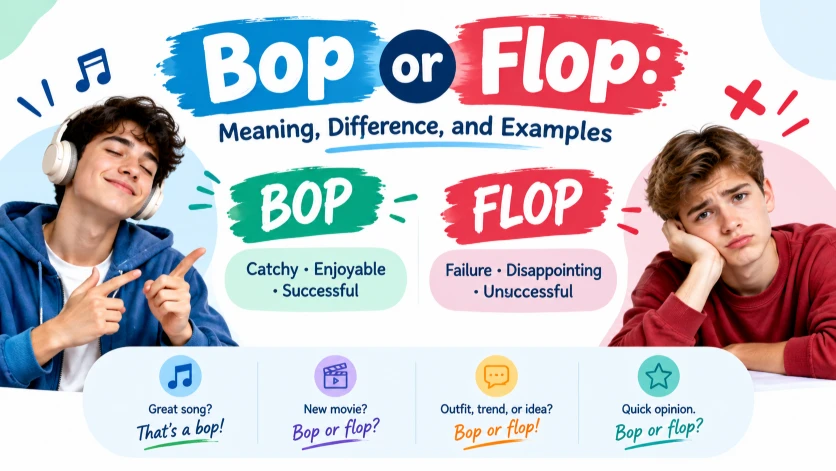
When someone asks “bop or flop?”, they usually want a quick opinion: Is something good, catchy, or successful, or does it miss the mark? In casual online language, bop is generally the positive choice, while flop describes something unsuccessful, disappointing, or poorly received.
The phrase is especially common when people talk about songs, albums, outfits, videos, trends, and other pop-culture content. For example, “This new song is a bop” means the speaker really likes the song. “That song was a flop” means it failed to make the desired impression.
The confusion comes from the fact that bop and flop are not alternative spellings of the same word. They have different meanings and are often used as opposites in informal conversation. The phrase “bop or flop?” simply asks which side of that contrast something belongs on.
This guide explains the meaning, history, grammar, regional usage, common mistakes, and everyday examples of bop or flop.
Bop or Flop: Quick Answer
Bop is usually a positive slang term for a catchy, enjoyable song or something that people strongly like. Flop means a failure or something that does not succeed.
Examples:
- “That new track is a bop.”
- “The album was a flop.”
- “Bop or flop? I actually love this song.”
So, if someone asks “bop or flop?”, they are usually asking, “Is this good or is it a miss?”
The phrase is informal. It works naturally in social media posts, comments, texts, music discussions, and casual conversations. It is less suitable for formal academic or professional writing.
What Does Bop or Flop Mean?
Bop or flop is a casual way to ask for a quick judgment about something.
In the most common music-related use:
- Bop = a very enjoyable or catchy song.
- Flop = something unsuccessful, disappointing, or poorly received.
The two words do not have identical grammatical roles.
Bop
In modern informal speech, bop can describe a song that is catchy, enjoyable, or fun to listen to.
For example:
“This chorus is such a bop.”
Cambridge Dictionary records several established meanings of bop, including dancing to pop music and a noun referring to bebop jazz. It also records bop as a light hit in American English.
The modern slang meaning of bop as praise for a song is especially common in informal internet and music language.
Flop
Flop can mean to fail or to be unsuccessful.
For example:
“The movie flopped at the box office.”
As a noun, a flop means a failure:
“The new show was a flop.”
Cambridge Dictionary defines flop as a verb meaning to be unsuccessful and as a noun meaning a failure.
Bop or Flop as a Pair
When the words appear together, they create a simple contrast:
Bop = positive reaction
Flop = negative reaction
That is why “bop or flop?” works well as a quick social-media question.
The Origin of Bop or Flop
The two words have separate histories.
Where Does Bop Come From?
The word bop has more than one historical sense.
One meaning comes from an imitative verb meaning to hit or strike lightly. Another musical meaning developed from bebop, the jazz style associated with the 1940s. The bop form was used as a shortened form of bebop.
Oxford also identifies the musical noun bop as a shortening of bebop.
Over time, bop developed broader informal uses connected with music, dancing, and enjoyable songs. Modern speakers may therefore say:
“That song is a bop.”
The exact history of every modern slang use should not be treated as a single straight line. The word has had several meanings across different periods and contexts.
Where Does Flop Come From?
Flop has a much older history as a word describing movement or falling.
Etymological sources trace the verb to around the early 1600s, probably as a variant of flap with a heavier sound. The sense of falling or dropping heavily developed later, while the figurative sense of failure emerged much later.
That gives the modern word a useful connection between physical collapse and failure:
“He flopped onto the sofa.”
and:
“The project flopped.”
The two meanings are different, but both are established uses of flop.
British English vs American English
There is no major British-versus-American spelling difference between bop and flop. The same spellings are used in both varieties.
However, bop has some regional differences in established dictionary meanings.
| Feature | British English | American English |
| Bop spelling | bop | bop |
| Flop spelling | flop | flop |
| Bop as music slang | Used informally | Used informally |
| Bop as a dance | Established informal use | Less central as a dictionary sense |
| Flop meaning failure | Common | Common |
| “Bop or flop?” online | Informal | Informal |
| Formal writing | Usually avoided as slang | Usually avoided as slang |
Cambridge lists bop as a mainly British noun for a dance to pop music, while its American entries include the noun meaning a light hit and the established jazz sense.
The important point is that bop or flop is not a British-versus-American spelling issue. Both varieties use the same spellings.
Which Version Should You Use?
The right choice depends on what you mean.
United States
Use bop when you mean a catchy or enjoyable song in casual speech.
“This song is a bop.”
Use flop when something has failed or performed poorly.
“The movie was a flop.”
United Kingdom
The same basic distinction works.
In addition, bop has an established British informal meaning referring to a dance or dancing event.
Canada
In casual Canadian English, the same general distinction is understandable:
- bop for something enjoyable, especially music
- flop for something unsuccessful
For formal writing, clearer standard terms are usually preferable.
Australia
Australian readers will generally understand bop and flop in informal pop-culture contexts.
The choice is still based on meaning, not spelling.
International Writing
For an international audience, context matters.
If you write:
“This song is a bop.”
many readers familiar with current internet or music slang will understand the positive meaning.
For a broad or formal audience, however, catchy, excellent, successful, or unsuccessful may be clearer.
Academic Writing
Avoid “bop or flop” unless you are discussing slang itself.
Instead, write:
“The song received a positive response.”
rather than:
“The song was a bop.”
Business Writing
The phrase is usually too casual for reports, proposals, and formal workplace documents.
Use terms such as:
- successful
- unsuccessful
- effective
- ineffective
- well received
- poorly received
Common Mistakes With Bop or Flop
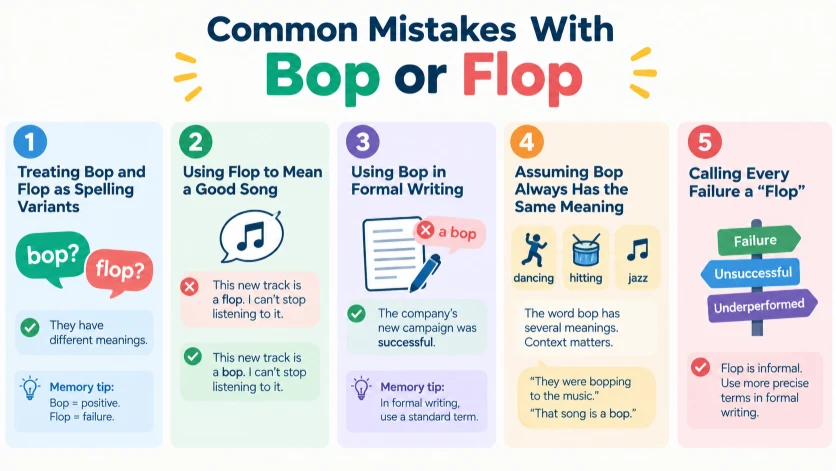
Mistake 1: Treating Bop and Flop as Spelling Variants
❌ “Is the correct word bop or flop?”
This can suggest that one word is simply a misspelling of the other.
✅ “Is this song a bop or a flop?”
Here, the words form a comparison.
Why? They have different meanings.
Memory tip: Bop = positive. Flop = failure.
Mistake 2: Using Flop to Mean a Good Song
❌ “This new track is a flop. I can’t stop listening to it.”
The two ideas conflict if the speaker means the song is excellent.
✅ “This new track is a bop. I can’t stop listening to it.”
Mistake 3: Using Bop in Formal Writing
❌ “The company’s new campaign was a bop.”
The sentence may be understandable, but it sounds highly informal.
✅ “The company’s new campaign was successful.”
Memory tip: If the setting is formal, replace slang with a precise standard term.
Mistake 4: Assuming Bop Always Has the Same Meaning
The word bop has several established meanings. Cambridge records meanings involving dancing, hitting, and bebop jazz.
Context matters.
“They were bopping to the music.”
Here, bopping relates to dancing.
“That song is a bop.”
Here, bop is informal praise for the song.
Mistake 5: Calling Every Failure a “Flop”
Flop is informal. In formal writing, words such as failure, unsuccessful, or underperformed may communicate the idea more precisely.
Everyday Examples
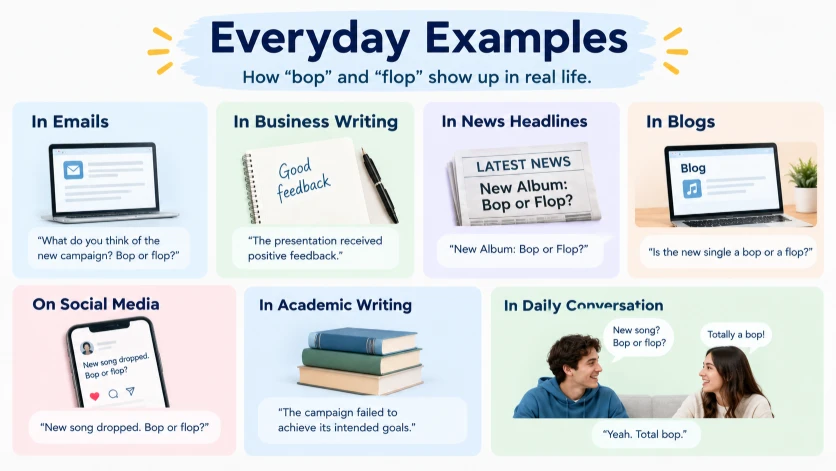
In Emails
Casual:
“What do you think of the new campaign? Bop or flop?”
Professional:
“What do you think of the new campaign? Do you think it will be successful?”
The second version is better for a formal business email.
In Business Writing
A casual workplace chat might say:
“That presentation was a bop.”
A formal report would more likely say:
“The presentation received positive feedback.”
Flop can also appear in informal business discussion:
“The launch was a flop.”
But formal reports usually need more specific evidence than a slang label.
In News Headlines
Informal entertainment coverage may use language such as:
“New Album: Bop or Flop?”
A more formal headline might say:
“New Album Receives Mixed Reviews.”
The first is designed for quick engagement. The second communicates the subject more directly.
In Blogs
A music blog might write:
“Is the new single a bop or a flop?”
This fits a conversational review style.
A more formal review might say:
“The new single succeeds because of its strong chorus and memorable rhythm.”
On Social Media
This is where the phrase feels most natural.
Examples include:
“New song dropped. Bop or flop?”
“Be honest. Is this outfit a bop or a flop?”
“I thought it would flop, but this is actually a bop.”
The phrase works because it invites a fast reaction.
In Academic Writing
Avoid the slang unless the subject is language, popular culture, or social-media communication.
Instead of:
“The campaign was a flop.”
write:
“The campaign failed to achieve its intended goals.”
In Daily Conversation
Friends might say:
“Have you heard the new song?”
“Yeah. Total bop.”
Or:
“Did you watch that new movie?”
“Yes, but it was a flop for me.”
The phrase is casual and often subjective.
Google Trends & Modern Usage
People search “bop or flop” because the phrase is easy to encounter in social media, music discussions, comments, and pop-culture conversations.
It is especially useful as a quick reaction format. Instead of asking for a long review, someone can ask if a song, outfit, video, trend, or idea is a bop or flop.
Current online usage also shows that bop can have meanings beyond music. Some internet communities use it as a derogatory label for a person, particularly a woman. That meaning is separate from the positive music sense and can be offensive.
Because meanings can change with context, readers should look at the noun and surrounding sentence before interpreting bop.
There is no need to invent a precise popularity percentage for the phrase. Search interest can change quickly across platforms and regions, and general web usage does not by itself establish a reliable worldwide frequency.
The safest general rule is simple:
When “bop” describes music, it is usually positive. When “flop” describes a release or project, it usually means failure.
Quick Comparison
| Version | Meaning | Correct? | Region | Example |
| bop | Catchy or enjoyable song in informal slang | Yes | Broad informal use | “This song is a bop.” |
| flop | Failure or unsuccessful result | Yes | Broad English use | “The movie was a flop.” |
| bop or flop | A quick positive-or-negative judgment | Yes | Informal, especially online | “Bop or flop?” |
| bopping | Dancing or moving to music | Yes | Informal | “They were bopping to the song.” |
| flopped | Failed or was unsuccessful | Yes | Broad English use | “The show flopped.” |
| successful | Achieved the desired result | Yes | Formal and informal | “The launch was successful.” |
| failure | Lack of success | Yes | Formal and informal | “The launch was a failure.” |
Bop vs. Flop: Meaning in One Glance
| Word or phrase | Positive or negative? | Main informal use | Formal alternative |
| Bop | Positive | Great or catchy song | Excellent, catchy, enjoyable |
| Flop | Negative | Failure or disappointment | Failure, unsuccessful result |
| Bop or flop? | Either | Asking for a quick opinion | Is it successful or unsuccessful? |
| Bopping | Neutral | Dancing or moving to music | Dancing |
| Flopped | Negative | Failed | Failed, underperformed |
Key Takeaways
- Bop and flop are different words, not spelling alternatives.
- In modern informal music language, bop usually expresses approval.
- Flop means a failure or something that was unsuccessful.
- “Bop or flop?” asks for a quick judgment.
- The phrase is especially natural in casual online and pop-culture contexts.
- Bop has other dictionary meanings, including connections with dancing, hitting, and bebop jazz.
- Flop has long-established meanings related to falling and failure.
- For academic and formal business writing, clearer standard vocabulary is usually better.
- Context is important because modern slang can develop additional meanings.
FAQs
What is bop or flop?
“Bop or flop” asks if a song is enjoyable and catchy (bop) or disappointing and not well received (flop).
What does “Bop” mean in K-pop slang?
In K-pop slang, bop usually means a very good, catchy, or enjoyable song.
What are flop songs?
Flop songs are songs that are considered unsuccessful, unpopular, or disappointing by listeners or fans.
Is bop slang for a good song?
Yes. Bop is informal slang for a song that is catchy, fun, or enjoyable to listen to.
What is the bop girl?
“Bop girl” is informal slang whose meaning depends on context. It can describe a girl associated with a fun, energetic, or trendy vibe, but it can also be used as a derogatory sexual label.
How to tell if a girl has a bop?
If you mean “bop” as slang for a person, be careful with the term because it can be insulting or sexualized. It is better to describe someone’s personality or style directly.
Conclusion
Bop or flop is a simple informal phrase that asks if something deserves approval or has failed to impress. When talking about music, bop usually means a catchy or enjoyable song. Flop, by contrast, describes something unsuccessful, disappointing, or unsuccessful in its intended purpose.
The key point is that bop and flop are not spelling variants. They are separate words with separate histories and meanings. Bop has established connections to dancing and bebop jazz, while flop developed from older senses involving falling or dropping and later gained its failure meaning.
Use “bop or flop?” freely in casual conversations, music discussions, social posts, and other informal settings. For academic or professional writing, replace the slang with more precise language such as successful, unsuccessful, catchy, well received, or disappointing.
Remember: a bop is the compliment, a flop is the letdown.
READ MORE!
- Adjuster or Adjustor: Which Spelling Is Correct?
- Java or Python: Key Differences, Uses, and Features
- Faint vs Feint: Understanding the Difference

I’m passionate about English grammar, vocabulary, and clear communication. I enjoy making English easier to understand through simple, practical, and easy-to-follow explanations. My goal is to help learners build confidence and improve their English for everyday use.








1 thought on “Bop or Flop: Meaning, Difference, and Examples”