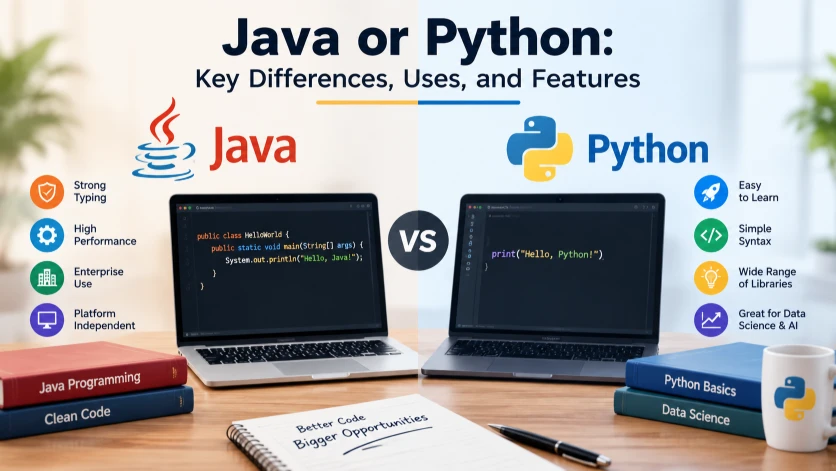
If you are choosing between Java or Python, the right choice depends on what you want to build and learn. Python is known for simple, readable syntax and fast development, while Java is a strongly typed, object-oriented language widely used for large applications and software systems. Both are powerful programming languages, but they have different strengths.
People often search for Java vs Python because both languages are popular choices for students, developers, automation, software development, and technical careers. The confusion usually starts when someone asks which language is easier, faster, better for beginners, or more useful for a particular project.
The answer is not simply that one language replaces the other. Java and Python solve many of the same programming problems, but they approach them differently.
This guide explains the difference between Java and Python in simple terms. You will learn how their syntax, typing, performance, learning curve, applications, and development styles compare. You will also see practical examples to help you decide where each language fits best.
Java or Python: Quick Answer
Choose Python when you want simple syntax, rapid development, scripting, automation, data analysis, or a beginner-friendly starting point.
Choose Java when you need a strongly typed language, large-scale application development, or a structured environment commonly used in enterprise software.
Python is often useful for:
- Beginners learning programming
- Automation and scripting
- Data analysis
- Artificial intelligence and machine learning
- Scientific computing
- Rapid prototypes
- Web applications
Java is often useful for:
- Enterprise applications
- Large software systems
- Backend development
- Android-related development and existing Java ecosystems
- Distributed applications
- Systems where strong typing and structured development are important
The important point is that Java and Python are not competitors in every situation. A development team may use both.
What Does Java or Python Mean?
Java and Python are programming languages. They let developers give instructions to computers and create software.
What is Java?
Java is a general-purpose, class-based, object-oriented programming language. It is strongly and statically typed.
Java code is normally compiled into bytecode that runs on the Java Virtual Machine, or JVM. This design supports Java’s long-standing goal of portability across different systems.
For example:
public class Hello {
public static void main(String[] args) {
System.out.println(“Hello, world!”);
}
}
Java usually requires more structure around even small programs. That can make the language feel more detailed at first, but the structure can also help developers manage large codebases.
What is Python?
Python is a general-purpose programming language known for readable syntax and a concise programming style.
A simple Python program can look like this:
print(“Hello, world!”)
Python lets beginners create useful programs with relatively little code. Its broad ecosystem also makes it useful across areas such as automation, web development, scientific computing, data work, and AI.
Java vs Python: Syntax and Readability
One of the most visible differences is syntax.
Java generally requires explicit types and more structural code.
For example:
int age = 20;
System.out.println(age);
Python can express the same basic idea more briefly:
age = 20
print(age)
Python also uses indentation as part of its syntax. Java normally uses braces to define blocks of code.
This means Python code can look shorter and more approachable to a new programmer. Java exposes more of the program’s structure, which can be useful when working on large applications.
Neither approach is automatically better. They serve different development preferences and project needs.
The Origin of Java or Python
Java and Python were created in different periods and for different goals.
The history of Java
Java began as part of a research project at Sun Microsystems. The language was originally called Oak and was designed by James Gosling and colleagues for software associated with consumer devices.
The project later shifted toward networked computing. Oak was renamed Java, and the language became closely associated with portable software and the growing Internet.
Java’s design emphasized portability. Its virtual-machine approach allowed compiled Java programs to run on systems that provided an appropriate Java runtime.
The history of Python
Python was created by Guido van Rossum in the early 1990s at Stichting Mathematisch Centrum in the Netherlands. Python was developed as a successor to the ABC programming language.
Python’s design placed strong emphasis on readability and programmer productivity.
The Python Software Foundation was established in 2001 to support Python-related intellectual property and the wider Python ecosystem.
The different origins help explain why the languages developed distinct programming styles.
British English vs American English
Java and Python are programming languages, so the British-versus-American spelling distinction does not apply to the language names themselves.
However, documentation and programming terminology can sometimes reflect regional English preferences.
| Term | British English | American English | Example |
| Program | program | program | Write a Python program. |
| Programming | programming | programming | Java programming is widely taught. |
| Organization | organisation | organization | The organization uses Java. |
| Color | colour | color | The interface uses a color setting. |
| Center | centre | center | Put the element in the center. |
When writing technical content for an international audience, consistency matters more than choosing one regional spelling.
For software documentation, follow the style guide of the organization or publication. If the documentation targets US readers, American spelling may be preferred. UK publications may use British spelling.
The language names Java and Python remain unchanged.
Which Version Should You Use?
There is no single version that every programmer should choose.
United States
Both Java and Python are widely used in US technology and education. Choose based on the role, project, or course requirements.
United Kingdom
The same principle applies. Your location does not require you to choose one programming language over the other.
Canada
Both languages can be useful. Consider the technology stack used by the school, employer, or project.
Australia
Python and Java can both be appropriate. Your specific development goal matters more than regional preference.
International Writing
Use Java and Python consistently. When writing about programming, avoid treating the names as interchangeable terms.
Academic Writing
Follow your instructor, course, department, or research project’s requirements. If you are learning fundamental programming concepts, Python may provide a shorter path to writing working code.
If your course specifically teaches Java, learning Java is the practical choice for that course.
Business Writing
Use the language already supported by the organization when contributing to an existing software system. Compatibility, libraries, developer skills, infrastructure, and maintenance requirements may matter more than personal preference.
Common Mistakes
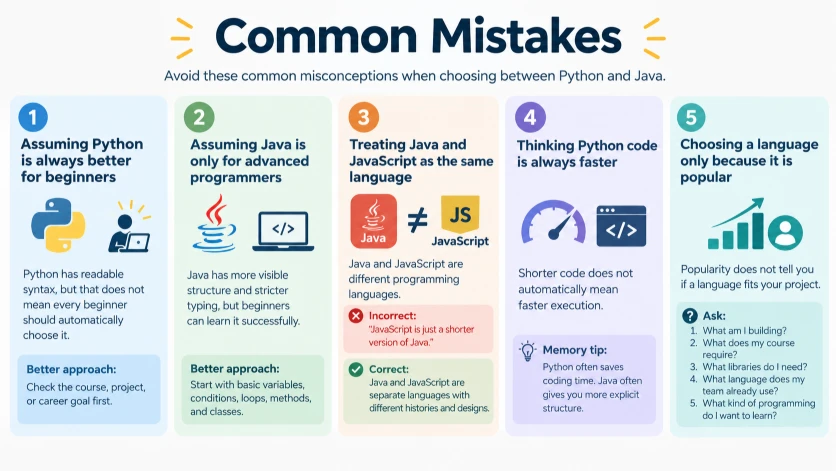
Mistake 1: Assuming Python is always better for beginners
Python has readable syntax, but that does not mean every beginner should automatically choose it.
Better approach: Check the course, project, or career goal first.
Mistake 2: Assuming Java is only for advanced programmers
Java has more visible structure and stricter typing, but beginners can learn it successfully.
Better approach: Start with basic variables, conditions, loops, methods, and classes.
Mistake 3: Treating Java and JavaScript as the same language
Java and JavaScript are different programming languages.
Incorrect: “JavaScript is just a shorter version of Java.”
Correct: Java and JavaScript are separate languages with different histories and designs.
Mistake 4: Thinking Python code is always faster
Shorter code does not automatically mean faster execution.
Memory tip:
Python often saves coding time. Java often gives you more explicit structure.
Mistake 5: Choosing a language only because it is popular
Popularity does not tell you if a language fits your project.
Ask:
- What am I building?
- What does my course require?
- What libraries do I need?
- What language does my team already use?
- What kind of programming do I want to learn?
Java or Python in Everyday Examples
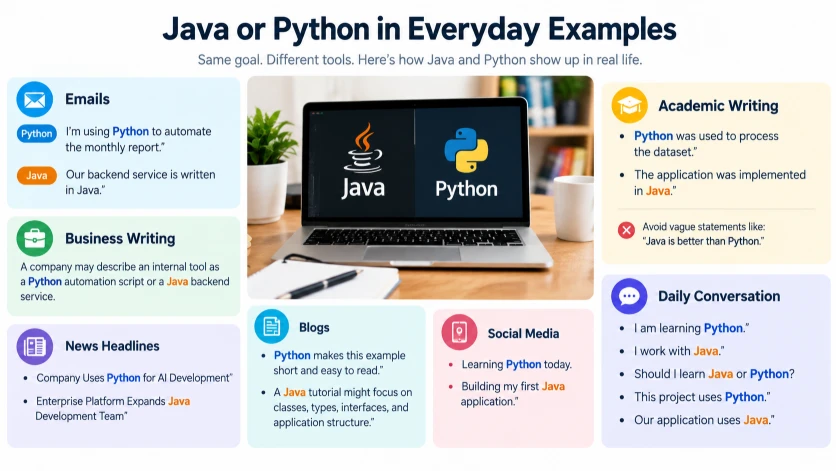
Emails
Python example:
“I’m using Python to automate the monthly report.”
Java example:
“Our backend service is written in Java.”
Both sentences are correct. The language depends on the software being discussed.
Business Writing
A company may describe an internal tool as a Python automation script or a Java backend service.
Technical business writing should name the actual technology rather than using Java and Python as general synonyms for programming.
News Headlines
Examples include:
- Company Uses Python for AI Development
- Enterprise Platform Expands Java Development Team
The language name provides information about the technology involved.
Blogs
A programming blog might explain:
“Python makes this example short and easy to read.”
A Java tutorial might instead focus on classes, types, interfaces, and application structure.
Social Media
Developers may casually write:
“Learning Python today.”
or:
“Building my first Java application.”
Both are natural uses.
Academic Writing
In academic writing, be precise:
“Python was used to process the dataset.”
or:
“The application was implemented in Java.”
Avoid vague statements such as:
“Java is better than Python.”
A stronger academic sentence explains the specific criterion being discussed.
Daily Conversation
People commonly say:
- “I am learning Python.”
- “I work with Java.”
- “Should I learn Java or Python?”
- “This project uses Python.”
- “Our application uses Java.”
Java or Python: Performance and Development Speed
Performance is one of the most common reasons people compare Java and Python.
Java is generally designed around compilation to JVM bytecode and runtime optimization. Python implementations commonly prioritize flexibility and developer productivity rather than raw execution speed.
However, real-world performance depends on the implementation, libraries, workload, hardware, architecture, and optimization.
Development speed is a different question.
Python often allows developers to express an idea in fewer lines. This can make prototypes and many scripts quick to write.
Java’s additional structure can be valuable when maintaining large systems with many developers.
So it is useful to separate two questions:
- How quickly can I write the program?
- How efficiently does the finished program run?
They are not the same measurement.
Google Trends & Modern Usage
People search for Java or Python, Java vs Python, and Python vs Java for several reasons.
Common search intent includes:
- Which language is easier to learn?
- Which is better for beginners?
- Which is faster?
- Which language is better for AI?
- Which is better for jobs?
- Should I learn Java or Python first?
- What is the difference between Java and Python?
Search interest can also vary by region, education level, industry, and technology trend.
There is no single universal answer to which language is “better.” Modern programming involves many specialized fields, and both languages continue to have established ecosystems.
For current language releases, always check official documentation rather than relying on old tutorials or outdated comparison articles.
Quick Comparison
| Version | Meaning | Correct? | Region | Example |
| Java | General-purpose programming language | Yes | International | “I am learning Java.” |
| Python | General-purpose programming language | Yes | International | “I am learning Python.” |
| JavaScript | Separate programming language | Yes | International | “The website uses JavaScript.” |
| Java vs Python | Comparison of two languages | Yes | International | “Java vs Python is a common comparison.” |
Java vs Python Feature Comparison
| Feature | Java | Python |
| Typing | Statically typed | Dynamically typed |
| Syntax | More explicit | More concise |
| Learning curve | Structured but can feel detailed | Often approachable for beginners |
| Development style | Strong object-oriented structure | Multi-paradigm |
| Common uses | Enterprise software, backend systems, large applications | Automation, data work, AI/ML, scripting, web development |
| Runtime | Commonly runs on the JVM | Commonly runs through a Python interpreter/runtime |
| Code length | Often more verbose | Often shorter |
| Portability | Major design goal | Cross-platform |
| Ecosystem | Large and mature | Large and broad |
| Best choice | Depends on project requirements | Depends on project requirements |
Key Takeaways
- Java and Python are both general-purpose programming languages.
- Python is known for readable syntax and rapid development.
- Java uses strong static typing and a more explicit structure.
- Python can be an approachable first programming language.
- Java can be useful for large, structured software systems.
- Neither language is automatically the right choice for every project.
- Your project, course, team, and technical requirements should guide the decision.
- Learning one does not prevent you from learning the other later.
FAQs
Is it better to learn Python or Java?
Python is generally easier for beginners, while Java is useful for structured, large-scale application development.
Which is the no. 1 coding language?
There is no single no. 1 coding language; the best choice depends on your goals and project needs.
Is Python or Java more difficult?
Java is generally more difficult to learn at first because it uses more explicit syntax and structure.
Which is faster, Java or Python?
Java is generally faster than Python for many CPU-intensive applications because it runs on the JVM.
Which is a higher salary, Python or Java?
Salary depends on the role, experience, location, and industry rather than the programming language alone.
Can I learn Java in 7 days?
You can learn Java basics in 7 days, but becoming proficient requires much more practice and experience.
Conclusion
When comparing Java or Python, the most useful question is not which language is universally better. The better question is which language fits your goal.
Python offers concise syntax and a productive development experience. That makes it attractive for beginners, automation, data analysis, scientific work, AI, and many rapid-development projects.
Java provides strong static typing, explicit structure, and a mature ecosystem suited to many large software systems. Its JVM-based design has also made portability an important part of its history.
If you are completely new to programming and want to experiment quickly, Python can be a practical starting point. If your course, employer, or project requires Java, learning Java is the logical choice.
You also do not have to make this a permanent decision. Programming fundamentals transfer between languages.
The best language is the one that fits the problem you are trying to solve.
READ MORE!
- Faint vs Feint: Understanding the Difference
- Discreetly or Discretely: What’s the Difference?
- Soy or Estoy: What’s the Difference in Spanish?

I’m passionate about English grammar, vocabulary, and clear communication. I enjoy making English easier to understand through simple, practical, and easy-to-follow explanations. My goal is to help learners build confidence and improve their English for everyday use.








2 thoughts on “Java or Python: Key Differences, Uses, and Features”