
Faint describes something weak, unclear, or losing consciousness, while Feint means a deceptive move or pretend attack. These two words sound alike, but they have different meanings and uses.
People often search for faint or feint because both words are pronounced the same in most standard English varieties. This makes them easy to confuse when writing. The difference becomes clear when you look at the context.
Use faint when you mean weak, barely noticeable, or unconscious. For example, “I heard a faint sound” or “She began to faint.” Use feint when someone makes a false movement to trick another person, especially in sports, combat, or strategy.
This guide explains their meanings, origins, spelling, common mistakes, regional usage, and everyday examples. It also gives you simple memory tricks so you can choose the right word with confidence.
Faint or Feint: Quick Answer
Faint and feint are both correct English words, but they have different meanings.
- Faint = weak, barely noticeable, or losing consciousness.
- Feint = a deceptive movement or pretend attack designed to mislead someone.
Examples:
- I heard a faint noise outside.
- She felt dizzy and almost fainted.
- The boxer made a feint with his left hand.
Easy memory tip:
Faint relates to weakness or losing consciousness. Feint relates to faking a move.
What Does Faint or Feint Mean?
What Does Faint Mean?
Faint has several common meanings.
As an adjective, it describes something that is weak, unclear, or difficult to notice.
Examples:
- There was a faint smell of smoke.
- I could see a faint light in the distance.
- She gave a faint smile.
Faint can also describe a person who is about to lose or has lost consciousness.
- He felt sick and fainted.
- She nearly fainted from the heat.
As a verb, faint means to lose consciousness for a short time.
As a noun, a faint means an episode of losing consciousness.
What Does Feint Mean?
A feint is a false or deceptive movement intended to make another person believe something will happen when it will not.
It often appears in:
- Boxing
- Fencing
- Martial arts
- Football
- Military strategy
- Other competitive situations
For example:
The boxer used a feint to make his opponent move.
Feint can also be used as a verb:
The player feinted to the left and moved right.
The key idea is deception. A feint makes someone expect one action while the person actually plans another.
The Origin of Faint or Feint
The two words have different histories, even though their modern pronunciations are very similar.
Origin of Faint
Faint entered English through Anglo-French and Old French forms related to weakness and failing strength. Its history is connected with the idea of becoming weak or losing consciousness.
Over time, faint developed several related meanings, including:
- Weak
- Barely noticeable
- Lacking strength
- Losing consciousness
This explains why we can talk about a faint sound, a faint light, or someone who faints.
Origin of Feint
Feint also came into English from French. It is related to the French verb feindre, meaning to pretend or make believe.
That history connects directly to its modern meaning. A feint is a pretend action designed to deceive an opponent.
The words therefore look and sound similar today, but they developed from different historical roots.
British English vs American English
There is no major spelling difference between British and American English for faint and feint.
| Word | British English | American English | Example |
| Faint | faint | faint | I heard a faint sound. |
| Faint as a verb | faint | faint | She may faint. |
| Feint | feint | feint | He made a feint. |
| Feinted | feinted | feinted | The player feinted left. |
Both words are standard in British and American English.
The main challenge is not regional spelling. It is meaning.
Pronunciation
In most standard varieties of English, faint and feint are homophones. They are generally pronounced like /feɪnt/.
This means you cannot rely on pronunciation to choose the spelling. You must look at the meaning and context.
Which Version Should You Use?
The right choice depends on your intended meaning, not your country.
United States
Use faint for weakness, unclear things, or loss of consciousness.
Use feint for a deceptive movement or strategy.
United Kingdom
The same distinction applies. British English uses faint and feint in the same basic ways.
Canada
Canadian English also uses both spellings according to meaning.
Australia
Australian English follows the same distinction.
International Writing
For a global audience, choose the word based on the intended meaning:
- Weak or barely visible → faint
- Deceptive movement → feint
Academic Writing
Use faint when describing weak evidence, sounds, colors, or signals.
Example:
The researchers detected a faint signal.
Use feint when discussing strategy, sports, historical combat, or deception.
Business Writing
Faint may appear when describing weak signals or indications.
The report found a faint indication of improvement.
Feint is less common in business writing but can describe a strategic deceptive action.
Common Mistakes
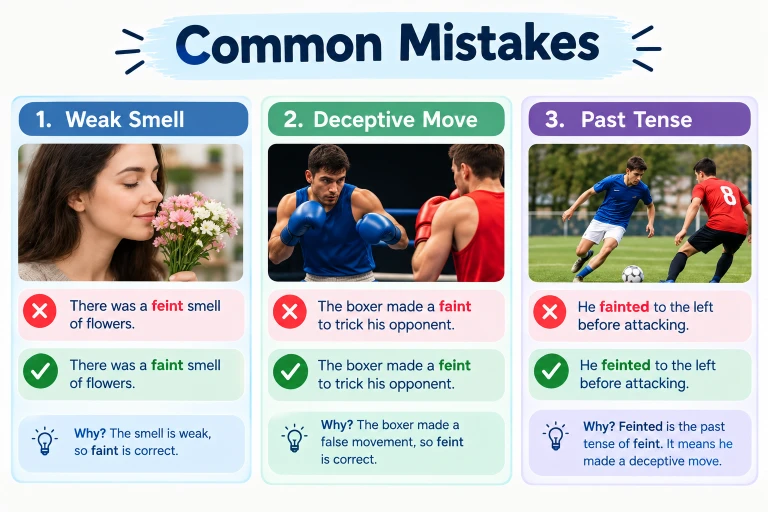
Mistake 1: Using “feint” for weak
❌ There was a feint smell of flowers.
✅ There was a faint smell of flowers.
Why? The smell is weak, so faint is correct.
Mistake 2: Using “faint” for a deceptive move
❌ The boxer made a faint to trick his opponent.
✅ The boxer made a feint to trick his opponent.
Why? The boxer made a false movement, so feint is correct.
Mistake 3: Confusing “faint” with “feinted”
❌ He fainted to the left before attacking.
✅ He feinted to the left before attacking.
Why? Feinted is the past tense of feint. It means he made a deceptive move.
A Simple Memory Tip
Remember:
Faint = weak. Feint = fake.
The word feint is connected to the idea of faking an action. If someone pretends to attack one way but moves another way, use feint.
Faint or Feint in Everyday Examples
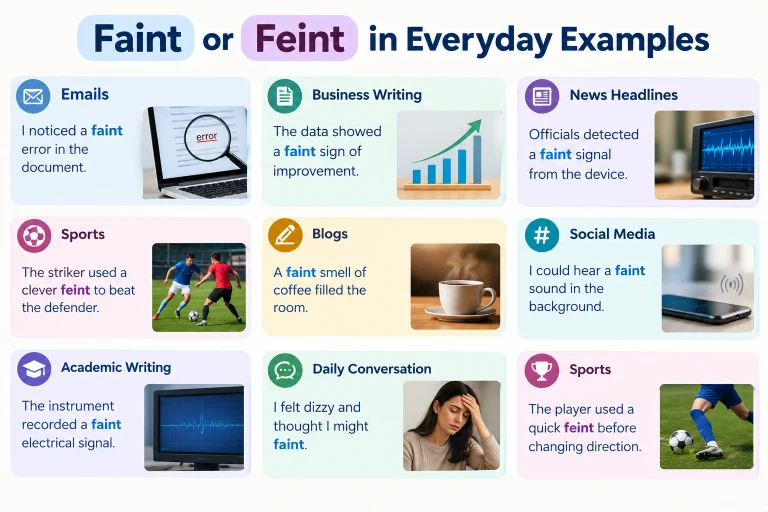
Emails
I noticed a faint error in the document.
Here, faint means slight or barely noticeable.
Business Writing
The data showed a faint sign of improvement.
News Headlines
Officials detected a faint signal from the device.
For a sports story:
The striker used a clever feint to beat the defender.
Blogs
A faint smell of coffee filled the room.
Social Media
I could hear a faint sound in the background.
Academic Writing
The instrument recorded a faint electrical signal.
Daily Conversation
I felt dizzy and thought I might faint.
Sports
The player used a quick feint before changing direction.
These examples show the central difference clearly. Faint usually describes weakness or reduced strength. Feint describes deception.
Faint or Feint: Google Trends & Modern Usage
Searches for faint or feint are largely driven by spelling confusion. Because the words are homophones, people may know how the word sounds but remain unsure which spelling fits their sentence.
Faint is much more common in everyday English because it has several meanings and appears in ordinary conversations and descriptions.
For example, people regularly use faint for:
- Weak sounds
- Weak smells
- Light colors
- Weak signs
- Losing consciousness
Feint has a narrower meaning. It appears more often in sports, fencing, boxing, martial arts, military writing, and discussions of strategy.
Exact Google Trends popularity can change by country, date range, and search wording. It is therefore better to describe general usage patterns than to claim fixed search numbers.
The important point is that faint and feint are not regional alternatives. They are different words with different meanings.
Quick Comparison
| Version | Meaning | Correct? | Region | Example |
| Faint | Weak or barely noticeable | ✅ | US, UK, Canada, Australia | A faint sound came from outside. |
| Faint | Lose consciousness | ✅ | US, UK, Canada, Australia | She began to faint. |
| Feint | Deceptive movement | ✅ | US, UK, Canada, Australia | He made a feint to the left. |
| Feinted | Made a deceptive movement | ✅ | US, UK, Canada, Australia | She feinted before moving forward. |
Key Takeaways
- Faint and feint are both correct words.
- Faint means weak, slight, unclear, or unconscious.
- Feint means a deceptive or fake movement.
- The two words are usually pronounced the same.
- There is no major British-American spelling difference.
- Use faint for weak sounds, smells, colors, signs, or loss of consciousness.
- Use feint for deception in sports, combat, and strategy.
- Remember: Faint = weak; feint = fake.
FAQs About Faint or Feint
Is it feint or faint of heart?
The correct phrase is “faint of heart,” meaning someone who is easily frightened or emotionally sensitive.
Is “I feel faint” grammatically correct?
Yes. “I feel faint” is grammatically correct and means you feel as though you might lose consciousness.
What does “feint” mean?
“Feint” means a deceptive movement or action used to distract or mislead someone, especially in sports or fighting.
Is “faint” or “feint” the correct sound?
Both words are pronounced the same, but they have different meanings and spellings.
Is it feint or faint?
Both are correct words, but they are used differently. Faint relates to weakness, dimness, or loss of consciousness, while feint means a deceptive move.
Is the phrase “faint of heart”?
Yes. “Faint of heart” is the correct phrase and describes someone who lacks courage or is easily frightened.
Conclusion
The choice between faint or feint depends entirely on meaning. Faint is the word you need when something is weak, slight, unclear, or when someone loses consciousness. Feint describes a deceptive movement made to trick another person.
These words are easy to confuse because they are usually pronounced the same. However, they are not spelling variations of the same word. They have different meanings and different historical origins.
For everyday writing, remember faint for weak sounds, smells, colors, signals, or feelings of weakness. Use feint when describing a fake move in boxing, football, fencing, martial arts, or strategy.
British and American English use the same spellings, so you do not need to change your choice based on location. The meaning of your sentence should guide you.
If you remember only one rule, make it this:
Faint means weak; feint means fake.
Use that simple distinction whenever you are unsure, and you will choose the correct word with confidence.
READ MORE!
- Soy or Estoy: What’s the Difference in Spanish?
- Gift or Present: What’s the Difference and Which Is Correct?
- Zootopia or Zootropolis: What’s the Difference?

I’m passionate about English grammar, vocabulary, and clear communication. I enjoy making English easier to understand through simple, practical, and easy-to-follow explanations. My goal is to help learners build confidence and improve their English for everyday use.








2 thoughts on “Faint vs Feint: Understanding the Difference”