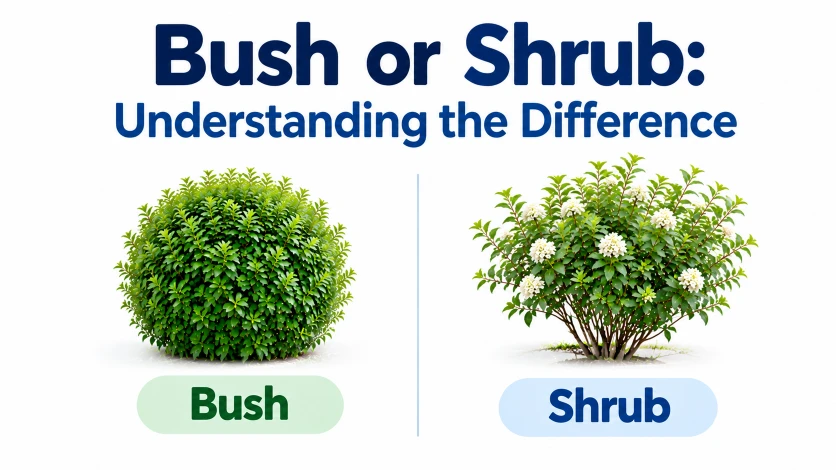
Bush and shrub often mean the same thing, but “shrub” is more common in formal gardening and plant descriptions, while “bush” is used more casually.
If you are wondering if a bush or shrub is the correct term, both can describe a low-growing, woody plant with several branches. In everyday English, bush and shrub are often interchangeable.
The main difference is one of context: shrub is more common in gardening, horticulture, and formal plant descriptions, while bush is a broader everyday word. The Royal Horticultural Society specifically notes that shrubs are more familiarly known as bushes.
This can make the choice seem harder than it is. A rose plant, for example, can be called a rose bush or a rose shrub. Both expressions are understandable, but one may sound more natural in a particular setting.
This guide explains the meaning, origin, regional use, and practical differences between bush and shrub. You will also see common mistakes, examples, and a quick comparison to help you choose the right word.
Bush or Shrub: Quick Answer
Bush and shrub are both correct words for many small, woody plants.
The simplest distinction is:
- Bush: Common, everyday term for a low, branching plant.
- Shrub: More formal or horticultural term for a woody plant with several stems.
- Rose bush: Very natural in everyday English.
- Rose shrub: Also correct, especially in gardening contexts.
- Shrub: Often preferred when discussing plant types or garden design.
- Bush: Can have additional meanings, such as wild vegetation or an uncultivated area.
Cambridge defines a bush as a plant with many small branches that creates a rounded shape. It defines a shrub as a larger plant with a rounded shape formed from many small branches, often grown in gardens.
So, if you are talking casually about a plant in your yard, bush is perfectly natural. If you are writing about horticulture, shrub may fit the context better.
What Does Bush or Shrub Mean?
What Does “Bush” Mean?
A bush is a low-growing plant with many branches. Those branches may grow directly from the ground or from a hard stem.
Examples include:
- rose bush
- lavender bush
- rhododendron bush
- berry bush
Cambridge gives examples such as rose bush, rhododendron bush, and lavender bush.
The word bush can also describe a dense group of vegetation. In countries such as Australia and South Africa, the bush can refer to undeveloped land covered with bushes and trees.
What Does “Shrub” Mean?
A shrub is a woody plant that is generally smaller than a tree and has several stems.
The Oxford Advanced Learner’s Dictionary defines a shrub as a large plant smaller than a tree, with several woody stems growing from the ground. It also lists bush as a synonym.
In horticulture, the word shrub is especially useful because it describes a general plant growth form.
The Royal Horticultural Society explains that shrubs usually have several main stems coming from near ground level rather than one central trunk.
Are Bush and Shrub Synonyms?
Often, yes.
You can usually say:
- a rose bush
- a rose shrub
Both can describe the same type of plant.
However, the words are not identical in every context. Bush has broader everyday and regional meanings, while shrub is more closely associated with the plant itself.
The Origin of Bush or Shrub
The two words have different histories even though their modern meanings overlap.
Origin of “Bush”
Bush is an old English word. Dictionary sources trace it to Old English forms such as busc and related Germanic words. Its history is connected with words for woods, bushes, and thickets.
The word developed several meanings over time.
It came to describe:
- a woody plant
- a group of shrubs
- a thicket
- uncultivated land
- other things resembling a bush
Its use for undeveloped land became especially established in places such as Australia and South Africa.
Origin of “Shrub”
Shrub also has Old English roots. Oxford traces it to Old English scrubb or scrybb, meaning shrubbery. The word is related to Scandinavian forms associated with brushwood and dwarf trees.
The modern word developed through Middle English forms such as shrubbe.
Its meaning stayed closely connected to low-growing woody plants. Unlike bush, it did not develop the same range of common regional meanings.
The exact boundary between a shrub and a tree is not always precise. Plant scientists and land-management agencies use growth-form descriptions, but real plants do not always fit neatly into one category.
British English vs American English
There is no major British-versus-American spelling difference between bush and shrub. Both words are standard in British and American English.
The bigger difference concerns context and meaning.
| Term | British English | American English | Example |
| Bush | Common everyday plant word | Common everyday plant word | “The cat hid behind the bush.” |
| Shrub | Common in gardening and formal plant descriptions | Common in gardening and formal plant descriptions | “The garden contains several flowering shrubs.” |
| Bush | Can refer to wild or uncultivated vegetation | Same general use | “They walked through the bush.” |
| Shrub | Often used for horticultural classification | Often used for horticultural classification | “This shrub grows well in partial shade.” |
Cambridge provides both British and American entries for bush and shrub, with closely related plant meanings.
The Royal Horticultural Society also uses shrub as the formal gardening term while explaining that shrubs are more familiarly known as bushes.
Which Version Should You Use?
United States
Use bush in casual conversation.
“There is a large bush beside the driveway.”
Use shrub when discussing landscaping, gardening, or plant types.
“These shrubs need regular pruning.”
United Kingdom
Both words are natural. Shrub is common in gardening language, while bush remains familiar in everyday speech.
Canada
Both terms work. Choose according to the context rather than spelling rules.
Australia
Bush has an important additional meaning. It can refer to natural or undeveloped land, so context matters.
“They live near the bush.”
This does not simply mean that they live near one small plant.
International Writing
For general readers, bush is usually easy to understand.
For formal gardening or plant-related content, shrub may provide greater precision.
Academic Writing
Use shrub when discussing plant growth forms or vegetation.
For example:
“The study examined shrub growth across dry habitats.”
Business Writing
Use the word that matches the subject.
A landscaping company might naturally write:
“We provide shrub planting and pruning services.”
A casual property description might say:
“The house has several bushes around the entrance.”
Common Mistakes
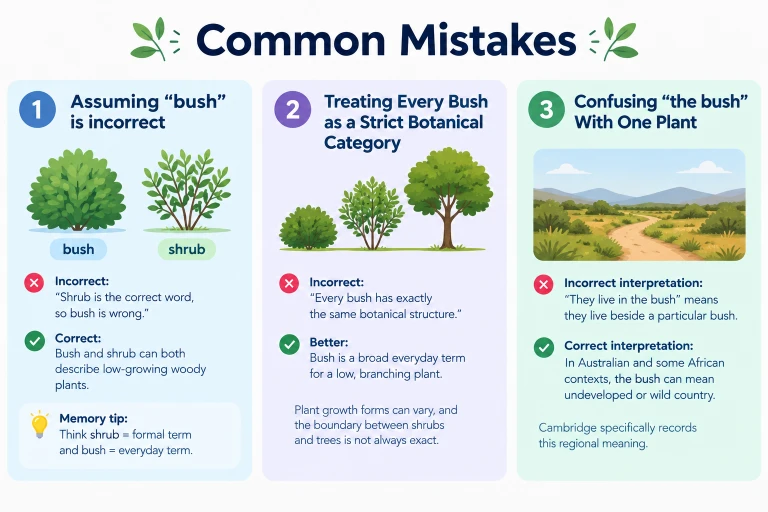
Mistake 1: Assuming “bush” is incorrect
Incorrect assumption:
“Shrub is the correct word, so bush is wrong.”
Correct:
“Bush and shrub can both describe low-growing woody plants.”
Why: Major dictionaries recognize the overlapping plant meanings. Oxford even lists bush as a synonym for shrub.
Memory tip:
Think shrub = formal plant term and bush = everyday term.
Mistake 2: Treating Every Bush as a Strict Botanical Category
Incorrect:
“Every bush has exactly the same botanical structure.”
Better:
“Bush is a broad everyday term for a low, branching plant.”
Plant growth forms can vary, and the boundary between shrubs and trees is not always exact.
Mistake 3: Confusing “the bush” With One Plant
Incorrect interpretation:
“They live in the bush” means they live beside a particular bush.
Correct interpretation:
In Australian and some African contexts, the bush can mean undeveloped or wild country.
Cambridge specifically records this regional meaning.
Everyday Examples
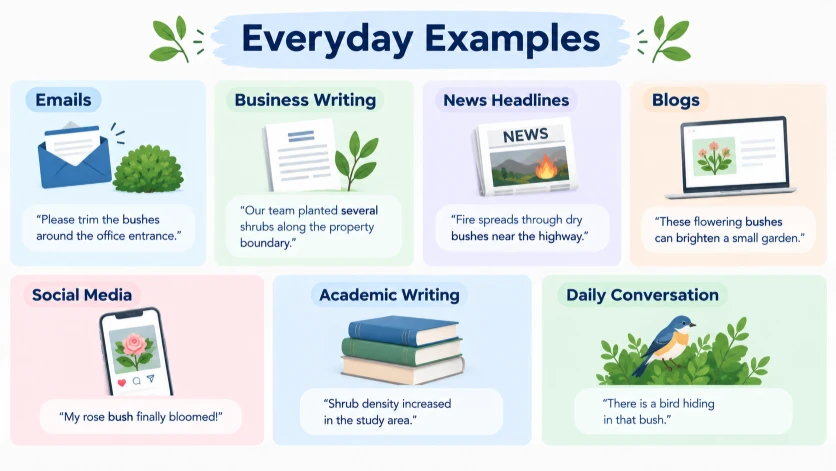
Emails
“Please trim the bushes around the office entrance.”
A landscaping email might use shrubs instead:
“The shrubs around the entrance need pruning.”
Business Writing
“Our team planted several shrubs along the property boundary.”
Shrub sounds natural in landscaping and property-management writing.
News Headlines
“Fire spreads through dry bushes near the highway.”
A more environmental or scientific report might use:
“Wildfire threatens native shrub vegetation.”
Blogs
“These flowering bushes can brighten a small garden.”
Or:
“Choose shrubs that tolerate dry soil.”
Both can work when the plant fits the description.
Social Media
“My rose bush finally bloomed!”
This casual use sounds completely natural.
Academic Writing
“Shrub density increased in the study area.”
Here, shrub is more suitable because the sentence discusses vegetation as a growth form.
Daily Conversation
“There is a bird hiding in that bush.”
This is a very natural everyday sentence.
You could also say:
“That shrub has beautiful flowers.”
The second sentence sounds slightly more garden-focused.
Google Trends & Modern Usage
Search interest in bush or shrub can come from several different needs. People may be trying to identify a plant, choose the right gardening term, understand a landscaping description, or check if the words are synonyms.
Modern dictionary usage shows that the two words continue to overlap strongly in their plant meanings. Cambridge defines both as low-growing, branching plants, while Oxford explicitly gives bush as a synonym for shrub.
Search behavior can also be affected by the broader meanings of bush. In Australia and parts of Africa, the bush can refer to undeveloped land or natural vegetation. That meaning creates searches that have nothing to do with garden shrubs.
There is no need to claim that one word is universally replacing the other. Current reference sources support continued use of both.
Quick Comparison
| Version | Meaning | Correct? | Region | Example |
| Bush | Low, branching woody plant | Yes | International | “A bird sat on the bush.” |
| Shrub | Woody plant, usually smaller than a tree | Yes | International | “The shrub needs pruning.” |
| Rose bush | A rose plant with a bushy form | Yes | International | “The rose bush is flowering.” |
| Rose shrub | A rose described as a shrub | Yes | International | “The rose shrub grows well here.” |
| The bush | Wild or undeveloped land in some regions | Yes | Especially Australia and Africa | “They traveled through the bush.” |
Key Takeaways
- Bush and shrub are both correct words for many low-growing woody plants.
- Their plant meanings overlap considerably.
- Bush is common in everyday English.
- Shrub is common in gardening and horticultural writing.
- Oxford lists bush as a synonym for shrub.
- The Royal Horticultural Society says shrubs are more familiarly known as bushes.
- Bush has additional regional meanings, especially for wild or undeveloped land.
- There is no major British-American spelling difference between the two words.
FAQs
Is a shrub like a bush?
Yes. A shrub is often called a bush, especially in everyday English. Shrub is more common in gardening and horticultural contexts, while bush is a broader everyday term.
How to identify a bush or shrub?
Look for a woody plant with multiple stems or branches, usually growing from near ground level. Unlike many trees, shrubs typically do not have one dominant central trunk.
Which plant is shrub?
Examples of shrubs include roses, hydrangeas, azaleas, rhododendrons, and boxwood. These plants are generally woody and grow with multiple stems rather than a single main trunk.
What is the difference between bush and bush?
There is no difference if both uses refer to the same plant meaning. Bush can also have different meanings depending on context, such as “the bush” for wild or undeveloped land in some regions.
What is the difference between a bush and a shrub?
The terms often overlap. Bush is the more familiar everyday word, while shrub is commonly used in gardening, landscaping, and plant descriptions. A shrub can therefore be called a bush in many situations.
What exactly is a shrub?
A shrub is a woody plant that is generally smaller than a tree and has several stems growing from near the ground. Shrubs can be evergreen or deciduous and come in many sizes and forms.
Conclusion
Bush or shrub is not usually a choice between a correct and incorrect word. Both are established English terms, and both can describe a low-growing woody plant with several branches. The main difference comes from context.
Bush is the familiar everyday choice. You might talk about a rose bush, a bush beside the house, or birds hiding in the bushes. Shrub is especially useful in gardening, landscaping, academic, and horticultural writing. The Royal Horticultural Society itself explains that shrubs are more familiarly known as bushes.
Regional meaning also matters. In Australia and some African contexts, the bush can refer to wild or undeveloped land, giving the word a meaning that shrub does not share.
So, choose the word that matches your audience and context. In casual writing, bush feels natural. In plant-focused writing, shrub often gives a more precise tone.
Remember: a shrub can be called a bush, but “bush” has meanings beyond the plant itself.
READ MORE!
- Bop or Flop: Meaning, Difference, and Examples
- Java or Python: Key Differences, Uses, and Features
- Discreetly or Discretely: What’s the Difference?

I’m Edward Fletcher, a UK-based English language writer with a passion for grammar and vocabulary. At VocabNex, I share simple explanations, useful examples, and practical English tips to help learners improve their language skills and communicate with confidence.








2 thoughts on “Bush or Shrub: Understanding the Difference”