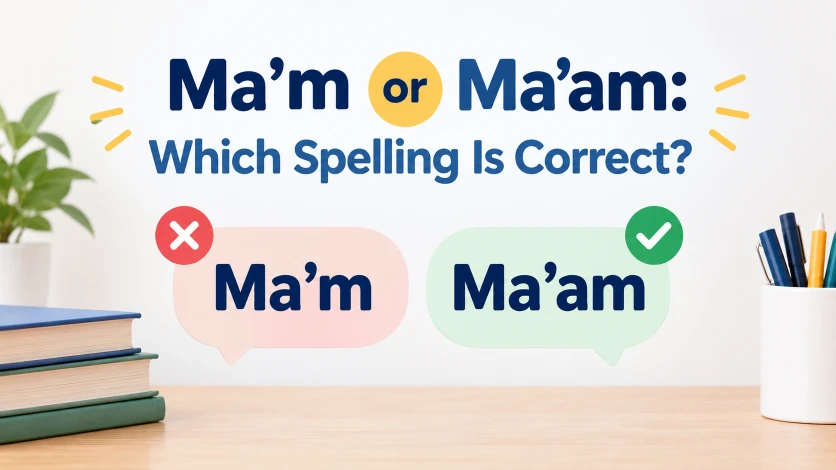
If you are wondering if ma’m or ma’am is correct, the standard spelling is ma’am. The apostrophe comes after the first a, not after the first m. Ma’am is a shortened form of madam and is used as a polite form of address for a woman.
This small apostrophe difference causes confusion because the pronunciation can make the word sound almost like one syllable. Writers may also see variations online and wonder if both spellings are acceptable. In standard English, major dictionaries such as Cambridge, Oxford, and Collins list ma’am, not ma’m, as the established form.
In this guide, you will learn what ma’am means, where it comes from, how it differs from madam, how American and British English use it, and how to use it correctly in emails, conversations, business writing, and other contexts.
Quick Answer
Ma’am is the standard spelling. It is a polite form of address for a woman and comes from madam. Cambridge and Oxford both define it as a polite way of addressing a woman, while Oxford notes that British usage can also apply to the Queen or senior women in the police or army.
For example:
- “Can I help you, ma’am?”
- “Yes, ma’am, I understand.”
- “Excuse me, ma’am.”
If you are writing ma’m, change it to ma’am.
What Does Ma’am Mean?
Ma’am is a respectful form of address used when speaking directly to a woman. It is especially common in American English and can sound polite, formal, or deferential depending on the situation.
It is related directly to madam.
For example:
“Good morning, ma’am.”
Here, ma’am does not describe the woman. It is used to address her directly.
Ma’am vs. Madam
Although they come from the same source, they are not always interchangeable in tone.
Ma’am is shorter and often more natural in spoken conversation.
Madam can sound more formal or traditional. It is also used in formal salutations such as Dear Madam. Oxford lists madam as a formal form of address in business situations.
The Origin of Ma’am
The word ma’am developed as a contraction of madam. Dictionary sources date the shortened form to the 17th century. Dictionary.com gives a first-recorded range of 1660–70, while Oxford describes ma’am as a mid-17th-century contraction of madam.
The longer word madam has an older history. Oxford traces it through Middle English and Old French ma dame, meaning “my lady.”
Over time, madam developed a shortened spoken form:
madam → ma’am
The apostrophe helps show that letters have been omitted. This is why the standard spelling is ma’am, rather than ma’m.
Why Is Ma’m Incorrect?
The spelling ma’m places the apostrophe in the wrong position for the established contraction.
Compare:
- madam
- ma’am ✓
- ma’m ✗
Major dictionary entries consistently give ma’am as the established form. Cambridge, Oxford, and Collins all list ma’am as the dictionary headword.
British English vs American English
The word exists in both British and American English, but everyday usage differs.
| British English | American English | Example |
| ma’am is established but can be more context-specific | ma’am is common as a polite form of address | “Can I help you, ma’am?” |
| Often associated with addressing the Queen or senior women in certain organizations | Commonly used when politely addressing a woman | “Yes, ma’am.” |
| Pronunciation may be /mɑːm/ | Common pronunciation is /mæm/ | “Thank you, ma’am.” |
Cambridge lists ma’am as a polite form of address in both varieties. It specifically notes British use for the Queen or women of high rank in organizations such as the army or police. Oxford similarly describes North American use as a polite way of addressing a woman and British use in more specific contexts.
Pronunciation also differs. Cambridge gives /mɑːm/ for UK English and /mæm/ for US English.
What About Canada and Australia?
The spelling remains ma’am. However, the frequency and social tone can vary by region and situation.
For formal or professional writing, always consider if a personal name or professional title would be clearer and more natural.
Which Version Should You Use?
The answer is simple for the spelling:
Use ma’am, not ma’m.
The more interesting question is when you should use the word at all.
United States
Ma’am is widely recognized as a polite form of address. It is common in customer service, schools, military contexts, and everyday respectful conversation. Collins describes it as mainly US usage in some of its definitions.
Example:
“Excuse me, ma’am. You dropped your phone.”
United Kingdom
Use ma’am when the context calls for it. British usage can be more specific, particularly when addressing the Queen or senior women in the police or military.
Canada
Ma’am is understandable and grammatically established. In professional communication, however, a person’s name or title may be more natural.
Australia
The spelling is ma’am. Australian government style guidance recommends avoiding contractions in formal content when they are unnecessary, although established titles and particular conventions can be exceptions.
International Writing
For international readers, ma’am is widely understood. If the situation is very formal, madam, a professional title, or the person’s name may be clearer.
Academic Writing
Academic writing usually favors precise, neutral language. Direct address is uncommon, so ma’am will rarely be necessary in a research paper.
Business Writing
In business emails, use the person’s name or professional title when possible.
For example:
Dear Ms. Taylor,
is usually more specific than:
Dear Ma’am,
Common Mistakes
| Incorrect | Correct | Why? |
| “Thank you, ma’m.” | “Thank you, ma’am.” | The standard spelling is ma’am. |
| “Yes ma’m, I understand.” | “Yes, ma’am, I understand.” | The apostrophe is misplaced in ma’m. |
| “Excuse me, ma’m.” | “Excuse me, ma’am.” | Use the established contraction of madam. |
| “Good morning ma’m.” | “Good morning, ma’am.” | The standard spelling and punctuation are ma’am. |
Memory Tip
Think of the original word:
MADAM
Remove the middle letters and write:
MA’AM
A simple visual reminder is:
ma + ‘ + am = ma’am
So remember:
The apostrophe in ma’am comes before the second “a.”
Everyday Examples
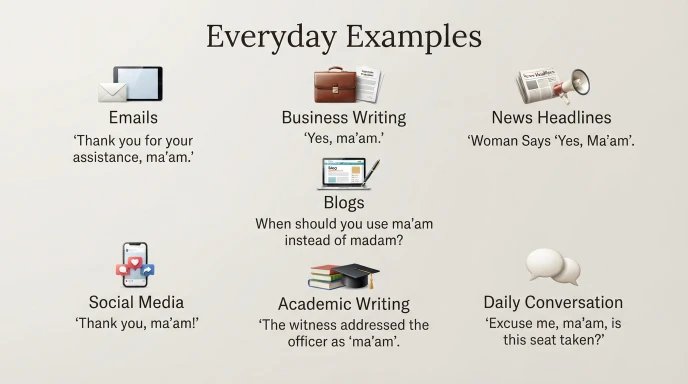
Emails
For most professional emails, use a person’s name or title when you know it.
“Thank you for your assistance, ma’am.”
This is grammatically possible, but:
“Thank you for your assistance, Ms. Carter.”
is often more specific.
Business Writing
“Yes, ma’am. Your appointment is confirmed.”
This works in dialogue or customer-service writing.
News Headlines
Woman Says “Yes, Ma’am” During Court Hearing
Headlines may capitalize words according to the publication’s headline style.
Blogs
“When should you use ma’am instead of madam?”
Here, the word is being discussed rather than used to address someone.
Social Media
“Thank you, ma’am! I really appreciate it.”
This is a natural conversational use.
Academic Writing
The witness addressed the officer as “ma’am.”
Quotation marks are useful because the writer is reporting the exact form of address.
Daily Conversation
“Excuse me, ma’am, is this seat taken?”
“Yes, ma’am.”
“Thank you, ma’am.”
Google Trends & Modern Usage
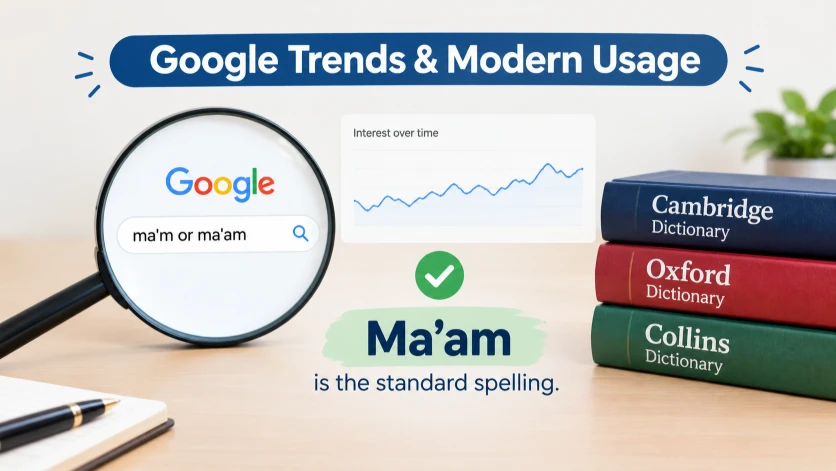
People search ma’m or ma’am because the apostrophe placement is easy to misremember. The word is pronounced as a short form of madam, so writers may wonder where the omitted letters are represented.
Modern dictionary entries show that ma’am remains an established English form. Cambridge, Oxford, and Collins all include it, with particularly strong everyday use in American English.
Exact Google Trends statistics are not included here because search-interest data can change by date, location, and search setting. It is therefore better not to assign unsupported popularity percentages to ma’m or ma’am.
The key modern usage point is straightforward:
Ma’am is the standard spelling.
Quick Comparison
| Version | Meaning | Correct? | Region | Example |
| ma’am | Polite form of address for a woman | Yes | US, UK, international English | “Thank you, ma’am.” |
| ma’m | Intended as a shortened form of madam | No, not the standard spelling | Not standard | “Thank you, ma’m.” |
| madam | Formal form of address for a woman | Yes | International English | “May I help you, madam?” |
Key Takeaways
- Ma’am is the standard spelling.
- Ma’m is not the standard dictionary form.
- Ma’am is a shortened form of madam.
- The apostrophe belongs after the first a.
- The word is used as a polite form of address for a woman.
- Ma’am is especially common in American English.
- British English uses ma’am in more specific contexts as well.
- In formal business writing, a person’s name or professional title is often clearer.
FAQs
Can I Say “Ma’am” to a Girl?
Yes, you can say “ma’am” to a girl or woman, especially in a polite or respectful situation. However, “ma’am” is usually used for an adult woman rather than a young girl.
Which Is Correct: “Mam” or “Ma’am”?
“Ma’am” is the standard spelling. It is a shortened form of “madam.”
“Mam” is commonly used in some regions, but “ma’am” is the standard form in American and British English.
Can I Say “Ma’am”?
Yes. You can say “ma’am” when speaking respectfully to a woman. For example:
- “Excuse me, ma’am.”
- “Yes, ma’am.”
- “Thank you, ma’am.”
What Is Correct: “Ma’am, Sir” or “Sir, Ma’am”?
It depends on who you are addressing. If you are speaking to a woman and a man together, “sir and ma’am” or “ma’am and sir” can both be understood. In most situations, it is more natural to address each person individually: “Yes, sir” and “Yes, ma’am.”
Is “Ma’am” Flirty?
No. “Ma’am” is normally polite and respectful, not flirty. If it sounds playful or flirty depends on the tone, relationship, and context. The word itself does not have a romantic meaning.
How Do You Call a Girl Attractive?
If you want to compliment a girl respectfully, you can say:
- “You look beautiful.”
- “You look really pretty.”
- “You’re very attractive.”
- “You have a beautiful smile.”
- “You look gorgeous.”
For a softer and more natural compliment, “You look really pretty” is a good choice.
Conclusion
When choosing between ma’m or ma’am, use ma’am. It is the standard English spelling and the established shortened form of madam. The apostrophe is important because it marks the letters omitted from the longer form. Major dictionaries, including Cambridge, Oxford, and Collins, recognize ma’am as the standard form.
The word is mainly used as a polite form of address for a woman. It is particularly common in American English, while British English uses it in somewhat different contexts.
For everyday conversation, “Yes, ma’am” and “Thank you, ma’am” are correct. For formal business or academic writing, consider if a person’s name or professional title would be more appropriate.
Remember: madam becomes ma’am, not ma’m.
If you are working on other commonly confused English spellings, use the same approach: check the standard dictionary form first, then consider context and regional usage.
READ MORE!
- Visible or Visable: Which Spelling Is Correct?
- Lowe’s Salem OR: Store Hours, Location & Services
- Apologizes vs Apologies: Common Errors and Correct Usage

I’m Edward Fletcher, a UK-based English language writer with a passion for grammar and vocabulary. At VocabNex, I share simple explanations, useful examples, and practical English tips to help learners improve their language skills and communicate with confidence.








2 thoughts on “Ma’m or Ma’am: Which Spelling Is Correct?”