
If you are unsure if to write met or meet, the answer depends on the time and grammar of the sentence. Meet is the base or present form of the verb, while met is its past simple and past participle form. Cambridge and Oxford both list met as the past form of meet.
The confusion often comes from the fact that the two words look and sound different, but they belong to the same verb. For example, you say, “I want to meet her tomorrow,” but “I met her yesterday.”
Knowing when to use each form helps you avoid a common verb-tense mistake in emails, schoolwork, business writing, and everyday conversation. This guide explains the meaning of met and meet, their grammar, history, regional usage, common errors, and practical examples.
Met or Meet: Quick Answer
Meet is the base form and present-tense form of the verb. Met is the past simple and past participle form of meet.
- Meet: used for the present, future, or after modal and auxiliary verbs.
- Met: used for completed actions in the past.
- Meet and met are both correct, but they are not interchangeable.
Examples:
- “I will meet you at noon.”
- “I met her yesterday.”
- “We have met before.”
The key is to look at when the action happens.
What Does Meet Mean?
Meet is a verb with several related meanings. Its most common meaning is to come together with another person, either by arrangement or by chance. Cambridge gives examples involving meeting someone for the first time, meeting by arrangement, and unexpectedly encountering someone.
1. To come together with someone
- “Let’s meet after work.”
- “We meet every Friday.”
- “I will meet you at the station.”
2. To become acquainted with someone
- “Nice to meet you.”
- “I would like you to meet my brother.”
3. To satisfy a requirement or need
Meet can also mean “satisfy,” “fulfill,” or “achieve.”
- “The product must meet safety standards.”
- “She worked hard to meet the deadline.”
- “The new plan should meet our needs.”
Cambridge also records uses such as meeting a target, requirement, condition, deadline, or expectation.
4. To wait for someone at a place
- “I will meet you at the airport.”
- “Can you meet me outside the library?”
So, meet is not limited to social meetings. Its meaning depends on context.
What Does Met Mean?
Met is the past simple and past participle of meet.
Use met when the meeting or other action is connected to a completed past event.
Past simple
- “I met Sarah last week.”
- “They met at university.”
- “We met in 2024.”
Present perfect
Use met after have, has, or had:
- “I have met him before.”
- “She has met the new manager.”
- “They had met several times before the conference.”
Past passive
- “The requirements were met.”
- “All conditions were met.”
This is why “The requirements were meet” is incorrect. After were, the sentence needs the past participle met.
The Origin of Meet and Met
The history of meet goes back many centuries. Etymological sources trace the verb through Middle English mēten to Old English metan, with meanings related to finding, encountering, or coming together. It is also connected with older Germanic forms.
The modern pair meet / met developed as part of the history of this irregular verb. The past form met is not a shortened modern spelling of meet. It has a much older grammatical history. Etymological records specifically identify met as the past tense and past participle of meet.
Over time, meet also developed wider meanings. These include coming into physical contact, encountering something, satisfying a requirement, and fulfilling an expectation. The sense of meeting expectations is recorded from the late 17th century.
This history helps explain why meet and met do not follow the regular pattern of verbs such as:
- walk → walked
- talk → talked
- work → worked
Instead:
- meet → met
- met → met
British English vs American English
There is no British-versus-American spelling difference between meet and met. Both varieties use the same forms.
| British English | American English | Example |
| meet | meet | “We will meet tomorrow.” |
| met | met | “We met yesterday.” |
| met | met | “I have met her before.” |
| meeting | meeting | “They are meeting now.” |
The pronunciation may vary slightly between British and American speakers, but the written verb forms remain the same. Cambridge lists the same verb forms for both varieties.
Regional differences may appear in other uses of meet. For example, meet can be a noun for a sporting event, especially in American English, as in “a track meet” or “a swimming meet.” Cambridge labels this noun use mainly US.
For ordinary verb usage, however, there is no need to choose a British spelling or an American spelling.
What about Canada and Australia?
Canadian and Australian English also use meet → met as the standard verb pattern. You do not need to change met to another regional form.
The main issue is therefore grammar, not geography.
Which Version Should You Use?
Choose meet or met according to the grammar of your sentence.
United States
Use the standard forms:
- “I will meet you tomorrow.”
- “I met him yesterday.”
United Kingdom
Use exactly the same forms:
- “We are going to meet later.”
- “We met last week.”
Canada
Use meet for the base or present form and met for the past and past participle.
Australia
The same standard verb forms apply:
- meet
- met
- met
- meeting
International writing
For international readers, these forms are clear and standard. There is no regional spelling problem to solve.
Academic writing
Use the correct tense based on the timeline:
- “The researchers met in 2023.”
- “The committee will meet next month.”
- “The researchers have met several times.”
Business writing
Pay close attention to tense:
- “We will meet with the client on Monday.”
- “We met with the client on Monday.”
- “The company has met all the requirements.”
The wrong form can make the timing unclear or make an otherwise professional sentence grammatically incorrect.
Common Mistakes
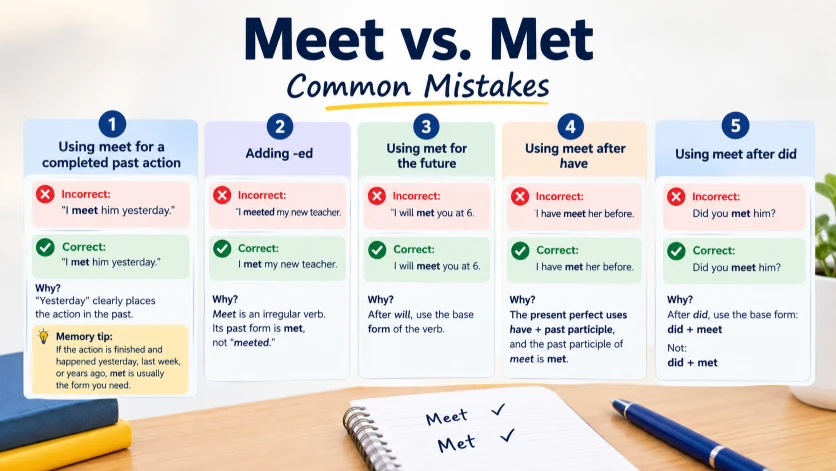
Mistake 1: Using meet for a completed past action
Incorrect:
“I meet him yesterday.”
Correct:
“I met him yesterday.”
Why?
“Yesterday” clearly places the action in the past.
Memory tip:
If the action is finished and happened yesterday, last week, or years ago, met is usually the form you need.
Mistake 2: Adding -ed
Incorrect:
“I meeted my new teacher.”
Correct:
“I met my new teacher.”
Why?
Meet is an irregular verb. Its past form is met, not “meeted.”
Mistake 3: Using met for the future
Incorrect:
“I will met you at 6.”
Correct:
“I will meet you at 6.”
Why?
After will, use the base form of the verb.
Mistake 4: Using meet after have
Incorrect:
“I have meet her before.”
Correct:
“I have met her before.”
Why?
The present perfect uses have + past participle, and the past participle of meet is met.
Mistake 5: Using meet after did
Incorrect:
“Did you met him?”
Correct:
“Did you meet him?”
Why?
After did, use the base form:
did + meet
Not:
did + met
Everyday Examples

Emails
Future:
“I would be happy to meet with you next week.”
Past:
“It was great to have met you at the conference.”
Business writing
“The team will meet on Friday to discuss the project.”
“The company met all the required standards.”
News headlines
“Leaders Meet to Discuss New Agreement”
A headline about a past event might say:
“Leaders Met to Discuss New Agreement”
The choice depends on the intended time reference.
Blogs
“I first met my editor while working on a college project.”
Social media
“Great to meet everyone today!”
“So glad we met!”
Academic writing
“The participants met for three sessions.”
“The study aims to meet the needs of first-year students.”
Daily conversation
“When did you meet her?”
“I met her at school.”
“When can we meet again?”
These examples show that the distinction is mainly grammatical. The meaning of the sentence determines which form fits.
Google Trends & Modern Usage
People searching for “met or meet” are usually trying to solve a grammar or word-choice problem. The search may come from a student, English learner, writer, editor, or someone checking a sentence before sending it.
Google Trends provides a tool for comparing search interest by location and time, but a public Trends page does not by itself provide a reliable grammatical measure of how often people use each word.
It is also important to remember that meet and met have different grammatical jobs. Comparing their raw search popularity would not tell us which form is “more correct.”
Modern English uses both forms extensively:
- meet for the base/present form and certain future constructions
- met for the past simple and past participle
The most common confusion is therefore not regional. It is verb tense and verb form.
Quick Comparison
| Version | Meaning | Correct? | Region | Example |
| meet | Base/present form | Yes | All major English varieties | “We meet every Friday.” |
| met | Past simple | Yes | All major English varieties | “We met yesterday.” |
| met | Past participle | Yes | All major English varieties | “We have met before.” |
| meeted | Intended past form of meet | No | Standard English | Use met instead |
Key Takeaways
- Meet is the base form of the verb.
- Met is the past simple form of meet.
- Met is also the past participle.
- “I meet him tomorrow” can be correct when used in the right construction, but “I met him yesterday” is the past form.
- Never write meeted as the standard past form.
- After will, use meet, not met.
- After have, has, or had, use met.
- British and American English use the same standard spellings: meet, met, met.
FAQs
How do you use met and meet?
Meet is the present/base form, while met is the past tense and past participle of meet. Use meet for something happening now or regularly, and met for something that already happened.
- I meet my friends every Friday.
- I met my friends yesterday.
What is the difference between “met” and “meet”?
The main difference is tense. Meet refers to the present or future, while met refers to the past.
- Meet: “I will meet Sarah tomorrow.”
- Met: “I met Sarah yesterday.”
Is it I met or meet?
Both “I met” and “I meet” are correct, but they describe different times.
- I meet him every week. → present/habitual
- I met him last week. → past
If you are talking about a meeting that already happened, use “I met.”
Is it correct to say “met with”?
Yes, “met with” is grammatically correct. It usually means that you had a meeting or discussion with someone.
- I met with my manager yesterday.
- She met with the client to discuss the project.
In casual contexts, you can also say “I met my friend.”
When we met or meet?
Use “when we met” when you are talking about a past meeting or the first time you encountered someone.
- I remember when we met.
- When we met, we were both students.
Use “when we meet” for a present, regular, or future situation.
- We talk when we meet.
- When we meet tomorrow, we can discuss it.
What is meant by met?
Met is the past tense and past participle of meet. It means that you encountered, got together with, or had a meeting with someone in the past.
For example:
“I met John yesterday.”
This means I saw or encountered John yesterday.
Conclusion
The difference between met and meet is simple once you identify the verb form you need. Meet is the base form, while met is both the past simple and past participle of the irregular verb meet.
Use meet for present or base-form constructions, such as “We meet every week” or “I will meet you tomorrow.” Use met for completed past actions, such as “We met last week.” It is also the correct form after have, has, and had, as in “I have met her before.”
There is no British-versus-American spelling choice here. The standard forms are the same across major varieties of English.
If you remember only one pattern, remember this:
Meet today. Met yesterday. Have met before.
That simple pattern will help you choose the correct form in conversation, schoolwork, emails, and professional writing.
READ MORE!
- Ma’m or Ma’am: Which Spelling Is Correct?
- Visible or Visable: Which Spelling Is Correct?
- Lowe’s Salem OR: Store Hours, Location & Services

I’m Edward Fletcher, a UK-based English language writer with a passion for grammar and vocabulary. At VocabNex, I share simple explanations, useful examples, and practical English tips to help learners improve their language skills and communicate with confidence.








1 thought on “Met or Meet: Which Is Correct?”