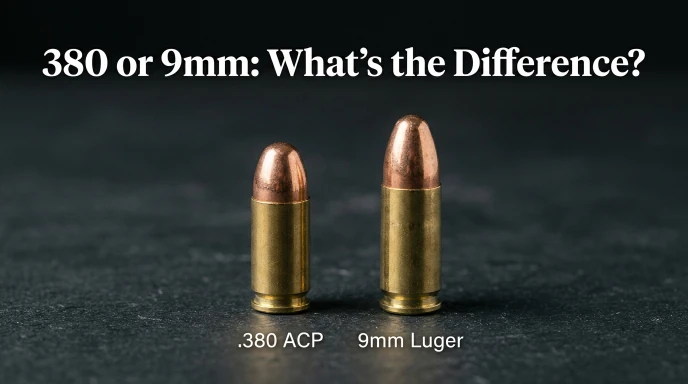
.380 ACP and 9mm are both handgun ammunition calibers, but they differ in bullet size, power, and performance.
The main difference between .380 ACP and 9mm Luger is their size, design, and typical use. Both are handgun cartridges, but they are not interchangeable. The best choice depends on the firearm’s specifications, its intended purpose, and the manufacturer’s guidance.
People search for “380 or 9mm” because the names sound similar and both cartridges are widely known in the United States. However, they differ in dimensions, performance characteristics, and the firearms designed to use them.
This guide explains what .380 ACP and 9mm mean, how their names developed, and how the two compare in general terms. It also covers common misconceptions, regional terminology, everyday examples, and frequently asked questions.
One important point comes first: never assume that ammunition is compatible with a firearm just because the cartridges look similar or have similar names. Always check the exact caliber marking and the manufacturer’s instructions.
380 or 9mm: Quick Answer
The terms .380 and 9mm refer to different cartridge types when comparing .380 ACP with 9mm Luger.
- .380 ACP: Also known as .380 Auto or 9×17mm.
- 9mm Luger: Also known as 9×19mm or 9mm Parabellum.
- Main difference: The cartridges have different case dimensions and specifications.
- Important safety rule: Use only the ammunition specified by the firearm manufacturer.
For example:
- A firearm marked for .380 Auto requires the correct .380 ammunition.
- A firearm marked for 9mm Luger requires the correct 9mm Luger ammunition.
- A box marked “9mm Short” may refer to .380 ACP, but the full designation must be verified.
What Does 380 or 9mm Mean?
What Is .380 ACP?
.380 ACP stands for .380 Automatic Colt Pistol. It is a handgun cartridge introduced by firearms designer John Moses Browning in the early 20th century.
It is also called .380 Auto. Some European naming systems use terms such as 9mm Short, 9mm Kurz, and 9mm Corto. These names refer to the shorter cartridge, not the 9mm Luger.
What Is 9mm Luger?
9mm Luger is a widely used handgun cartridge. It is also known as 9×19mm and 9mm Parabellum.
The name “9×19mm” describes its nominal bullet diameter class and case length in millimeters. It is a separate cartridge from .380 ACP, which is commonly identified as 9×17mm.
The word “9mm” alone can be unclear because several cartridges use a 9mm designation. When accuracy matters, use the full cartridge name.
Why Do People Confuse Them?
The confusion comes from three main factors:
- Both names include a reference to 9mm.
- Both cartridges use bullets of approximately the same diameter.
- Some older or regional names for .380 ACP include the words “9mm Short.”
These similarities do not make the cartridges equivalent. Their full specifications and the firearm’s chamber marking matter more than a shared number.
The Origin of .380 ACP and 9mm Luger
The two cartridges have different histories.
The History of .380 ACP
.380 ACP was developed in the United States by John Moses Browning and introduced in 1908. Its name reflects its association with the Automatic Colt Pistol cartridge family.
Over time, it gained other names in Europe. Terms such as “Kurz” and “Corto” mean “short” in German and Italian, respectively. These names helped distinguish it from longer 9mm cartridges.
The History of 9mm Luger
The 9mm Luger cartridge was developed in Germany by Georg Luger around the turn of the 20th century and introduced in 1902. The name “Parabellum” is also associated with this cartridge.
It became widely adopted for military, law-enforcement, sporting, and civilian applications. Its full designation, 9×19mm, helps distinguish it from other cartridges with similar names.
Why the Names Still Cause Confusion
Cartridge names developed across countries, languages, and manufacturers. As a result, the same cartridge may have several recognized names, while different cartridges may share part of a name.
The Sporting Arms and Ammunition Manufacturers’ Institute (SAAMI) publishes accepted cartridge names and guidance on ammunition interchangeability. Its resources are more reliable for checking technical names than guessing from a label.
British English vs. American English
There is no major British-versus-American spelling difference between .380 ACP and 9mm Luger. The distinction is technical, not grammatical.
| Context | Common designation | What it means |
| United States | .380 ACP or .380 Auto | The .380 cartridge |
| United States | 9mm Luger | The 9×19mm cartridge |
| United Kingdom | 9mm or 9×19mm | Often refers to 9mm Luger when the context is clear |
| International technical writing | 9×17mm or 9×19mm | More precise dimensional designations |
| Historical European references | 9mm Kurz or 9mm Corto | Alternate names associated with .380 ACP |
These are common naming conventions, not rules that apply to every document or market. Always use the designation found in the firearm’s documentation and the ammunition manufacturer’s specifications.
Style Guide and Publishing Advice
For an educational article, define both cartridges at the start:
- Write “.380 ACP (.380 Auto)” for the first cartridge.
- Write “9mm Luger (9×19mm)” for the second.
- Use the full names when discussing safety or technical differences.
- Avoid treating “9mm” and “.380” as interchangeable terms.
This approach helps readers understand the topic even if they are unfamiliar with ammunition terminology.
Which Version Should You Use?
The correct designation depends on the country, the audience, and the context. Neither cartridge name is a regional spelling variant of the other.
- United States: Use “.380 ACP” or “.380 Auto” for the first cartridge and “9mm Luger” for the second.
- United Kingdom: Use the complete technical designation in educational or safety-related writing. Do not assume that “9mm” identifies every cartridge with a 9mm label.
- Canada: Prefer complete cartridge names in technical, educational, and safety documents.
- Australia: Use the firearm manufacturer’s stated chambering and recognized technical terminology.
- International writing: Include both the common name and metric designation, such as “9mm Luger (9×19mm).”
- Academic writing: Define the terms on first use and cite reliable technical sources.
- Business writing: Use the exact product or cartridge designation shown in official specifications.
For general readers, clarity matters more than regional shorthand. For firearm safety, the manufacturer’s specifications take priority over informal terminology.
Common Mistakes
Mistake 1: Assuming All 9mm Cartridges Are the Same
Incorrect: “Both cartridges say 9mm, so they must be identical.”
Correct: “.380 ACP and 9mm Luger are different cartridges.”
Explanation: Several cartridges use 9mm in their names. Their dimensions and specifications can differ.
Memory tip: Check the complete name, not just the number.
Mistake 2: Treating .380 ACP as Another Name for 9mm Luger
Incorrect: “.380 Auto is simply another name for 9mm Luger.”
Correct: “.380 Auto and 9mm Luger refer to different cartridges.”
Explanation: .380 Auto is an accepted name for .380 ACP. 9mm Luger refers to the longer 9×19mm cartridge.
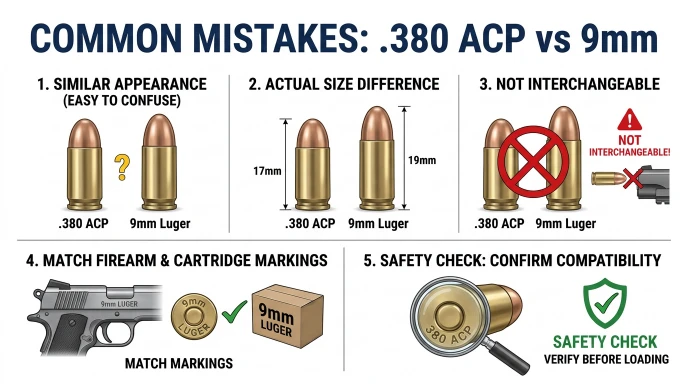
Memory tip: Remember the case lengths: 17mm versus 19mm.
Mistake 3: Assuming Similar Bullet Diameter Means Compatibility
Incorrect: “The bullets have similar diameters, so the ammunition can be used in either firearm.”
Correct: “Ammunition must match the firearm’s specified chambering.”
Explanation: Similar bullet diameter does not mean that cartridges have the same case dimensions or operating specifications.
Memory tip: Similar size does not mean interchangeable.
Mistake 4: Using “9mm” Without Context
Incorrect: “The firearm uses 9mm,” when the exact cartridge has not been identified.
Correct: “The firearm is chambered for 9mm Luger,” when confirmed by its markings and documentation.
Explanation: The fuller name prevents confusion with other 9mm-designated cartridges.
Memory tip: When precision matters, use the complete cartridge name.
Mistake 5: Assuming a Cartridge Is Safe Because It Fits
Incorrect: “If the cartridge fits, it is safe to use.”
Correct: “Use only ammunition approved for the firearm’s chambering.”
Explanation: SAAMI warns that physical fit alone does not establish safe compatibility.
Memory tip: Verify first. Never rely on appearance alone.
Everyday Examples

The following examples show how to use the terms clearly in different kinds of writing.
Emails
- “Could you confirm if the manual specifies .380 ACP or 9mm Luger?”
- “Please check the manufacturer’s documentation for the exact cartridge designation.”
Business Writing
- “The product specifications identify the chambering as 9mm Luger.”
- “The listing should distinguish .380 Auto from 9mm Luger.”
News Headlines
- “.380 ACP and 9mm Luger: Understanding the Difference”
- “Why Cartridge Names Matter for Firearm Safety”
Blogs
- “This guide explains why .380 ACP is not the same as 9mm Luger.”
- “Learn how cartridge naming conventions can cause confusion.”
Social Media
- “.380 ACP and 9mm Luger are different cartridges. Always verify the full designation.”
- “A shared 9mm label does not mean two cartridges are interchangeable.”
Academic Writing
- “The study distinguishes .380 ACP from 9mm Luger by cartridge dimensions and technical specifications.”
- “Standardized cartridge terminology helps reduce ambiguity in technical communication.”
Daily Conversation
- “Do you mean .380 Auto or 9mm Luger?”
- “Let’s check the firearm’s documentation before identifying the cartridge.”
Google Trends & Modern Usage
People search for “380 or 9mm” because the terms look similar, both are common in handgun discussions, and some alternate names make the distinction less obvious.
The phrase appears in several kinds of search intent:
- Informational: What is the difference between .380 and 9mm?
- Educational: What do .380 ACP and 9mm Luger mean?
- Comparison: Are .380 and 9mm the same size?
- Terminology: Is .380 Auto the same as 9mm Short?
- Safety: Can different cartridge types be used in the same firearm?
Which Term Is More Popular?
Without a current, region-filtered Google Trends comparison, it would be misleading to claim an exact search-volume winner or provide percentages.
The phrases also have different meanings depending on context. “9mm” can refer to a broad family of cartridge names, while “.380 ACP” is a more specific term.
For reliable content, use the primary keyword naturally in the title and introduction, then include related phrases such as:
- .380 ACP vs. 9mm Luger
- .380 Auto vs. 9mm
- 9mm Luger vs. 380 ACP
- Is .380 the same as 9mm?
- 9×17mm vs. 9×19mm
- Difference between .380 Auto and 9mm Luger
These variations address related questions without repeating the same phrase unnaturally. Search popularity should be checked directly in Google Trends if numerical comparisons are needed.
Quick Comparison
| Version | Meaning | Correct? | Common designation | Example |
| .380 ACP | .380 Automatic Colt Pistol | Yes | .380 Auto | “The manual specifies .380 ACP.” |
| .380 Auto | Alternate name for .380 ACP | Yes | .380 Automatic | “The label reads .380 Auto.” |
| 9mm Luger | 9×19mm handgun cartridge | Yes | 9mm Parabellum | “The documentation specifies 9mm Luger.” |
| 9×17mm | Metric designation associated with .380 ACP | Yes, in the correct context | .380 ACP | “The technical reference identifies 9×17mm.” |
| 9×19mm | Metric designation for 9mm Luger | Yes | 9mm Luger | “The cartridge is identified as 9×19mm.” |
| 9mm Short | Historical or regional name associated with .380 ACP | Yes, in the correct context | 9mm Kurz | “The older reference uses 9mm Short.” |
| 9mm | A potentially ambiguous shortened name | Context-dependent | Often 9mm Luger | “Confirm which 9mm cartridge is meant.” |
The alternate names above are supported by SAAMI’s cartridge naming resources.
Key Takeaways
- .380 ACP and 9mm Luger are different handgun cartridges.
- .380 ACP is also known as .380 Auto.
- 9mm Luger is also known as 9×19mm or 9mm Parabellum.
- .380 ACP is associated with the 9×17mm designation.
- Similar bullet diameters do not make the cartridges interchangeable.
- The words “9mm Short” may refer to .380 ACP, depending on the source.
- There is no British-versus-American spelling rule that makes one cartridge name a variant of the other.
- Always follow the firearm manufacturer’s specifications and verify the full cartridge designation.
FAQs
Is a .380 Better Than a 9mm?
Neither caliber is universally better. The 9mm generally offers higher velocity and energy, while .380 ACP typically produces less recoil. The better choice depends on the firearm, intended use, and the shooter’s ability to handle it safely.
Is a .380 a Girl Gun?
No. Calling a .380 a “girl gun” is a stereotype. Firearm suitability depends on factors such as fit, recoil management, reliability, and safe handling not gender.
Will a .380 Stop an Attacker?
A .380 ACP can cause life-threatening injuries, but no caliber guarantees that an attacker will stop immediately. Outcomes depend on many factors, and any shooting can have serious consequences.
Is a .380 Enough for Self-Defense?
A .380 ACP can be used for personal defense, but it generally has less power than 9mm ammunition. Safe handling, reliability, appropriate ammunition, and regular training are important considerations.
Why Is .380 More Expensive Than 9mm?
.380 ACP can sometimes cost more per round because of manufacturing volume, demand, availability, and retailer pricing. However, prices vary by brand, location, and market conditions, so .380 is not always more expensive.
What Caliber Is a .380 Equal To?
The .380 ACP is also known as 9mm Short, 9mm Browning Short, or 9×17mm. Despite its similar bullet diameter, it is not interchangeable with 9×19mm 9mm Luger ammunition.
Can I Shoot .380 in My 9mm?
No. .380 ACP and 9mm Luger are different cartridges and are not interchangeable. Use only the ammunition specified by the firearm’s manufacturer. Using the wrong cartridge can cause serious injury or firearm damage.
Is 9mm Enough for Self-Defense?
9mm Luger is widely used for personal defense and generally offers more ballistic performance than .380 ACP. However, no caliber guarantees a particular outcome. Responsible firearm storage, safe handling, and appropriate training remain essential.
Conclusion
When comparing .380 ACP and 9mm Luger, the most important point is that they are different cartridges, not alternative spellings of the same thing. .380 ACP is also called .380 Auto and is associated with the 9×17mm designation. 9mm Luger is also known as 9mm Parabellum or 9×19mm.
Their similar names and nominal bullet diameters explain why people confuse them. However, their case dimensions and technical specifications are different. The term “9mm Short” can refer to .380 ACP in some naming systems, which adds another layer of confusion.
For clear writing, use the complete cartridge names and explain alternate names when needed. For practical safety, never rely on appearance, a shared number, or an informal label to determine if ammunition is suitable for a firearm. Follow the manufacturer’s specifications and consult a qualified professional whenever a designation is uncertain.
Remember: similar names do not mean the same cartridge, and similar dimensions do not guarantee compatibility. If this guide helped clarify the difference, share it with readers who may have the same question.
READ MORE!
- Stafford or Hurts: Who Is the Better NFL Quarterback?
- Herpes or Folliculitis: How to Tell the Difference
- Porcelain vs Ceramic: What’s the Difference?

I’m Edward Fletcher, a UK-based English language writer with a passion for grammar and vocabulary. At VocabNex, I share simple explanations, useful examples, and practical English tips to help learners improve their language skills and communicate with confidence.