Both “unattentive” and “inattentive” are correct English words, but “inattentive” is the more common choice for describing someone who is not paying attention.
Both words can mean lacking attention or care, so the real difference is usually one of usage, tone, and context rather than correctness. Cambridge defines inattentive as “not giving attention” to someone or something.
People often search “unattentive or inattentive” because the two words look and sound similar. They also share the same positive base idea, attentive, with a negative prefix added. This can make it difficult to know which form sounds more natural in a sentence.
In everyday English, inattentive is a safe and natural choice when someone is not listening, watching, or concentrating. Unattentive is also valid and can describe a lack of care, notice, or attention, depending on context.
This guide explains their meanings, origins, regional usage, common mistakes, examples, and practical advice so you can choose the right word confidently.
Unattentive or Inattentive: Quick Answer
Both “unattentive” and “inattentive” are correct, but “inattentive” is generally the more natural choice when you mean “not paying attention.”
- Inattentive: not giving attention or not listening carefully.
- Unattentive: not attentive or not giving enough attention or care.
- Best everyday choice: inattentive
Examples
- The student was inattentive during the lesson.
- The waiter seemed inattentive to the customers.
- The driver was inattentive and missed the warning sign.
Cambridge specifically uses inattentive for someone who is not giving attention to a person or thing.
What Does Unattentive or Inattentive Mean?
What Does “Inattentive” Mean?
Inattentive means not giving attention to someone or something.
It can describe someone who is:
- Not listening
- Not watching carefully
- Easily distracted
- Failing to notice something
- Not paying enough attention to another person’s needs
For example:
The inattentive student missed the teacher’s instructions.
The word is especially natural when discussing concentration, listening, observation, or behavior.
Cambridge gives examples involving inattentive students, audiences, caregivers, and people who fail to notice or respond properly.
What Does “Unattentive” Mean?
Unattentive means not attentive or failing to give enough attention or care.
For example:
The employee was unresponsive and inattentive to the customer’s concerns.
Unattentive can sound slightly more descriptive or formal in some contexts.
Are They Synonyms?
Yes. In many sentences, unattentive and inattentive can be used as synonyms.
However, they are not always equally natural.
Compare:
The child was inattentive in class. ✅
The child was unattentive in class. ❌
Here, unattentive is not the normal spelling.
The correct word is inattentive.
But unattentive is itself a legitimate word. It simply tends to be less common than inattentive.
Simple Difference
A useful way to think about them is:
Inattentive = not paying attention
Unattentive = not attentive or not giving enough attention
When you are unsure, inattentive is usually the safer everyday choice.
The Origin of Unattentive or Inattentive
Both words are built from attentive, but they use different negative prefixes.
The Origin of “Inattentive”
Inattentive dates from the 1650s. It was formed from in-, meaning “not” or “opposite of,” plus attentive.
The word attentive has roots in Old French and Latin. It ultimately connects with Latin attendere, meaning “to give heed” or “to pay attention.”
So the structure is simple:
in- + attentive = inattentive
The prefix in- changes the meaning to the opposite.
The Origin of “Unattentive”
Unattentive follows another English word-building pattern:
un- + attentive = unattentive
The prefix un- commonly means “not” or “the opposite of.”
This form is understandable because English has many adjectives beginning with un-, such as:
- unhappy
- unclear
- unfair
- unhelpful
- unaware
However, English does not always allow speakers to freely add either un- or in- to every adjective. Standard usage determines which form is natural.
Why Does “Inattentive” Usually Sound Better?
The negative prefix in- has long been established with attentive. The historical form inattentive is well documented from the 17th century.
That is why inattentive is the standard choice in many contexts, even though unattentive also exists.
British English vs American English Spelling
There is no British-American spelling difference between these words.
Both British and American English use:
- inattentive
- unattentive
The main difference is not spelling. It is how often each word appears in a particular context.
| British English | American English | Example |
| inattentive | inattentive | The student was inattentive. |
| unattentive | unattentive | The service seemed unattentive. |
| attentive | attentive | She was attentive to every detail. |
| inattention | inattention | His inattention caused a mistake. |
Cambridge lists inattentive in both UK and US English and defines it as not giving attention.
Style and Publishing
For general English writing, inattentive is usually the clearer choice when discussing a person’s failure to pay attention.
In formal writing, choose the word that best fits the exact meaning rather than changing the prefix simply for variety.
Which Version Should You Use?
United States
Use inattentive when describing someone who is distracted or not paying attention.
The driver was inattentive.
Unattentive is also possible, but it is less common in many everyday contexts.
United Kingdom
The same advice applies. Inattentive is a standard and familiar choice.
Canada
Canadian English generally follows the same pattern. Inattentive works well for formal and everyday writing.
Australia
Use inattentive when describing a lack of attention or concentration. Unattentive can also be understood when the context calls for it.
International Writing
For a global audience, inattentive is usually the safest option because its meaning is clear and widely recognized.
Academic Writing
Academic writing should favor precision.
For example:
Inattentive participants may miss important instructions.
This is clearer than using a less familiar alternative simply to avoid repetition.
Business Writing
Use inattentive when discussing poor listening or lack of focus.
The representative appeared inattentive during the meeting.
Use unattentive when the emphasis is more broadly on a failure to give proper care or attention.
Common Mistakes with Unattentive or Inattentive
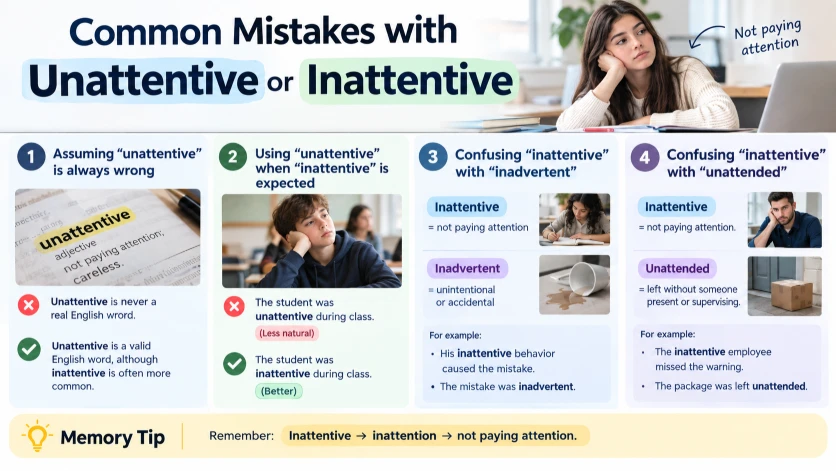
Mistake 1: Assuming “unattentive” is always wrong
❌ Unattentive is never a real English word.
✅ Unattentive is a valid English word, although inattentive is often more common.
Mistake 2: Using “unattentive” when “inattentive” is expected
Less natural:
The student was unattentive during class.
Better:
The student was inattentive during class.
Mistake 3: Confusing “inattentive” with “inadvertent”
These words are very different.
Inattentive = not paying attention.
Inadvertent = unintentional or accidental.
For example:
His inattentive behavior caused the mistake.
The mistake was inadvertent.
Cambridge defines inadvertent as “not intentional.”
Mistake 4: Confusing “inattentive” with “unattended”
These words also have different meanings.
Inattentive = not paying attention.
Unattended = left without someone present or supervising.
For example:
The inattentive employee missed the warning.
The package was left unattended.
Memory Tip
Remember:
Inattentive → inattention → not paying attention
This connection makes inattentive easier to remember.
Unattentive or Inattentive in Everyday Examples
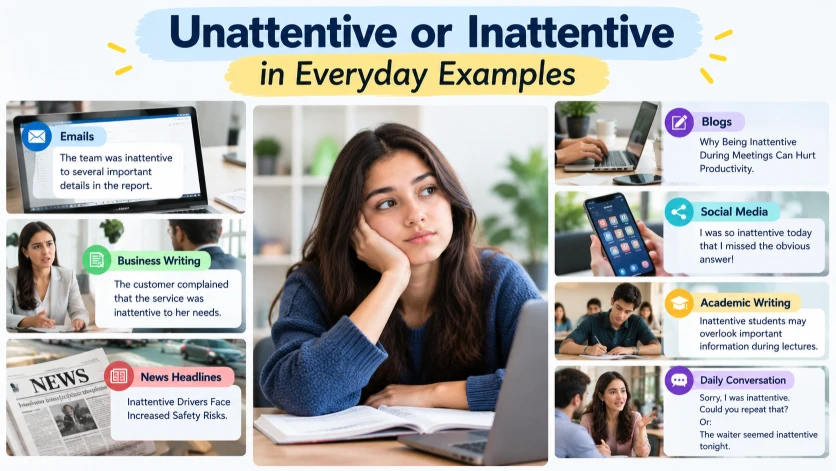
Emails
The team was inattentive to several important details in the report.
Business Writing
The customer complained that the service was inattentive to her needs.
News Headlines
Inattentive Drivers Face Increased Safety Risks
Blogs
Why Being Inattentive During Meetings Can Hurt Productivity
Social Media
I was so inattentive today that I missed the obvious answer!
Academic Writing
Inattentive students may overlook important information during lectures.
Daily Conversation
Sorry, I was inattentive. Could you repeat that?
Or:
The waiter seemed inattentive tonight.
Google Trends & Modern Usage
People searching “unattentive or inattentive” are usually trying to determine which adjective is correct or which one sounds more natural.
Both words are valid, but inattentive is especially useful in contexts involving concentration, listening, observation, and failure to notice something. Cambridge’s examples show inattentive in classroom, service, caregiving, and general attention contexts.
The word unattentive can also appear when writers want to describe someone as failing to provide sufficient attention or care. Its use depends strongly on context.
Exact Google Trends figures should not be invented because search interest changes by country, date, and query. For purposes, the important distinction is semantic:
- Inattentive → lack of attention
- Unattentive → not attentive or insufficiently attentive
- Attentive → paying close attention
- Inattention → failure to give attention
Quick Comparison
| Version | Meaning | Correct? | Region | Example |
| inattentive | Not giving attention | ✅ Yes | US, UK, international | He was inattentive in class. |
| unattentive | Not attentive or not giving enough attention | ✅ Yes | US, UK, international | The service was inattentive. |
| attentive | Giving careful attention | ✅ Yes | All major varieties | She is attentive to detail. |
| inattention | Failure to give attention | ✅ Yes | All major varieties | His inattention caused the error. |
| inadvertent | Unintentional or accidental | ✅ Yes | All major varieties | It was an inadvertent mistake. |
| unattended | Left without attention or supervision | ✅ Yes | All major varieties | The bag was unattended. |
Key Takeaways
- Inattentive and unattentive are both real English words.
- Inattentive is usually the more natural choice for “not paying attention.”
- Unattentive can describe a lack of attention or care.
- There is no British-American spelling difference.
- Do not confuse inattentive with inadvertent.
- Do not confuse inattentive with unattended.
- For general writing, inattentive is usually the safest choice.
- Always choose the word based on the exact meaning and context.
FAQs
Is unattentive a correct word?
Yes. Unattentive is a correct English word meaning “not attentive,” but inattentive is more commonly used.
What does inattentive mean?
Inattentive means not paying attention or not giving enough attention to something.
What are the 9 symptoms of inattentive ADHD?
The nine inattentive symptoms include careless mistakes, difficulty sustaining attention, not seeming to listen, failing to follow instructions, poor organization, avoiding sustained mental effort, losing things, being easily distracted, and being forgetful.
What is another word for unattentive?
Common alternatives include inattentive, distracted, careless, unobservant, and unmindful.
Is it unattentive or inattentive?
Both are correct words, but inattentive is the more commonly used choice.
How do you spell unattentive?
The correct spelling is unattentive U-N-A-T-T-E-N-T-I-V-E.
Conclusion
Unattentive and inattentive are both correct, but they are not equally common in every context. When you want to say that someone is not paying attention, listening, watching, or concentrating, inattentive is usually the clearest and safest choice. Cambridge directly defines inattentive as not giving attention to someone or something.
Unattentive is also a legitimate word. It can describe someone who is not attentive or who fails to give enough attention or care. The difference is therefore less about right versus wrong and more about natural usage and context.
There is also no special British or American spelling rule that changes these words. Writers in both varieties can use inattentive and unattentive.
For most general, academic, and professional writing, choose inattentive when you mean “not paying attention.” Keep unattentive for contexts where it sounds natural and accurately expresses the intended meaning.
Simple rule: When you mean “not paying attention,” inattentive is usually your best choice.
READ MORE!
- Twinning or Twining: What’s the Real Difference?
- Teady or Not: The Correct Phrase Explained
- Mens or Men’s: A Simple Guide to Correct Usage

I’m Edward Fletcher, a UK-based English language writer with a passion for grammar and vocabulary. At VocabNex, I share simple explanations, useful examples, and practical English tips to help learners improve their language skills and communicate with confidence.








1 thought on “Unattentive or Inattentive: Two Words, One Meaning? ”