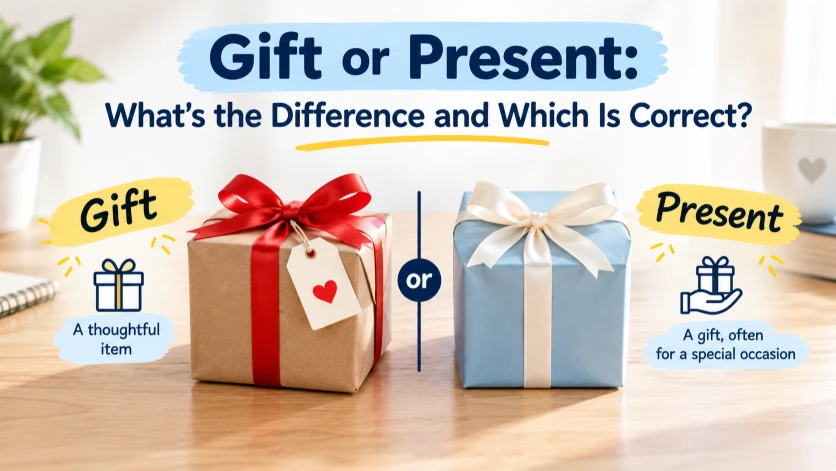
Gift or present can both mean something you give to another person, and in most everyday situations, you can use either word.
The two words often confuse English learners because they have almost the same meaning. For example, you can say, “I bought a gift for my sister” or “I bought a present for my sister.” Both sentences are correct.
People often search for gift or present because they want to know if one word is more correct, more formal, or more natural than the other. The good news is that there is no major difference in meaning when you use these words to describe something given to someone. However, their tone and other meanings can differ slightly.
Gift often sounds a little more formal and has some special meanings in English. Present is common in everyday speech, especially when talking about birthdays, Christmas, and other celebrations. This guide explains the difference, origins, usage, common mistakes, and practical examples so you can choose the right word with confidence.
Gift or Present : Quick Answer
Gift and present both mean something you give to someone without expecting payment. In this meaning, they are usually interchangeable.
- Gift: I bought my mother a birthday gift.
- Present: I bought my mother a birthday present.
- Gift: Thank you for the wonderful gift.
- Present: Thank you for the wonderful present.
The main difference is usage and tone. Gift can sound more formal and can also mean a natural talent, such as “a gift for music.” Present can also mean “current” or “being in a particular place.”
Simple rule: Use gift or present when you mean something given to another person.
Definition and Meaning of Gift or Present
What Does “Gift” Mean?
A gift is something that one person gives to another without asking for payment.
For example:
She gave me a beautiful gift for my birthday.
The word gift can also describe a natural skill or talent.
He has a gift for teaching children.
In this sentence, gift does not mean a physical object. It means a special ability.
Gift can also appear in formal expressions:
- a gift to the community
- a gift of money
- a gift certificate
- a gift shop
- a gift card
What Does “Present” Mean?
A present can also mean something given to someone.
My friends gave me a birthday present.
This meaning is very close to gift.
However, present has several other meanings.
As an adjective, it can mean current or existing now:
We must consider the present situation.
As an adjective, it can also mean being in a particular place:
All the students were present.
As a verb, present can mean to show, introduce, or give something formally:
She will present her ideas tomorrow.
So, while gift and present can have the same meaning, present has more common meanings outside the idea of giving something.
The Origin of Gift or Present
The two words come from different language histories.
Origin of “Gift”
Gift comes from Old Norse gift, meaning “a gift” or “something given.” It is related to the idea of giving.
The word later became part of English and developed its modern meaning of something given freely to another person.
English also uses gift for a natural talent. This meaning developed from the idea of something valuable that a person possesses naturally.
Origin of “Present”
Present comes from Latin praesens, meaning “being at hand” or “being present.” It entered English through Old French.
The word developed several meanings. One of them became connected with something given or placed before someone. This led to the noun present, meaning something given to another person.
The word also kept its other meanings, such as:
- existing now
- being here
- showing something
- formally giving something
Why Do “Gift” and “Present” Both Exist?
English has many words with similar meanings because it developed from several languages, including Old English, Old Norse, French, and Latin.
Over time, words from different sources can develop similar meanings. That is why English speakers can use gift and present for the same object in many situations.
British English vs American English Spelling
There is no major British-American spelling difference between gift and present.
Both forms are correctly spelled in British English and American English.
| Meaning | British English | American English |
| Something given to someone | gift | gift |
| Something given to someone | present | present |
| Natural talent | gift | gift |
| Current time | present | present |
| Being somewhere | present | present |
The difference is not spelling. It is mainly context, frequency, and style.
For example:
- UK: I bought her a birthday present.
- US: I bought her a birthday present.
- UK: Thank you for the gift.
- US: Thank you for the gift.
Both versions are natural.
Which Spelling Should You Use?
You do not need to choose between different spellings because gift and present are both correct words.
For American English
Both are correct. Gift is common in many contexts, especially formal and commercial writing.
Thank you for your gift.
For British English
Both are also correct. Present is very common in everyday conversations about birthdays and Christmas.
What did you get for your birthday?
I got a new watch as a present.
For Commonwealth English
Both words work well. Your choice can depend on the situation and personal style.
For a Global Audience
Use gift when you want a simple word that works well in many formal and international contexts.
Use present when you are talking casually about something given for a birthday, holiday, or special event.
Professional tip: Do not change gift to present, or vice versa, just because you think one is a British or American spelling. They are not regional spelling variants.
Common Mistakes with Gift or Present
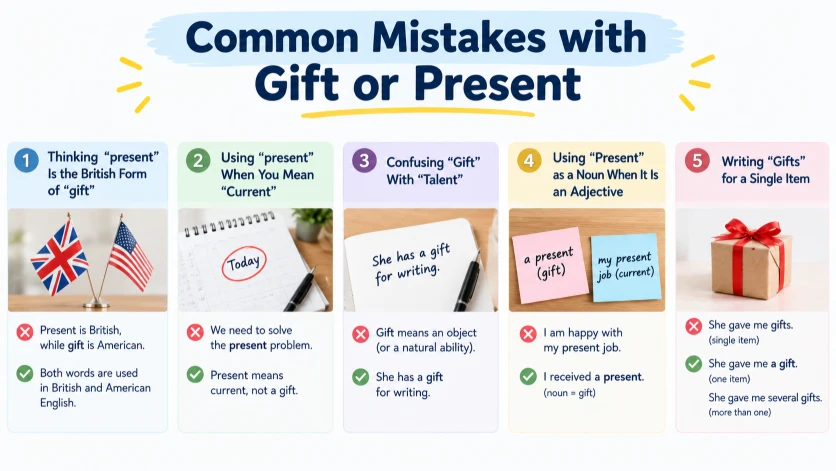
1. Thinking “present” Is the British Form of “gift”
This is incorrect.
Both words appear in British and American English.
Incorrect idea:
Present is British, while gift is American.
Correct:
Both words are used in British and American English.
2. Using “present” When You Mean “Current”
The meaning depends on context.
We need to solve the present problem.
Here, present means current, not a gift.
3. Confusing “Gift” With “Talent”
Gift can mean a natural ability.
She has a gift for writing.
Here, nobody is giving her an object.
4. Using “Present” as a Noun When It Is an Adjective
Compare:
I received a present.
Here, present is a noun meaning a gift.
I am happy with my present job.
Here, present is an adjective meaning current.
5. Writing “Gifts” for a Single Item
Use the singular form when you mean one item.
She gave me a gift.
Use gifts for more than one.
She gave me several gifts.
Gift or Present in Everyday Examples
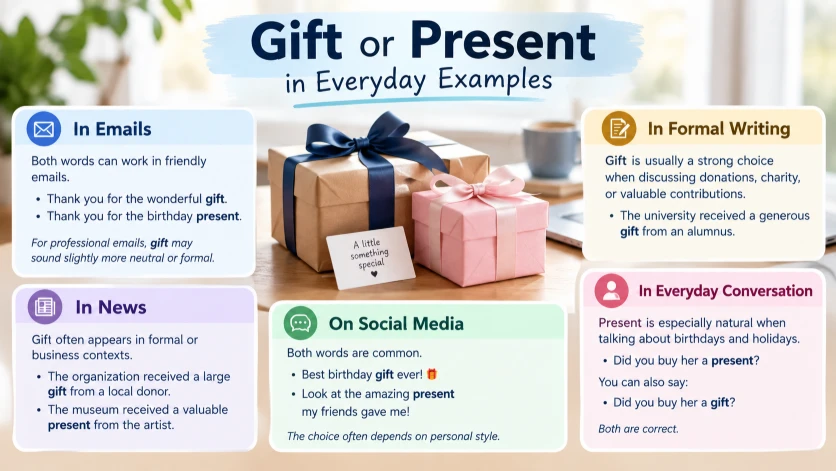
In Emails
Both words can work in friendly emails.
Thank you for the wonderful gift. I really appreciate it.
Or:
Thank you for the birthday present. I love it!
For professional emails, gift may sound slightly more neutral or formal.
In News
Gift often appears in formal or business contexts.
The organization received a large gift from a local donor.
You may also see:
The museum received a valuable present from the artist.
However, gift is more natural in many formal donation contexts.
On Social Media
Both words are common.
Best birthday gift ever! 🎁
Look at the amazing present my friends gave me!
The choice often depends on personal style.
In Formal Writing
Gift is usually a strong choice when discussing donations, charity, or valuable contributions.
The university received a generous gift from an alumnus.
In Everyday Conversation
Present is especially natural when talking about birthdays and holidays.
Did you buy her a present?
You can also say:
Did you buy her a gift?
Both are correct.
Comparison
| Feature | Gift | Present |
| Something given to someone | Yes | Yes |
| Birthday use | Very common | Very common |
| Christmas use | Very common | Very common |
| Formal writing | Very common | Common |
| Natural talent | Yes | No |
| Current or existing now | No | Yes |
| Being in a place | No | Yes |
| Verb meaning “to show/give formally” | No | Yes |
| British English | Correct | Correct |
| American English | Correct | Correct |
Gift vs Present: Quick Examples
| Situation | Best Choice | Example |
| Birthday | Either | I bought her a gift/present. |
| Christmas | Either | He gave me a gift/present. |
| Charity donation | Gift | They made a generous gift. |
| Natural talent | Gift | She has a gift for art. |
| Current situation | Present | We need to solve the present problem. |
| Being somewhere | Present | Everyone was present. |
| Formal presentation | Present | He will present the report. |
Gift or Present : Google Trends & Usage Data
Search interest for gift and present can change based on country, season, and context.
Both words receive strong attention around major gift-giving events, such as:
- Christmas
- birthdays
- Valentine’s Day
- Mother’s Day
- Father’s Day
- weddings
- anniversaries
The word gift also appears in many commercial and formal searches, such as gift ideas, gift cards, gift shops, and gift baskets.
The word present is often used in everyday questions and phrases related to celebrations, such as birthday present and Christmas present.
Google Trends uses a normalized scale rather than showing absolute search volume. Search results can also change by country, date range, and search phrase. Therefore, you should check the exact country and time period before making claims about which word is more popular.
FAQs About Gift or Present
Is it gift or present in the UK?
Both are correct, but present is very commonly used in British English.
What is the difference between a gift and a presentation?
A gift is something given to someone, while a presentation is the act of presenting something or a formal talk.
Is it a birthday present or gift?
Both are correct: birthday present and birthday gift.
What is the difference between “present” and “presents”?
Present is singular, while presents is plural.
Should I say gift or present?
Both are correct; choose either based on your preference and context.
What do British people call presents?
British people commonly call them presents, although gifts is also widely understood and used.
Conclusion
Gift or present is not really a question of correct versus incorrect English. Both words are correct when you mean something given to another person without expecting payment. The choice usually depends on context and personal style.
Gift can sound a little more formal and has an important extra meaning: a natural talent or ability. For example, “She has a gift for teaching.” Present has several other meanings too. It can describe something current, someone who is in a place, or the act of formally showing something.
There is also no British-American spelling rule that separates these two words. People use both gift and present in British and American English. For birthdays, Christmas, and other celebrations, either word works well.
If you want a safe choice for formal, business, or international writing, gift is often a good option. For casual conversations about celebrations, present sounds very natural. The key is to choose the word that fits your meaning and context.
READ MORE!
- Zootopia or Zootropolis: What’s the Difference?
- Switch or Vers: What’s the Difference?
- Neosporin or Bacitracin: Which One Is Better for Minor Wounds?

I’m passionate about English grammar, vocabulary, and clear communication. I enjoy making English easier to understand through simple, practical, and easy-to-follow explanations. My goal is to help learners build confidence and improve their English for everyday use.








2 thoughts on “Gift or Present: What’s the Difference and Which Is Correct? ”