
If you mean “looked quickly or secretly,” use peeked; if you mean “reached the highest point,” use peaked. These words sound alike, but they have different meanings and uses.
The confusion happens because peeked and peaked are homophones. They have the same pronunciation in most varieties of English, but their spellings and meanings differ. This makes them easy to mix up in texts, emails, schoolwork, and online writing.
For example, you might write, “She peeked through the door,” because she looked briefly. But you would write, “Sales peaked in December,” because sales reached their highest level.
Knowing the difference is simple once you connect each word to its base word. Peeked comes from peek, meaning to look quickly or secretly. Peaked comes from peak, meaning the highest point or level.
This guide explains the meanings, origins, regional usage, common mistakes, examples, and easy memory tricks so you can use peeked or peaked correctly every time.
Peeked or Peaked: Quick Answer
Peeked and peaked are both correct words, but they do not mean the same thing.
- Peeked = looked quickly, briefly, or secretly.
- She peeked through the window.
- He peeked inside the box.
- Peaked = reached the highest point or level.
- The temperature peaked at 35°C.
- The team’s performance peaked in June.
Easy rule
Peeked → peek → look
Peaked → peak → highest point
If someone looks, use peeked.
If something reaches its highest level, use peaked.
What Does Peeked or Peaked Mean?
What Does “Peeked” Mean?
Peeked is the past tense of peek.
To peek means to look at something quickly, briefly, or secretly.
For example:
The child peeked through the curtains.
The child looked through the curtains, probably for only a short time.
You can use peek in many everyday situations:
- peek through a door
- peek inside a box
- peek around a corner
- peek at a message
- peek through a window
- peek at the answer
The word often suggests a quick or secret look.
What Does “Peaked” Mean?
Peaked is the past tense of peak.
As a verb, peak means to reach the highest point, level, value, or stage.
For example:
Demand peaked during the holiday season.
This means demand reached its highest level during that period.
You can use peaked for many things:
- prices peaked
- sales peaked
- temperatures peaked
- interest peaked
- performance peaked
- traffic peaked
- popularity peaked
The word does not mean looking. It describes reaching a maximum or highest point.
Peeked vs Peaked in Simple Terms
Think of the two words this way:
Peeked = looked
Peaked = reached the top
That one distinction solves most peeked or peaked questions.
The Origin of Peeked or Peaked
The words peek and peak have different histories, even though they sound the same.
Origin of “Peek”
Peek developed in English as a word for looking briefly or secretly. Its exact early history is not completely certain, but it is associated with the idea of taking a quick look.
The verb became established in English with meanings related to looking through a small opening or looking secretly.
From peek, English formed:
- peek
- peeking
- peeked
- peek at
The spelling helps separate this word from peak, which has a different meaning.
Origin of “Peak”
Peak refers to the top or highest point of something. The noun has been used in English for a high pointed summit and later developed broader meanings.
Today, peak can refer to:
- the top of a mountain
- the highest point of a graph
- the highest level of activity
- the best stage of performance
- the greatest level of popularity
The verb peak developed from this idea of reaching the top or highest level.
For example:
The athlete peaked at age 25.
This means the athlete reached their highest level of performance around that time.
Why Are Peeked and Peaked Confused?
The main reason is pronunciation.
Peeked and peaked are normally pronounced the same way:
/piːkt/
They are therefore homophones, which are words that sound alike but have different spellings and meanings.
English contains many such pairs:
- see / sea
- right / write
- brake / break
- flour / flower
- peek / peak
The spelling provides the clue to the meaning.
British English vs American English
There is no British-American spelling difference between peeked and peaked.
Both words have the same spelling and meaning in British English and American English.
| Word | British English | American English | Example |
| Peeked | Correct | Correct | She peeked through the door. |
| Peaked | Correct | Correct | Sales peaked in July. |
| Peek | Correct | Correct | He wanted to peek inside. |
| Peak | Correct | Correct | The mountain has a snowy peak. |
The difference is therefore about meaning, not regional spelling.
British and American style guides both use peeked for looking and peaked for reaching a high point.
A Note About “Peek” and “Peak”
Both base words are also used in British and American English:
Peek: I took a peek inside.
Peak: The graph reached its peak.
The same distinction applies to their past-tense forms.
Which Version Should You Use?
You do not need to choose based on country. Choose based on meaning.
United States
Use peeked for a quick look.
She peeked at her phone.
Use peaked for reaching the highest point.
Interest peaked after the announcement.
United Kingdom
The same rule applies.
He peeked through the window.
Tourism peaked in August.
Canada
Canadian English also uses peeked and peaked according to their meanings.
Australia
Australian English follows the same basic distinction.
She peeked into the room.
Demand peaked during summer.
International Writing
For a global audience, focus on the meaning rather than regional spelling.
If you mean looked briefly, write peeked.
If you mean reached the highest point, write peaked.
Academic Writing
Peaked is common in academic and research writing when describing data.
The number of cases peaked in 2020.
Peeked is less common in academic writing because it describes a casual or secret look.
Business Writing
Peaked is frequently used in business and financial contexts.
Revenue peaked during the fourth quarter.
Peeked may appear in informal workplace writing.
I peeked at the report before the meeting.
Common Mistakes with Peeked or Peaked
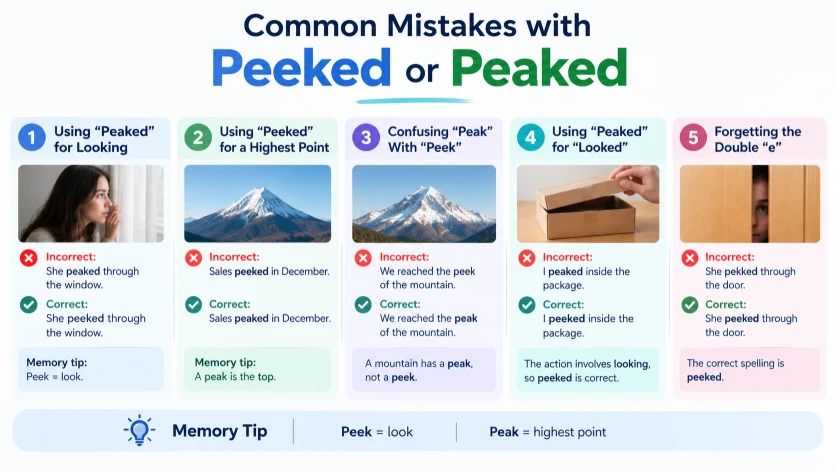
Mistake 1: Using “Peaked” for Looking
Incorrect:
She peaked through the window.
Correct:
She peeked through the window.
Why? She looked through the window. She did not reach a highest point.
Memory tip: Peek = look.
Mistake 2: Using “Peeked” for a Highest Point
Incorrect:
Sales peeked in December.
Correct:
Sales peaked in December.
Why? Sales reached their highest level in December.
Memory tip: A peak is the top.
Mistake 3: Confusing “Peak” With “Peek”
Incorrect:
We reached the peek of the mountain.
Correct:
We reached the peak of the mountain.
A mountain has a peak, not a peek.
Mistake 4: Using “Peaked” for “Looked”
Incorrect:
I peaked inside the package.
Correct:
I peeked inside the package.
The action involves looking, so peeked is correct.
Mistake 5: Forgetting the Double “e”
Incorrect:
She pekked through the door.
Correct:
She peeked through the door.
The correct spelling is peeked.
Quick Memory Trick
Remember:
Peek with your eyes. Peak at the top.
This simple connection can help you remember the difference.
Peeked or Peaked in Everyday Examples
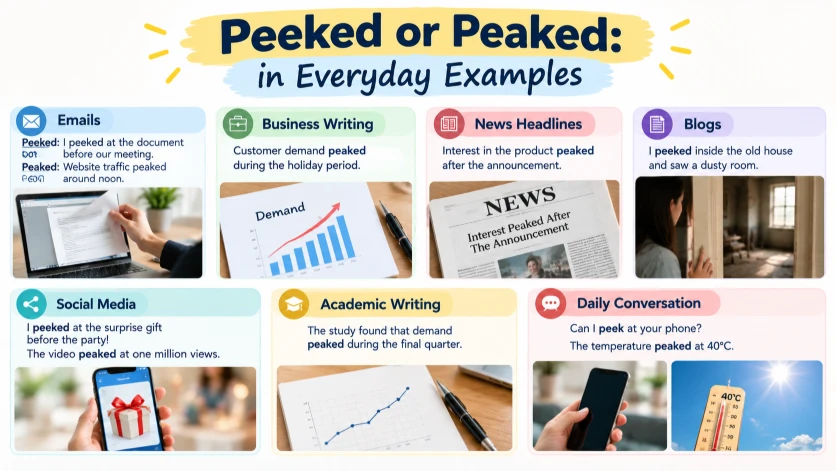
Emails
Peeked:
I peeked at the document before our meeting.
Peaked:
Website traffic peaked around noon.
Business Writing
Customer demand peaked during the holiday period.
Here, peaked describes the highest level of demand.
News Headlines
Interest in the product peaked after the announcement.
News writing often uses peaked when discussing numbers, trends, interest, prices, or activity.
Blogs
I peeked inside the old house and saw a dusty room.
Here, peeked means took a quick look.
Social Media
I peeked at the surprise gift before the party! 🎁
Or:
The video peaked at one million views.
Both are correct, but they describe completely different actions.
Academic Writing
The study found that demand peaked during the final quarter.
In research writing, peaked is useful when describing the highest point in data.
Daily Conversation
Can I peek at your phone?
The temperature peaked at 40°C.
These examples show the basic difference clearly.
Google Trends & Modern Usage
People often search peeked or peaked because the two words sound identical. This makes the spelling difficult to choose when writing quickly.
The confusion is especially common in:
- text messages
- social media
- school assignments
- online searches
- emails
- English-learning content
Modern usage also gives peak a wider range of meanings. People now commonly talk about peak traffic, peak demand, peak performance, peak hours, and peak popularity.
At the same time, peek remains common in everyday expressions such as “peek inside,” “peek through,” and “take a peek.”
Search interest can also change by country, season, and topic. Exact Google Trends results depend on the selected location, date range, and search term. For that reason, it would be misleading to give one fixed popularity figure for peeked and peaked without a specific Trends query.
The important usage pattern is clear: peaked often appears in discussions of data, performance, prices, and trends, while peeked usually appears in descriptions of looking.
Quick Comparison
| Version | Meaning | Correct? | Region | Example |
| Peek | Look quickly or secretly | Yes | US, UK, Canada, Australia | Peek inside the box. |
| Peeked | Looked quickly or secretly | Yes | US, UK, Canada, Australia | She peeked through the door. |
| Peak | Highest point or level | Yes | US, UK, Canada, Australia | The mountain has a high peak. |
| Peaked | Reached the highest point | Yes | US, UK, Canada, Australia | Sales peaked in June. |
| Pekked | Not standard English | No | All regions | ❌ She pekked inside. |
| Peaked for “looked” | Wrong word choice | No | All regions | ❌ She peaked through the door. |
Key Takeaways
- Peeked means looked quickly, briefly, or secretly.
- Peaked means reached the highest point or level.
- Peeked comes from peek.
- Peaked comes from peak.
- The two words are usually pronounced the same.
- They have the same spelling in British and American English.
- Use peeked for eyes and looking.
- Use peaked for maximum levels, performance, prices, or trends.
- Remember: Peek = look; peak = top.
FAQs About Peeked or Peaked
Which is correct: “peeked,” “peaked,” or “piqued”?
All three are correct, but they have different meanings: peeked = looked briefly, peaked = reached the highest point, and piqued = stimulated interest or curiosity.
What does “peeked” mean?
Peeked means looked quickly or secretly at something.
What does “peaked” mean?
Peaked means reached the highest level, point, or value.
What does taking a peek mean?
Taking a peek means having a quick look at something.
Do you say “peaked my interest”?
No. The correct phrase is “piqued my interest.”
Is it peek or peak for looking?
Use peek for looking: “I peeked through the window.”
Conclusion
The difference between peeked or peaked becomes easy once you focus on their base words. Peeked comes from peek, which means to look quickly, briefly, or secretly. Peaked comes from peak, which means to reach the highest point or level.
Use peeked when someone looks:
She peeked through the door.
Use peaked when something reaches its maximum:
Sales peaked in December.
Both words are correct in British and American English, so you do not need to change them based on your audience’s region. The key is choosing the word that matches your meaning.
Also remember that piqued is a separate word. In the phrase “piqued my interest,” neither peeked nor peaked works.
When in doubt, use the simplest memory rule: peek with your eyes, peak at the top. Once you connect each spelling with its meaning, this common homophone pair becomes much easier to use correctly.
READ MORE!
- Unattentive or Inattentive: Two Words, One Meaning?
- Twinning or Twining: What’s the Real Difference?
- Teady or Not: The Correct Phrase Explained

I’m passionate about English grammar, vocabulary, and clear communication. I enjoy making English easier to understand through simple, practical, and easy-to-follow explanations. My goal is to help learners build confidence and improve their English for everyday use.








1 thought on “Peeked or Peaked: Learn the Correct Usage ”