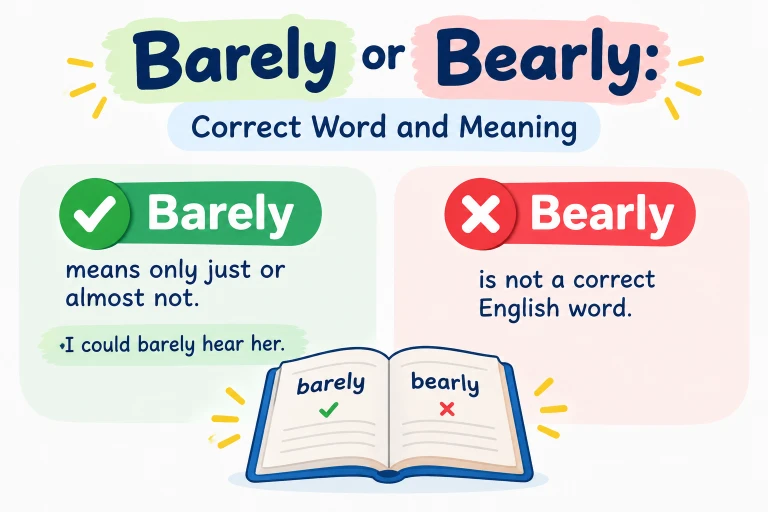
Barely is the correct spelling when you mean “only just,” “hardly,” or “almost not”; bearly is usually a misspelling.
People often search for “barely or bearly” because the two words sound very similar in speech. The confusion becomes even easier to understand because barely comes from the word bare, while bearly visually looks like it comes from bear. However, these forms do not normally have the same meaning.
In everyday English, barely is a common adverb. You can use it when something happens by a very small amount, almost does not happen, or is only just enough. For example, “I barely caught the bus” means I caught it, but only just.
Bearly is not the standard spelling for this meaning. It can appear rarely with a bear-related meaning, but in normal writing, use barely.
This guide explains the meaning, origin, spelling, regional usage, common mistakes, and practical examples of barely or bearly.
Barely or Bearly: Quick Answer
Barely is the correct word when you mean only just, hardly, or almost not. Bearly is generally a misspelling of barely.
Examples:
- Correct: I could barely hear you.
- Correct: She barely passed the test.
- Incorrect: I could bearly hear you.
- Incorrect: She bearly passed the test.
Easy memory tip:
Barely = almost not.
Definition and Meaning of Barely or Bearly
What Does “Barely” Mean?
Barely is an adverb that means only just, by the smallest amount, or almost not. Cambridge defines it as something happening by the smallest amount or only just.
For example:
- We barely had enough money.
- He could barely walk.
- I barely slept last night.
- The sign was barely visible.
Oxford also lists several uses, including something being possible only with difficulty, almost not happening, or being only a certain amount.
What Does “Bearly” Mean?
In standard everyday English, bearly is usually a misspelling of barely.
Rarely, bearly can be used as an adjective meaning related to or characteristic of bears, but this is uncommon.
Therefore, if you want to say “hardly” or “only just,” always write barely.
The Origin of Barely or Bearly
The word barely comes from bare + -ly. Its roots go back to Old English bærlice. The word originally had meanings connected with being openly or clearly, while the modern sense of “only just” appeared by the late 15th century.
The word bare itself comes from Old English bær, meaning uncovered or naked.
Bearly, when used as a rare bear-related adjective, comes naturally from bear + -ly. This explains why the spelling exists, but it does not make bearly correct when you mean “almost not.”
The spelling confusion mainly comes from the similar sound of bare and bear.
British English vs American English Spelling
There is no spelling difference between British and American English for this word.
| Meaning | British English | American English | Example |
| Only just | barely | barely | I barely arrived on time. |
| Almost not | barely | barely | She could barely see. |
| Bear-related rare adjective | bearly | bearly | A rare bear-related use |
Cambridge gives barely as the standard spelling in both UK and US English.
So if you write for readers in the United States, United Kingdom, Canada, or Australia, use barely when you mean “only just.”
Which Spelling Should You Use?
For US English
Use barely.
I barely had enough time.
For UK English
Use barely.
She could barely walk.
For Canada and Australia
Use barely for the standard meaning.
For International English
Barely is the safest choice because it is widely understood and standard.
For Academic Writing
Use barely when the meaning is “only just” or “almost not.”
For Business Writing
Use barely in professional sentences such as:
The company barely met its annual target.
Common Mistakes with Barely or Bearly
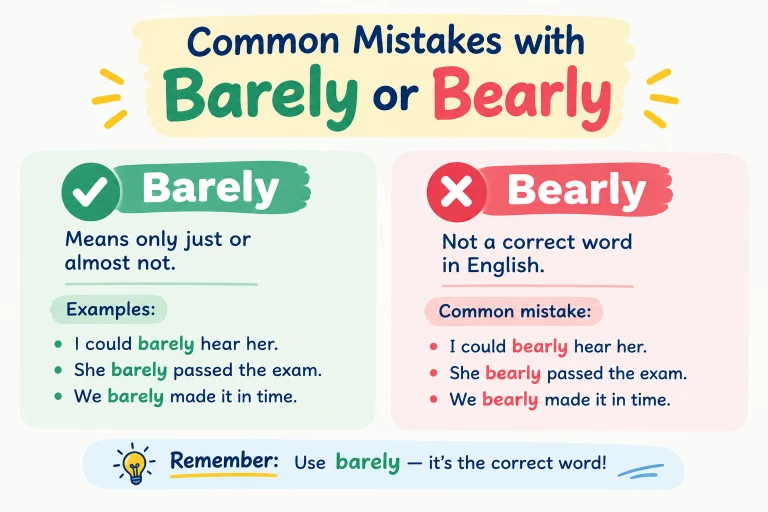
Mistake 1: Writing “bearly” instead of “barely”
❌ I bearly finished my work.
✅ I barely finished my work.
Explanation: The intended meaning is “only just,” so barely is correct.
Mistake 2: Confusing “barely” with “bear”
❌ She could bearly see the road.
✅ She could barely see the road.
Memory tip: Think barely = hardly.
Mistake 3: Assuming “bearly” is the normal spelling
❌ He was bearly able to stand.
✅ He was barely able to stand.
Although bearly can have a rare bear-related use, it is not the normal word for “hardly.”
Barely or Bearly in Everyday Examples
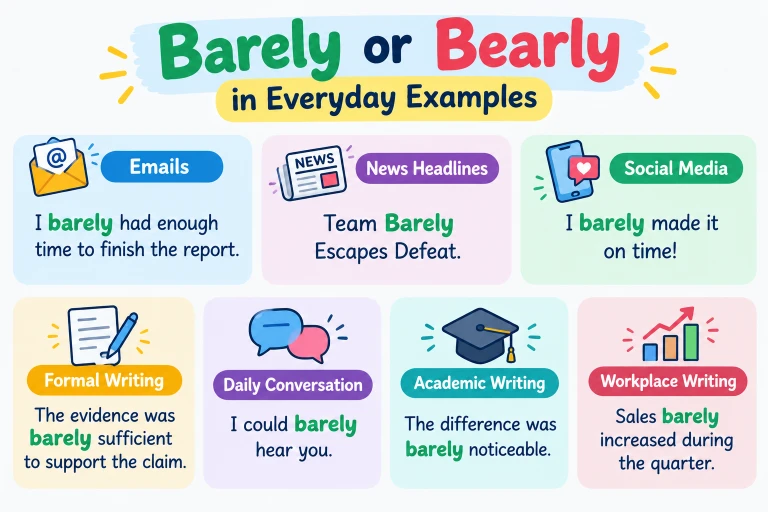
Emails
I barely had enough time to finish the report.
News Headlines
Team Barely Escapes Defeat
Social Media
I barely made it on time!
Formal Writing
The evidence was barely sufficient to support the claim.
Daily Conversation
I could barely hear you.
Academic Writing
The difference was barely noticeable.
Workplace Writing
Sales barely increased during the quarter.
Barely or Bearly: Google Trends & Usage Data
People search “barely or bearly” mainly because the spelling is easy to confuse. The two forms look and sound similar, but barely is overwhelmingly the standard word for the meaning “only just” or “almost not.”
Search interest can vary by country, language-learning audience, and context. Students, ESL learners, writers, and people checking spelling are especially likely to search this phrase.
Exact Google Trends numbers depend on the selected country, date range, and search type, so specific statistics should not be claimed without checking those settings.
For normal English writing, barely is the word you should use.
Barely vs Bearly: Quick Comparison
| Word | Meaning | Correct for “only just”? | Usage | Example |
| Barely | Only just; almost not | ✅ Yes | Very common | I barely slept. |
| Bearly | Rarely bear-related; often a misspelling | ❌ No | Very uncommon | Avoid in normal writing. |
| Hardly | Almost not | ✅ Alternative | Common | I could hardly see. |
| Scarcely | Almost not | ✅ Alternative | More formal | There was scarcely any time. |
Key Takeaways
- Barely is the correct spelling for “only just” or “almost not.”
- Bearly is usually a spelling mistake.
- Barely is used in both British and American English.
- Barely is an adverb.
- Barely can mean “by the smallest amount.”
- Hardly and scarcely can often replace barely.
- Remember: Barely = hardly.
FAQs
What is the meaning of “bearly”?
“Bearly” is not a standard English word. It is usually a misspelling of “barely,” which means only just or almost not.
How do I use “barely”?
Use barely when something happens by a very small amount.
Example: I could barely hear her.
Is “barely” a proper word?
Yes. Barely is a correct and commonly used English word.
Is “barely” or “barley” the correct spelling?
Both are correct words, but they have different meanings. Barely means “only just,” while barley is a type of grain.
What is the difference between “barely” and “bearly”?
Barely is the correct word when you mean “only just” or “almost not.” Bearly is generally an incorrect spelling.
What does “just barely” mean?
“Just barely” means something happened by the smallest possible amount or margin.
Example: She just barely passed the exam.
Conclusion
When choosing between barely or bearly, use barely when you mean “only just,” “hardly,” or “almost not.” It is the standard spelling in both British and American English. For example, “She could barely walk” means she could walk, but only with great difficulty.
The spelling bearly is usually an error in everyday writing. Although dictionaries and word references record rare bear-related uses of bearly, that meaning is not what most writers intend when they type “bearly.”
The easiest way to remember the difference is to connect barely with hardly. If your sentence means that something happened by a very small amount, choose barely.
If you are writing an email, school assignment, blog post, business document, or social media caption, barely is the safe and correct choice for this meaning.
Remember: Barely means “only just,” while bearly is usually a misspelling.
READ MORE!
- Shepherd or Shepard: Which Spelling Is Correct?
- Pail or Pale: What’s the Difference?
- Bagpack or Backpack: Which Spelling Is Correct?

I’m Edward Fletcher, a UK-based English language writer with a passion for grammar and vocabulary. At VocabNex, I share simple explanations, useful examples, and practical English tips to help learners improve their language skills and communicate with confidence.








1 thought on “Barely or Bearly: Correct Word and Meaning ”