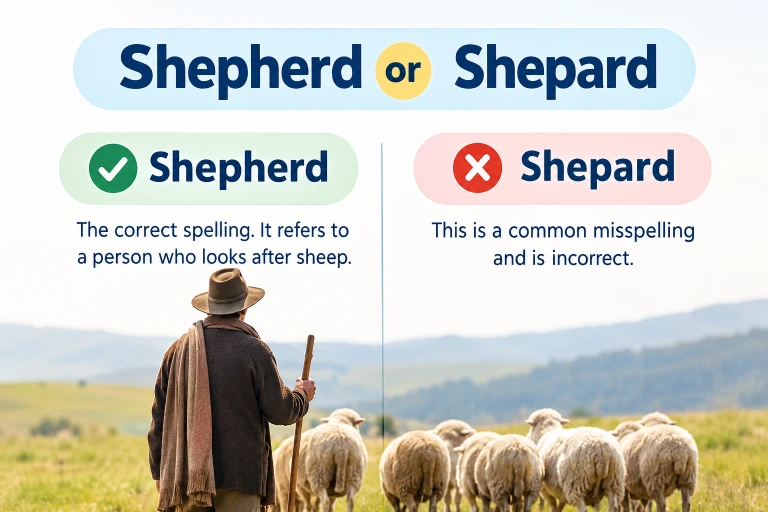
Shepherd is the correct spelling for a person who takes care of sheep, while shepard is usually a misspelling. The word often causes confusion because the letters in shepherd do not match the way many people expect it to sound.
If you have ever wondered if to write shepherd or shepard, you are not alone. The extra h and e can make the spelling easy to forget, especially for English learners and people who mainly hear the word in conversation. This guide explains the difference in a simple way.
You will learn what shepherd means, where the word came from, how British and American English use it, and how to avoid the common spelling mistake. You will also see everyday examples from emails, news, social media, and formal writing.
The quick rule is simple: Use shepherd when you mean a person who cares for sheep. Do not use shepard as the standard spelling of this common noun.
Shepherd or Shepard: Quick Answer
Shepherd is the correct standard English spelling. It means a person whose job is to care for and move sheep.
- Correct: The shepherd watched the sheep.
- Incorrect: The shepard watched the sheep.
Shepard is not the standard spelling of the common English word. However, Shepard can appear as a surname or proper name, so it may be correct when referring to a person’s name.
Definition and Meaning of Shepherd or Shepard
What does shepherd mean?
A shepherd is a person who looks after sheep. A shepherd may guide, protect, feed, and move a flock from one place to another. Cambridge gives the same basic meaning in both its British and American English entries.
Example:
The shepherd led the sheep into the field.
Shepherd as a noun
As a noun, shepherd refers to a person who cares for sheep.
Examples:
- The shepherd watched the flock.
- A young shepherd worked on the farm.
- The shepherd moved the sheep to a safer field.
Shepherd as a verb
Shepherd can also work as a verb. It means to guide or move sheep. It can also mean to guide people carefully from one place or situation to another.
Examples:
- The dogs shepherded the sheep into the pen.
- Volunteers shepherded the visitors through the building.
- She shepherded the children toward the bus.
Does Shepard have a meaning?
Shepard is generally not the standard spelling for the common noun shepherd. However, Shepard may be used as a surname or personal name.
So, when you mean someone who looks after sheep, write shepherd.
The Origin of Shepherd or Shepard
The spelling shepherd has a long history. Etymonline traces it to Middle English shep-herd, meaning a person who leads, tends, and guards sheep in a pasture. It came from Old English sceaphierde, formed from sceap, meaning “sheep,” and hierde, meaning “herder.”
The word therefore has a very clear original structure:
sheep + herder = shepherd
Over time, the spelling changed into the modern form shepherd.
The unusual spelling can cause confusion because modern pronunciation does not make every letter obvious. Cambridge lists the UK pronunciation as /ˈʃep.əd/ and the US pronunciation as /ˈʃep.ɚd/.
This helps explain why some people write shepard after hearing the word. They may spell it based on its sound rather than its historical spelling.
A useful memory trick is:
Shepherd has “herd” inside it.
Think of sheep + herd when remembering the spelling.
British English vs American English Spelling
There is no spelling difference between British and American English for this word. Both use shepherd.
The main difference is pronunciation. Cambridge gives the UK pronunciation as /ˈʃep.əd/ and the US pronunciation as /ˈʃep.ɚd/.
| Feature | British English | American English |
| Correct spelling | shepherd | shepherd |
| Incorrect common spelling | shepard | shepard |
| Pronunciation | /ˈʃep.əd/ | /ˈʃep.ɚd/ |
| Meaning | Person who cares for sheep | Person who cares for sheep |
| Verb | shepherd | shepherd |
Examples
British English:
The shepherd moved the sheep across the field.
American English:
The shepherd moved the sheep across the field.
The spelling stays exactly the same.
Which Spelling Should You Use?
Use shepherd in all standard English writing.
For American English
Use shepherd in schoolwork, business writing, articles, emails, and everyday communication.
Correct:
The shepherd cared for the sheep.
For British English
Use shepherd as well. British English does not change the spelling to shepard.
For Commonwealth English
Countries such as Australia, Canada, and New Zealand also use shepherd in standard English.
For a global audience
Choose shepherd. It is the recognized spelling and is easy for English readers to understand.
Simple rule:
Shepherd is correct everywhere. Shepard is not the standard spelling of the word.
Common Mistakes with Shepherd or Shepard
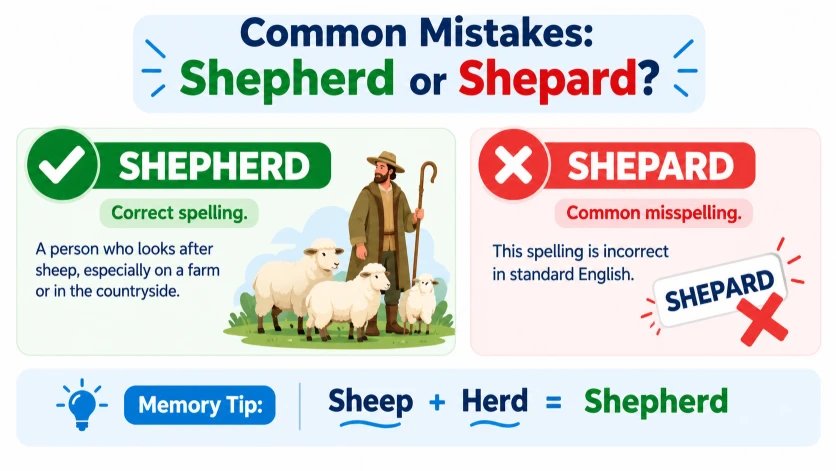
1. Writing “shepard” instead of “shepherd”
❌ The shepard watched the flock.
✅ The shepherd watched the flock.
2. Forgetting the “herd” part
Many people remember the beginning shep- but forget the herd ending.
A useful trick is to think:
sheep + herd → shepherd
3. Confusing spelling with pronunciation
The word may sound simpler than it looks. Do not spell it only from its pronunciation.
4. Using “shepard” in formal writing
Avoid shepard in essays, reports, articles, and professional documents unless it is a person’s actual name.
5. Confusing a name with the common word
Shepard may be a surname. For example, if someone’s family name is Shepard, the capitalized spelling is correct.
Shepherd or Shepard in Everyday Examples
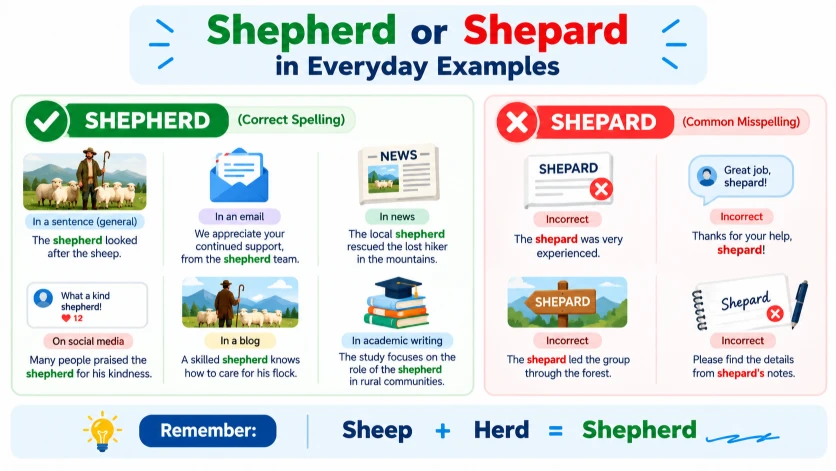
Emails
The shepherd will bring the sheep back before sunset.
Business Writing
The farm hired an experienced shepherd to care for the flock.
News Headlines
Local Shepherd Helps Protect Sheep During Winter
Social Media
Beautiful morning with the shepherd and his flock! 🐑
Formal Writing
The shepherd carefully monitored the flock throughout the day.
Daily Conversation
The shepherd is taking the sheep to the field.
Academic Writing
The study examines the traditional role of the shepherd in rural communities.
Creative Writing
The shepherd walked quietly across the hillside as the sun began to set.
In every example, shepherd is the correct spelling when the word refers to a person who cares for sheep.
Shepherd or Shepard: Google Trends & Usage Data
Google Trends can help compare searches for shepherd and shepard, but it is important to understand what the data means. Google says Trends measures search interest for the exact search terms entered. Spelling variations and misspellings can be analyzed separately.
This matters for shepherd or shepard because people may search for the misspelled version while trying to confirm the correct spelling.
Google Trends also allows users to compare interest by country or region and across different time periods.
However, low-volume spelling queries may not produce enough data for a useful graph. Google notes that very low search volumes can appear as 0 in Trends.
For Content, this means an article targeting “shepherd or shepard” can still be useful even when the misspelling has limited search volume. It directly answers a spelling question and helps readers find the correct form.
Quick Comparison
| Word | Correct? | Meaning | Example |
| Shepherd | ✅ Yes | A person who cares for sheep | The shepherd watched the flock. |
| Shepard | ❌ Usually no | Common misspelling | Avoid this spelling for the occupation. |
| Shepherded | ✅ Yes | Guided or moved | She shepherded the children inside. |
| Shepherding | ✅ Yes | The act of guiding or caring | Shepherding requires patience. |
| Shepherdess | ✅ Yes | Female shepherd | The shepherdess cared for the flock. |
Key Takeaways
- Shepherd is the correct standard spelling.
- Shepard is usually a spelling mistake when referring to a person who cares for sheep.
- Shepherd can be both a noun and a verb.
- British and American English use the same spelling.
- The word comes from Old English and is linked to sheep and herder.
- Shepard can still be correct as a surname or proper name.
- Remember: sheep + herd = shepherd.
FAQs About Shepherd or Shepard
1. What is the difference between shepherd and shepard?
Shepherd is the correct standard English spelling for a person who looks after sheep. Shepard is usually a misspelling, although it can be a surname or proper name.
2. Is it German shepard or shepherd?
The correct spelling is German Shepherd. It is the name of the dog breed, so German Shepard is incorrect.
3. Is Shepard a boy or girl name?
Shepard can be used as a name for either a boy or a girl, although it is more commonly used as a surname or given name for boys. It is also sometimes used as a modern unisex name.
4. How do you say shepard?
If you mean the standard word shepherd, it is pronounced with two syllables. The spelling Shepard as a name may have the same pronunciation, depending on the person.
5. Is the H in shepherd silent?
No. The h in shepherd is not silent. It contributes to the “sh” sound at the beginning of the word.
6. Is Shepard a popular name?
Shepard is a recognized name, but it is much less common as a given name than many traditional names. It is also well established as a surname, so its popularity can vary depending on if you are looking at first names or family names.
Conclusion
When choosing between shepherd or shepard, always use shepherd when you mean a person who cares for sheep. The spelling shepard is not the standard form of the common English word, although it can appear as a surname or proper name.
The word shepherd has a long history and comes from Old English roots connected with sheep and herding. Today, it works as both a noun and a verb. You can write about a shepherd who cares for sheep, or you can use shepherd as a verb when someone guides sheep or people.
British and American English use the same spelling, so you do not need to change it for your audience. The main difference is pronunciation.
If you often forget the spelling, remember this simple clue: shepherd contains the idea of “sheep + herd.” That makes it much easier to choose the correct form every time.
READ MORE!
- Teat or Teet: Which Spelling Is Correct?
- Pail or Pale: What’s the Difference?
- Kabob or Kebab: Which Spelling Is Correct?

I’m Edward Fletcher, a UK-based English language writer with a passion for grammar and vocabulary. At VocabNex, I share simple explanations, useful examples, and practical English tips to help learners improve their language skills and communicate with confidence.








2 thoughts on “Shepherd or Shepard: Which Spelling Is Correct?”