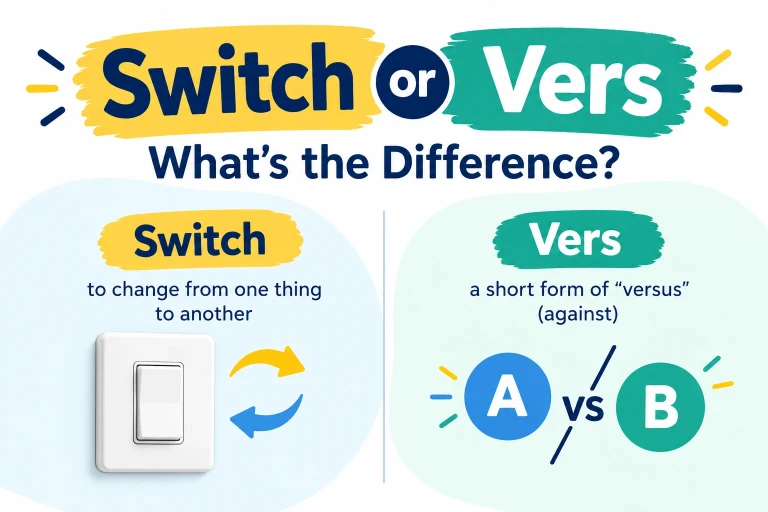
If you have seen “switch” and “vers” in dating, queer, or BDSM discussions, the two terms can seem interchangeable. They do overlap, but they usually describe different kinds of flexibility.
Vers commonly refers to flexibility between top and bottom sexual roles, while switch more often refers to moving between dominant and submissive roles in a power dynamic.
The confusion happens because some communities use the words more broadly, and some people use switch and vers almost interchangeably.
Context matters. This guide explains what each term means, where the difference comes from, how usage varies, and how to understand phrases such as “vers top,” “vers bottom,” and “switch.”
Switch or Vers: Quick Answer
Vers is short for versatile and usually describes someone who is comfortable taking both top and bottom sexual roles. Switch usually describes someone who can move between dominant and submissive roles in a BDSM or power-exchange context.
In simple terms:
- Vers → flexibility in top/bottom sexual roles.
- Switch → flexibility in dominant/submissive roles.
- Both → a person can identify as both vers and switch.
- Neither → labels are optional and do not have to describe everyone.
The terms can overlap, especially in casual conversations, so it is better to ask what someone means rather than assume.
What Does Switch or Vers Mean?
What does “vers” mean?
Vers is a shortened form of versatile. In sexual terminology, it generally describes someone who is comfortable with both top and bottom roles. Research on sexual-position labels also uses “versatile” for people who may take either the insertive or receptive role.
For example:
- Vers: comfortable with both roles.
- Vers top: usually prefers topping but is open to bottoming.
- Vers bottom: usually prefers bottoming but is open to topping.
Being vers does not mean someone must divide their preferences equally. A person can strongly prefer one role and still consider themselves versatile.
What does “switch” mean?
Switch usually refers to someone who enjoys both sides of a dominant/submissive dynamic. In BDSM, a switch may take the dominant role in one situation and the submissive role in another.
For example:
- A person may be dominant with one partner and submissive with another.
- Someone may prefer different roles depending on the situation.
- A switch may have a strong preference for one role while still enjoying the other.
A switch does not have to be 50/50.
The Origin of Switch or Vers
The two terms have different linguistic backgrounds.
Vers comes from versatile, a word that means capable of adapting or taking different forms. In sexual communities, “vers” developed as a shortened label for sexual versatility, especially for people who are comfortable with both top and bottom roles. Academic literature has long used “versatile” as a sexual-position category.
Switch is an older general English word meaning to change from one thing to another. Its specialized BDSM meaning developed during the 20th century. A 2025 qualitative study notes that the use of “switch” for people who take both dominant-type and submissive-type BDSM roles dates to the 20th century.
Over time, both terms became associated with flexibility, which helps explain why people sometimes treat them as synonyms.
British English vs American English
Unlike spelling pairs such as color/colour, switch and vers do not have a major British-versus-American spelling difference.
| Term | British English | American English | Example |
| Switch | switch | switch | “They identify as a switch.” |
| Vers | vers | vers | “They describe themselves as vers.” |
| Versatile | versatile | versatile | “They are sexually versatile.” |
The main difference is context and community usage, not spelling. “Vers” is informal slang, while “versatile” is the full standard English word.
In BDSM discussions, switch is often more closely associated with dominant/submissive dynamics. In queer sexual terminology, vers is commonly associated with top/bottom flexibility. However, real-world usage varies.
Which Version Should You Use?
There is no single “correct” choice because these are labels rather than competing spellings.
United States
Both terms appear in online dating, queer communities, and BDSM discussions. Choose the term that accurately describes the type of flexibility you mean.
United Kingdom
The same basic meanings apply. British English does not require a different spelling.
Canada
Both terms may be understood in LGBTQ+ and BDSM contexts. Clear context is more important than regional spelling.
Australia
The same general distinction applies. If the audience may not know the slang, use the full phrase versatile or explain switch.
International writing
For a general audience, define the term the first time you use it:
“Vers, short for versatile, usually refers to flexibility between top and bottom roles.”
This makes the meaning clear without assuming that every reader knows the slang.
Academic writing
Use versatile or a clearly defined term rather than assuming readers understand informal slang. Academic research commonly discusses “top,” “bottom,” and “versatile” as sexual-position labels.
Business writing
These terms are generally inappropriate unless the subject specifically requires them. If they are necessary, define them clearly and use neutral, respectful language.
Common Mistakes
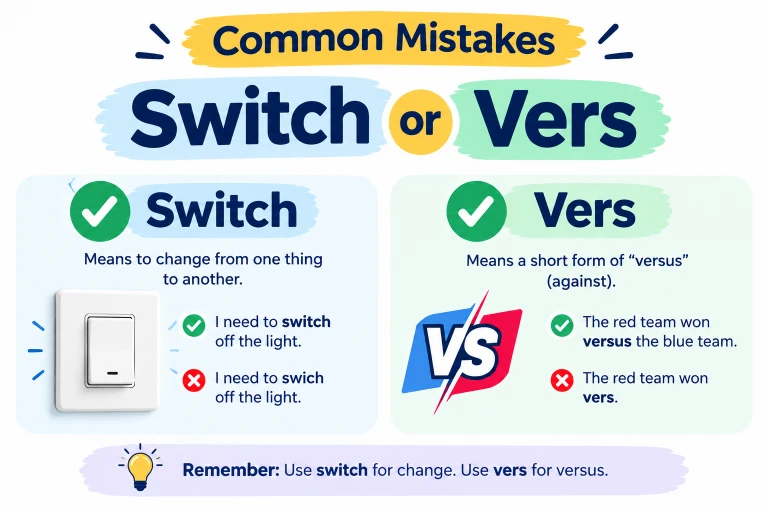
Mistake 1: Treating switch and vers as exact synonyms
Incorrect:
“Switch and vers always mean exactly the same thing.”
Better:
“Switch and vers can overlap, but they may describe different types of flexibility.”
Why?
Vers often focuses on top/bottom roles, while switch often focuses on dominant/submissive dynamics.
Mistake 2: Assuming top means dominant
Incorrect:
“If someone is a top, they must be dominant.”
Correct:
“A top can be dominant, submissive, or neither.”
Top/bottom and dominant/submissive are separate concepts. Research and BDSM terminology distinguish physical or activity roles from power roles.
Mistake 3: Thinking vers means 50/50
Incorrect:
“A vers person must split their preferences equally.”
Correct:
“Vers means someone is open to both roles. It does not require a 50/50 balance.”
Memory tip:
Vers = versatile. Switch = changes roles.
Switch or Vers in Everyday Examples
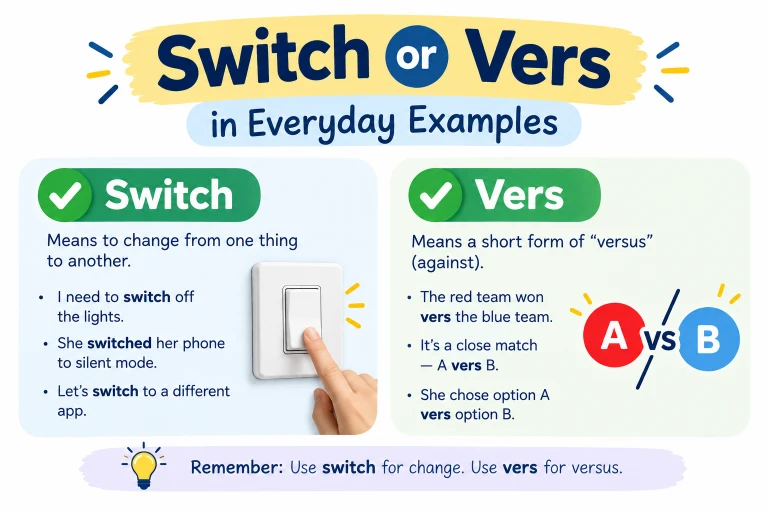
These terms usually appear in informal or community-specific settings rather than ordinary business English.
Emails
“Please define what you mean by ‘vers’ so the terminology is clear.”
Business Writing
“The article explains the difference between versatile and switch roles.”
News Headlines
“Switch and Vers: Understanding Flexible Sexual Roles”
Blogs
“Vers usually refers to flexibility between top and bottom roles.”
Social Media
“What is the difference between vers and switch?”
Academic Writing
“Research commonly distinguishes top, bottom, and versatile sexual-position labels.”
Daily Conversation
“When you say switch, do you mean dominant/submissive flexibility or top/bottom flexibility?”
That question is often the clearest way to avoid misunderstanding.
Google Trends & Modern Usage
Search interest in switch or vers is closely tied to online discussions about dating, LGBTQ+ terminology, BDSM, and sexual-role vocabulary. The terms are more specialized than everyday English words, so their popularity can vary significantly by audience, platform, region, and search wording.
Modern usage also shows that the distinction is not completely fixed. Some sources use switch and vers interchangeably, while others make a clearer distinction between top/bottom versatility and dominant/submissive switching.
Academic research confirms that sexual-role labels can be complex and may include combinations such as vers/top and vers/bottom.
Exact Google Trends numbers should not be assumed without specifying the country, date range, and exact search terms. For that reason, this article does not invent numerical popularity figures.
Quick Comparison
| Version | Meaning | Correct? | Region | Example |
| Vers | Flexible between top and bottom roles | Yes | International | “He identifies as vers.” |
| Versatile | Full form of vers | Yes | International | “They describe themselves as versatile.” |
| Switch | Flexible between dominant and submissive roles | Yes | International | “They identify as a switch.” |
| Vers switch | May describe flexibility on both axes | Yes | Informal | “They identify as a vers switch.” |
The exact meaning can depend on the community and speaker, so context remains important.
Key Takeaways
- Vers is short for versatile.
- Vers commonly describes flexibility between top and bottom roles.
- Switch commonly describes flexibility between dominant and submissive roles.
- The two terms can overlap.
- A person can be both vers and switch.
- Neither term requires a 50/50 split.
- Top does not automatically mean dominant.
- Bottom does not automatically mean submissive.
- These labels are optional and personal.
- When unsure, ask what the person means by the label.
FAQs
What is the difference between a vers and a switch?
A vers (versatile) can take either a top or bottom role, while a switch can alternate between dominant and submissive roles.
Does vers mean switch?
No. Vers usually refers to flexibility between top and bottom roles, while switch refers to changing between dominant and submissive roles.
What does vers mean?
Vers is short for versatile. In sexual contexts, it generally describes someone who is comfortable being either a top or a bottom.
Can a woman be a vers?
Yes. Vers can describe anyone, regardless of gender, who is comfortable taking either top or bottom roles.
Is vers top or bottom?
A vers can be either. The term means the person is comfortable with both top and bottom roles rather than being limited to one.
What does a switch mean?
A switch is someone who enjoys taking both dominant and submissive roles, depending on the situation or partner.
Conclusion
The main difference between switch or vers is usually the type of flexibility each word describes. Vers, short for versatile, commonly refers to someone who is comfortable with both top and bottom sexual roles. Switch more often refers to someone who can move between dominant and submissive roles, particularly in BDSM and power-exchange settings.
Still, these meanings are not universal. Some people use switch and vers as near-synonyms, while others make a clear distinction. That is why context matters more than trying to force every person into one definition.
If you are writing for a general audience, define the terms before using them. If you are speaking with someone directly, ask what the label means to them.
Memorable takeaway: Vers describes flexibility in sexual positioning; switch usually describes flexibility in power roles.
READ MORE!

I’m passionate about English grammar, vocabulary, and clear communication. I enjoy making English easier to understand through simple, practical, and easy-to-follow explanations. My goal is to help learners build confidence and improve their English for everyday use.








2 thoughts on “Switch or Vers: What’s the Difference?”