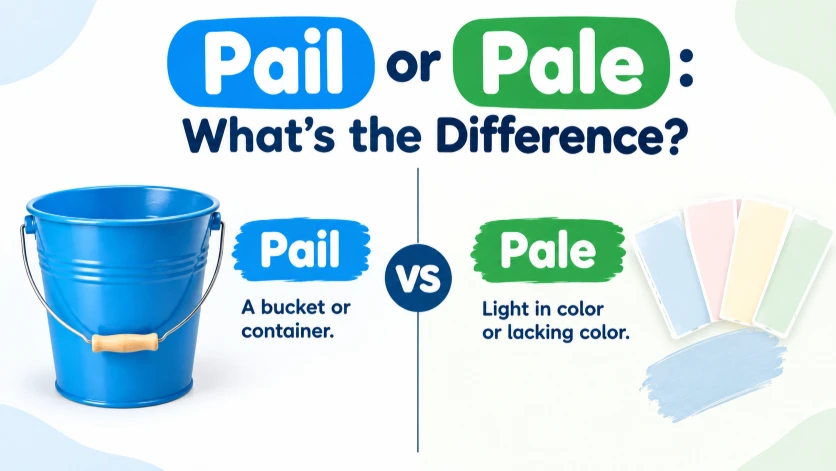
“Pail” means a bucket, while “pale” means light in color or lacking brightness.
If you are wondering if pail or pale is the right word, both are correct, but they have completely different meanings. Pail means a bucket or container, while pale usually describes something light in color or a person whose face has lost color.
People often confuse these words because they are pronounced the same way, /peɪl/, but they are spelled differently and used in very different situations. This makes them a common example of homophones, words that sound alike but have different meanings and spellings.
The good news is that the difference is easy to remember. If you are talking about a container for water, paint, sand, or other materials, use pail. If you are talking about a light color, a pale face, or something that loses color, use pale.
This guide explains the meaning, history, usage, common mistakes, regional differences, and everyday examples of pail or pale so you can choose the right word with confidence.
Pail or Pale: Quick Answer
Pail and pale are both correct English words, but they do not mean the same thing.
- Pail = a bucket or container.
- Pale = light in color or lacking normal color.
- Both are pronounced /peɪl/.
- They are homophones, not spelling variations.
Examples:
She filled the pail with water.
He looked pale after the long walk.
The walls are pale blue.
A simple memory trick is:
Pail = a container.
Pale = a light color.
Cambridge defines pail as a bucket or container, while pale can describe a light color or a face with less color than usual.
What Does Pail or Pale Mean?
What Does Pail Mean?
A pail is a container, usually open at the top and fitted with a handle. It is commonly used for carrying or holding liquids and other materials.
A pail can hold:
- Water
- Milk
- Paint
- Sand
- Soil
- Cleaning supplies
For example:
The farmer carried a pail of milk.
Please fill the pail with water.
In American English, pail is a familiar word for a bucket. Cambridge notes that pail is mainly used in US English, while British English usually prefers bucket.
What Does Pale Mean?
Pale usually means light in color or less colorful than normal. It can describe skin, clothing, paint, light, or other things.
For example:
She wore a pale pink dress.
His face looked pale.
The room was painted pale green.
The word can also be used as a verb:
His face paled when he heard the news.
As a verb, pale means to become lighter or lose its usual color.
Other Meanings of Pale
The word pale has some less common meanings.
As a noun, a pale can mean a pointed wooden stake used in a fence. It can also refer to a defined area or boundary in historical contexts. Cambridge also lists the Pale, referring to a historical area around Dublin controlled by the English during the Middle Ages.
For everyday English, however, the most useful meaning is:
Pale = light in color or lacking color.
Are Pail and Pale Homophones?
Yes. Pail and pale are homophones because they have the same pronunciation but different spellings and meanings.
| Word | Pronunciation | Meaning |
| pail | /peɪl/ | A bucket or container |
| pale | /peɪl/ | Light in color or lacking color |
This is why spelling matters so much when writing these words.
The Origin of Pail or Pale
Although pail and pale sound alike today, they come from different historical roots.
Origin of Pail
The word pail dates to Middle English. Merriam-Webster gives its first known use as the 14th century and traces it to Middle English payle and paille.
The Online Etymology Dictionary traces pail to a Middle English word meaning a cylindrical bucket. It probably came through Old French paele or paelle, related to a pan or shallow vessel, and ultimately to Latin patella, meaning a small pan or dish.
Over time, the word developed into the modern meaning of a bucket-like container.
Origin of Pale
The adjective pale has a different history. It entered English through Old French paile, meaning pale or light-colored, from Latin pallidus, meaning pale, pallid, or colorless.
Merriam-Webster also traces the adjective to Middle English and Latin pallidus. Its first known use is recorded as the 12th century for the word pale, although its different grammatical senses have separate histories.
Interestingly, pale also has an older noun meaning related to a stake or fence. That sense comes from a different historical root connected to Latin palus, meaning a stake or post.
So, even though pail and pale sound identical, they did not develop from the same word.
British English vs American English
There is no spelling difference between British and American English for pail or pale. Both are spelled exactly the same.
The main regional difference is how often pail is used. Cambridge labels pail as mainly US and notes that British English usually uses bucket instead.
| Word | British English | American English | Example |
| pail | Less common, usually bucket | Common | Fill the pail with water. |
| pale | Common | Common | She wore a pale blue shirt. |
| paling | Used | Used | His face was paling. |
| paler | Used | Used | This color is paler. |
| palest | Used | Used | This is the palest shade. |
Pail vs Bucket
In the US, pail and bucket can both refer to a similar container.
In the UK, bucket is usually the more natural everyday word. Cambridge specifically lists pail as mainly US and says UK English usually uses bucket.
This means an American speaker might say:
I carried a pail of water.
A British speaker is more likely to say:
I carried a bucket of water.
Both speakers understand the meaning.
Does Pale Change Between US and UK English?
No. Pale has the same spelling and basic meanings in both varieties.
For example:
She has pale skin.
The walls are pale yellow.
These forms work in both British and American English.
Which Version Should You Use?
United States
Use pail when you mean a bucket or similar container.
The child carried a pail of sand.
Use pale for light colors or a loss of color.
His face became pale.
United Kingdom
Pale is used in the same way.
For a container, bucket is usually more natural than pail in everyday British English.
Canada
Both pail and pale are understood. The correct choice depends on the meaning.
Fill the pail with water.
She chose a pale blue color.
Australia
The same basic distinction applies. Use pail for the container and pale for color or loss of color.
International English
For clear international writing, choose the word based on meaning.
- Container → pail
- Light color → pale
If your audience is mainly British, bucket may be more natural than pail.
Academic Writing
Academic writers should choose the spelling that matches the intended meaning.
The researchers collected the sample in a pail.
The solution became pale yellow.
Never choose one simply because the two words sound alike.
Business Writing
The same rule applies in professional writing.
Please place the materials in the pail.
The logo uses a pale blue background.
Common Mistakes
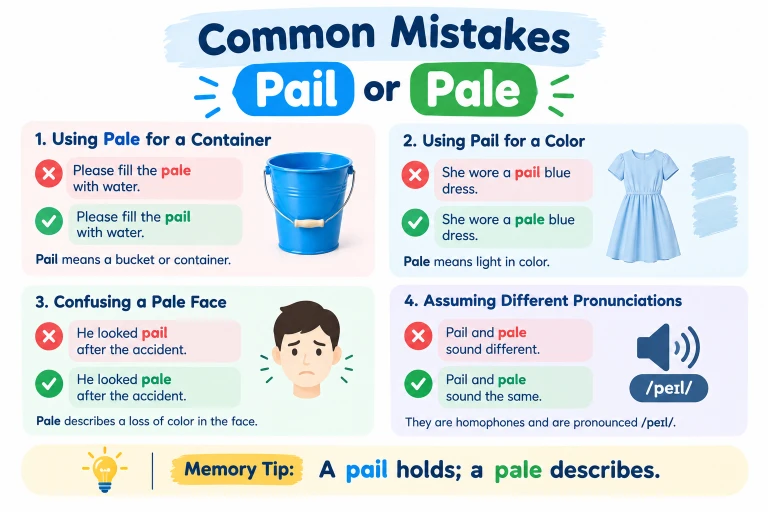
Mistake 1: Using Pale for a Container
❌ Please fill the pale with water.
✅ Please fill the pail with water.
Why? A pail is a container.
Mistake 2: Using Pail for a Color
❌ She wore a pail blue dress.
✅ She wore a pale blue dress.
Why? Pale means light or not strong in color.
Mistake 3: Confusing a Pale Face
❌ He looked pail after the accident.
✅ He looked pale after the accident.
Why? A person’s face can become pale when they are sick, frightened, shocked, or unwell.
Mistake 4: Assuming the Words Have Different Pronunciations
They do not. Pail and pale are pronounced the same way: /peɪl/.
Easy Memory Tip
Think of this simple pair:
Pail = pale? No. Pail = pail of water.
Pale = pale color.
You can also remember:
A pail holds. Pale describes.
Everyday Examples
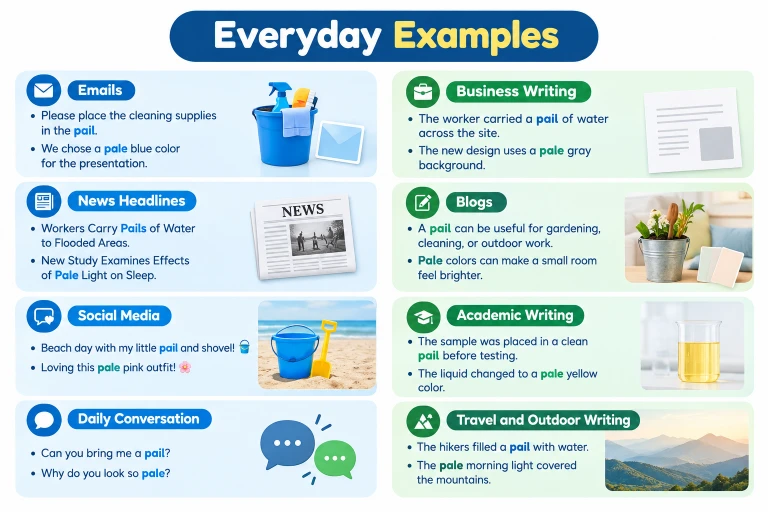
Emails
Please place the cleaning supplies in the pail.
We chose a pale blue color for the presentation.
Business Writing
The worker carried a pail of water across the site.
The new design uses a pale gray background.
News Headlines
Workers Carry Pails of Water to Flooded Areas
New Study Examines Effects of Pale Light on Sleep
The exact wording of a headline depends on the subject, but the spelling always follows the meaning.
Blogs
A pail can be useful for gardening, cleaning, or outdoor work.
Pale colors can make a small room feel brighter.
Social Media
Beach day with my little pail and shovel! 🪣
Loving this pale pink outfit! 🌸
Academic Writing
The sample was placed in a clean pail before testing.
The liquid changed to a pale yellow color.
Daily Conversation
Can you bring me a pail?
Why do you look so pale?
Travel and Outdoor Writing
The hikers filled a pail with water.
The pale morning light covered the mountains.
Google Trends & Modern Usage
Searches for “pail or pale” are usually driven by spelling confusion. People often know how the word sounds but are unsure which spelling matches the meaning they want.
Google Trends measures relative search interest, not absolute search volume. Its data is normalized on a 0–100 scale, so a Trends score should not be treated as the number of searches. Exact results can also change depending on the country, date range, and search term selected.
For this topic, broad usage patterns are more useful than claiming an exact popularity number.
Why Do People Search “Pail or Pale”?
The main reasons include:
- They are homophones.
- They have very different meanings.
- Both spellings are real English words.
- Learners may know the pronunciation but not the spelling.
- American and British usage differs slightly for “pail.”
The word pail is more closely associated with American English, while British speakers commonly prefer bucket for the same type of container.
The word pale, however, is common in both British and American English for colors, skin, light, and related meanings.
For content, “pail or pale” is therefore a useful comparison query because the search intent is not simply to find a definition. Users want to know which spelling to choose in a sentence.
Quick Comparison
| Version | Meaning | Correct? | Region | Example |
| Pail | Bucket or container | ✅ Yes | Mainly US | Fill the pail with water. |
| Pale | Light in color | ✅ Yes | US, UK, international | She wore a pale dress. |
| Pale | Lacking normal color | ✅ Yes | US, UK, international | His face looked pale. |
| Pail | Light color | ❌ No | None | ❌ Pail blue |
| Pale | Container | ❌ No | None | ❌ Fill the pale |
Key Takeaways
- Pail and pale are both correct words.
- Pail means a bucket or container.
- Pale usually means light in color or lacking color.
- Both words are pronounced /peɪl/.
- They are homophones with different meanings and spellings.
- British English usually prefers bucket instead of pail.
- American English commonly uses pail for a bucket-like container.
- Pale has the same basic spelling and meaning in British and American English.
- Remember: A pail holds; pale describes.
FAQs About Pail or Pale
1. Is it pale of water or pail of water?
The correct phrase is “a pail of water.” Here, pail means a bucket or container.
2. What is meant by pail?
A pail is a bucket-like container used for carrying or holding liquids, such as water.
3. Is a pale a bucket?
No. Pale does not mean a bucket. The correct word for a bucket is pail.
4. What does pale mean?
Pale means light in color or lacking its usual color, such as pale blue or pale skin.
5. Is it pale or pail?
Use pail for a bucket or container. Use pale when describing a light color or a loss of color.
6. What is a pale of water?
“A pale of water” is incorrect. The correct phrase is “a pail of water.”
Conclusion
The difference between pail or pale is simple once you connect each word to its meaning. Pail is a noun for a bucket or similar container, while pale usually describes something that has a light color or less color than normal. Pale can also work as a verb when something becomes lighter or loses color.
Both words sound the same, which is why they can cause confusion in writing. They are homophones, so you cannot rely on pronunciation alone. You need to look at the meaning of the sentence.
There is also a small regional difference. Pail is mainly associated with American English, while British speakers generally prefer bucket. Pale is used normally in both British and American English.
For school, business, academic, and everyday writing, use the word that matches your meaning.
Remember: A pail is a container, while pale is about color.
If you are learning English, save this simple rule and use it whenever these two homophones cause confusion.
READ MORE!
- Bagpack or Backpack: Which Spelling Is Correct?
- Teat or Teet: Which Spelling Is Correct?
- Kabob or Kebab: Which Spelling Is Correct?

I’m Edward Fletcher, a UK-based English language writer with a passion for grammar and vocabulary. At VocabNex, I share simple explanations, useful examples, and practical English tips to help learners improve their language skills and communicate with confidence.








2 thoughts on “Pail or Pale: What’s the Difference?”