
Discreetly and discretely are both correct words, but they have different meanings.
People often search for “discreetly or discretely” because the two words look and sound almost the same, yet they describe different actions. Discreetly means doing something carefully, privately, or without attracting attention. Discretely means doing something separately or as distinct parts.
This small spelling difference can change the meaning of a sentence. For example, “She spoke discreetly” means she spoke quietly or privately. “The data was stored discretely” means the data was stored in separate units. Knowing the difference helps you choose the right word in emails, reports, academic writing, and everyday communication.
The easiest way to remember them is simple: discreetly = private or careful, while discretely = separate or distinct.
Discreetly or Discretely: Quick Answer
Discreetly means quietly, privately, or without attracting attention.
She discreetly left the meeting.
Discretely means separately or as individual, distinct units.
The samples were analyzed discretely.
So, use discreetly for privacy or tact. Use discretely for things that are separate or distinct.
Definition and Meaning of Discreetly or Discretely
Discreetly
Discreetly is the adverb form of discreet.
It means:
- Carefully
- Privately
- Quietly
- Without drawing attention
- With good judgment
Example:
He discreetly checked his phone during the meeting.
Here, he checked his phone without making it obvious.
Another example:
She discreetly asked for help.
The person asked in a private or tactful way.
Discretely
Discretely is the adverb form of discrete.
It means:
- Separately
- Individually
- As distinct units
- Without being joined together
This word is more common in technical, scientific, mathematical, and academic contexts.
Example:
The information was recorded discretely.
This means the information was recorded as separate units.
Another example:
The machine measures each signal discretely.
Here, each signal is treated as a separate item.
The Origin of Discreetly or Discretely
The two words have related historical roots, which helps explain their similar spelling.
Discreet comes from Old French and ultimately traces back to Latin discretus, meaning separated, distinguished, or discerning. Over time, discreet developed its modern meaning of being careful, tactful, and avoiding unwanted attention.
Discrete also comes from the Latin discretus. Its modern meaning focuses more strongly on things being separate, distinct, or individually identifiable.
Although the words share a historical connection, English developed different meanings for them.
That is why discreetly and discretely look so similar but cannot always be used interchangeably.
British English vs American English Spelling
Unlike many spelling differences between British and American English, there is no major US-versus-UK spelling difference here.
Both forms are standard in British and American English:
| Word | American English | British English | Meaning |
| Discreetly | ✓ | ✓ | Privately or carefully |
| Discretely | ✓ | ✓ | Separately or distinctly |
| Discreet | ✓ | ✓ | Careful or tactful |
| Discrete | ✓ | ✓ | Separate or distinct |
The important issue is meaning, not regional spelling.
For example:
She discreetly closed the door.
This has the same meaning in American and British English.
Likewise:
The results were analyzed discretely.
The meaning remains the same in both varieties of English.
Which Spelling Should You Use?
Choose the word based on what you mean rather than where you are writing.
Use Discreetly When:
You mean privately, quietly, tactfully, or without attention.
The manager discreetly handled the complaint.
Use Discretely When:
You mean separately, individually, or as distinct units.
The values were recorded discretely.
For US and UK Writing
Both forms are correct in:
- American English
- British English
- Canadian English
- Australian English
- Academic writing
- Business writing
The key is to match the word with the intended meaning.
Common Mistakes with Discreetly or Discretely
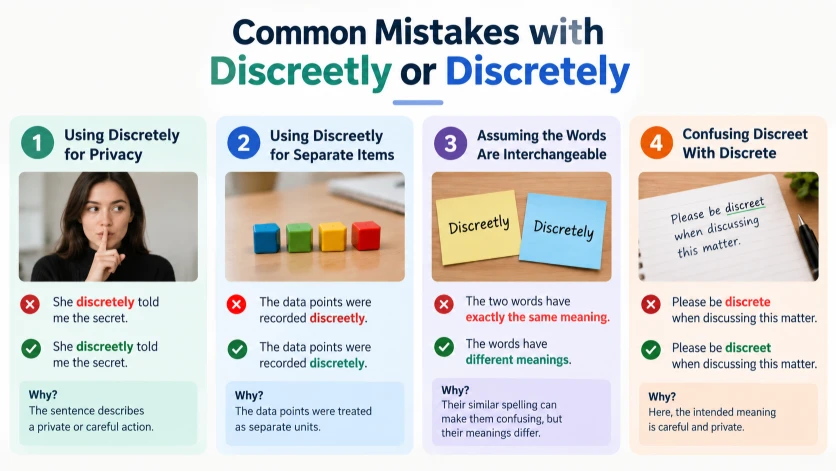
Mistake 1: Using Discretely for Privacy
❌ She discretely told me the secret.
✅ She discreetly told me the secret.
Why? The sentence describes a private or careful action.
Mistake 2: Using Discreetly for Separate Items
❌ The data points were recorded discreetly.
✅ The data points were recorded discretely.
Why? The data points were treated as separate units.
Mistake 3: Assuming the Words Are Interchangeable
❌ The two words have exactly the same meaning.
✅ The words have different meanings.
Why? Their similar spelling can make them confusing, but their meanings differ.
Mistake 4: Confusing Discreet With Discrete
❌ Please be discrete when discussing this matter.
✅ Please be discreet when discussing this matter.
Here, the intended meaning is careful and private.
Discreetly or Discretely in Everyday Examples
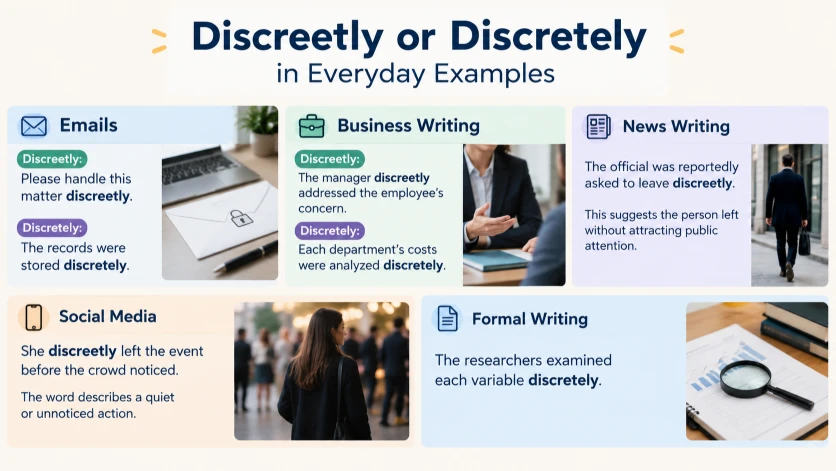
Emails
Discreetly:
Please handle this matter discreetly.
Discretely:
The records were stored discretely.
Business Writing
Discreetly:
The manager discreetly addressed the employee’s concern.
Discretely:
Each department’s costs were analyzed discretely.
News Writing
Officials reportedly asked the official to leave discreetly.
This suggests the person left without attracting public attention.
Social Media
She discreetly left the event before the crowd noticed.
The word describes a quiet or unnoticed action.
Formal Writing
The researchers examined each variable discretely.
This use is more technical and focuses on separate variables.
Discreetly or Discretely: Comparison
| Word | Meaning | Common Context | Example |
| Discreetly | Privately or carefully | Social, business, personal | She discreetly left the room. |
| Discretely | Separately or distinctly | Science, math, technology | The values were measured discretely. |
| Discreet | Careful and tactful | Personal and professional | He is very discreet. |
| Discrete | Separate or distinct | Technical and academic | The system has discrete units. |
Discreetly or Discretely: Google Trends & Usage Data
Searches for “discreetly or discretely” usually come from people trying to solve a spelling and meaning problem. The two words are easy to confuse because they differ by only one letter.
Their usage also varies by context.
Discreetly appears frequently in everyday, professional, and social situations because people often need to describe private or careful actions.
Discretely is more specialized. Technical, scientific, mathematical, and academic writers often use it to describe separate units or distinct values.
Search interest can also vary by country and language-learning audience. However, search volume alone does not determine which word is correct. Meaning and context should guide the choice.
FAQs About Discreetly or Discretely
What does it mean to act discreetly?
To act discreetly means to behave carefully and privately, without attracting attention or revealing sensitive information.
What does discrete mean?
Discrete means separate, distinct, or individually different from other things.
Is discretely a word?
Yes, discretely is a correct word. It means separately, individually, or in distinct parts.
What’s the difference between discreet and indiscreet?
Discreet means careful and private, while indiscreet means careless about keeping information private or behaving appropriately.
What is the difference between “discreetly” and “discretely”?
Discreetly means privately or carefully, while discretely means separately or individually.
What is discreet LGBTQ?
Discreet in an LGBTQ context generally means keeping someone’s sexual orientation or gender identity private or not openly revealing it.
Conclusion
Both discreetly and discretely are correct English words, but they describe different situations. The main difference is meaning. Discreetly describes an action done privately, carefully, or without attracting attention. Discretely describes something treated separately or as a distinct unit.
Use discreetly when talking about secrets, privacy, tact, or quiet actions. For example, “She discreetly asked the manager for help.” Use discretely when describing separate values, objects, signals, or units. For example, “The measurements were recorded discretely.”
There is no important British-versus-American spelling difference between these words. Both forms are standard in both varieties of English. The correct choice depends entirely on context.
A simple memory tip is to connect discreetly with being private and discretely with being separate. Once you understand that distinction, choosing the right word becomes much easier.
READ MORE!
- Faint vs Feint: Understanding the Difference
- Soy or Estoy: What’s the Difference in Spanish?
- Gift or Present: What’s the Difference and Which Is Correct?

I’m Edward Fletcher, a UK-based English language writer with a passion for grammar and vocabulary. At VocabNex, I share simple explanations, useful examples, and practical English tips to help learners improve their language skills and communicate with confidence.







