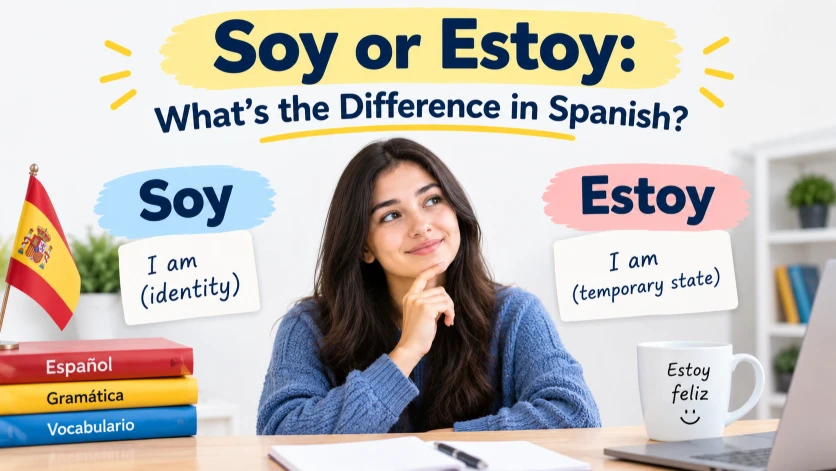
Soy and estoy are both correct Spanish words, but you use soy for permanent or defining traits and estoy for temporary states, locations, and conditions. English speakers often find these words confusing because both can translate as “I am.”
The key difference comes from their verbs. Soy is the first-person singular form of ser, while estoy is the first-person singular form of estar. Spanish uses these two verbs where English usually uses just one verb, “to be.”
For example, you say “Soy estudiante” to identify yourself as a student, but “Estoy cansado” to describe how you feel right now. You also use estoy for location, as in “Estoy en casa” or “I am at home.”
People search for soy or estoy because choosing between ser and estar is one of the most common challenges for Spanish learners. Once you understand what each verb expresses, the difference becomes much easier.
This guide explains the meanings, origins, usage rules, common mistakes, examples, and practical tips for choosing soy or estoy correctly.
Soy or Estoy: Quick Answer
Soy means “I am” and comes from ser. It is mainly used for identity, origin, profession, characteristics, and other defining information.
Estoy also means “I am”, but it comes from estar. It is commonly used for location, temporary conditions, feelings, and states.
Use soy for:
- Identity: Soy Ana.
- Nationality or origin: Soy de México.
- Profession: Soy profesor.
- Defining characteristics: Soy alto.
- Relationships or identity: Soy su hermano.
Use estoy for:
- Location: Estoy en casa.
- Feelings: Estoy feliz.
- Temporary conditions: Estoy cansado.
- Situations or states: Estoy ocupado.
Simple rule:
Soy = what or who I am.
Estoy = how or where I am.
Definition and Meaning of Soy or Estoy
What Does “Soy” Mean?
Soy is the first-person singular form of the Spanish verb ser.
It usually translates as:
I am
You use soy to describe identity, origin, profession, characteristics, and other qualities that identify or define a person.
Examples:
- Soy estudiante. = I am a student.
- Soy de España. = I am from Spain.
- Soy médico. = I am a doctor.
- Soy una persona tranquila. = I am a calm person.
The idea is often connected to identity or what something is.
What Does “Estoy” Mean?
Estoy is the first-person singular form of estar.
It also translates as:
I am
However, estar commonly expresses location, feelings, temporary conditions, and states.
Examples:
- Estoy en casa. = I am at home.
- Estoy cansado. = I am tired.
- Estoy feliz. = I am happy.
- Estoy ocupado. = I am busy.
The idea is often connected to state, condition, or location.
Why Does Spanish Have Two Forms for “I Am”?
English normally uses “I am” for both types of meaning.
Spanish separates many of these meanings between ser and estar.
Compare:
Soy feliz. = I am a happy person.
Estoy feliz. = I am happy right now.
The exact meaning can depend on context, and the traditional “permanent versus temporary” rule is useful but not perfect. Ser and estar are better understood by the types of information they express.
The Origin of Soy or Estoy
Soy and estoy come from two different Spanish verbs: ser and estar.
Origin of “Soy”
The Spanish verb ser has a complex history. Its forms developed from several Latin verbs, including forms related to esse, the Latin verb meaning “to be.”
The form soy became the Spanish first-person singular present form of ser.
Because ser developed from different historical forms, its modern conjugation does not always look predictable to beginners.
For example:
- yo soy = I am
- tú eres = you are
- él/ella es = he/she is
- nosotros somos = we are
Origin of “Estoy”
Estoy comes from the Spanish verb estar. The verb is related to Latin stare, meaning “to stand” or “to be standing.”
Over time, estar developed its modern Spanish meanings connected with states, conditions, and location.
Its present-tense forms include:
- yo estoy = I am
- tú estás = you are
- él/ella está = he/she is
- nosotros estamos = we are
Why Do Soy and Estoy Look So Different?
They come from different verbs with different historical roots. Spanish did not simply create two spellings for the English phrase “I am.”
Instead:
- soy comes from ser
- estoy comes from estar
This is why learners must learn both verbs and their common uses.
British English vs American English Spelling
The British-American spelling rules do not apply directly to soy and estoy because both are Spanish words.
English speakers in the United States, United Kingdom, Canada, Australia, and other English-speaking regions use the same Spanish spellings.
| Spanish Word | Meaning | US English | UK English |
| Soy | I am, from ser | Soy | Soy |
| Estoy | I am, from estar | Estoy | Estoy |
| Ser | To be | Ser | Ser |
| Estar | To be | Estar | Estar |
There is no standard British or American spelling such as one country using soy and another using estoy.
The important difference is Spanish grammar, not English regional spelling.
Accent Marks Matter
Related forms of estar often include accent marks:
- estás
- está
- están
The word estoy itself does not take an accent mark.
Likewise, soy does not take an accent mark.
Correct:
Estoy feliz.
Not:
Estóy feliz.
Which Spelling Should You Use?
Because soy and estoy are Spanish words, your audience’s English dialect does not change the spelling.
United States
Use the standard Spanish forms:
Soy estudiante.
Estoy cansado.
Spanish is widely used in the United States, so these forms appear frequently in schools, workplaces, signs, media, and everyday conversation.
United Kingdom
Use the same Spanish forms.
Soy de Londres.
Estoy en casa.
Canada
Use standard Spanish:
Soy profesor.
Estoy ocupado.
Australia
The same forms apply:
Soy australiano.
Estoy aquí.
International Writing
Use soy and estoy according to Spanish grammar. Do not choose between them based on English-speaking region.
Academic Writing
For Spanish assignments, language courses, and academic work, use the form that matches the grammatical meaning.
Soy estudiante de español.
Estoy en la universidad.
Business Writing
Use soy for identity or professional information:
Soy gerente de ventas.
Use estoy for location or current status:
Estoy en Madrid esta semana.
Common Mistakes with Soy or Estoy
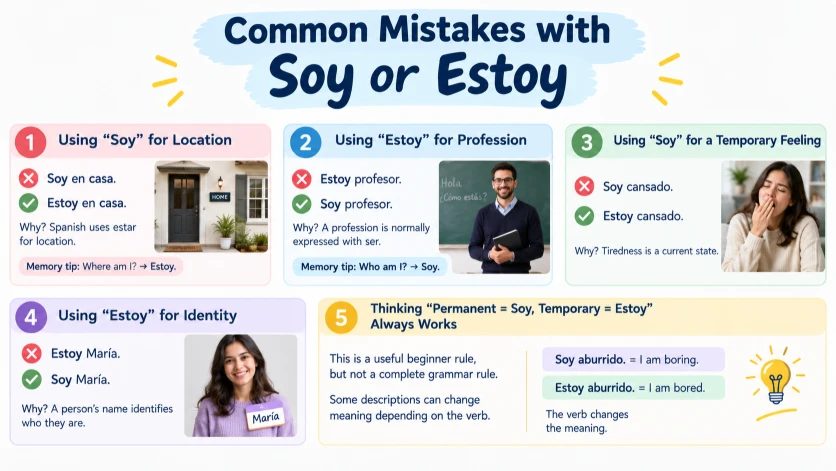
Mistake 1: Using “Soy” for Location
Incorrect:
Soy en casa.
Correct:
Estoy en casa.
Why? Spanish uses estar for location.
Memory tip: Where am I? → Estoy.
Mistake 2: Using “Estoy” for Profession
Incorrect:
Estoy profesor.
Correct:
Soy profesor.
Why? A profession is normally expressed with ser.
Memory tip: Who am I? → Soy.
Mistake 3: Using “Soy” for a Temporary Feeling
Incorrect:
Soy cansado.
Correct:
Estoy cansado.
Why? Tiredness is a current state.
Mistake 4: Using “Estoy” for Identity
Incorrect:
Estoy María.
Correct:
Soy María.
Why? A person’s name identifies who they are.
Mistake 5: Thinking “Permanent = Soy, Temporary = Estoy” Always Works
This is a useful beginner rule, but it is not a complete grammar rule.
Some descriptions can change meaning depending on if you use ser or estar.
For example:
Soy aburrido. = I am boring.
Estoy aburrido. = I am bored.
The verb changes the meaning.
Soy or Estoy in Everyday Examples

Emails
For introductions:
Soy Carlos, el nuevo gerente.
For current location:
Estoy en la oficina.
Business Writing
Soy el director de la empresa.
This identifies the speaker’s role.
Estoy disponible para una reunión mañana.
This describes the speaker’s current availability.
News Headlines
Spanish news may use forms of ser and estar according to the information being reported.
El país está en alerta.
This describes a current state.
El presidente es economista.
This describes identity or profession.
Blogs
Soy una gran fan de la música española.
Here, soy describes identity or a personal characteristic.
Social Media
Estoy feliz hoy. ❤️
This describes a current feeling.
Soy de Colombia. 🇨🇴
This describes origin.
Academic Writing
Soy estudiante de historia.
Estoy en mi segundo año.
Both sentences can be correct because they express different ideas.
Daily Conversation
¿Quién eres?
Soy Laura.
And:
¿Dónde estás?
Estoy en casa.
These two questions provide an easy way to remember the difference:
Who are you? → Soy.
Where are you? → Estoy.
Soy or Estoy: Google Trends & Usage Data
Searches for soy or estoy often come from Spanish learners who want to understand the difference between ser and estar.
The topic remains important because English uses one common verb, “to be,” while Spanish uses two major verbs for many “to be” meanings.
Common searches include:
- soy vs estoy
- ser vs estar
- when to use soy
- when to use estoy
- soy or estoy meaning
- Spanish ser and estar
- difference between soy and estoy
Interest can also vary by country, language-learning trends, school curricula, and the number of people studying Spanish.
Exact Google Trends popularity depends on the selected country, date range, language, and search term. Therefore, a fixed global percentage or ranking would not accurately describe usage.
The broader pattern is clear: soy and estoy are both essential beginner Spanish forms, and learners often search for them because both can translate as “I am.”
Quick Comparison
| Version | Meaning | Correct? | Main Use | Example |
| Soy | I am | Yes | Identity | Soy Ana. |
| Soy | I am | Yes | Profession | Soy profesor. |
| Soy | I am | Yes | Origin | Soy de Chile. |
| Estoy | I am | Yes | Location | Estoy en casa. |
| Estoy | I am | Yes | Feeling | Estoy feliz. |
| Estoy | I am | Yes | Current condition | Estoy cansado. |
| Soy en | I am in | No | Wrong location form | ❌ Soy en Madrid. |
| Estoy profesor | I am a teacher | No | Wrong profession form | ❌ Estoy profesor. |
Key Takeaways
- Soy and estoy can both mean “I am.”
- Soy comes from ser.
- Estoy comes from estar.
- Use soy for identity, origin, profession, and defining traits.
- Use estoy for location, feelings, and many current states.
- British and American English do not change the Spanish spelling.
- “Permanent versus temporary” is a helpful beginner guide, but context matters.
- Remember: Who or what am I? Soy. Where or how am I? Estoy.
FAQs About Soy or Estoy
Do I use soy or estoy?
Use soy for identity or lasting characteristics, and estoy for temporary states or conditions.
Is it soy or estoy feliz?
The correct phrase is “estoy feliz” because happiness is a current state.
Is it correct to say “yo soy”?
Yes. “Yo soy” means “I am” and is used for identity or characteristics.
Should I say “estoy bien” or “soy bien”?
Say “estoy bien”, meaning “I am well/fine.” “Soy bien” is not correct in this context.
Do I say “yo tengo” or “just tengo”?
Both can be correct, but “tengo” is usually enough because Spanish verb endings already show the subject. “Yo tengo” adds emphasis.
Is “yo estoy” “I am”?
Yes. “Yo estoy” means “I am”, usually for temporary conditions, feelings, or locations.
Conclusion
The difference between soy or estoy becomes much clearer when you remember that they come from two different Spanish verbs. Soy is the first-person form of ser, while estoy is the first-person form of estar.
Use soy when you describe who you are, where you are from, your profession, or other defining information. For example, “Soy estudiante” means “I am a student.” Use estoy for location, feelings, and many current conditions, such as “Estoy en casa” or “Estoy cansado.”
The common rule that ser is permanent and estar is temporary can help beginners, but it should not be treated as a complete rule. Spanish grammar depends on meaning and context, and some adjectives change meaning when paired with ser or estar.
For English speakers, the biggest challenge is simple: English often uses “I am” for both ideas. Spanish makes a distinction.
Remember: soy tells who or what you are, while estoy often tells where or how you are.
READ MORE!
- Gift or Present: What’s the Difference and Which Is Correct?
- Zootopia or Zootropolis: What’s the Difference?
- Cake or Pie: What’s the Difference?

I’m Edward Fletcher, a UK-based English language writer with a passion for grammar and vocabulary. At VocabNex, I share simple explanations, useful examples, and practical English tips to help learners improve their language skills and communicate with confidence.








1 thought on “Soy or Estoy: What’s the Difference in Spanish? ”