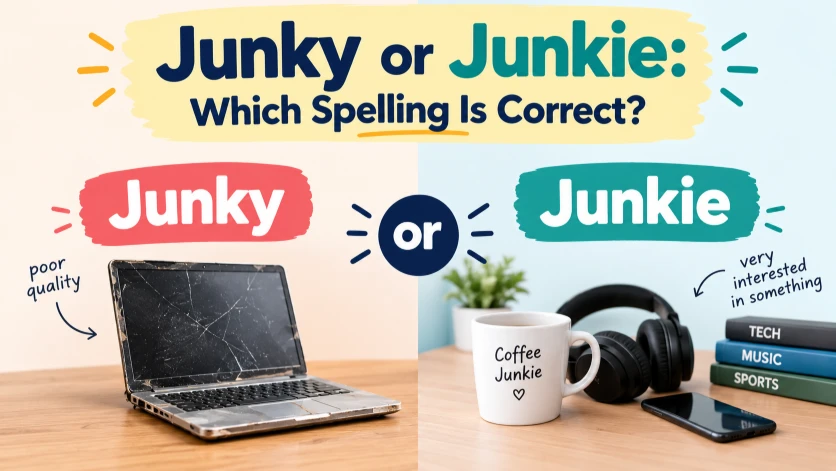
Have you ever wondered if to write junky or junkie? Both are real English words, but they have different meanings and uses. Choosing the wrong one can change the meaning of your sentence.
Junky usually describes something cheap, poorly made, worn out, or full of junk. Junkie is an informal word traditionally used for a person addicted to drugs. It can also describe someone who is very enthusiastic about a particular activity, as in news junkie or fitness junkie.
The confusion comes from the fact that these words sound alike and share the word junk. However, their spelling, meaning, and use are not interchangeable. The ending matters, especially when you are writing an article, an email, or a school assignment.
In this guide, you will learn the difference between junky and junkie, where each word comes from, how American and British usage compare, and which spelling fits different situations. You will also find everyday examples, common mistakes, and answers to frequently asked questions.
By the end, you will know how to choose the right word and avoid confusing your readers.
Junky or Junkie: Quick Answer
Both junky and junkie are correct English spellings, but they do not always mean the same thing.
- Junky (adjective): Describes something of poor quality, shabby, cheap-looking, or full of junk.
- Junkie (noun): Often describes a person with a drug addiction. It can also mean someone who is very enthusiastic about an activity.
Examples:
- “The garage was full of junky old furniture.”
- “She is a news junkie who follows every major story.”
- “The writer chose junky to describe the poorly made chair.”
One important detail: Junky is also a recognized alternative spelling of the noun junkie. The surrounding sentence helps you identify the intended meaning.
What Does Junky or Junkie Mean?
What Does Junky Mean?
Junky is an informal adjective. It describes something that seems cheap, poorly made, worn out, or worthless.
It can also describe a place that contains too much unwanted stuff. The word often expresses a negative opinion about quality or appearance.
Examples:
- “This phone case feels junky.”
- “We need to clean out the junky storage room.”
- “He bought a junky old car that keeps breaking down.”
In these sentences, junky describes a thing or place, not a person with an addiction.
The word is especially common in informal North American English. In more formal writing, you might use poor-quality, shabby, cheaply made, or cluttered, depending on the meaning.
What Does Junkie Mean?
Junkie is an informal noun. It has two main uses.
1. A person with a drug addiction
The word has traditionally been used for a person addicted to drugs, particularly heroin. However, it can sound insulting or dehumanizing when applied to a person.
For respectful and professional writing, use terms such as a person with a substance use disorder or a person experiencing addiction, when appropriate.
Example:
- Less respectful: “The article called him a junkie.”
- More respectful: “The article described him as a person experiencing drug addiction.”
2. Someone who loves an activity or subject
In casual speech, junkie can describe a person who is very interested in something or constantly seeks it out.
Examples:
- “I’m a news junkie.”
- “My brother is a sports junkie.”
- “She is an adrenaline junkie who loves exciting activities.”
This second meaning is common in informal conversation, blogs, and headlines. It is often playful, but it can sound exaggerated or inappropriate in formal writing.
The Origin of Junky and Junkie
The two words share the base word junk, but their histories developed along different paths.
The History of Junky
The adjective junky developed from junk and the adjective-forming suffix -y. This suffix can mean “full of” or “characterized by.”
For example, muddy means covered with mud, while junky describes something characterized by junk or poor quality.
Historical word references record junky in the sense of shabby or run-down from the 1870s. Its modern use includes things that are cheaply made or of little value.
The History of Junkie
The noun junkie emerged in American slang in the early 20th century. It came from junk, which was used as a slang term for narcotic drugs, combined with the suffix -ie.
Etymological references date the drug-related sense to around 1923. Over time, the word also developed a broader informal meaning for someone with an intense interest in something, as in a computer junkie.
Why Are the Spellings Different?
English uses both -y and -ie in words that sound similar. These endings do not always have a single fixed meaning.
The key difference is grammatical:
- Junky is commonly an adjective describing quality.
- Junkie is commonly a noun referring to a person.
Because dictionaries also recognize junky as an alternative spelling of the noun junkie, spelling alone does not settle every case. Always consider the sentence and intended meaning.
British English vs. American English
Both spellings appear in British and American English. The main difference is not a strict regional spelling rule. It is how the word functions in the sentence.
| British English | American English | Example |
| Junky describes poor quality, especially in informal usage | Junky commonly describes poor quality | “The chair looks junky.” |
| Junkie is an informal noun for a person with an addiction or intense interest | Junkie has the same general uses | “He’s a news junkie.” |
| Junky can also be used as a noun variant of junkie | Junky can also be used as a noun variant of junkie | “The old slang term appeared as junky.” |
| Formal writing often favors more precise wording | Formal writing often favors more precise wording | “A person with a substance use disorder.” |
Dictionary entries recognize junky as an adjective and also list it as an alternative form of the noun junkie. Oxford identifies junky as especially North American when used as an adjective.
What About Style Guides?
For schoolwork, journalism, and professional writing, follow the style guide required by your publisher or institution.
- Use junky when you mean shabby or poor in quality.
- Use junkie for the informal noun unless a source or established quotation uses another spelling.
- Avoid using junkie to label a person in sensitive health reporting.
- Replace slang with a precise term when writing formal reports or academic papers.
There is no universal rule that makes junky exclusively American or junkie exclusively British.
Which Version Should You Use?
Your best choice depends on the meaning you want to express and the audience you are writing for.
| Audience or situation | Recommended usage | Example |
| United States | Use junky for poor quality and junkie for the noun | “The desk looks junky.” |
| United Kingdom | Use the same distinction | “He’s a news junkie.” |
| Canada | Use the same distinction in standard writing | “That device feels junky.” |
| Australia | Use the same distinction; check local editorial preferences | “She’s a fitness junkie.” |
| International writing | Prefer clear, widely understood wording | “The product is poorly made.” |
| Academic writing | Avoid slang unless analyzing language or quoting a source | “The study discusses substance use disorder.” |
| Business writing | Use neutral, specific descriptions | “The equipment is low quality.” |
For most readers, the easiest rule is to use junky for poor quality and junkie for a person who is very interested in something.
When discussing addiction, choose respectful language instead of relying on a slang label.
Common Mistakes
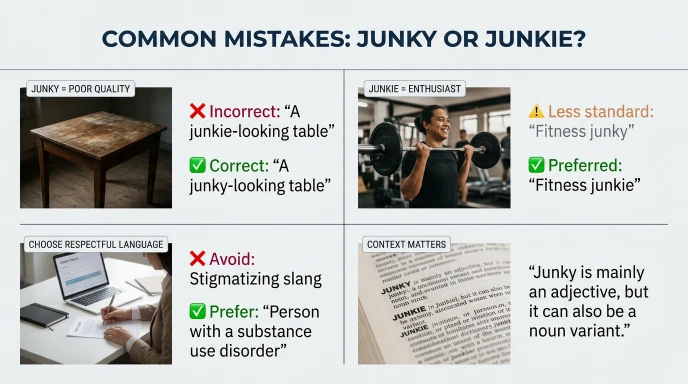
Writers often confuse these words because they sound alike. The best way to avoid errors is to check the meaning and the part of speech.
Mistake 1: Using Junkie to Describe Poor Quality
Incorrect: “I bought a junkie-looking table.”
Better: “I bought a junky-looking table.”
Why? The sentence describes the table’s poor quality or appearance. The adjective junky is the natural choice.
Memory tip: If you are describing an object, try junky.
Mistake 2: Using Junky for an Enthusiast
Less standard: “She is a fitness junky.”
Preferred: “She is a fitness junkie.”
Why? Junkie is the more familiar spelling for a person who is extremely enthusiastic about a subject or activity. Although junky can also be a noun variant, consistency helps readers.
Memory tip: If you mean a person who loves something, choose junkie.
Mistake 3: Treating Both Words as Formal
Less suitable for formal writing: “The report called the person a junkie.”
More suitable: “The report described the person as having a substance use disorder.”
Why? Junkie can be stigmatizing when used to describe a person with an addiction. Neutral, person-centered language is usually more appropriate in health, education, and professional settings.
Memory tip: In formal writing, choose a precise description rather than slang.
Mistake 4: Assuming One Spelling Is Always Wrong
Incorrect claim: “Junky is never a noun.”
Correct explanation: Junky is mainly an adjective, but dictionaries also recognize it as an alternative spelling of the noun junkie.
Why? English spelling can vary by word function and usage. Context determines which meaning is intended.
Everyday Examples of Junky and Junkie
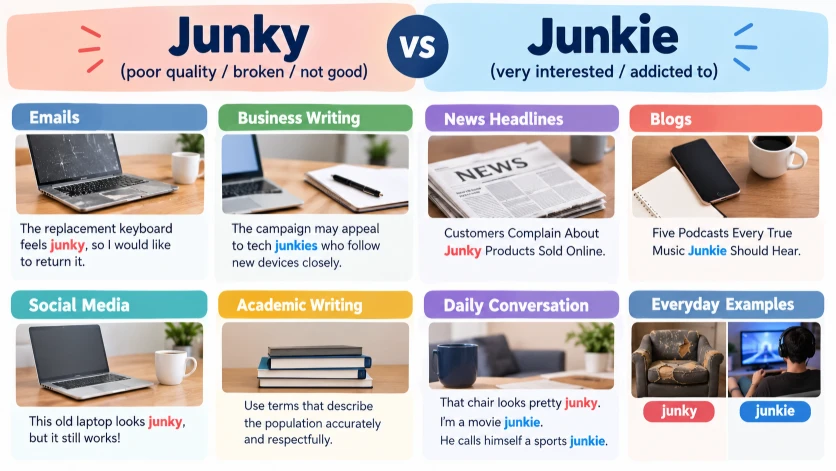
Here are practical examples showing how both words appear in different types of writing.
Emails
- Junky: “The replacement keyboard feels junky, so I would like to return it.”
- Junkie: “I’m a news junkie, so I read the morning headlines every day.”
Business Writing
- Junky: “The sample product looks junky and does not meet our quality standards.”
- Junkie: “The campaign may appeal to tech junkies who follow new devices closely.”
For formal business documents, poor quality and technology enthusiast may sound more professional.
News Headlines
- Junky: “Customers Complain About Junky Products Sold Online”
- Junkie: “Political Junkie Follows Every Election Debate”
These are illustrative headline examples, not actual news reports.
Blogs
- Junky: “How to Turn a Junky Garage Into a Useful Workspace”
- Junkie: “Five Podcasts Every True Music Junkie Should Hear”
Social Media
- “This old laptop looks junky, but it still works!”
- “Coffee junkie checking out a new café today.”
The first sentence comments on quality. The second expresses enthusiasm in a casual, playful way.
Academic Writing
- Less suitable: “The research focuses on junkies.”
- Better: “The research examines people experiencing substance use disorders.”
In academic writing, use terms that describe the population accurately and respectfully. If the word junkie appears in a historical quotation or language study, explain its context.
Daily Conversation
- “That chair looks pretty junky.”
- “I’m a movie junkie. I watch films every weekend.”
- “He calls himself a sports junkie because he follows several leagues.”
These examples show the most useful distinction: one word usually describes quality, while the other commonly describes a person.
Google Trends and Modern Usage
People search for junky or junkie because both words sound the same and share similar spelling. They may also see both forms in online posts, informal writing, and dictionaries.
Which Spelling Is More Popular?
There is no verified Google Trends comparison presented here, so it would be misleading to claim that one spelling receives a specific percentage or number of searches.
Dictionary evidence confirms that both forms are used, but they have different grammatical roles. Junky is particularly associated with poor quality in North American English, while junkie is a familiar spelling for the noun meaning an enthusiast or a person with an addiction.
Why Do People Confuse Them?
Three factors explain most of the confusion:
- Pronunciation: Both words are pronounced almost identically.
- Shared word history: Both are connected to junk.
- Overlapping spelling: Junky is also accepted as a variant of the noun junkie.
How Should You Use Them Online?
For blog posts, educational articles, and search-optimized content, explain the meaning early and use examples that show the difference.
For instance, an article about a badly made product should use junky when describing its quality. An article about an enthusiastic reader might use book junkie, while a health article should generally prefer respectful, precise language about addiction.
Search optimization should help readers understand the words, not encourage repeated keywords without purpose.
Quick Comparison
| Version | Meaning | Correct? | Region | Example |
| Junky | Cheap, shabby, or poor in quality | Yes | Especially North American usage | “The bag looks junky.” |
| Junkie | Person with a drug addiction | Yes, informal | British, American, and international English | “The novel portrays a person struggling with addiction.” |
| Junkie | Person very interested in an activity | Yes, informal | British, American, and international English | “He’s a music junkie.” |
| Junky | Alternative spelling of the noun junkie | Yes, but less preferred in many contexts | English usage varies | “The older text uses the spelling junky.” |
The practical rule: Use junky for poor quality and junkie for an enthusiast. When referring to addiction, consider if a more respectful and precise term would be better.
Key Takeaways
- Junky is mainly an adjective that describes something shabby, cheap, or poorly made.
- Junkie is mainly a noun for a person with an addiction or a strong interest in something.
- Both spellings are correct English words.
- Junky can also appear as an alternative spelling of the noun junkie.
- Neither spelling belongs exclusively to British or American English.
- Use more precise wording in academic and business writing.
- Avoid using junkie as a label for someone experiencing addiction.
- Always check the intended meaning before choosing a spelling.
FAQs
What Does Junkie Mean in Slang?
In slang, “junkie” usually refers to a person who is addicted to drugs, particularly someone who uses drugs compulsively. Informally, people also use it to describe someone who is extremely enthusiastic about something, such as a “fitness junkie” or “news junkie.” However, when referring to a person with a substance use disorder, the term can sound insulting or stigmatizing.
What Does “Junky” Mean?
“Junky” is an informal adjective that means cheap, poorly made, unreliable, or in bad condition. For example, “This is a junky old car” means the car is in poor condition. It can also describe something that looks like junk or is of low quality. Unlike “junkie,” it does not usually refer to a person addicted to drugs.
Is Junky an Offensive Word?
“Junky” is not necessarily offensive when describing an object, such as a junky computer or an old piece of furniture. However, calling something or someone “junky” can sound dismissive. If you mean a person who struggles with addiction, avoid using “junkie,” because it can be hurtful and reinforce negative stereotypes. More respectful alternatives include “person with a substance use disorder” or “person experiencing addiction.”
Who Is a Junky?
A “junky,” often spelled “junkie,” is a slang term traditionally used for someone addicted to drugs. The spelling “junkie” is more common for this meaning. Today, it is generally better to describe the person rather than define them by an addiction, using terms such as “person with a drug addiction” or “person with a substance use disorder.”
Is It Junkie or Junky?
Both spellings are correct, but they have different common uses. “Junkie” is the standard spelling for the slang term referring to a person with a drug addiction or someone intensely interested in something. “Junky” is usually an adjective describing something cheap, shabby, unreliable, or poorly made. For example, “He is a coffee junkie” and “The junky chair is falling apart” use each word appropriately.
Why Are People Called Junkies?
People have historically been called “junkies” because the slang term became associated with drug addiction, particularly heroin use. Over time, the word also developed a figurative meaning for people who are extremely enthusiastic about an activity or interest, such as a “sports junkie.” Because the term can carry negative associations when applied to people with addiction, more respectful, person-first language is generally preferred.
Conclusion
The difference between junky and junkie becomes clear when you focus on meaning and grammar. Both are correct English spellings, but they usually serve different purposes.
Use junky when describing something cheap, shabby, worn out, or poorly made. Use junkie when referring informally to someone who is very enthusiastic about an activity, such as a news junkie or a music junkie. The word can also refer to a person with a drug addiction, although that use may sound offensive or judgmental.
Remember that junky can also be an alternative spelling of the noun junkie. This is why context matters more than spelling alone.
For students, ESL learners, writers, and editors, the safest approach is to choose the word that clearly expresses the intended meaning. In formal writing, use precise language and avoid slang when a neutral alternative is more appropriate.
The memorable rule is simple: junky usually describes a thing, while junkie usually describes a person.
If this guide helped you understand the difference, explore more commonly confused English words to improve your spelling and writing skills.
READ MORE!
- Finalize or Finalise: Which Spelling Is Correct?
- Targetting or Targeting: Which Spelling Is Correct?
- Sitting or Seating: What’s the Difference?

I’m Edward Fletcher, a UK-based English language writer with a passion for grammar and vocabulary. At VocabNex, I share simple explanations, useful examples, and practical English tips to help learners improve their language skills and communicate with confidence.