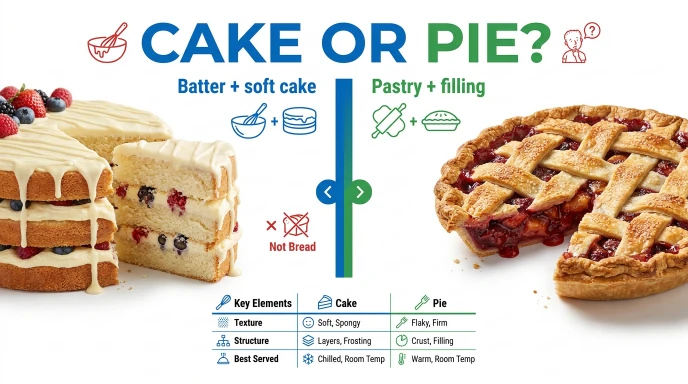
Cake and pie are both baked desserts, but the main difference is how they are built: cake is usually made from a sweet batter, while pie is built around a pastry crust and filling. That simple rule clears up most of the confusion behind the search “cake or pie.”
People search this phrase for several reasons. Some want to know which dessert is technically a cake or a pie. Others are learning English and want to understand how native speakers use the two words. Food writers, students, recipe creators, and editors may also need a clear definition for a specific dessert.
The confusion grows because some foods sit near the boundary. Cheesecake, for example, has “cake” in its name but often has a crumb or pastry-like base. Pumpkin pie has a filling that may look similar to a custard dessert. Tart, flan, cobbler, and torte can create even more questions.
The good news is that the basic distinction is easy to remember. Let’s break it down.
Cake or Pie: Quick Answer
If you need the answer fast, use this rule:
- Cake: The main structure comes from a sweet batter or dough.
- Pie: The main structure usually comes from a pastry crust and filling.
- Cake is often frosted.
- Pie is often served with its filling exposed or covered by pastry.
- Both can contain fruit, chocolate, cream, nuts, or custard.
For example:
- Chocolate cake is cake because its body is made from cake batter.
- Apple pie is pie because apples sit inside a pastry crust.
- Carrot cake is still cake even though it contains vegetables.
- Pumpkin pie is still pie because its defining structure is the crust and filling.
Cambridge defines cake as a sweet food made from a mixture such as flour, eggs, fat, and sugar. It defines pie as food made with meat, vegetables, or fruit covered in pastry and baked.
The important point is this: ingredients alone do not always decide the name. Structure and traditional usage matter too.
What Does Cake or Pie Mean?
“Cake or pie” is not a special English expression with one fixed meaning. It is a comparison between two types of food.
What is a cake?
A cake is generally a baked food made from a sweet batter or dough. Common ingredients include:
- Flour
- Sugar
- Eggs
- Butter or another fat
- Milk or another liquid
- Baking powder or another raising agent
Cake can be soft, dense, light, moist, or rich.
Common examples include:
- Birthday cake
- Chocolate cake
- Sponge cake
- Carrot cake
- Pound cake
- Angel food cake
- Fruit cake
Merriam-Webster also records broader meanings of cake, including a small baked or fried food and a flattened mass of food.
What is a pie?
A pie is usually a baked dish made with pastry and a filling.
The filling may be:
- Fruit
- Meat
- Vegetables
- Custard
- Nuts
- Chocolate
- Cheese
Common examples include:
- Apple pie
- Pumpkin pie
- Cherry pie
- Pecan pie
- Chicken pot pie
- Steak and kidney pie
Pie is not limited to sweet food. Savory pies are common, especially in British cuisine. Cambridge specifically includes meat, vegetables, and fruit in its definition of pie.
The easiest way to remember it
Think about the main structure.
Cake = batter-based structure.
Pie = pastry-and-filling structure.
There are exceptions, but this rule works for most everyday examples.
The Origin of Cake or Pie
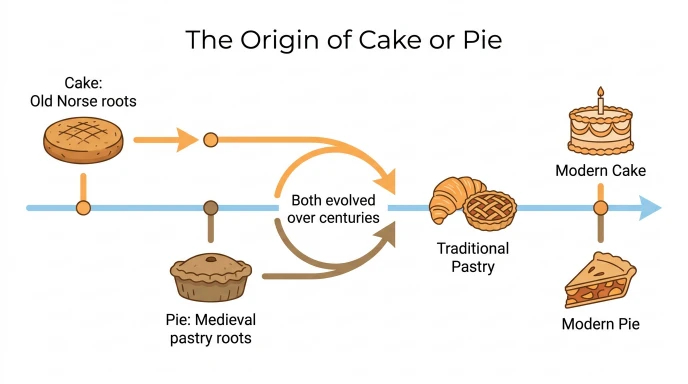
The words cake and pie have very different histories.
Where does “cake” come from?
The English word cake dates to the Middle English period. Merriam-Webster traces it to Old Norse kaka, with a first known use in English in the 13th century.
Etymonline also traces cake to Old Norse kaka. Its early meaning referred to a flat or relatively thin mass of baked dough. Over time, the word developed broader meanings and came to describe sweet baked foods made with flour, sugar, butter, and other ingredients.
Where does “pie” come from?
Pie appeared in English by about the 13th century. Etymonline traces the food sense to Medieval Latin pie, referring to meat or fish enclosed in pastry. Medieval pies could contain many ingredients, while fruit pies became common later.
This history explains something useful: pie originally described a pastry container for a filling, while cake developed from the idea of a baked mass or dough.
Why did the meanings change?
Food words change as recipes change.
Cooks developed new ingredients, techniques, shapes, and regional traditions. A word that once described one type of food could later cover many related foods.
That is why modern definitions are useful, but they cannot explain every recipe perfectly.
British English vs American English
There is no major British-American spelling difference between cake and pie. Both countries spell the words the same way.
The bigger difference is food tradition and usage.
| British English | American English | Example |
| cake | cake | chocolate cake |
| pie | pie | apple pie |
| sponge cake | sponge cake | Victoria sponge |
| pie | pie | pumpkin pie |
| tart | tart | fruit tart |
| cheesecake | cheesecake | New York cheesecake |
British English has a strong tradition of fruit pies, meat pies, tarts, and sponge cakes. American English also uses these terms, but American food culture has developed its own well-known categories, such as pumpkin pie, pecan pie, and American-style layer cakes.
There are also regional differences in what people consider a typical dessert. A British writer may distinguish more strongly between a tart, pie, pudding, and cake, while an American reader may use different everyday categories.
For writers, the safest approach is simple: use the established name of the food your audience knows.
Which Version Should You Use?
You do not normally choose between cake and pie based on country. You choose the word that matches the food.
United States
Use cake for batter-based cakes and pie for pastry-based pies.
Examples:
- chocolate cake
- birthday cake
- apple pie
- pumpkin pie
- pecan pie
United Kingdom
Use the same basic distinction, but remember that British English has a wide range of pastry foods.
Examples:
- Victoria sponge cake
- Christmas cake
- apple pie
- steak pie
- mince pie
Canada
Canadian English uses both cake and pie in the standard ways. Local food traditions may influence which desserts are most familiar.
Australia
Australian English also follows the standard meanings. Meat pie is especially familiar in Australian food culture, showing why pie does not always mean dessert.
International writing
For a global audience, use the simplest description.
Instead of:
“It is a pastry-based confection.”
Write:
“It is a pie with a fruit filling.”
This is clearer for English learners and general readers.
Academic writing
Use the established food name. If classification matters, define your terms.
For example:
“For this study, cake refers to batter-based baked desserts, while pie refers to pastry-based desserts with a filling.”
Business writing
Be direct and specific.
Instead of:
“Our new baked product is similar to both categories.”
Write:
“Our new dessert combines a cake base with a fruit-pie filling.”
Common Mistakes
Mistake 1: Calling every sweet baked food a cake
Incorrect: “Apple pie is a type of cake.”
Correct: “Apple pie is a type of pie.”
Explanation: The main structure is pastry with an apple filling.
Memory tip: Look at the base and structure, not just the sweetness.
Mistake 2: Thinking pie must be sweet
Incorrect: “A pie always contains fruit.”
Correct: “A pie can be sweet or savory.”
Explanation: Meat and vegetable pies are common.
Memory tip: Pie can be dessert or dinner.
Mistake 3: Assuming frosting makes a dessert a cake
Incorrect: “If it has frosting, it must be cake.”
Correct: “Frosting alone does not define a cake.”
Explanation: A dessert’s name depends on its overall structure and established culinary use.
Memory tip: Frosting is decoration, not the definition.
Mistake 4: Assuming all round baked foods are pies
Incorrect: “It is round, so it is a pie.”
Correct: “Shape alone does not decide if something is a cake or pie.”
Explanation: Cakes and pies can both be round.
Memory tip: Shape helps, but structure matters more.
Cake or Pie in Everyday Examples
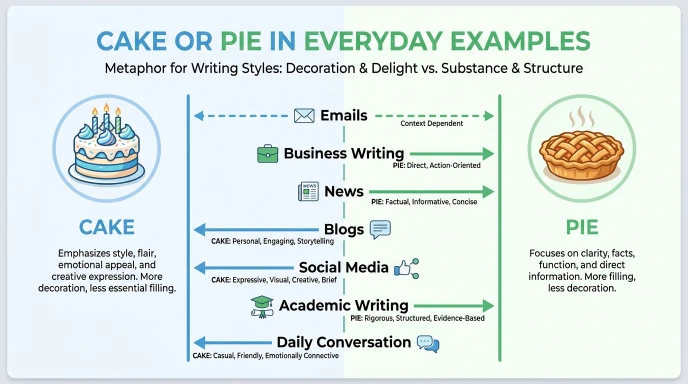
Emails
“Please let me know if you would prefer chocolate cake or apple pie for the event.”
This is clear and natural.
Business writing
“The bakery sells cakes, fruit pies, and seasonal desserts.”
This wording works well for menus, websites, and business reports.
News headlines
“Local Bakery Launches New Apple Pie”
or
“Popular Cake Shop Opens Second Location”
News headlines favor short, familiar food terms.
Blogs
“If you love rich chocolate desserts, this cake is worth trying. If you prefer fruit and flaky pastry, choose the pie.”
This style directly compares the two foods.
Social media
“Cake or pie? Which dessert would you choose for your birthday?”
Here, the phrase is informal and conversational.
Academic writing
“Cake and pie differ mainly in their structure, preparation, and traditional classification.”
This is more formal and precise.
Daily conversation
“Do you want cake or pie?”
This is completely natural English.
You may also hear:
“I can’t decide between cake and pie.”
That sentence simply means the speaker wants to choose between two desserts.
Google Trends & Modern Usage
The phrase “cake or pie” has a clear comparison intent. People may search it because they want to understand the difference, choose a dessert, settle a food-classification question, or learn English vocabulary.
However, Google Trends should be handled carefully. Google says Trends data represents relative search interest, not absolute search volume. Results are normalized by time and location and scaled from 0 to 100.
Google also distinguishes between a search term and a topic. A search term measures the exact wording entered, while a topic can combine related searches.
For this keyword, that distinction matters. Someone searching:
- “cake or pie”
- “cake vs pie”
- “difference between cake and pie”
- “is cheesecake a cake”
- “is pumpkin pie a cake”
may have closely related intent, but these are not the same exact search term.
Regional interest can also change. Google Trends allows comparison by country and region, but a region with a higher relative score does not necessarily have more total searches.
So, rather than inventing search-volume numbers, the useful content conclusion is this:
“Cake or pie” is best treated as a comparison keyword with strong informational intent.
Quick Comparison
| Version | Meaning | Correct? | Region | Example |
| Cake | Batter-based baked food | Yes | Global English | Chocolate cake |
| Pie | Pastry with a filling | Yes | Global English | Apple pie |
| Cake vs pie | Direct comparison | Yes | Global English | Cake vs pie difference |
| Cake or pie | Choice or comparison | Yes | Global English | Cake or pie for a party? |
| Pie cake | Not a standard category | Usually no | Global English | Avoid unless naming a specific recipe |
| Pie-cake | Hybrid or creative term | Context-dependent | Varies | Use only when the recipe calls for it |
The last two entries are important for content writers. A creative recipe may combine elements of cake and pie, but that does not create a universal new category.
Key Takeaways
- Cake is usually made from a sweet batter or dough.
- Pie usually has a pastry crust and a filling.
- Cake can be sweet or, in broader uses, made in other forms.
- Pie can be sweet or savory.
- There is no major British-American spelling difference for cake or pie.
- Food names can depend on culinary tradition, not ingredients alone.
- Cake or pie is mainly a comparison and choice query.
- When in doubt, describe the structure clearly.
FAQs
Which came first, pie or cake?
Pie likely came first. Early pie-like foods were made long before modern cakes developed. Over time, both evolved into the sweet and savory foods we enjoy today.
Do people prefer cake or pie?
It depends on personal taste, culture, and occasion. Cake is especially popular for birthdays and celebrations, while pie is often enjoyed during holidays and family meals.
What does cake or pie mean?
“Cake or pie” refers to a comparison between two baked foods. Cake is usually soft and made from batter, while pie typically has a pastry crust with a sweet or savory filling.
Why is cake better than pie?
Cake may be better for people who prefer soft, fluffy, and sweet desserts. It also offers many choices for flavors, fillings, frosting, and decorations, making it popular for special occasions.
Is cake healthy or junk?
Cake is generally considered a treat rather than a healthy food. Many cakes contain sugar, butter, and refined flour. However, enjoying a small portion occasionally can fit into a balanced diet.
Conclusion
Cake or pie is a simple comparison, but the difference becomes much clearer when you focus on structure. Cake is usually built from a sweet batter or dough. Pie is usually built from pastry and a filling. That distinction explains familiar examples such as chocolate cake, birthday cake, apple pie, and pumpkin pie.
The two words also have long histories. Cake entered English from Old Norse, while pie appeared in medieval English and was linked to pastry-filled dishes.
For English learners, writers, and editors, there is no major British-American spelling issue to solve. Both countries spell the words cake and pie the same way. The main differences come from food traditions and regional preferences.
For content, “cake or pie” should be treated as a comparison query. Give the direct answer first, then explain the structure, examples, exceptions, and regional usage.
The easiest rule to remember is: cake is usually batter-based, while pie is usually pastry-based.
READ MORE!
Neosporin or Bacitracin: Which One Is Better for Minor Wounds?

I’m passionate about English grammar, vocabulary, and clear communication. I enjoy making English easier to understand through simple, practical, and easy-to-follow explanations. My goal is to help learners build confidence and improve their English for everyday use.








4 thoughts on “Cake or Pie: What’s the Difference?”