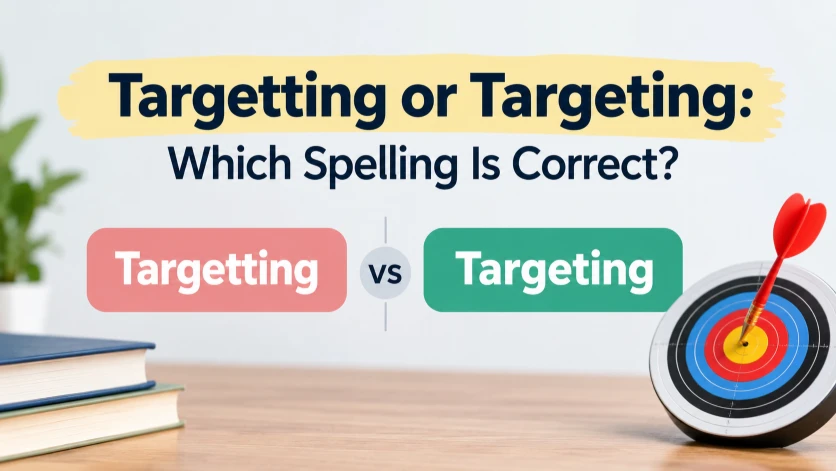
Have you ever wondered if to write targetting or targeting? The two spellings look almost identical, so it is easy to think that both are correct. However, in standard English, targeting is the correct spelling, while targetting is a common misspelling.
The confusion comes from the word target. When we add the suffix -ing to many English words, we double the final consonant. For example, run becomes running, and sit becomes sitting. This rule can make targetting look correct, even though the standard spelling follows a different pattern.
The word targeting is used in many settings. You may see it in marketing, business, education, technology, sports, and everyday conversation. It can describe choosing a specific audience, aiming at a goal, or directing attention toward a person or thing.
In this guide, you will learn why targeting is correct, how the word is formed, and how to use it in sentences. You will also find spelling rules, regional guidance, practical examples, and answers to common questions.
Targeting or Targetting: Quick Answer
The correct spelling for most writing is targeting, with one t before -ing.
Examples:
- Correct: The company is targeting new customers.
- Incorrect in standard usage: The company is targetting new customers.
- Correct: Our campaign is targeting local readers.
Remember that targeting is used in both American and British English. Although the double-t form appears as an uncommon variant in some references, targeting is the safest choice for general and professional writing.
What Does Targeting Mean?
Targeting is the present participle of the verb target. It means directing an action, message, product, or effort toward a particular person, group, place, or goal.
The word can serve different purposes in a sentence.
1. Targeting as an ongoing action
Use targeting with forms of be to describe an action that is happening now or around the present time.
Examples:
- The company is targeting younger customers.
- The team is targeting a place in the final.
- The campaign is targeting people who need affordable services.
2. Targeting as a noun or activity
The word can also describe the process of choosing and reaching a specific audience or objective.
Examples:
- Audience targeting helps marketers reach relevant readers.
- Better targeting may improve an advertising campaign.
- The research focuses on the targeting of specific cells.
3. Targeting in marketing and business
In marketing, targeting means choosing the audience most likely to need or respond to a product, service, or message.
For example, a company selling school supplies may target parents, teachers, and students before the school year begins.
The goal is to reach the right people rather than show the same message to everyone.
The Origin of Targeting
To understand the spelling, it helps to look at the base word target and the suffix -ing.
The word target developed in English over time. Today, it can refer to an object that someone aims at, a result someone hopes to achieve, or a person or group selected for a particular action.
The word targeting is formed by adding the common English suffix -ing to the verb target. This suffix can show an ongoing action or turn a verb into the name of an activity.
The spelling does not require an extra t.
Why is it targeting and not targetting?
English spelling rules often require the final consonant to be doubled before a suffix beginning with a vowel. However, this usually depends on factors such as syllable count and where the word’s main stress falls.
Compare these words:
| Base word | Correct form | Why |
| Run | Running | The final consonant doubles |
| Sit | Sitting | The final consonant doubles |
| Stop | Stopping | The final consonant doubles |
| Target | Targeting | The final t does not double |
| Visit | Visiting | The final consonant does not double |
In target, the main stress falls on the first syllable: TAR-get. The final syllable is not stressed, so the usual spelling is targeting, not targetting.
This is also why the standard past-tense form is targeted, not targetted.
British English vs American English
Many English words have different British and American spellings. For example, British English commonly uses colour, while American English uses color.
However, targeting is the standard spelling in both varieties. The double-t form is sometimes recorded as an uncommon variant, so it is too broad to claim that it is always a British spelling.
| British English | American English | Example |
| Targeting | Targeting | The business is targeting new customers. |
| Targeted | Targeted | The company targeted local buyers. |
| Target | Target | We need to target the right audience. |
| Colour | Color | The design uses a bright color. |
| Travelling / Traveling | Traveling / Travelling | She is traveling abroad. |
The last two examples illustrate genuine regional spelling differences. They do not mean that every word must follow a separate British or American pattern.
What about targetting?
You may encounter targetting in online articles, informal posts, or older material. Some references list it as an uncommon alternative. However, targeting is much more suitable as the default for a broad audience.
For consistency, use targeting unless a specific publication’s style guide or an established specialist source requires another form.
Which Version Should You Use?
The best choice is usually simple: write targeting.
- United States: Use targeting in schoolwork, business documents, websites, and everyday writing.
- United Kingdom: Use targeting as the standard form. Do not assume the double-t spelling is required in British English.
- Canada: Use targeting unless your organization follows a specific house style.
- Australia: Use targeting for general and professional writing.
- International writing: Choose targeting because it is widely understood and standard across major English varieties.
- Academic writing: Follow your university’s style guide and use targeting consistently.
- Business writing: Use targeting in reports, marketing plans, proposals, and presentations.
If you are editing a website, blog, or article, consistency matters. Search for both targetting and targetted so you can correct these forms throughout the document.
Common Mistakes
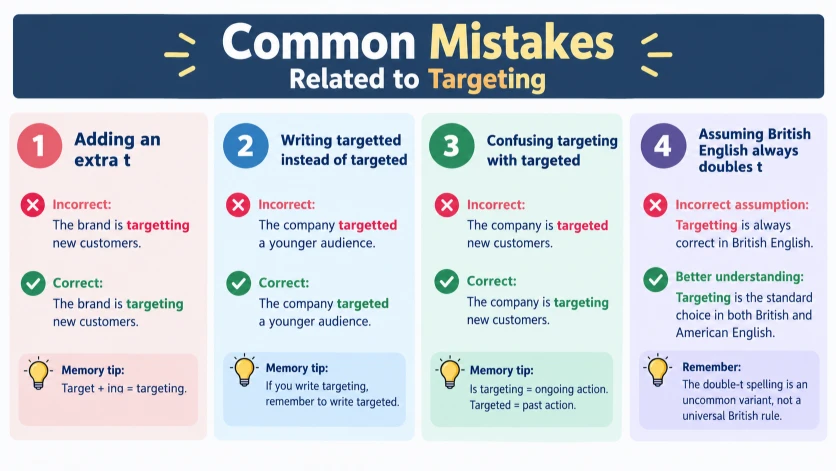
These are the most common spelling and grammar errors related to targeting.
Mistake 1: Adding an extra t
Incorrect: The brand is targetting new customers.
Correct: The brand is targeting new customers.
Explanation: The standard spelling does not double the final t when adding -ing to target.
Memory tip: Target + ing = targeting.
Mistake 2: Writing targetted instead of targeted
Incorrect: The company targetted a younger audience.
Correct: The company targeted a younger audience.
Explanation: The same spelling pattern applies when adding -ed. The standard past-tense form contains one t at the end of the base word.
Memory tip: If you write targeting, remember to write targeted.
Mistake 3: Confusing targeting with targeted
Incorrect: The company is targeted new customers.
Correct: The company is targeting new customers.
Explanation: Use is targeting for an ongoing action. Use targeted for a past action, as in, “The company targeted new customers last year.”
Memory tip: Is targeting describes an action in progress. Targeted often describes a completed action.
Mistake 4: Assuming British English always doubles t
Incorrect assumption: Targetting is always correct in British English.
Better understanding: Targeting is the standard choice in both British and American English. The double-t spelling is an uncommon variant, not a universal British rule.
Memory tip: Regional spelling differences are word-specific. Do not apply one spelling pattern to every word.
Everyday Examples
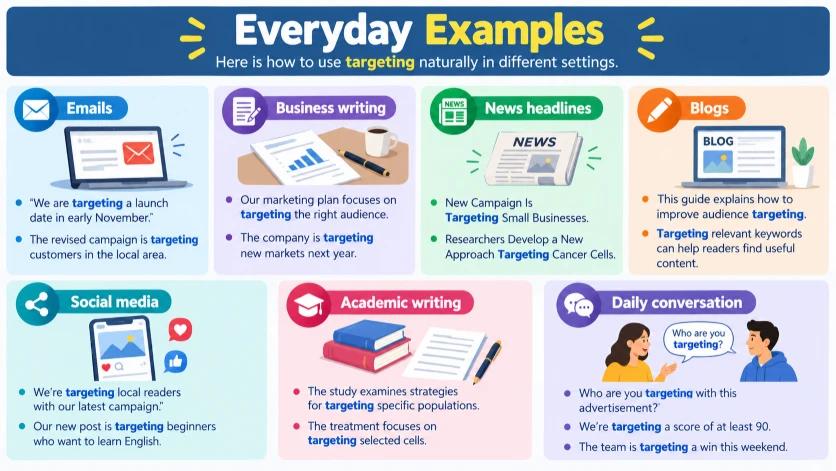
Here is how to use targeting naturally in different settings.
Emails
- “We are targeting a launch date in early November.”
- “The revised campaign is targeting customers in the local area.”
Business writing
- “Our marketing plan focuses on targeting the right audience.”
- “The company is targeting new markets next year.”
News headlines
- “New Campaign Is Targeting Small Businesses”
- “Researchers Develop a New Approach Targeting Cancer Cells”
Blogs
- “This guide explains how to improve audience targeting.”
- “Targeting relevant keywords can help readers find useful content.”
Social media
- “We’re targeting local readers with our latest campaign.”
- “Our new post is targeting beginners who want to learn English.”
Academic writing
- “The study examines strategies for targeting specific populations.”
- “The treatment focuses on targeting selected cells.”
Daily conversation
- “Who are you targeting with this advertisement?”
- “We’re targeting a score of at least 90.”
- “The team is targeting a win this weekend.”
These examples show that targeting can refer to an audience, a goal, a group, or a specific object. Its meaning depends on the context.
Google Trends and Modern Usage
The spelling question targetting or targeting often comes from a simple habit: English has many words that double their final consonant before adding a suffix.
Words such as running and stopping encourage writers to apply the same pattern to target. However, the standard form is targeting.
Which spelling is more common?
Targeting is the standard form shown by major learner-dictionary references such as Cambridge Dictionary. It also appears widely in marketing, technology, education, research, and news writing.
Google Trends can help explore search interest in spelling variants, but its data should be interpreted carefully. Google explains that search-term comparisons may not capture misspellings and spelling variations in the same way as related topics. Therefore, a Trends chart alone cannot prove that one spelling is grammatically correct.
Without a verified, location-specific comparison, it would be misleading to give exact search figures or claim that one country searches for the misspelling more often than another.
Why do people search for targetting or targeting?
Common reasons include:
- Checking spelling before publishing an article.
- Writing a marketing plan or business email.
- Learning English spelling rules.
- Editing schoolwork or academic papers.
- Wondering if British English uses a different spelling.
The practical answer remains the same: use targeting for standard English writing.
Quick Comparison
| Version | Meaning | Correct? | Region | Example |
| Targeting | Directing effort toward a person or goal | Yes | US, UK, and international | We are targeting new readers. |
| Targetting | Intended as the same word | Generally avoid | Uncommon variant | Use targeting instead. |
| Targeted | Past-tense or past-participle form | Yes | US, UK, and international | The campaign targeted students. |
| Targetted | Intended as the past form of target | Generally avoid | Uncommon variant | Write targeted instead. |
| Target | A goal, object, or person selected for an action | Yes | US, UK, and international | Our target is 1,000 readers. |
Key Takeaways
- Targeting is the preferred standard spelling.
- Targetting is an uncommon alternative and is best avoided in general writing.
- The standard spelling is the same in American and British English.
- Targeting is the present participle of target.
- Use targeted for the standard past-tense form.
- Do not double the final consonant automatically when adding -ing.
- Always follow a publication’s style guide when one applies.
FAQs
Does targeting have two ts?
No, targeting has only one “t” at the end of target before adding “-ing.” The correct spelling is targeting, not targetting. For example: “The company is targeting new customers.”
What does “targetting” mean?
Targetting is a common misspelling of targeting. In standard English, targeting means directing an effort, action, or message toward a particular person, group, or goal. For example: “The campaign is targeting young adults.”
Which is correct, “targetting” or “targeting”?
Targeting is the correct spelling in both American and British English. The word target keeps one final “t” when adding “-ing,” so targetting is incorrect.
What is targeting someone?
Targeting someone means directing attention, actions, criticism, or an effort toward a particular person. Depending on the context, it can be neutral, such as targeting a customer with an advertisement, or negative, such as repeatedly harassing someone.
How do you spell “targeting” in the UK?
The correct British English spelling is targeting, with one “t” before “-ing.” Unlike words such as travelling and cancelling, target does not double its final “t” when forming targeting.
What is the past tense of target?
The past tense of target is targeted, with one “t” at the end of the base word before “-ed” is added. For example: “The advertisement targeted local customers.” The spelling targetted is incorrect in standard English.
What does “targeting” mean in English?
Targeting means choosing or directing something toward a specific person, group, object, or objective. It is commonly used in marketing, business, technology, and everyday conversation. For example: “The school is targeting improvements in student performance.”
Which is correct, targeted or targetted?
Targeted is the correct spelling in both American and British English. The word target takes “-ed” without doubling the final “t.” For example: “The company targeted a new audience.” Targetted is a misspelling.
Conclusion
When choosing between targetting or targeting, the best answer for standard English is targeting. It is the preferred spelling in American English, British English, and international writing. The double-t form exists as an uncommon variant, but most writers should avoid it unless a specific style guide requires otherwise.
The confusion is understandable because English spelling rules can be tricky. Words such as running and stopping double their final consonants before -ing. However, target follows a different pattern because its main stress falls on the first syllable. That is why the standard forms are targeting and targeted.
If you are writing an email, preparing an academic assignment, editing a blog post, or creating an article, choosing the standard spelling helps your writing look clear and professional.
You can also remember the three forms together: target, targeting, and targeted. This simple habit will help you avoid the same mistake in future writing.
Remember: When in doubt, write targeting with one t. If this guide helped you, explore more commonly confused words to strengthen your spelling and grammar skills.
READ MORE!
- Papa or Pappa: Which Spelling Is Correct?
- Copies or Copys: Which Spelling Is Correct?
- Informations or Information: What Is the Correct Word?

I’m passionate about English grammar, vocabulary, and clear communication. I enjoy making English easier to understand through simple, practical, and easy-to-follow explanations. My goal is to help learners build confidence and improve their English for everyday use.