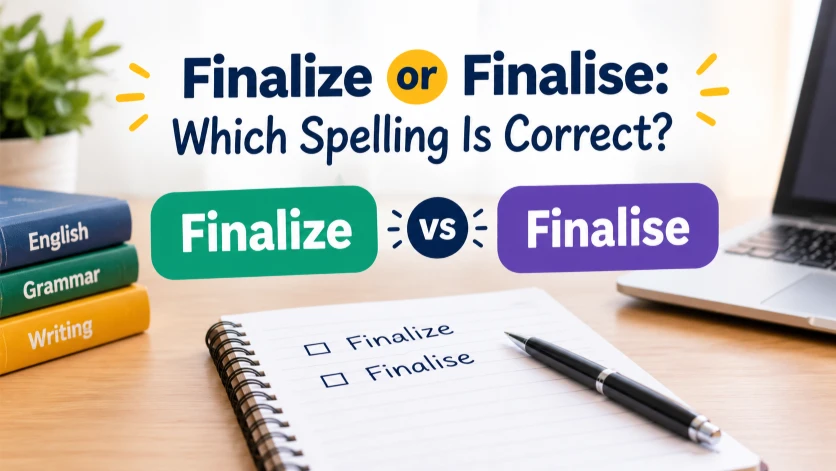
Both finalize and finalise are correct spellings. The difference is regional: finalize is the preferred spelling in American English, while finalise is common in British English and other varieties that follow British spelling conventions. Both words mean to complete something, settle the final details, or make a decision official.
If you are writing an email, preparing a business report, editing an academic paper, or publishing an article, the best spelling depends on your target audience and the style guide you follow. Neither spelling is inherently wrong, and both are widely understood.
In this guide, you will learn what finalize and finalise mean, where they come from, how American and British usage differs, and which version to use in different countries. You will also find practical examples, common mistakes, a comparison table, and answers to frequently asked questions.
Finalize vs Finalise: The Quick Answer
Finalize is the standard preferred spelling in American English. Finalise is widely used in British English and in countries such as Australia. Both have the same meaning: to complete or settle something.
- American English: “We need to finalize the report.”
- British English: “We need to finalise the report.”
- Both spellings are correct, but consistency matters within the same document.
What Does Finalize or Finalise Mean?
Finalize and finalise are verbs. They mean to complete something, settle the remaining details, or make a decision final.
You use these words when a plan, agreement, schedule, document, or other task is nearly complete and needs a final decision.
For example:
- “We need to finalize the wedding arrangements.”
- “The team will finalise the project plan tomorrow.”
- “The company has finalized the terms of the contract.”
All three sentences are correct. The spelling changes, but the meaning stays the same. Cambridge Dictionary defines finalize as making a final and certain decision about a plan, date, or similar matter. It also notes that British English usually uses finalise.
When Should You Use Finalize?
Use finalize when you follow American English spelling conventions. It is suitable for:
- US business emails and reports
- American academic writing
- Contracts and project documents
- US websites and online publications
- Messages for American readers
Example: “Please finalize the budget before Friday.”
When Should You Use Finalise?
Use finalise when you follow British English spelling conventions or a style guide that prefers the -ise ending.
It is common in British English and appears in writing influenced by British spelling standards.
Example: “Please finalise the budget before Friday.”
The key is to choose the spelling that suits your readers and keep it consistent.
The Origin of Finalize and Finalise
The word finalize developed from final and the verb-forming suffix -ize. The word final traces back through Old French to the Latin word finalis, meaning relating to an end or conclusion. The Latin word finis means “end.”
The verb finalize is recorded from around 1850. The spelling finalise follows the same word-building pattern but uses -ise instead of -ize. Both forms developed within English spelling traditions.
Why do the two spellings exist?
English has several spelling differences between American and British usage. Examples include:
| American English | British English |
| Finalize | Finalise |
| Organize | Organise |
| Recognize | Recognise |
| Realize | Realise |
| Standardize | Standardise |
These differences reflect spelling preferences, not changes in meaning. Also, British English does not always require -ise. Some British style guides prefer -ize in many words, so the spelling used by a particular publisher may vary.
British English vs American English
The main difference between finalize and finalise is regional spelling preference. American English generally favors finalize, while British English usually favors finalise.
| British English | American English | Example |
| Finalise | Finalize | We need to finalise/finalize the plan. |
| Finalised | Finalized | The deal was finalised/finalized yesterday. |
| Finalising | Finalizing | She is finalising/finalizing the report. |
| Finalisation | Finalization | The finalisation/finalization of the deal took time. |
Both versions are understood in the UK and the US. However, using the expected local spelling helps your writing look consistent and professional.
Does British English Always Use Finalise?
No. British English does not follow one universal rule that requires every word ending in -ize to change to -ise.
For example, the Oxford style traditionally accepts many -ize spellings, including finalize. Other British publications prefer -ise. The best choice depends on the dictionary, publisher, or style guide you follow.
If you are writing for a British organization, check its house style before changing every -ize word to -ise.
Does American English Use Finalise?
American English generally uses finalize. You may still see finalise in international documents, quoted material, or writing prepared under British English conventions.
If your audience is mainly in the United States, finalize is the safer default.
Which Version Should You Use?
The best spelling depends on your audience, country, and writing rules.
| Audience or setting | Recommended spelling | Reason |
| United States | Finalize | Standard American preference |
| United Kingdom | Finalise, or follow house style | Common British preference |
| Canada | Finalize or finalise, depending on style | Canadian usage can vary |
| Australia | Finalise | Common British-style spelling |
| International writing | Choose one consistent form | Avoids unnecessary variation |
| Academic writing | Follow the required style guide | Universities and journals may differ |
| Business writing | Follow company style | Keeps documents consistent |
For the United States
Choose finalize for American readers. Use it in business proposals, project updates, school assignments, and website content written in American English.
Example: “We expect to finalize the agreement this week.”
For the United Kingdom
Choose finalise if your publication follows the common British -ise spelling convention.
Example: “We hope to finalise the agreement this week.”
If your publisher follows an -ize style, however, finalize may be correct there too.
For Canada
Canadian English uses a mix of British and American spelling conventions. The right choice can depend on the organization or publication.
For Canadian business or academic writing, check the relevant style guide rather than assuming that every word must follow either American or British spelling.
For Australia
Finalise is a common choice in Australian English, which uses many British-style spellings. Use it when it matches your organization’s preferred spelling conventions.
For International Writing
If your content serves readers from several countries, choose one spelling standard and apply it throughout the document.
For example, if you select finalize, use related forms such as finalized, finalizing, and finalization consistently. If you select finalise, use finalised, finalising, and finalisation.
For Academic and Business Writing
Follow the rules set by your university, journal, employer, or client. A consistent spelling system is more important than choosing one regional form as universally correct.
In formal writing, you can also use alternatives such as complete, settle, or confirm when they express your meaning more precisely.
Common Mistakes
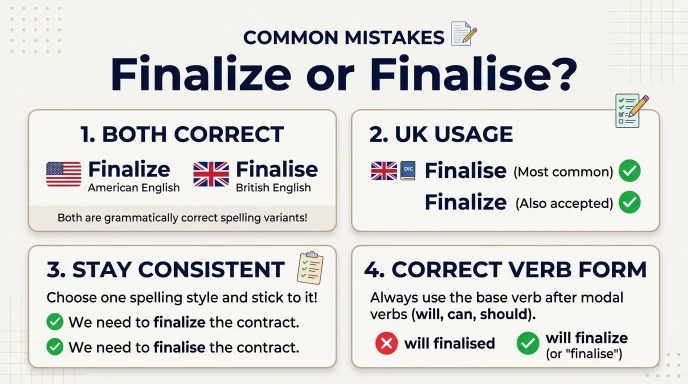
Writers often assume that one spelling must be wrong. In reality, both finalize and finalise are accepted forms.
Mistake 1: Calling Finalise Incorrect
Incorrect claim: “Finalise is always a spelling mistake.”
Correct understanding: Finalise is a valid spelling used in British English and other writing that follows -ise conventions.
Explanation: The difference is regional preference, not meaning.
Memory tip: Think of finalise as a British-style option.
Mistake 2: Calling Finalize Incorrect in British English
Incorrect claim: “Finalize can never be used in the UK.”
Correct understanding: Finalize is also used in British publications, particularly those that prefer -ize spellings.
Explanation: British English has more than one accepted spelling convention.
Memory tip: Follow your style guide rather than relying on a country name alone.
Mistake 3: Mixing Spellings in One Document
Inconsistent example: “We will finalize the report before the manager finalises the budget.”
Better example: “We will finalize the report before the manager finalizes the budget.”
Or, in -ise style:
“We will finalise the report before the manager finalises the budget.”
Explanation: The original sentence is understandable, but mixing conventions without a reason can look careless.
Memory tip: Pick one spelling family and stick to it.
Mistake 4: Using the Wrong Verb Form
Incorrect: “We will finalised the report tomorrow.”
Correct: “We will finalize the report tomorrow.”
Explanation: After will, use the base form of the verb. The same rule applies to finalise.
Other correct forms include:
- Present: “We finalize the report.”
- Past: “We finalized the report.”
- Present participle: “We are finalizing the report.”
- Past participle: “We have finalized the report.”
For British -ise spelling, the corresponding forms are finalise, finalised, finalising, and finalised.
Everyday Examples of Finalize and Finalise
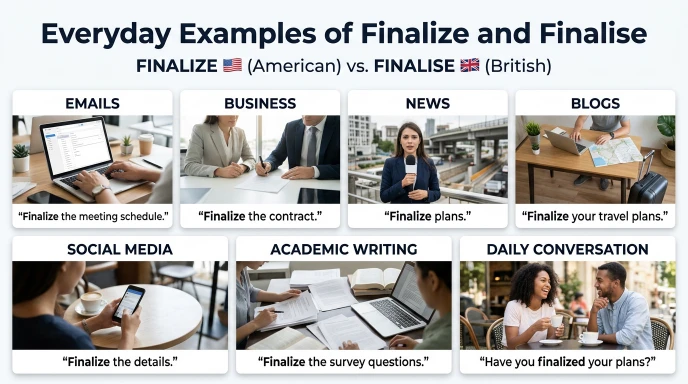
The best way to understand these spellings is to see how they work in everyday writing. The sentences below use the same meaning but follow different spelling styles.
1. Emails
American English:
Hi Alex, please finalize the meeting schedule before sending it to the team.
British English:
Hi Alex, please finalise the meeting schedule before sending it to the team.
Both are correct. Choose the version that matches your workplace’s writing style.
2. Business Writing
American English:
The company expects to finalize the contract by the end of the month.
British English:
The company expects to finalise the contract by the end of the month.
In both cases, the sentence means that the company expects to settle the remaining details.
3. News Headlines
American English:
Officials Finalize Plans for the New Transport Project
British English:
Officials Finalise Plans for the New Transport Project
News organizations often follow their own editorial style. Match the spelling used by the publication.
4. Blogs
American English:
How to Finalize Your Travel Plans in Five Simple Steps
British English:
How to Finalise Your Travel Plans in Five Simple Steps
If your blog targets a specific country, use its preferred spelling throughout your articles, headings, and image text.
5. Social Media
American English:
We are ready to finalize the details. More updates coming soon!
British English:
We are ready to finalise the details. More updates coming soon!
Social media posts are usually informal, but consistent spelling still makes your content look polished.
6. Academic Writing
American English:
The researchers will finalize the survey questions before collecting the data.
British English:
The researchers will finalise the survey questions before collecting the data.
Students and researchers should follow their university’s or journal’s style guide. Do not change the spelling simply because a different version appears in a source.
7. Daily Conversation
American English:
“Have you finalized your plans for the weekend?”
British English:
“Have you finalised your plans for the weekend?”
Both sentences sound natural. The spelling difference does not change the pronunciation in ordinary usage or the meaning of the question.
Google Trends and Modern Usage
People search for finalize or finalise because English spelling varies across countries. Writers may also encounter both forms when reading international news, working with overseas clients, or editing documents written by people from different regions.
Which Spelling Is More Popular?
General spelling conventions suggest that finalize is more common in American English, while finalise is associated with British-style spelling. This is a useful regional guide, but it should not be treated as a precise measurement of search volume.
Google Trends can help you investigate interest by country and over time. However, its results represent relative search interest rather than exact search counts. Google also explains that spelling variations can affect comparisons, so the terms and settings need to be selected carefully.
You can explore the data using Google Trends and compare the two search terms by region and date.
Why Do People Search for Finalize or Finalise?
Common reasons include:
- Checking which spelling is correct.
- Learning the difference between American and British English.
- Editing a business email or formal document.
- Choosing the right spelling for a website.
- Understanding related forms such as finalized, finalised, finalization, and finalisation.
For content, use the spelling that fits your main audience. A US-focused article would normally use finalize, while a UK-focused article following -ise conventions would normally use finalise.
Avoid changing your entire spelling system just to target a second keyword. Clear writing, consistent usage, and useful information should come first.
Finalize vs Finalise: Quick Comparison
| Version | Meaning | Correct? | Region | Example |
| Finalize | Complete or settle something | Yes | Mainly US preference | We will finalize the plan. |
| Finalise | Complete or settle something | Yes | Common UK preference | We will finalise the plan. |
| Finalized | Past tense or past participle | Yes | Mainly US preference | We finalized the deal. |
| Finalised | Past tense or past participle | Yes | Common UK preference | We finalised the deal. |
| Finalizing | Ongoing action | Yes | Mainly US preference | We are finalizing the report. |
| Finalising | Ongoing action | Yes | Common UK preference | We are finalising the report. |
The table shows that the difference extends to related word forms. It is not limited to the base verb.
Key Takeaways
- Finalize is the preferred spelling in American English.
- Finalise is common in British English and other British-style spelling systems.
- Both spellings mean to complete something or settle its final details.
- Neither spelling is universally wrong.
- British publications may use finalize if their style guide follows the -ize convention.
- Related forms include finalized/finalised and finalization/finalisation.
- Follow your audience’s expectations or your organization’s style guide.
- Keep your spelling consistent throughout each document or article.
FAQs
What Is the Meaning of Finalise?
Finalise means to complete something, make a final decision, or put the finishing touches on a plan or arrangement. It is the standard British English spelling of finalize.
Is It Finalized or Finalised in the UK?
In the UK, finalised is the standard spelling. In American English, finalized is preferred. Both words have the same meaning: something has been completed or officially settled.
What Is the Meaning of Finalizing?
Finalizing means completing the last steps of something to make it final. For example: “We are finalizing the details of the meeting before sending the invitations.”
Which Is Correct, Finalisation or Finalization?
Both spellings are correct, but they follow different spelling conventions. Finalisation is standard in British English, while finalization is standard in American English. Both mean the act of completing or settling something.
Is Finalise or Finalize Correct?
Both are correct. Finalise is commonly used in British English, while finalize is the preferred spelling in American English. Choose the spelling that matches your audience and remain consistent throughout your writing.
What Is a Synonym for Finalise?
Common synonyms for finalise include complete, finish, conclude, settle, confirm, and finalize. The best synonym depends on the context. For example, “finalise an agreement” can also mean “complete an agreement” or “settle the terms.”
Can You Provide a Sentence Using the Word “Finalise”?
Certainly. Here is an example using British English:
“We need to finalise the project budget before the end of the week.”
In this sentence, finalise means to complete and officially settle the budget details.
What Is Another Word for Finalised?
Another word for finalised is completed. Other alternatives include finished, settled, confirmed, and concluded. For example, “The arrangements have been finalised” can be rewritten as “The arrangements have been completed.”
Conclusion
The choice between finalize and finalise comes down to spelling conventions, not meaning. Both words are correct, and both mean to complete a task, settle an agreement, or make a final decision.
Use finalize when writing for an American audience. Choose finalise when following a British English style guide that prefers -ise endings. In countries such as Canada and Australia, check the spelling conventions used by your employer, university, or publisher rather than assuming that one rule fits every situation.
The same principle applies to related words. American English commonly uses finalized, finalizing, and finalization, while British-style -ise writing commonly uses finalised, finalising, and finalisation.
For students, writers, editors, and website owners, consistency is the most useful rule. Choose your spelling style before you begin, and apply it throughout the document. If you are editing someone else’s work, follow the original publication’s style unless you have been asked to change it.
Remember: Finalize is the usual American spelling, finalise is common in British English, and both are correct.
If this guide helped clear up the confusion, explore our other spelling guides to improve your everyday and professional writing.
READ MORE!
- Cavalry or Calvary: Which Is Correct?
- Met or Meet: Which Is Correct?
- Papa or Pappa: Which Spelling Is Correct?

I’m passionate about English grammar, vocabulary, and clear communication. I enjoy making English easier to understand through simple, practical, and easy-to-follow explanations. My goal is to help learners build confidence and improve their English for everyday use.






1 thought on “Finalize or Finalise: Which Spelling Is Correct?”