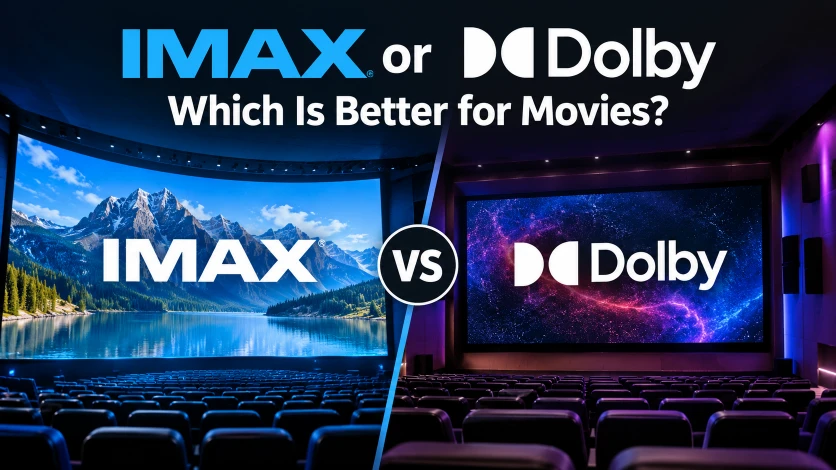
Choosing between IMAX and Dolby Cinema can change how a movie looks, sounds, and feels. IMAX is often the better choice for a huge screen and an immersive, larger-than-life picture, while Dolby Cinema is often better for deep contrast, rich colors, and powerful Dolby Atmos sound. The best option depends on the movie, the theater, and what you enjoy most.
People search for IMAX or Dolby because both formats promise a premium movie experience, but they use different technologies. IMAX focuses on its large-screen presentation, specialized projection systems, and theater design. Dolby Cinema combines Dolby Vision picture technology with Dolby Atmos sound in participating theaters.
There is no single winner for every movie. Some films are specially made or formatted for IMAX, while others benefit from Dolby Vision’s contrast and color. Screen size, seating, projection equipment, and the specific movie version can also affect the result.
In this guide, you will learn the main differences between IMAX and Dolby Cinema, compare picture and sound quality, understand ticket value, and discover which format is best for action films, science fiction, animation, and everyday moviegoing.
IMAX or Dolby: Quick Answer
IMAX and Dolby Cinema are two premium movie theater experiences. Neither is always better. Your choice depends on if you value a larger image, special expanded-screen scenes, strong contrast, immersive sound, or comfortable seating.
- Choose IMAX for a huge screen, large-scale action, and films with an IMAX-expanded aspect ratio.
- Choose Dolby Cinema for rich contrast, detailed dark scenes, vivid colors, and Dolby Atmos audio.
- Choose based on the theater if one location has better projection, sound, or seats.
- Check the movie format before booking because not every film uses every feature of a premium theater.
For example, a science-fiction film with IMAX-expanded scenes may be especially impressive in IMAX. A dark thriller with detailed shadows may benefit from Dolby Vision in Dolby Cinema. Both can deliver excellent results.
What Does IMAX or Dolby Mean?
What is IMAX?
IMAX is a cinema format built around an immersive presentation. It is known for large screens, specialized projection systems, and sound designed for the theater.
Some IMAX presentations show more of the image vertically than standard screenings. This is called an expanded aspect ratio. It can reveal additional picture at the top and bottom of selected scenes. However, the amount of extra image depends on the movie and the theater.
IMAX is a strong option for viewers who want to feel surrounded by the action. It can be particularly appealing for large-scale adventures, space films, and movies made to take advantage of the format.
What is Dolby Cinema?
Dolby Cinema combines two major technologies:
- Dolby Vision: Picture technology designed to deliver rich colors, high contrast, and detailed highlights and shadows.
- Dolby Atmos: Sound technology that can place audio around and above the audience for a more immersive experience.
Participating Dolby Cinema theaters also feature a purpose-designed environment and seating. The exact experience can vary by location.
Dolby Cinema is a great choice for viewers who care about visual detail, subtle changes in lighting, clear dialogue, and sounds that seem to move through the theater.
Are IMAX and Dolby the same thing?
No. They are different cinema experiences with different technology and presentation goals.
IMAX emphasizes its large-format presentation and, in some releases, expanded picture. Dolby Cinema combines Dolby Vision picture technology with Dolby Atmos sound. Both can provide excellent image and audio quality, but the results depend on the specific film and theater.
The Origin of IMAX and Dolby Cinema
IMAX and Dolby developed from different areas of entertainment technology.
IMAX began as a large-format film projection system. It was introduced at Expo 67 in Montreal, Canada, and later developed into a cinema experience associated with large screens and immersive presentation. Digital projection and laser systems have since expanded the ways IMAX films can be shown.
Dolby Laboratories was founded in 1965 by Ray Dolby. The company first became widely known for audio noise-reduction technology and later developed cinema sound systems and picture technologies. Dolby Atmos brought object-based, three-dimensional sound to cinemas, while Dolby Vision developed high dynamic range imaging.
Today, Dolby Cinema brings Dolby Vision and Dolby Atmos together in a premium theater setting. IMAX and Dolby have both evolved beyond their original technologies, so it is best to compare modern theater experiences rather than assume every IMAX or Dolby auditorium is identical.
British English vs American English
Unlike spelling comparisons such as colour vs color, IMAX vs Dolby is not a British-versus-American English issue. Both names refer to cinema brands and formats, and their spelling does not change between the United States and the United Kingdom.
| Context | British English | American English | Example |
| IMAX | IMAX | IMAX | We booked IMAX tickets. |
| Dolby Cinema | Dolby Cinema | Dolby Cinema | Dolby Cinema has Dolby Vision and Dolby Atmos. |
| Cinema | Cinema | Movie theater / theater | The cinema is nearby. |
| Film | Film | Movie / film | Which film are you watching? |
| Colour / color | Colour | Color | Dolby Vision can display rich colors. |
Regional vocabulary may differ, but the technology names remain the same. In professional writing, keep the official brand spelling and use the local spelling of ordinary words.
Which Version Should You Use?
The best choice depends on your location, the movie, and your personal preferences.
- United States: Compare local IMAX auditoriums with Dolby Cinema locations. Both are widely known premium formats, but availability varies.
- United Kingdom: Check if your cinema offers IMAX, Dolby Cinema, or another premium large-screen option. Availability is not the same at every venue.
- Canada: IMAX has a notable presence, but Dolby-equipped theaters may be available in some cities. Compare the actual screens and showtimes.
- Australia: IMAX is a strong option for large-format viewing. Dolby-equipped premium screenings may also be available, depending on the city and cinema.
- International audiences: Check the theater’s specifications instead of assuming that every venue using the same brand offers identical equipment.
- Academic writing: Explain the technology accurately. Use IMAX and Dolby Cinema as proper names.
- Business writing: Use the full name on first mention, then use the shorter name if the meaning is clear.
If you are buying tickets, the most useful question is not which format has the better reputation. It is which available screening gives you the best combination of picture, sound, seating, and value for that movie.
IMAX vs Dolby: Picture Quality, Sound, and Comfort
This is the most important part of the comparison. A premium format can make a movie more engaging, but different technologies improve different parts of the experience.
| Feature | IMAX | Dolby Cinema |
| Main strength | Large-format presentation | Contrast, color, and immersive sound |
| Picture | Depends on projection system and film | Dolby Vision picture technology |
| Screen size | Often very large | Varies by theater |
| Expanded image | Available for selected films and theaters | Depends on the film’s presentation, not an IMAX expansion feature |
| Sound | Specialized cinema sound system | Dolby Atmos |
| Dark scenes | Depends on projector and presentation | Designed for strong contrast and shadow detail |
| Seating | Depends on theater | Purpose-designed premium seating in Dolby Cinema |
| Best for | Large-scale visual immersion | Picture detail and spatial sound |
Which has better picture quality?
Dolby Cinema is a strong choice if you want high contrast, detailed shadows, bright highlights, and rich colors. Dolby Vision is designed to help preserve details across bright and dark parts of a scene.
IMAX can be more impressive when a movie uses an expanded aspect ratio or when the theater’s screen and projection system make the image feel enormous.
However, IMAX is not one single projector specification. Film-based IMAX and digital IMAX systems differ, and theater equipment matters. It would be misleading to say that every IMAX screen has a better picture than every Dolby Cinema screen, or the reverse.
Which has better sound?
Dolby Cinema uses Dolby Atmos, which can place sounds around and above the audience. This can make a passing aircraft, distant footsteps, or a dramatic musical score feel more immersive.
IMAX also uses cinema sound systems designed for an immersive presentation. Its sound can be powerful and engaging, particularly in action films.
Choose Dolby Cinema if Dolby Atmos is your priority. But do not assume that the sound will always be better in every seat or theater. Speaker placement, room acoustics, sound mixing, and volume all matter.
Which is better for action movies?
Both formats work well for action movies.
IMAX may have the edge when the film uses expanded IMAX scenes, large landscapes, or compositions designed for a tall screen. Dolby Cinema may appeal more if you enjoy detailed explosions, strong contrast, and spatial sound.
For the best experience, check if the movie was filmed or formatted for IMAX and if the Dolby screening is available in your area.
Which is better for dark movies?
Dolby Cinema is often a good choice for horror films, dark thrillers, and movies with night scenes. Dolby Vision is designed to deliver high contrast and preserve detail in shadows and highlights.
That does not mean IMAX always struggles with dark scenes. The result depends on its projection system, the movie’s master, and the theater environment.
Which has better seating?
Dolby Cinema locations are known for premium recliners and carefully designed seating. This can make a long movie more comfortable.
IMAX seating varies considerably between theaters. Some have modern, comfortable seats, while others have a more traditional auditorium layout.
If comfort is important, check photographs, seat maps, and reviews of the specific cinema before purchasing tickets.
Common Mistakes When Comparing IMAX and Dolby
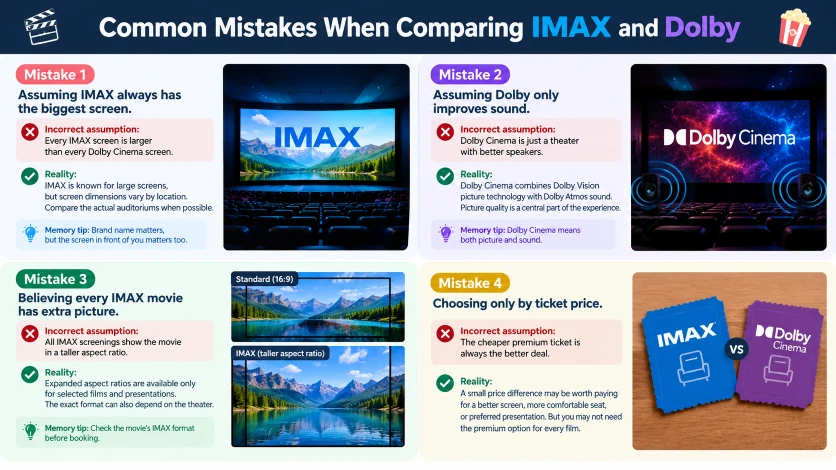
Mistake 1: Assuming IMAX always has the biggest screen
Incorrect assumption: Every IMAX screen is larger than every Dolby Cinema screen.
Correct understanding: IMAX is known for large screens, but screen dimensions vary by location. Compare the actual auditoriums when possible.
Memory tip: Brand name matters, but the screen in front of you matters too.
Mistake 2: Assuming Dolby only improves sound
Incorrect assumption: Dolby Cinema is just a theater with better speakers.
Correct understanding: Dolby Cinema combines Dolby Vision picture technology with Dolby Atmos sound. Picture quality is a central part of the experience.
Memory tip: Dolby Cinema means both picture and sound.
Mistake 3: Believing every IMAX movie has extra picture
Incorrect assumption: All IMAX screenings show the movie in a taller aspect ratio.
Correct understanding: Expanded aspect ratios are available only for selected films and presentations. The exact format can also depend on the theater.
Memory tip: Check the movie’s IMAX format before booking.
Mistake 4: Choosing only by ticket price
Incorrect assumption: The cheaper premium ticket is always the better deal.
Correct understanding: A small price difference may be worth paying for a better screen, more comfortable seat, or preferred presentation. But you may not need the premium option for every film.
Memory tip: Compare the experience, not just the price.
Everyday Examples: When to Choose IMAX or Dolby
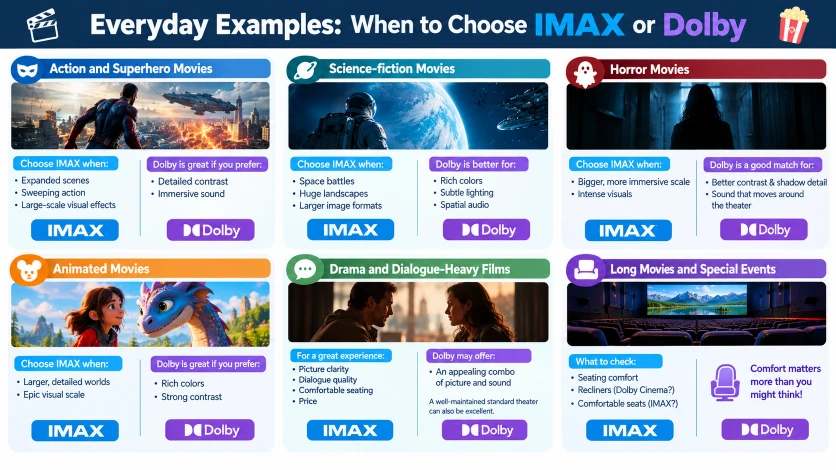
Here are practical situations that can help you choose.
Action and superhero movies
Choose IMAX when the film features expanded scenes, sweeping action, or large-scale visual effects. Dolby Cinema is also an excellent option if you prefer detailed contrast and immersive sound.
Science-fiction movies
IMAX is especially appealing for space battles, enormous landscapes, and films designed for a larger image. Dolby Cinema can be better for viewers who want rich colors, subtle lighting, and spatial audio.
Horror movies
Dolby Cinema can be a good match for horror because contrast and shadow detail can help preserve the mood of dark scenes. Sound that moves around the theater can also heighten suspense.
Animated movies
Both formats can look excellent. Dolby Cinema may appeal to viewers who value rich colors and contrast, while IMAX can make detailed animated worlds feel larger.
Drama and dialogue-heavy films
For a drama, consider picture clarity, dialogue quality, seating comfort, and price. Dolby Cinema may offer an appealing combination of picture and sound, but a well-maintained standard theater can also provide an excellent experience.
Long movies and special events
For a long movie, seating comfort matters more than many people expect. Check if the specific Dolby Cinema offers recliners and if your local IMAX auditorium has comfortable seating.
Google Trends and Modern Usage: Why Do People Search for IMAX or Dolby?
People often search for “IMAX or Dolby” when a new blockbuster opens, tickets are available in multiple premium formats, or they want to decide if an upgrade is worth the cost.
The confusion makes sense because both formats are marketed as premium experiences, but they do not offer exactly the same features.
Common search questions include:
- Is IMAX better than Dolby Cinema?
- Does IMAX have better sound?
- Is Dolby Cinema better for dark movies?
- Is IMAX worth the extra money?
- Which format has the bigger screen?
- Should I watch a movie in IMAX or Dolby?
These questions reflect different priorities. One person may care most about the largest possible picture, while another may prefer deep blacks, comfortable seating, or immersive sound.
Exact regional popularity should be checked using the Google Trends comparison tool rather than guessed. Search interest can vary by country, movie release, and time period. Without a specific, verified Trends comparison, it would be inaccurate to claim that one term consistently receives more searches worldwide.
For useful comparisons, select a country, compare the search terms over the same period, and remember that Google Trends reports relative search interest rather than total search counts.
IMAX vs Dolby: Quick Comparison
| Version | Main benefit | Correct choice for | Example |
| IMAX | Large-format presentation | Expanded scenes and huge visuals | A space adventure designed for IMAX |
| Dolby Cinema | Dolby Vision and Dolby Atmos | Rich contrast and spatial sound | A dark thriller with detailed lighting |
| Both | Premium presentation | Viewers who want an immersive movie | A major blockbuster available in both |
| Standard cinema | Often lower ticket cost | Everyday viewing and tighter budgets | A comedy or casual movie night |
Neither format wins every category. The right choice depends on the film, the actual theater, and your preferences.
Key Takeaways
- IMAX focuses on a large-format, immersive cinema presentation.
- Dolby Cinema combines Dolby Vision picture technology with Dolby Atmos sound.
- IMAX can be the better choice for movies with expanded IMAX scenes.
- Dolby Cinema is appealing for rich contrast, color, and spatial sound.
- Neither format guarantees a better experience in every theater.
- Seating, screen size, projection quality, and sound setup can affect your choice.
- Check the movie’s format and local auditorium before buying tickets.
FAQs
Is IMAX better than Dolby?
IMAX and Dolby Cinema offer different movie experiences. IMAX is often preferred for its giant screen, expanded aspect ratio in selected films, and immersive presentation. Dolby Cinema stands out for Dolby Vision picture quality, deep contrast, rich colors, and Dolby Atmos sound. The better option depends on the movie, theater setup, and your personal preferences.
Which is louder, Dolby or IMAX?
Neither is always louder. Both IMAX and Dolby Cinema can deliver powerful, immersive sound, but actual volume depends on the theater’s calibration and the film’s audio mix. Dolby Atmos focuses on precise, three-dimensional sound placement, while IMAX sound systems are designed for a powerful cinematic experience.
Which is better, IMAX Enhanced or Dolby Vision?
Dolby Vision generally offers excellent HDR picture quality, with detailed highlights, deep blacks, and rich colors on compatible displays. IMAX Enhanced combines IMAX-certified picture and sound standards with supported content, sometimes including an expanded aspect ratio and DTS audio. The better choice depends on your TV, audio setup, and the content available.
Which is cheaper, IMAX or Dolby?
Ticket prices vary by cinema, location, showtime, and movie. IMAX may be cheaper at some theaters, while Dolby Cinema may cost more at others. Compare ticket prices at your local cinema to find the more affordable option.
What is the disadvantage of IMAX?
The main disadvantages of IMAX can include higher ticket prices, limited theater availability, and variable picture quality depending on the screen and film format. Some movies are not filmed or presented in an expanded IMAX aspect ratio, so you may not always get the full-screen experience.
Which sound is better than Dolby Atmos?
There is no universally better sound system than Dolby Atmos. Alternatives such as DTS:X and IMAX’s theater sound systems can also provide immersive, high-quality audio. The best option depends on speaker configuration, theater calibration, the movie’s sound mix, and personal preference.
Conclusion
When comparing IMAX or Dolby, remember that the two formats offer different strengths. IMAX is known for its large-format presentation and can show an expanded image for selected movies. Dolby Cinema combines Dolby Vision picture technology with Dolby Atmos sound, making it appealing to viewers who value contrast, color, and immersive audio.
If you are watching a major action movie, science-fiction adventure, or film with expanded IMAX scenes, IMAX is an excellent choice. If you prefer detailed shadows, rich colors, and sound that moves around the auditorium, Dolby Cinema may suit you better.
Before booking, check the specific movie format, theater equipment, seating, and ticket price. A well-equipped auditorium can make a bigger difference than the brand name alone. Also, remember that not every movie takes full advantage of every premium format.
The final recommendation: Choose IMAX for the scale of the picture and Dolby Cinema for its combination of picture detail and immersive sound. If both are available, let the movie and your personal preferences make the decision.
Planning your next movie night? Compare the available screenings before booking and choose the experience you will enjoy most.
READ MORE!
- Sole or Soul: What’s the Difference?
- Herpes or Folliculitis: How to Tell the Difference
- Porcelain vs Ceramic: What’s the Difference?

I’m Edward Fletcher, a UK-based English language writer with a passion for grammar and vocabulary. At VocabNex, I share simple explanations, useful examples, and practical English tips to help learners improve their language skills and communicate with confidence.