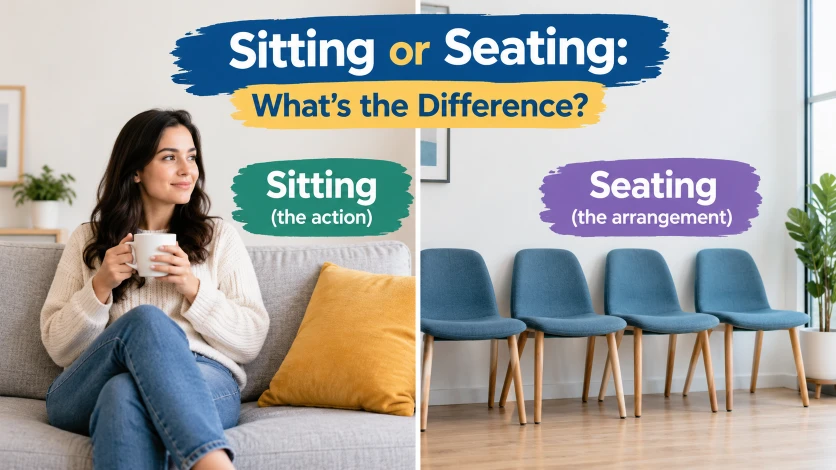
The main difference between sitting and seating is simple: sitting usually describes the act of being in a seated position, while seating refers to places for people to sit or the act of arranging people in seats.
For example, “I am sitting on the sofa” describes what a person is doing. “The restaurant has seating for 50 guests” describes how many people the restaurant can accommodate.
Although these words come from the same verb, sit, they are not always interchangeable. You may see them on restaurant signs, event tickets, booking websites, office instructions, and in everyday conversations. Choosing the wrong word can make a sentence sound unnatural or change its meaning.
In this guide, you will learn the meaning of sitting and seating, how to use each word correctly, and which one fits different situations. You will also find practical examples, common mistakes, a quick comparison table, and answers to frequently asked questions.
Sitting or Seating: Quick Answer
Use sitting when you mean the action or state of sitting. Use seating when you mean seats, seating arrangements, or the process of placing people in seats.
Examples:
- Sitting: “The children are sitting quietly.”
- Seating: “The theater offers comfortable seating.”
- Seating arrangement: “Please check the seating chart before the wedding.”
Remember this simple rule: people sit, while places provide seating. This is a useful guide, although context can affect the exact meaning.
What Does Sitting or Seating Mean?
What Does Sitting Mean?
Sitting is the -ing form of the verb sit. It can describe the act of lowering your body into a seated position or the state of being seated.
It is also used as a noun in some contexts, such as a sitting for a portrait or a scheduled period for an exam or meeting.
Examples:
- “I am sitting at my desk.”
- “The dog is sitting beside the door.”
- “We have an exam sitting at 9 a.m.”
- “The artist arranged a sitting for the portrait.”
In everyday English, sitting most often refers to what a person or animal is doing.
What Does Seating Mean?
Seating comes from the verb seat, which means to place someone on a seat or provide someone with a place to sit.
It commonly refers to seats, their availability, or the way people are arranged.
Examples:
- “The restaurant has outdoor seating.”
- “Please follow the seating plan.”
- “The staff are seating guests near the stage.”
- “The stadium has seating for thousands of fans.”
In the sentence “The staff are seating guests,” seating is a verb form. In “The venue offers extra seating,” it is a noun.
The Main Difference
| Word | Main meaning | Example |
| Sitting | Being or placing yourself in a seated position | “He is sitting on a bench.” |
| Seating | Seats, capacity, arrangement, or placing someone in a seat | “The hall has extra seating.” |
Both words are correct English. The right choice depends on what you want to describe.
The Origin of Sitting and Seating
Both words are connected to the English verb sit, but their forms developed for different grammatical purposes.
Sitting is formed from sit with the ending -ing. This ending can show an ongoing action, as in “She is sitting,” or help form a noun, as in “sitting for a portrait.”
Seating is formed from seat with the same -ing ending. The verb seat means to place someone in a seat. Over time, seating also became a common noun for seats, arrangements, and the capacity of a venue.
The difference is therefore not a spelling mistake or a difference between British and American English. It comes from the different base verbs: sit and seat.
A helpful way to remember this is that sit focuses on the person taking the position, while seat often focuses on placing someone or providing a place for them.
British English vs American English
There is no major spelling difference between British and American English for sitting and seating. Both forms are standard in both varieties.
| British English | American English | Example |
| Sitting | Sitting | “She is sitting near the door.” |
| Seating | Seating | “The restaurant offers outdoor seating.” |
| Seating plan | Seating chart or seating plan | “Check the seating plan before the event.” |
| Sitting room | Living room or sitting room | “We relaxed in the living room.” |
| Reserved seating | Reserved seating | “The concert has reserved seating.” |
The main variation is in word choice for certain settings, not in the spelling of sitting or seating.
In the United Kingdom, sitting room is a familiar term for a room where people relax. In the United States, living room is more common in everyday speech, although sitting room is also understood.
Similarly, seating chart is especially familiar in American event planning, while seating plan is widely used in British English. Both are understandable internationally.
For professional writing, follow the terminology used by your organization, publication, or intended audience.
Which Version Should You Use?
Choose the word based on the meaning you want, not the country where you are writing.
- United States: Use sitting for the action and seating for seats or arrangements. “The venue has seating for 100 guests” is natural.
- United Kingdom: Follow the same distinction. “The guests are sitting outside” and “The hall offers additional seating” are both correct.
- Canada: Both words are standard. Choose familiar local terms, such as seating plan or seating chart, depending on the context.
- Australia: Both forms are correct. Use sitting for the action and seating for available seats or arrangements.
- International writing: Use simple, direct sentences. “Please take a seat” and “The room has seating for 30 people” are easy to understand.
- Academic writing: Use sitting when describing posture or an activity. Use seating when discussing seat allocation, classroom design, or audience capacity.
- Business writing: Use seating arrangement, seating capacity, or seating plan for practical arrangements. Use sitting when describing a person’s position or an activity.
The key is consistency. Neither word is automatically more correct because of regional preference.
Common Mistakes
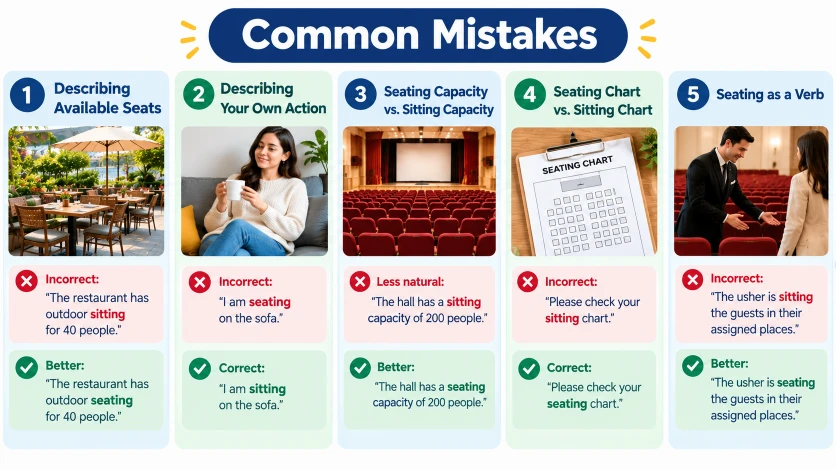
Mistake 1: Using Sitting to Describe Available Seats
Incorrect: “The restaurant has outdoor sitting for 40 people.”
Better: “The restaurant has outdoor seating for 40 people.”
Explanation: The sentence refers to an area where customers can sit. Seating is the natural word for this meaning.
Memory tip: If you mean available seats, think seating.
Mistake 2: Using Seating to Describe Your Own Action
Incorrect: “I am seating on the sofa.”
Correct: “I am sitting on the sofa.”
Explanation: When you describe your own position, use sitting. The verb seat generally means to place someone in a seat, as in “The host is seating the guests.”
Memory tip: You sit yourself down; you seat someone else.
Mistake 3: Confusing Seating Capacity With Sitting Capacity
Less natural: “The hall has a sitting capacity of 200 people.”
Better: “The hall has a seating capacity of 200 people.”
Explanation: Seating capacity is the usual phrase for the number of people a venue can accommodate in seats.
Memory tip: When counting seats in a venue, use seating capacity.
Mistake 4: Assuming Sitting and Seating Are Interchangeable
Incorrect: “Please check your sitting chart.”
Correct: “Please check your seating chart.”
Explanation: A seating chart shows where people are assigned to sit. Sitting chart is not the standard expression for this purpose.
Memory tip: Plans, charts, and arrangements usually use seating.
Mistake 5: Forgetting That Seating Can Be a Verb
Incorrect: “The usher is sitting the guests in their assigned places.” This is possible in some contexts, but it is not the usual wording for an usher arranging guests.
Better: “The usher is seating the guests in their assigned places.”
Explanation: Here, seating means directing or placing guests in their seats.
Memory tip: If someone is helping other people find their seats, seating is often the best choice.
Everyday Examples of Sitting and Seating
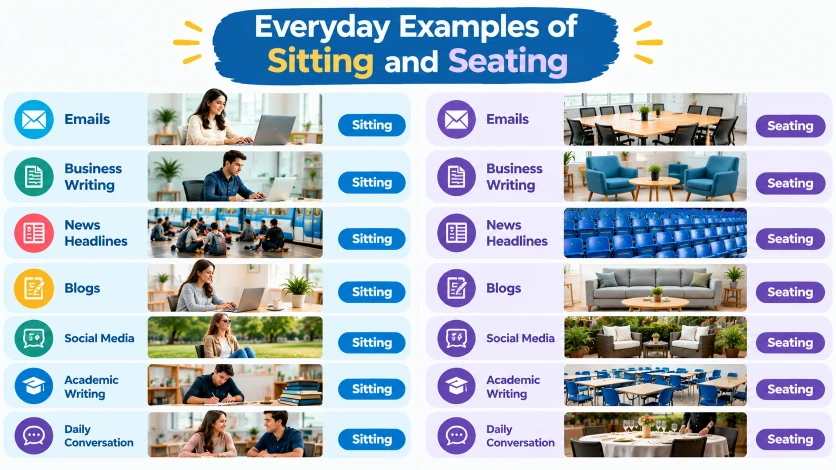
The easiest way to learn these words is to see how they work in real situations.
Emails
- Sitting: “I will be sitting near the front during the presentation.”
- Seating: “Please confirm the seating arrangements for the meeting.”
Business Writing
- Sitting: “Employees should avoid sitting for long periods without breaks.”
- Seating: “The office renovation will include additional seating areas.”
News Headlines
- Sitting: “Passengers Are Sitting on the Floor After Train Delays”
- Seating: “New Stadium Seating to Accommodate More Fans”
Blogs
- Sitting: “Sitting at a desk all day can make it harder to stay active.”
- Seating: “How to Choose Comfortable Seating for a Small Living Room”
Social Media
- Sitting: “Just sitting outside and enjoying the sunshine.”
- Seating: “Our new outdoor seating area is ready for summer!”
Academic Writing
- Sitting: “The study examined the effects of prolonged sitting on daily activity.”
- Seating: “The researchers evaluated classroom seating arrangements.”
Daily Conversation
- Sitting: “Where are you sitting?”
- Seating: “Is there any seating available outside?”
- Sitting: “I was sitting by the window when you called.”
- Seating: “The host is seating guests now.”
These examples show that the words may appear in similar situations, but they do different jobs in a sentence.
Google Trends and Modern Usage
People search for “sitting or seating” because the words look similar, share a related meaning, and often appear in the same settings. Restaurants, event venues, offices, schools, and public buildings commonly use seating when discussing available places or arrangements.
Sitting appears more often in descriptions of everyday actions, posture, and activities. For example, people may write “sitting at a desk,” “sitting on the floor,” or “sitting quietly.”
Seating is common in phrases such as “seating capacity,” “seating arrangement,” “seating area,” and “reserved seating.”
What About Google Trends?
Google Trends can help compare search interest for “sitting” and “seating” over a selected period and in different countries. However, no live Trends figures are provided here, so exact popularity rankings or percentages should not be assumed.
Also, the two words have different meanings and uses. A search comparison alone cannot prove that one is more correct than the other.
The most useful lesson is to consider the phrase and the context. If you are writing about a person in a chair, sitting is usually right. If you are writing about chairs available to guests, seating is usually right.
Quick Comparison
| Version | Meaning | Correct? | Region | Example |
| Sitting | Being in a seated position | Yes | All major English varieties | “She is sitting outside.” |
| Seating | Available seats or a seating arrangement | Yes | All major English varieties | “There is seating outside.” |
| Sitting | A period of an activity or session | Yes, in the right context | International | “The exam has a morning sitting.” |
| Seating | Placing people in seats | Yes | International | “Staff are seating the guests.” |
| Sitting capacity | Intended number of seated people | Usually not the standard phrase for venue capacity | International | Use “seating capacity.” |
| Sitting chart | A chart showing assigned places | Usually incorrect for this meaning | International | Use “seating chart” or “seating plan.” |
Key Takeaways
- Sitting usually describes the action or state of being seated.
- Seating usually refers to available seats, arrangements, or placing people in seats.
- “I am sitting on a chair” is correct.
- “The room has seating for 30 people” is correct.
- Use seating capacity, not usually sitting capacity, when describing a venue.
- Use seating chart or seating plan when showing assigned places.
- British and American English use both words with the same basic distinction.
- Always choose the word that matches your intended meaning.
Frequently Asked Questions
Is it sitting or seating for a meeting?
Seating is used when referring to the arrangement of chairs or places for people at a meeting. Sitting refers to the act of being seated. For example: “Please arrange the seating for the meeting” and “We are sitting in the meeting room.”
Which is correct, seating or sitting?
Both seating and sitting are correct, but they have different meanings. Seating refers to seats or their arrangement, while sitting means resting your body on a chair or another surface. For example: “The seating capacity is 50” and “I am sitting on a chair.”
Is it one seating or one sitting?
One sitting is correct when referring to completing something in a single session. For example: “I finished the entire book in one sitting.” One seating is generally not used with this meaning, although seating can refer to a specific seating arrangement or occasion in certain contexts.
Are you sitting or seating?
Sitting is correct when asking if someone is seated. For example: “Are you sitting comfortably?” Seating usually means arranging seats or providing someone with a place to sit. For example: “The staff are seating the guests.”
When to use seating?
Use seating when talking about chairs, seating arrangements, capacity, or the act of showing people to their seats. For example: “The restaurant offers outdoor seating” or “The organizer is seating the guests according to their reservations.”
What is a seating meeting?
A seating meeting is not a common standard expression in English. If you mean a meeting where people discuss or arrange seats, say “a meeting about seating arrangements.” If you mean a meeting where participants sit together, simply say “a meeting” or “a seated meeting,” depending on the context.
Conclusion
Understanding the difference between sitting and seating makes your English clearer and more natural. Both words are correct, but they are used in different ways.
Use sitting when describing a person or animal in a seated position, such as “The child is sitting on the floor.” It can also refer to an activity or a scheduled session, depending on the context.
Use seating when talking about available seats, seating capacity, seating arrangements, or placing people in seats. For example, “The restaurant offers outdoor seating” and “The host is seating the guests” are both correct.
These rules apply to British English, American English, and other major varieties of English. The main difference is the meaning of each word, not its spelling or regional form.
When writing emails, academic papers, business documents, or everyday messages, consider what you want to describe before choosing a word. This simple habit can help you avoid common mistakes and write with greater confidence.
Remember: people are sitting, places provide seating, and hosts seat guests. If you found this guide helpful, explore more commonly confused words to strengthen your English vocabulary.
READ MORE!
- Cavalry or Calvary: Which Is Correct?
- Met or Meet: Which Is Correct?
- Papa or Pappa: Which Spelling Is Correct?

I’m Edward Fletcher, a UK-based English language writer with a passion for grammar and vocabulary. At VocabNex, I share simple explanations, useful examples, and practical English tips to help learners improve their language skills and communicate with confidence.







2 thoughts on “Sitting or Seating: What’s the Difference?”