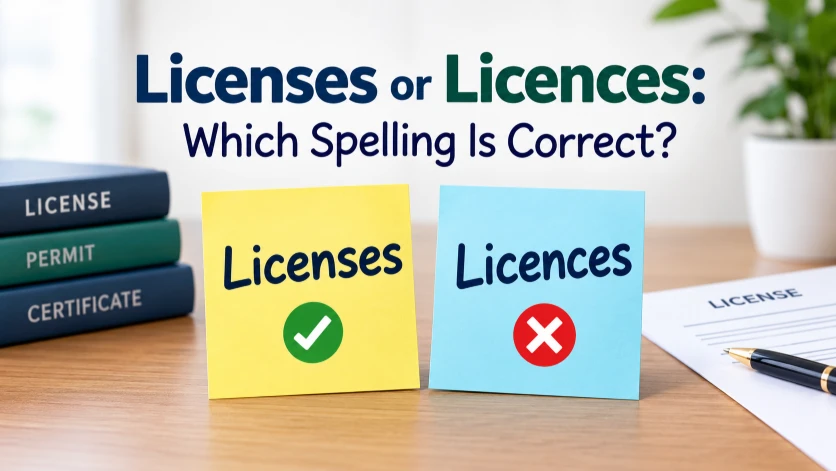
Have you ever wondered if to write licenses or licences? Both spellings are correct, but the right choice depends on which type of English you use. American English uses license as both a noun and a verb, while British English uses licence as a noun and license as a verb.
This small spelling difference can confuse students, writers, editors, and anyone who writes for an international audience. For example, an American driver may have a driver’s license, while a British driver usually has a driving licence. Both terms refer to official permission to drive.
The same rule applies to other types of permission, including business permits, professional qualifications, and software agreements. However, the difference is not simply about adding an extra letter. British English also changes the spelling of the plural noun and keeps the verb form distinct.
In this guide, you will learn when to use licenses and licences, how American and British spelling rules work, and which version is best for your audience. You will also find practical examples, common mistakes, and answers to frequently asked questions.
Licenses or Licences: Quick Answer
The correct spelling depends on the region and the word’s role in the sentence.
- Licenses: The plural noun in American English and the verb form in both American and British English.
- Licences: The plural noun in British English, Canadian English, and Australian English when following the traditional noun-verb distinction.
- License: The singular noun in American English and the verb in both systems.
- Licence: The singular noun in British English and in many Canadian and Australian contexts.
Examples:
- US: She renewed her driver’s licenses? No. She renewed her driver’s license.
- UK: She renewed her driving licence.
- UK and US: The authorities license qualified professionals.
The key is to distinguish the noun, which names permission or a document, from the verb, which means to grant official permission.
What Does Licenses or Licences Mean?
Both words refer to official permission, a legal document, or the right to do or use something. Their basic meaning does not change with the spelling.
A licence or license may allow someone to drive, run a business, practise a profession, or use software under agreed terms.
Licenses as a noun
In American English, licenses is the plural of license. It refers to two or more permits or grants of permission.
Examples:
- The state issued new business licenses.
- The company renewed its software licenses.
- The drivers must carry valid licenses.
In British English, the same plural noun is spelled licences.
Licenses as a verb
Licenses can also be a verb. It describes what a person, company, or authority does when it grants permission.
Examples:
- The agency licenses medical professionals.
- The government licenses local businesses.
- The company licenses its software to schools.
This spelling works in both American and British English because the verb is spelled license in both systems.
Licences as a noun
In British English, licences is the plural form of the noun licence.
Examples:
- The council checks restaurant licences.
- Several driving licences expired last month.
- The firm holds software licences for its staff.
These sentences use the British noun spelling. In American English, use licenses instead.
The Origin of Licenses or Licences
The word license has roots in Latin. It is linked to licentia, a word associated with permission or freedom, and entered English through French and Latin influences.
Over time, English developed different spelling conventions across regions. British English commonly adopted the distinction between licence as a noun and license as a verb. American English uses license for both forms.
This difference follows a broader pattern in English spelling. Some words have separate noun and verb forms in British English, while American English often uses one spelling for both.
For example:
| British English | American English |
| a licence | a license |
| to license | to license |
| several licences | several licenses |
| licenses a business | licenses a business |
The change is mainly a spelling convention, not a change in meaning. Both varieties use the word to describe permission or the act of granting it.
For a reliable dictionary definition and regional usage, consult the Cambridge Dictionary entries for licence and license.
British English vs American English
The main difference is how each variety spells the noun. The verb is generally license in both.
| British English | American English | Example |
| licence (singular noun) | license (singular noun) | She has a driving licence/license. |
| licences (plural noun) | licenses (plural noun) | The office issued several licences/licenses. |
| license (verb) | license (verb) | The authority will license the company. |
| licensed (past tense or participle) | licensed (past tense or participle) | The business is licensed. |
| licensing (verb form) | licensing (verb form) | The agency is licensing new operators. |
Why does British English use two spellings?
British English uses -ce for the noun and -se for the verb in this word. The spelling helps readers identify the role of the word.
Consider these sentences:
- The shop needs a licence. Here, the word names a permit.
- The council will license the shop. Here, the word describes an action.
Why does American English use one spelling?
American English uses license as both a noun and a verb. The sentence structure tells you which meaning applies.
- The driver renewed the license. Noun.
- The state will license the driver. Verb.
Neither system is more correct than the other. Each follows its own accepted spelling rules.
Which Version Should You Use?
Choose your spelling based on the audience, publication rules, and country where the text will be used.
- United States: Use license as a noun and verb. Write licenses for the plural noun.
- United Kingdom: Use licence for the noun and license for the verb.
- Canada: The traditional distinction is licence for the noun and license for the verb. Follow the relevant Canadian style guide or official terminology.
- Australia: Standard Australian usage generally distinguishes the noun licence from the verb license. Check the style guide for your publication.
- International writing: Choose one spelling system based on your main audience. If the audience is mixed, explain the regional difference when it matters.
- Academic writing: Follow your university, journal, or publisher’s style guide. Consistency matters more than choosing one regional variety over another.
- Business writing: Use the spelling preferred by your clients, company, or target market. Legal documents should also follow the terminology used by the relevant authority.
For example, a US website might use business licenses, while a UK website might use business licences. Both are correct for their intended readers.
Remember that official documents may use a specific title. When quoting or referring to a named document, retain its official spelling.
Common Mistakes
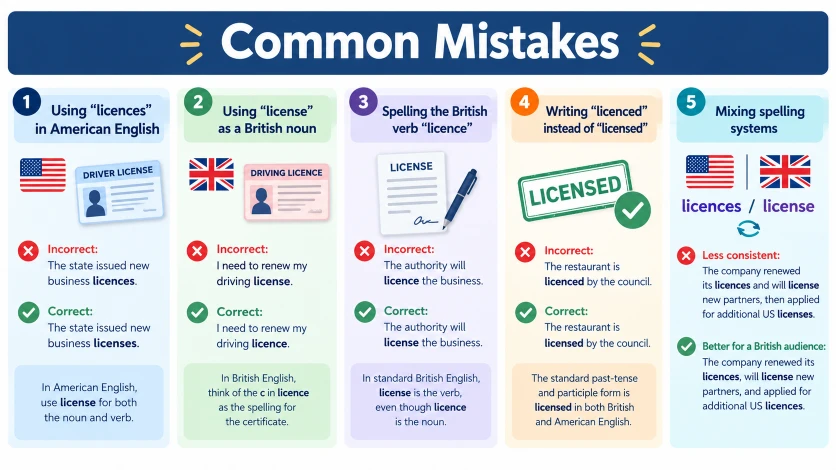
The easiest way to avoid mistakes is to identify if the word names a thing or describes an action.
Mistake 1: Using “licences” in American English
Incorrect for standard American English: The state issued new business licences.
Correct: The state issued new business licenses.
Explanation: American English uses license as the noun, so its plural form is licenses.
Memory tip: In American English, use license for both the noun and verb.
Mistake 2: Using “license” as a British noun
Incorrect in standard British usage: I need to renew my driving license.
Correct: I need to renew my driving licence.
Explanation: British English normally uses licence for the document and license for the action.
Memory tip: In British English, think of the c in licence as the spelling for the certificate.
Mistake 3: Spelling the British verb “licence”
Incorrect: The authority will licence the business.
Correct: The authority will license the business.
Explanation: In standard British English, license is the verb, even though licence is the noun.
Memory tip: The action takes s: license.
Mistake 4: Writing “licenced” instead of “licensed”
Incorrect: The restaurant is licenced by the council.
Correct: The restaurant is licensed by the council.
Explanation: The standard past-tense and participle form is licensed in both British and American English.
Memory tip: Remember the spelling pattern: license, licensed, licensing.
Mistake 5: Mixing spelling systems
Less consistent: The company renewed its licences and will license new partners, then applied for additional US licenses.
Better for a British audience: The company renewed its licences, will license new partners, and applied for additional US licences if the references are to British-style generic nouns.
Explanation: Keep the spelling system consistent unless you are quoting official names or using terminology required by a particular jurisdiction.
Everyday Examples
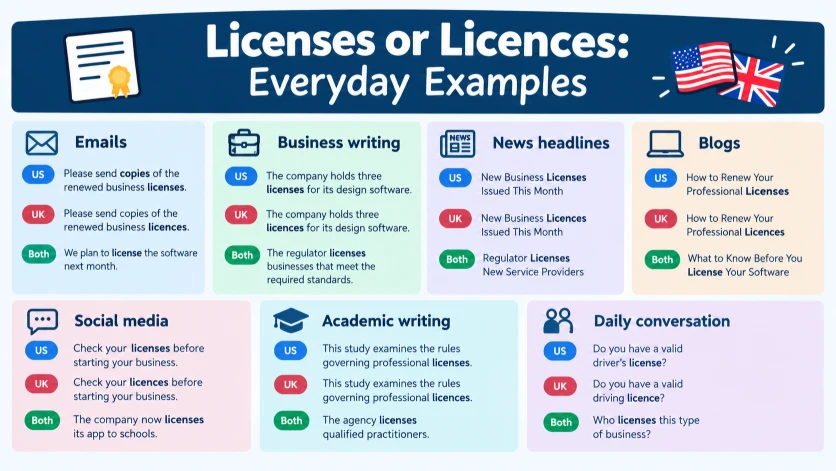
These examples show how to use licenses and licences in common types of writing.
Emails
- US: “Please send copies of the renewed business licenses.”
- UK: “Please send copies of the renewed business licences.”
- Both: “We plan to license the software next month.”
Business writing
- US: “The company holds three licenses for its design software.”
- UK: “The company holds three licences for its design software.”
- Both: “The regulator licenses businesses that meet the required standards.”
News headlines
- US: “New Business Licenses Issued This Month”
- UK: “New Business Licences Issued This Month”
- Both: “Regulator Licenses New Service Providers”
Blogs
- US: “How to Renew Your Professional Licenses”
- UK: “How to Renew Your Professional Licences”
- Both: “What to Know Before You License Your Software”
Social media
- US: “Check your licenses before starting your business.”
- UK: “Check your licences before starting your business.”
- Both: “The company now licenses its app to schools.”
Academic writing
- US: “This study examines the rules governing professional licenses.”
- UK: “This study examines the rules governing professional licences.”
- Both: “The agency licenses qualified practitioners.”
Daily conversation
- US: “Do you have a valid driver’s license?”
- UK: “Do you have a valid driving licence?”
- Both: “Who licenses this type of business?”
The examples demonstrate that the meaning stays the same. The spelling changes mainly with regional conventions and grammatical function.
Google Trends & Modern Usage
People search for licenses or licences because spell-checkers, websites, government forms, and English-learning resources may use different spelling systems.
A writer who sees driving licence on a British website may wonder if it is a spelling error. An American reader may expect driver’s license instead. Both forms are accepted in their respective varieties of English.
Which spelling is more popular?
There is no single worldwide answer that makes one spelling correct everywhere. American English commonly uses licenses, while British English commonly uses licences for plural nouns.
Without a verified, region-filtered Google Trends comparison, exact search volumes or popularity percentages should not be claimed. Search interest can also change based on location, time period, and the search terms selected.
Why do people confuse the two?
Three common reasons explain the confusion:
- Similar pronunciation: Both spellings are pronounced the same way in standard usage.
- Different regional rules: American and British English follow different noun-spelling conventions.
- Different grammatical roles: British English distinguishes the noun licence from the verb license.
How should writers handle the difference online?
If your website targets US readers, use American spelling in titles, articles, and examples. If it targets UK readers, use British spelling consistently.
For international websites, explain the difference once and follow one main style throughout the content. This helps readers understand the word without making the article feel inconsistent.
Quick Comparison
| Version | Meaning | Correct? | Region | Example |
| License | Singular noun | Yes | US | I have a license. |
| Licenses | Plural noun | Yes | US | She holds two licenses. |
| Licence | Singular noun | Yes | UK, Canada, Australia | I have a licence. |
| Licences | Plural noun | Yes | UK, Canada, Australia | She holds two licences. |
| License | Verb | Yes | US and UK | They license the business. |
| Licensed | Past tense or participle | Yes | US and UK | The company is licensed. |
| Licensing | Verb form | Yes | US and UK | The agency is licensing firms. |
The regional labels above describe common standard usage. Always check local rules and the style guide for formal or legal writing.
Key Takeaways
- Licenses is the plural noun in American English.
- Licences is the plural noun in British English.
- Both varieties use license as a verb.
- British English uses licence for the singular noun.
- American English uses license for both the singular noun and the verb.
- Licensed and licensing are standard forms in both varieties.
- Match your spelling to your audience and keep it consistent.
- For legal documents, follow the terminology used by the relevant authority.
FAQs
1. Is it licences or licenses in the UK?
In British English, licence is the noun and license is the verb. The plural noun is licences. For example: “The company holds several licences.”
2. How do you say multiple licenses?
In American English, the plural is licenses. In British English, it is licences. Both refer to more than one official permission or authorization.
3. What does “licenses” mean?
Licenses can be a plural noun in American English, meaning official permissions, or a verb meaning to grant permission. For example: “The state licenses new drivers.”
4. Is there a plural for license?
Yes. The plural of license is licenses in American English. In British English, the noun is spelled licence, and its plural is licences.
5. Which is correct: “licensed” or “license”?
Both are correct, but they have different uses. License is the verb in American English, while licensed is its past-tense form and past participle. For example: “The state licensed the business.” In British English, the verb is also spelled license, and licensed is its past form.
6. Can you use the word “licensing” in a sentence?
Yes. Licensing refers to the process of granting or obtaining official permission. For example: “The company is licensing its software to businesses around the world.”
Conclusion
The choice between licenses and licences is easier once you know which variety of English you are using. Both spellings are correct, but they do not serve exactly the same grammatical role in every region.
In American English, license is used as both a noun and a verb, and licenses is its plural noun form. In British English, licence is the noun, licences is its plural, and license is the verb. The forms licensed and licensing are standard in both varieties.
For US readers, choose license and licenses. For UK readers, use licence and licences for nouns and license for the verb. Canadian and Australian writers should follow their local conventions and any relevant style guide.
If you write for an international audience, explain the difference when needed and use one spelling system consistently. When dealing with official permits, legal documents, or government forms, follow the wording used by the relevant authority.
Remember: American English uses “license” for both noun and verb, while British English uses “licence” for the noun and “license” for the verb.
If this guide helped you, share it with another writer or English learner who wants to avoid common spelling mistakes.
READ MORE!
- Papa or Pappa: Which Spelling Is Correct?
- Copies or Copys: Which Spelling Is Correct?
- Informations or Information: What Is the Correct Word?

I’m passionate about English grammar, vocabulary, and clear communication. I enjoy making English easier to understand through simple, practical, and easy-to-follow explanations. My goal is to help learners build confidence and improve their English for everyday use.