Have you ever heard someone ask, “Aye or nay?” and wondered what it means? The phrase is a simple way to ask someone to say yes or no. “Aye” means yes, while “nay” means no. Both words are correct English words, but they are more common in voting, formal decisions, and traditional speech than in everyday conversation.
People often search for “aye or nay” because they see it in a meeting, hear it during a vote, or come across it in a book or historical film. The words may sound old-fashioned, but they still have clear uses today.
The main difference is easy to remember. If you support a proposal, you vote “aye.” If you oppose it, you vote “nay.” However, the exact meaning can depend on the setting, especially in formal voting.
In this guide, you will learn what aye and nay mean, where they came from, how to use them in sentences, and if they differ in British and American English. You will also find common mistakes, practical examples, and answers to frequently asked questions.
Aye or Nay: The Meaning in Simple Words
“Aye or nay” means “yes or no.” Aye expresses agreement or support, while nay expresses disagreement or opposition.
- Aye: Yes, I agree, or I support the proposal.
- Nay: No, I disagree, or I oppose the proposal.
Examples:
- “All those in favor, say aye.”
- “The committee voted nay on the proposal.”
- “Should we accept the offer, aye or nay?”
The phrase is especially common in formal votes, parliamentary proceedings, and traditional expressions. In ordinary conversation, most people simply say “yes or no.”
What Does Aye or Nay Mean?
The phrase “aye or nay” asks for a clear decision between two choices. It is often used when people must approve or reject a plan, motion, or proposal.
What does aye mean?
Aye is a word that means “yes.” It shows agreement, approval, or support. It is also used as a noun to describe an affirmative vote.
Examples:
- “I vote aye on the new policy.”
- “The ayes have it.” This means the proposal received more support than opposition under the voting rules.
- “Aye, I agree with your decision.”
In modern English, aye is especially familiar in formal voting and in Scottish or Northern English speech. It is also associated with traditional sailor language.
What does nay mean?
Nay means “no,” especially when someone rejects a proposal or votes against it. It can also appear in older or formal writing to strengthen a statement, as in “difficult, nay impossible.”
Examples:
- “I vote nay on this proposal.”
- “Three members voted aye, and two voted nay.”
- “The plan was not simply difficult, nay, it was almost impossible.”
The first two examples use nay to express opposition. The third uses it in the older sense of introducing a stronger statement.
Is aye or nay more formal than yes or no?
Usually, yes. The words yes and no fit almost any setting, from casual conversation to business emails. Aye and nay sound more traditional or formal, especially when used to cast a vote.
For example:
- Everyday speech: “Yes, I agree.”
- Formal vote: “Aye.”
- Everyday speech: “No, I disagree.”
- Formal vote: “Nay.”
Use the wording that suits your audience and situation.
The Origin of Aye or Nay
The words aye and nay have different histories, even though they now work as opposites in voting.
Where does aye come from?
The history of aye is not fully certain. English records show it as an expression of agreement from around the late 16th century. One proposed explanation links it to the pronoun “I,” as a way of expressing personal agreement, but this is not established as the definite origin.
There is also an older aye meaning “always” or “ever.” That use has Scandinavian roots and appears in English much earlier. Although the spellings are the same, the historical development of the two senses is not identical.
Where does nay come from?
Nay comes from Middle English and has roots in Old Norse nei, meaning “no.” The word has long been used to express refusal or disagreement.
Over time, nay became associated with formal voting and older styles of English. It also survived in phrases that add emphasis, such as “not good, nay, excellent,” although this type of use is less common in everyday speech today.
Why do people still use aye and nay?
The words remain useful because they are short, clear, and traditional. In formal meetings, a spoken “aye” or “nay” can make a person’s position easy to hear.
They also appear in historical writing, literature, films, and discussions of government. Their continued use does not mean that ordinary words such as yes and no are incorrect. It simply reflects the setting and style.
British English vs American English
Both aye and nay are recognized in British and American English. The main difference is how commonly people use them and which terms are preferred in formal voting.
| British English | American English | Example |
| Aye is familiar in parliamentary voting. | Yea is common in formal congressional roll-call voting. | “The member voted aye.” / “The senator voted yea.” |
| Nay is used for a vote against a proposal. | Nay is also used in formal voting. | “Two members voted nay.” |
| Aye may appear in Scottish and Northern English speech. | Aye is understood but may sound regional or old-fashioned in everyday speech. | “Aye, that’s right.” |
| “The ayes have it” is a familiar parliamentary expression. | The expression is understood, though local voting terms may differ. | “The ayes have it.” |
The Cambridge Dictionary recognizes aye as a word for “yes” and as a term for an affirmative vote. In the United States, the Senate describes its formal voting process using yea and nay, including in roll-call votes.
Important: These are tendencies, not strict spelling rules. Neither word belongs exclusively to one country.
Which Version Should You Use?
The best choice depends on where you are writing, who will read your work, and if you are discussing a formal vote.
- United States: Use yes and no in everyday writing. Use yea and nay when discussing US Senate voting terminology. Aye is also a valid English word.
- United Kingdom: Use yes and no for general writing. Aye and nay fit parliamentary or traditional contexts.
- Canada: Use yes and no for clear, general communication. Follow the terminology used by the specific legislature or organization when describing a vote.
- Australia: Use yes and no in most everyday and professional writing. Use aye or nay when the context calls for traditional or formal voting language.
- International writing: Choose yes and no because they are widely understood by English learners and readers around the world.
- Academic writing: Use direct, standard language unless you are quoting a source or analyzing parliamentary terminology.
- Business writing: Prefer “approve,” “reject,” “agree,” or “disagree” when these words make a decision clearer.
For example, write “Please confirm if you approve the proposal” in a business email rather than “Please respond aye or nay.” The latter is understandable, but it may sound unnecessarily formal.
Common Mistakes
Knowing the basic meanings is easy. The challenge is using each word in the right context.
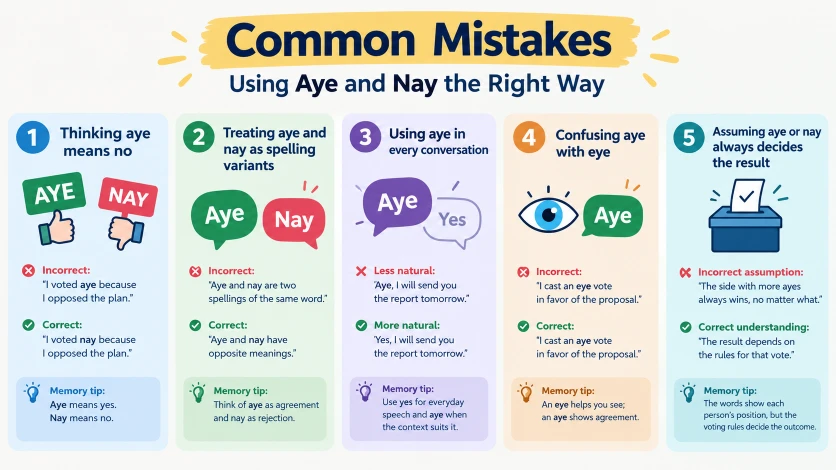
Mistake 1: Thinking aye means no
Incorrect: “I voted aye because I opposed the plan.”
Correct: “I voted nay because I opposed the plan.”
Explanation: Aye expresses support, while nay expresses opposition in a yes-or-no vote.
Memory tip: Aye means yes. Nay means no.
Mistake 2: Treating aye and nay as spelling variants
Incorrect: “Aye and nay are two spellings of the same word.”
Correct: “Aye and nay have opposite meanings.”
Explanation: Both words are correct, but they express different positions. You cannot swap them without changing the meaning.
Memory tip: Think of aye as agreement and nay as rejection.
Mistake 3: Using aye in every conversation
Less natural: “Aye, I will send you the report tomorrow.”
More natural: “Yes, I will send you the report tomorrow.”
Explanation: Aye can be correct, but it may sound old-fashioned or regional in ordinary conversation. Yes is the safer choice for general communication.
Memory tip: Use yes for everyday speech and aye when the context suits it.
Mistake 4: Confusing aye with eye
Incorrect: “I cast an eye vote in favor of the proposal.”
Correct: “I cast an aye vote in favor of the proposal.”
Explanation: Aye means yes or an affirmative vote. Eye refers to the organ used for sight. The two words sound alike but have different meanings.
Memory tip: An eye helps you see; an aye shows agreement.
Mistake 5: Assuming aye or nay always decides the result
Incorrect assumption: “The side with more ayes always wins, no matter what.”
Correct understanding: “The result depends on the rules for that vote.”
Explanation: Some decisions require a simple majority, while others require a special majority or other conditions. The words indicate each person’s position, but the voting rules determine the outcome.
Memory tip: Know the voting rule as well as the voting words.
Everyday Examples of Aye or Nay
Here are practical examples showing how aye and nay work in different settings.
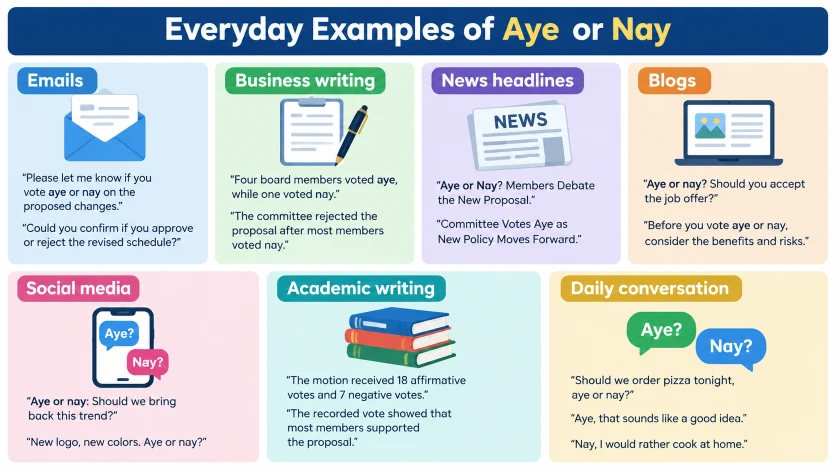
Emails
- “Please let me know if you vote aye or nay on the proposed changes.”
- “Could you confirm if you approve or reject the revised schedule?”
The second version is usually better for professional emails because it is more direct.
Business writing
- “Four board members voted aye, while one voted nay.”
- “The committee rejected the proposal after most members voted nay.”
These examples suit meeting minutes and formal reports.
News headlines
- “Aye or Nay? Members Debate the New Proposal”
- “Committee Votes Aye as New Policy Moves Forward”
These headlines use traditional voting language to make the decision clear.
Blogs
- “Aye or nay? Should you accept the job offer?”
- “Before you vote aye or nay, consider the benefits and risks.”
The phrase can give a blog title a traditional or playful tone.
Social media
- “Aye or nay: Should we bring back this trend?”
- “New logo, new colors. Aye or nay?”
This use is informal and often invites people to share their opinions.
Academic writing
- “The motion received 18 affirmative votes and 7 negative votes.”
- “The recorded vote showed that most members supported the proposal.”
In academic writing, affirmative and negative may be clearer than aye and nay, unless you are discussing the original voting terms.
Daily conversation
- “Should we order pizza tonight, aye or nay?”
- “Aye, that sounds like a good idea.”
- “Nay, I would rather cook at home.”
These sentences are understandable, but they may sound playful or old-fashioned. Most speakers would say “yes or no” in a normal conversation.
Google Trends & Modern Usage
People search for “aye or nay” because they want to understand the phrase, learn the difference between the two words, or decide if the expression fits a sentence.
Where is aye or nay commonly used?
The phrase appears in several settings:
- Parliamentary discussions: Members use formal voting terms to show support or opposition.
- Scottish and Northern English speech: Aye can be used as a regional way to say yes.
- Historical fiction: The words help create an older or traditional tone.
- Online polls: People sometimes use “aye or nay” as a playful alternative to “yes or no.”
- Sailor-themed dialogue: “Aye, aye” is associated with acknowledging or agreeing to an instruction.
These are general usage patterns, not measured search statistics. Without a verified Google Trends comparison for a specified region and time period, it would be misleading to claim that one word receives a particular percentage of searches or is growing at a specific rate.
Why do people confuse aye and nay?
The words are often learned together because they form a pair. Both can be used as short voting responses, and both may seem unfamiliar to readers who mainly use everyday English.
The easiest way to remember them is to connect each word with its meaning:
- Aye = yes, support, or approval.
- Nay = no, opposition, or rejection.
If you are unsure which word sounds natural, use yes or no. You will still communicate your meaning correctly.
Quick Comparison
| Version | Meaning | Correct? | Region | Example |
| Aye | Yes or an affirmative vote | Yes | English-speaking regions, especially formal voting and some regional speech | “I vote aye.” |
| Nay | No or a negative vote | Yes | English-speaking regions, especially formal contexts | “I vote nay.” |
| Yes | Agreement or affirmation | Yes | International English | “Yes, I agree.” |
| No | Disagreement or refusal | Yes | International English | “No, I disagree.” |
| Yea | Yes, especially in formal voting | Yes | Common in US legislative terminology | “The senator voted yea.” |
| Eye | Organ used for sight | Yes, but unrelated | International English | “My eye hurts.” |
The key distinction is that aye and yes can express agreement, while nay and no can express disagreement. Yea is another affirmative term, and eye has an entirely different meaning.
Key Takeaways
- Aye means yes.
- Nay means no.
- “Aye or nay” asks someone to choose between approval and opposition.
- Both words are correct English words, not spelling mistakes.
- Aye is common in formal voting and some regional speech.
- Nay is used in formal voting and some older expressions.
- US legislative voting commonly uses yea and nay.
- For everyday conversation, business emails, and international writing, yes and no are usually the clearest choices.
FAQs
What does aye or nay mean?
“Aye or nay” means “yes or no.” It asks someone to agree or disagree with a suggestion, decision, or proposal. In formal voting, an aye vote supports the proposal, while a nay vote opposes it. The phrase is also used informally in online polls and conversations when someone wants a quick answer.
Is aye positive or negative?
Aye is positive in the sense that it expresses agreement or support. If a committee asks members to vote on a proposal, saying “aye” means you support it. The opposite is nay, which expresses opposition. However, the final result depends on the rules of the vote, not simply on the meaning of the words.
Is nay a real word?
Yes, nay is a valid English word. It means “no,” especially in formal voting, and can also introduce a stronger statement in older or formal writing. For example, “The task was difficult, nay, almost impossible” uses nay to intensify the previous idea. It is less common than no in everyday conversation.
Is aye the same as yes?
Yes, aye can mean the same thing as yes. Both express agreement or affirmation. However, aye is more closely associated with formal voting, Scottish or Northern English speech, and traditional expressions. In most everyday situations, yes sounds more natural and is understood by a wider range of English speakers.
Is it aye or yay?
Both words are correct, but they mean different things in use. Aye means yes or an affirmative vote. Yay is an informal expression of happiness or excitement, as in “Yay, we won!” Do not confuse yay with yea, which can also mean yes, especially in formal voting.
What is the difference between aye, nay, and yea?
Aye and yea both express agreement or an affirmative vote, while nay expresses disagreement or a negative vote. Their use varies by setting. In the US Senate, yea and nay are common formal voting terms. In British parliamentary contexts, aye is a familiar affirmative term.
How do you pronounce aye and nay?
Aye is pronounced like the letter “I,” with the sound /aɪ/. Nay rhymes with “day” and “say,” with the sound /neɪ/. The words are easy to distinguish once you know their sounds. Remember that pronunciation alone does not tell you the meaning; aye means yes and nay means no.
What does “the ayes have it” mean?
“The ayes have it” is a phrase used to announce that a proposal has received enough support to pass under the applicable voting rules. It generally means the affirmative side has won. The expression is associated with parliamentary proceedings and formal meetings, although people also use it humorously in everyday conversation.
Is aye or nay formal or informal?
It can be either, depending on the setting. Aye and nay are established terms in formal voting, but they also appear in regional speech, historical writing, and playful online questions. In standard business communication and most casual conversations, yes and no are usually more natural and easier to understand.
Conclusion
Understanding “aye or nay” is simple once you remember what each word means. Aye means yes, and nay means no. Both are correct English words, but they are most useful when discussing formal votes, traditional expressions, or situations where a distinctive style is appropriate.
The phrase is common in parliamentary language and can also appear in books, films, online polls, and casual conversations. In British parliamentary contexts, aye is a familiar affirmative voting term. In US legislative voting, yea and nay are commonly used instead.
For everyday communication, choose words that make your meaning clear. Use yes and no in most conversations, emails, school assignments, and business documents. Save aye and nay for settings where they fit the tone or reflect the actual voting terminology.
You do not need to avoid either word simply because it sounds old-fashioned. The important thing is to understand the meaning and use it correctly.
Remember: Aye means yes, nay means no, and the right choice depends on the context. If this guide helped clear up the confusion, explore more commonly confused words to strengthen your English vocabulary.
READ MORE!
- Herpes or Folliculitis: How to Tell the Difference
- Sole or Soul: What’s the Difference?
- Porcelain vs Ceramic: What’s the Difference?

I’m Edward Fletcher, a UK-based English language writer with a passion for grammar and vocabulary. At VocabNex, I share simple explanations, useful examples, and practical English tips to help learners improve their language skills and communicate with confidence.






1 thought on “Aye or Nay: Meaning, Difference, and How to Use Them”