
The key difference between relieve and relief is that relieve is a verb, while relief is a noun. Use relieve when someone or something reduces pain, stress, worry, or discomfort. Use relief when you mean the comfort or freedom from pain, stress, or worry.
For example:
- Correct: “This medicine may relieve your headache.”
- Correct: “This medicine brought me great relief.”
- Incorrect: “This medicine gave me great relieve.”
Both words are correct English spellings, but they serve different roles in a sentence. They are closely related in meaning, which is why students, English learners, writers, and even native speakers sometimes mix them up.
In this guide, you will learn what relieve and relief mean, how to use each word, where they came from, and how to avoid common grammar mistakes. You will also find everyday examples, a comparison table, and answers to frequently asked questions.
Relieve or Relief: Meaning and Usage
The easiest way to choose between these words is to ask yourself one question: Are you describing an action or a feeling?
- Use relieve for an action that makes a problem less severe.
- Use relief for the comfort or ease that results from that action.
What Does Relieve Mean?
Relieve is a verb. It means to reduce pain, stress, worry, pressure, or another unpleasant condition.
It can also mean to free someone from a duty or replace a person who is doing a job.
Examples:
- “A warm bath can relieve muscle tension.”
- “Talking to a friend helped relieve my stress.”
- “The manager will relieve her of some duties.”
- “Another nurse arrived to relieve the tired nurse.”
Common word forms include:
| Word form | Example |
| Relieve | This exercise may relieve stress. |
| Relieves | This cream relieves itching. |
| Relieved | I felt relieved after the exam. |
| Relieving | Walking is relieving my tension. |
Notice that relieved is also an adjective when it describes how someone feels.
For example: “I was relieved to hear the good news.”
What Does Relief Mean?
Relief is a noun. It refers to the feeling of comfort that comes when pain, worry, stress, or difficulty becomes less severe.
It can also mean help given to people in need, a replacement worker, or a type of artistic design.
Examples:
- “I felt great relief after the test.”
- “The medicine provided relief from the pain.”
- “The charity delivered food and emergency relief.”
- “The night guard waited for relief to arrive.”
Common expressions with relief include:
- Pain relief: A reduction in pain.
- Stress relief: Something that helps reduce stress.
- A sigh of relief: A sign that worry has ended.
- Relief effort: An organized attempt to help people facing hardship.
- Relief worker: Someone who replaces another worker or provides emergency aid.
A useful grammar rule is that you can often place an article or adjective before the noun relief.
For example, “some relief,” “great relief,” and “a sense of relief” are all correct.
The Origin of Relieve and Relief
The words relieve and relief are closely related. Both entered English through French and have roots in the Latin word relevare, meaning to lift up or lighten.
Over time, their meanings developed around the idea of making a burden lighter.
- Relieve became the verb used for the act of easing a burden, pain, or difficulty.
- Relief became the noun used for the easing itself or the comfort that follows.
This shared history explains why the words have similar meanings but different grammatical roles.
For example, if a person has a heavy burden, someone might relieve that person of the burden. The person may then feel relief.
The spelling difference is not a British versus American English issue. Both forms are standard in modern English, and the correct choice depends on the sentence.
British English vs American English
There is no meaningful spelling difference between relieve and relief in British and American English. Both countries use the same spellings and the same basic meanings.
| British English | American English | Example |
| Relieve | Relieve | Rest may relieve your stress. |
| Relief | Relief | Rest can provide relief. |
| Relieved | Relieved | She felt relieved after the meeting. |
| Relieving | Relieving | The treatment is relieving the discomfort. |
Regional Differences
The words themselves do not change across these varieties of English. However, the expressions around them may differ depending on the context, industry, or audience.
For example, pain relief is widely understood in both the UK and the US. The same is true of stress relief, disaster relief, and a sigh of relief.
Style Guides and Publishing Preferences
British and American style guides generally follow the same grammatical distinction:
- Use relieve when the word acts as a verb.
- Use relief when the word acts as a noun.
- Use relieved when describing a person’s response or emotional state.
Writers should focus on grammar and sentence meaning rather than regional spelling rules. In professional writing, consistency and clear word choice matter more than choosing one national variety over another.
Which Version Should You Use?
The correct choice depends on what you want to say, not where you live.
United States
Use relieve for an action and relief for a result or type of help. Both spellings are standard in American English.
United Kingdom
Follow the same distinction. Write “This should relieve the pressure” and “The change brought relief.”
Canada
Both words are correct. Canadian writers can use either word according to its grammatical role.
Australia
Use relieve for the action and relief for the noun, just as in other major varieties of English.
International writing
Choose the word that fits the sentence. Both are widely understood by English readers around the world.
Academic Writing
Use the verb relieve to describe an action or effect, and the noun relief to describe an outcome.
- Correct: “The intervention helped relieve anxiety.”
- Correct: “Participants reported relief from anxiety.”
Business Writing
Use relieve when describing a reduction in pressure or responsibility. Use relief when naming the benefit or support.
- “The new system may relieve the team’s workload.”
- “The new system provides relief during busy periods.”
Common Mistakes
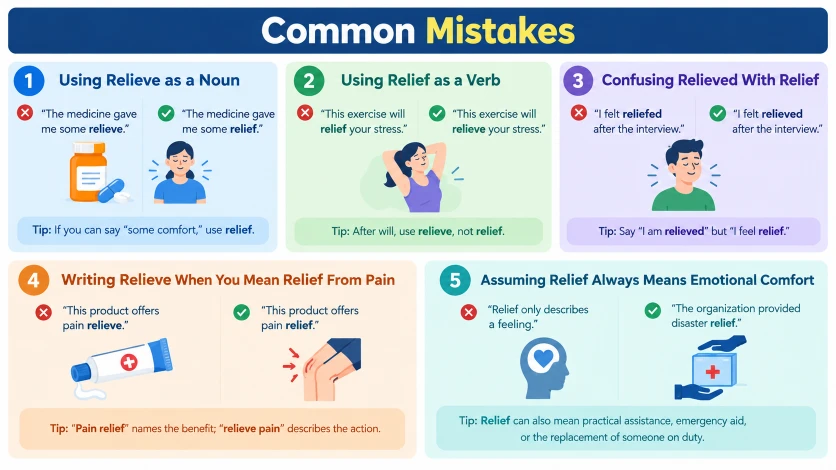
The most common error is using relieve where a noun is required or using relief where a verb is needed.
Mistake 1: Using Relieve as a Noun
Incorrect: “The medicine gave me some relieve.”
Correct: “The medicine gave me some relief.”
Why? The word some is followed here by a noun. Relief names the comfort provided by the medicine.
Memory tip: If you can say “some comfort,” use relief.
Mistake 2: Using Relief as a Verb
Incorrect: “This exercise will relief your stress.”
Correct: “This exercise will relieve your stress.”
Why? The word will is followed by the base form of a verb. Since relieve describes the action, it is the right choice.
Memory tip: After will, use relieve, not relief.
Mistake 3: Confusing Relieved With Relief
Incorrect: “I felt reliefed after the interview.”
Correct: “I felt relieved after the interview.”
Why? Relieved is the correct form to describe a person’s emotional state. Reliefed is not the standard form.
Memory tip: Say “I am relieved” but “I feel relief.”
Mistake 4: Writing Relieve When You Mean Relief From Pain
Incorrect: “This product offers pain relieve.”
Correct: “This product offers pain relief.”
Why? The expression pain relief uses a noun to name the benefit. If you describe what the product does, use the verb: “This product may relieve pain.”
Memory tip: “Pain relief” names the benefit; “relieve pain” describes the action.
Mistake 5: Assuming Relief Always Means Emotional Comfort
Incorrect assumption: “Relief only describes a feeling.”
Correct understanding: “The organization provided disaster relief.”
Why? Relief can also refer to practical assistance, emergency aid, or the replacement of someone on duty.
Memory tip: Relief can mean comfort, help, or replacement, depending on context.
Everyday Examples of Relieve and Relief

The best way to learn the difference is to see how each word works in real situations.
1. Emails
- “I hope the new schedule will relieve some of your workload.”
- “Thank you for your help. It was a great relief to have your support.”
- “I was relieved to receive your confirmation.”
2. Business Writing
- “Automation can relieve employees of repetitive tasks.”
- “The revised process offers relief from unnecessary paperwork.”
- “The company introduced a plan to relieve pressure on its customer service team.”
3. News Headlines
- “New Measures Aim to Relieve Pressure on Hospitals”
- “Emergency Relief Reaches Families After Flooding”
- “Residents Express Relief as Water Supply Returns”
In headlines, relieve describes an action or intended effect, while relief identifies a result, feeling, or form of assistance.
4. Blogs
- “Five Simple Ways to Relieve Everyday Stress”
- “How Exercise Can Provide Stress Relief”
- “Find Relief From a Busy Schedule With Better Planning”
5. Social Media
- “A short walk can help relieve stress.”
- “Finally finished my exams. What a relief!”
- “Feeling relieved after getting the results.”
6. Academic Writing
- “The study examined if the intervention could relieve symptoms.”
- “Participants reported a reduction in stress and a sense of relief.”
- “Further research is needed to determine if the treatment provides lasting relief.”
Academic writers should also avoid claiming that a treatment works unless the evidence supports that conclusion.
7. Daily Conversation
- “Can you help relieve some of this pressure?”
- “What a relief to be home!”
- “I feel so relieved that everything went well.”
- “The new fan helps relieve the heat in this room.”
These examples show that relieve often describes what something does, while relief names what someone experiences or receives.
Google Trends and Modern Usage
People search for “relieve or relief” because the two words look and sound similar and share a related meaning. The main challenge is understanding their grammatical roles.
Common searches include:
- Relieve or relief: which is correct?
- Is it pain relief or pain relieve?
- What is the difference between relieve and relief?
- Should I say “relieve stress” or “stress relief”?
- Is it “a sigh of relief” or “a sigh of relieve”?
These searches reflect a common English-learning question: when should you use a verb, and when should you use a noun?
Regional Popularity
Both words are standard in American, British, Canadian, and Australian English. There is no established regional spelling preference that makes relieve correct in one country and relief correct in another.
Without a verified, date-specific Google Trends comparison, it would be misleading to claim that one word is more popular in a particular country or to give exact search percentages.
Modern Usage Patterns
The words appear in many areas of modern life:
- Health: pain relief, relieve discomfort.
- Mental well-being: stress relief, relieve anxiety.
- Work: relieve pressure, workload relief.
- Emergency support: disaster relief, relief supplies.
- Everyday conversation: a sigh of relief, feel relieved.
Understanding these common expressions can help you choose the right word without memorizing every sentence.
Quick Comparison
| Version | Meaning | Correct? | Region | Example |
| Relieve | To reduce pain, worry, or pressure | Yes, as a verb | All major English varieties | Rest may relieve stress. |
| Relief | Comfort, help, or reduction of difficulty | Yes, as a noun | All major English varieties | Rest provides relief. |
| Relieved | Feeling comfort after worry or difficulty ends | Yes | All major English varieties | I felt relieved. |
| Reliefed | Not a standard form of the verb | No, in ordinary standard English | All major English varieties | Use “relieved” instead. |
| Relieving | Reducing or easing something | Yes, as a verb form or adjective | All major English varieties | The break is relieving the pressure. |
Key Takeaways
- Relieve is a verb that means to reduce pain, stress, worry, or difficulty.
- Relief is a noun that describes comfort, assistance, or a reduction in difficulty.
- Say “relieve pain” but “pain relief.”
- Say “relieve stress” but “stress relief.”
- Use relieved to describe how someone feels after a worry or problem eases.
- Both relieve and relief are correct spellings in British and American English.
- The right choice depends on grammar and meaning, not geography.
- Remember the simple rule: you relieve a problem, and you experience relief.
Frequently Asked Questions
Is it relief or relieve from work?
Relief is a noun, while relieve is a verb. Use relief from work when referring to a break or freedom from work-related pressure. For example: “I need some relief from work.” Use relieve when describing an action, such as “This break will relieve my stress.”
Is it relief or relieve pain?
Relieve pain is correct because relieve is a verb meaning to reduce or ease pain. For example: “This medicine may help relieve pain.” You can use relief as a noun in a sentence such as “The medicine provided relief from the pain.”
Do you feel relief or relieved?
Both are correct, but they are used differently. Relief is a noun, while relieved is an adjective describing how someone feels. For example: “I feel relief after hearing the good news” and “I feel relieved that everything went well.”
What is the difference between “relief” and “relieve”?
Relief is a noun that means comfort or a reduction in pain, worry, or difficulty. Relieve is a verb that means to ease or reduce something unpleasant. For example: “The news brought relief” and “The news helped relieve my worries.”
Which is correct, relief or relieve?
Both relief and relieve are correct English words, but the right choice depends on the sentence. Use relief for a feeling or state of comfort, as in “I felt great relief.” Use relieve for an action, as in “The treatment may relieve discomfort.”
What is a better word for “relieve”?
A suitable alternative to relieve depends on the context. You can use ease for pain or stress, alleviate for discomfort or suffering, reduce for pressure or symptoms, and soothe for irritation or emotional distress. For example: “This exercise helps ease tension.”
Conclusion
The difference between relieve or relief is simple once you understand how each word works. Relieve is a verb that describes an action, while relief is a noun that describes comfort, help, or the easing of a problem.
For example, you can relieve stress, experience stress relief, relieve pain, or seek pain relief. If you want to describe how someone feels after a problem ends, use relieved, as in “I felt relieved when I passed the exam.”
These rules apply to American, British, Canadian, Australian, and international English. You do not need to memorize different regional spellings. Instead, focus on the meaning and grammatical role of the word in your sentence.
If you are writing an email, completing a school assignment, preparing a blog post, or improving your English, choosing the right word will make your writing clearer and more natural.
Remember: You relieve a problem, but you feel relief when the problem becomes easier. Save this rule for your next writing task, and explore more commonly confused words to keep improving your English.
READ MORE!
- Stafford or Hurts: Who Is the Better NFL Quarterback?
- Herpes or Folliculitis: How to Tell the Difference
- Porcelain vs Ceramic: What’s the Difference?

I’m passionate about English grammar, vocabulary, and clear communication. I enjoy making English easier to understand through simple, practical, and easy-to-follow explanations. My goal is to help learners build confidence and improve their English for everyday use.






1 thought on “Relieve or Relief: What Is the Difference?”